


Imagine you are tasked with designing the logic for a “Transfer Cash” feature in a high-stakes online banking system. You have a mountain of notes, a few paragraphs of text, and the daunting realization that if you miss even one edge case—like an unauthenticated user or a sudden system timeout—the consequences could be disastrous for the user experience. This is where the AI-powered use case scenario analyzer becomes your most trusted ally. By transforming ambiguous natural language into a structured, crystalline roadmap, this professional online scenario analysis tool ensures that no stone is left unturned in your requirements gathering phase, providing the certainty you need to move from concept to code.
The transition from a simple narrative to a robust technical requirement can often feel like a game of telephone, where important details get lost in translation. Visual Paradigm’s innovative solution bridges this gap by acting as an intelligent intermediary. Whether you are a business analyst looking to validate requirements or a QA engineer aiming to accelerate the quality assurance process, this application provides a guided, two-step workflow that turns “what if” questions into “here is the answer” certainties. It’s like having an expert consultant meticulously dissect your use case for every possible outcome, ensuring comprehensive scenario coverage without the manual headache.
Quick Takeaways for Better Requirements Management
-
Automated Logic Extraction: Effortlessly identifies conditions and actions from plain text descriptions.
-
Decision Table Precision: Eliminates ambiguity by mapping every possible logical outcome in a structured matrix.
-
Accelerated QA: Instantly generates core test scenarios, reducing manual test case design by hours.
-
Seamless Collaboration: Provides a shared, unambiguous technical language for BAs, Developers, and stakeholders.
-
Zero Friction: No account registration is required to access the full suite of AI analysis features.
Step 1: Transforming Narratives into Structured Data
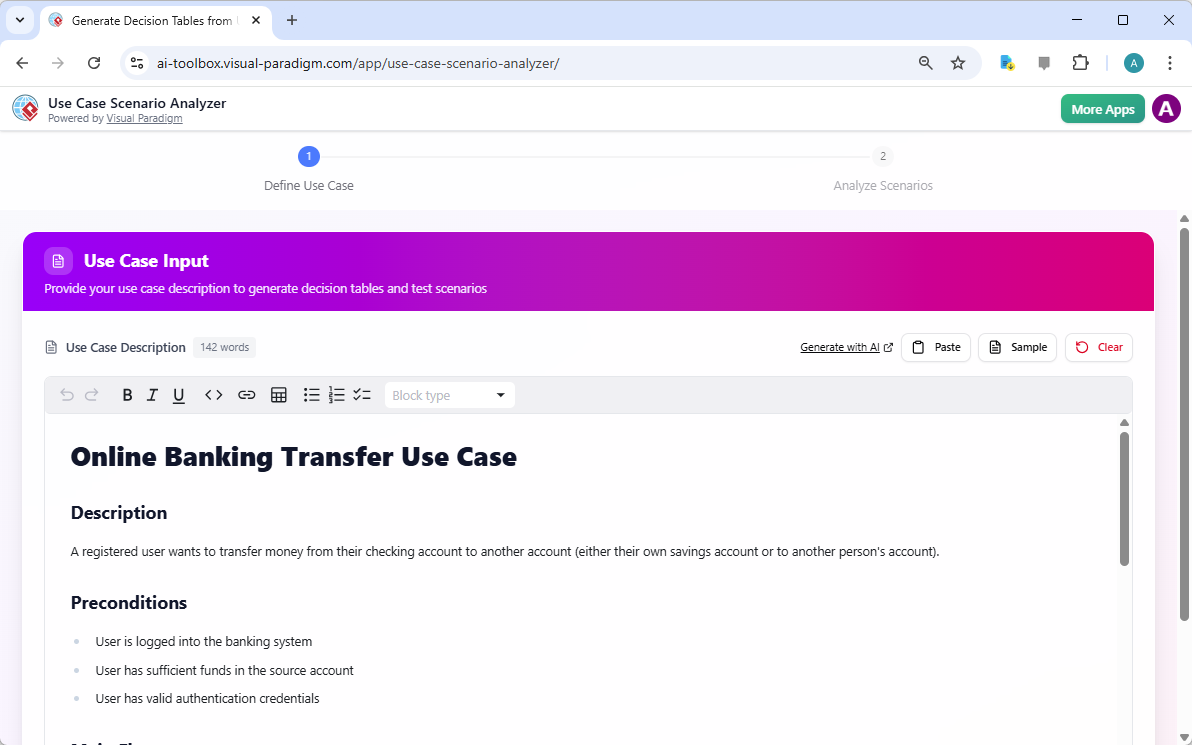
The journey begins with a clean, intuitive interface designed for maximum efficiency. In the first phase of the process, titled “Define Use Case,” the user provides the narrative foundation for the analysis. You don’t need to be a coding expert to use this easy-to-use AI requirements tool; you simply need to describe how the system should behave. For instance, in an online banking context, you would detail the “Transfer Cash” flow, including what happens when a user is logged in, when funds are insufficient, or when authentication fails.
As seen in the initial setup, the interface is focused and distraction-free. You input your text, and the system prepares to analyze the logic. This is where the best online use case analyzer starts to shine, as it begins to parse the specific preconditions and main flows of your business rules. It’s a straightforward path from your initial thoughts to a detailed, testable analysis that leaves no room for misinterpretation by the development team.
Uncovering the “Ifs” and “Thens” with AI Precision
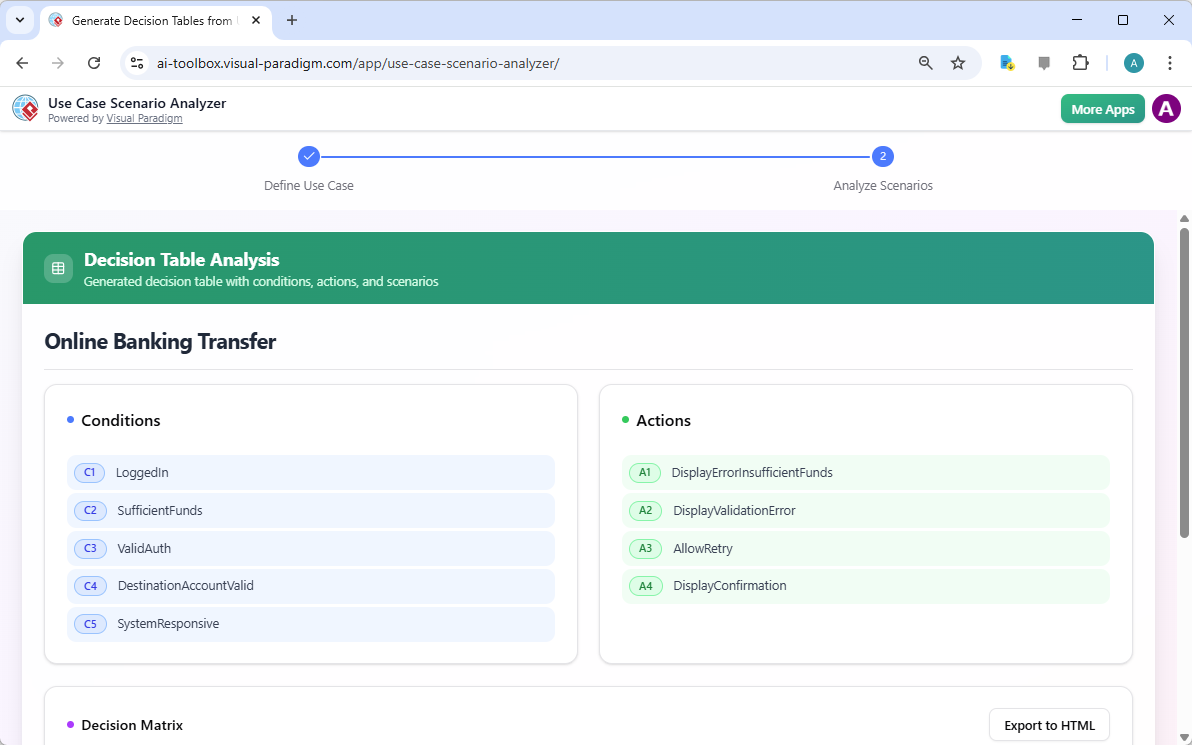
Once you click the analysis button, the AI goes to work. It acts like a digital detective, meticulously reading through your sentences to find the “if-then” logic hidden within your paragraphs. In the “Analyze Scenarios” phase, the tool presents a clear, categorized breakdown of your use case. You are no longer looking at a wall of text; instead, you see Conditions like “LoggedIn,” “SufficientFunds,” and “SystemResponsive” listed neatly alongside Actions such as “DisplayConfirmation” or “AllowRetry.”
This visual clarity is the first major milestone in moving from a messy draft to a professional technical specification. By explicitly defining these conditions and actions, the tool helps you uncover hidden requirements or inconsistencies that were buried in the original description. It’s a powerful way to ensure that the system’s behavior is explicitly understood by everyone involved in the project lifecycle, from the project manager to the lead developer.
The Power of the Automated Decision Matrix
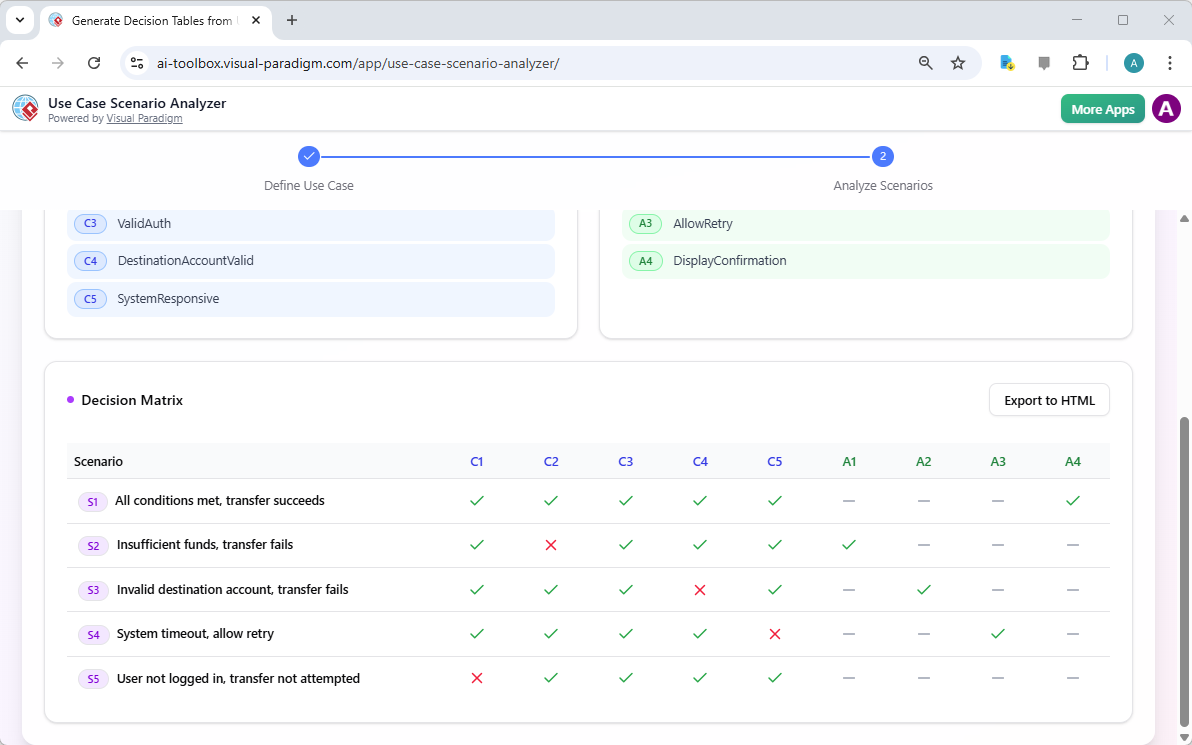
The real magic happens when these conditions and actions collide in the Decision Matrix. This is the heart of the AI-powered use case scenario analyzer. It presents a comprehensive grid where rows represent unique scenarios—such as “Invalid destination account, transfer fails”—and columns denote the specific state of each condition. A green checkmark or a red cross tells you exactly what the system should do under those specific circumstances, providing a crystal-clear map of your system’s behavior.
Managing complex logic through plain text is notoriously difficult and error-prone. However, with this advanced decision table generator, you receive an exhaustive representation of every logical path. This matrix is derived directly from your input, ensuring that edge cases—like a system timeout occurring while a user has sufficient funds—are accounted for and assigned a specific action, such as allowing a retry. This level of detail would traditionally take hours of manual effort to map out but is now generated in seconds.
Bridging the Gap Between Requirements and QA
For Quality Assurance (QA) engineers, the value of this tool cannot be overstated. One of the most significant bottlenecks in software development is the creation of comprehensive test plans. The AI-powered use case scenario analyzer solves this by suggesting “Core Test Scenarios” derived directly from the analysis. These are not just generic tests; they are specific, logical paths that must be validated to ensure the feature functions correctly under all possible states.
By using these AI-generated suggestions, QA teams can automate test case generation foundations, ensuring that critical paths and obscure edge cases are covered from day one. This proactive approach to testing reduces the likelihood of bugs reaching production and significantly accelerates the overall development timeline. Developers also benefit, as they can use the decision tables to guide their coding, ensuring they handle every condition correctly without having to guess the intent behind a vague requirement.
Conclusion: Mastering System Logic with Visual Paradigm
In the fast-paced world of software development, clarity is king. The AI-powered use case scenario analyzer from Visual Paradigm transforms the often-chaotic process of requirements gathering into a structured, reliable, and highly efficient workflow. By converting natural language into automated decision tables and test scenarios, it empowers teams to build better software, faster, and with fewer errors. From the initial “Online Banking Transfer” description to the final, detailed decision matrix, this professional online scenario analysis tool provides the expert-level depth required for modern system design.
Ready to bring absolute clarity to your next project? Experience the future of requirements validation today. Whether you are refining business rules or preparing a complex test plan, the AI-powered use case scenario analyzer is the essential tool for modern professionals who refuse to leave their system logic to chance.
Try the Use Case Scenario Analyzer now: Launch the AI Toolbox
Learn more about our innovative features: Visit the Official Product Page
Related Links
-
Use Case: A use case is a description of interactions between users and a system to achieve a specific goal, commonly used in software engineering and requirements analysis.
-
What is a Use Case Scenario Analyzer? A Guide to AI-Powered Decision Making: This page explains how AI-powered scenario analysis enhances use case modeling by enabling intelligent decision-making and automated pattern recognition in system design.
-
Unraveling Scenarios with the Use Case Scenario Analyzer: A comprehensive guide on using the Use Case Scenario Analyzer to examine and refine use case flows for improved system clarity.
-
Comprehensive Guide to the Use Case Scenario Analyzer in Visual Paradigm: An in-depth tutorial on leveraging the Use Case Scenario Analyzer to validate and enhance use case scenarios in software projects.