
Model-Based Systems Engineering (MBSE) introduces significant complexity to the development lifecycle. As systems grow in scope, the models used to describe them expand exponentially. Without standardized structures, engineering teams often find themselves rebuilding common architectural elements repeatedly. This redundancy consumes time and introduces inconsistencies. A robust library of reusable SysML patterns addresses this inefficiency directly.
Creating a curated collection of verified model fragments allows organizations to shift focus from structural setup to actual system design. This guide outlines the methodology for constructing, maintaining, and utilizing a SysML pattern library. It covers technical architecture, governance strategies, and implementation workflows essential for sustainable MBSE adoption.
Why Reusable Patterns Matter in MBSE 📚
Consistency is the backbone of effective systems modeling. When different engineers construct similar subsystems using different methods, traceability becomes difficult to maintain. Requirements may map to different block structures, and verification logic may vary across teams. A pattern library enforces a standard syntax and semantic structure.
The benefits extend beyond simple time savings. Standardized patterns reduce the cognitive load on engineers. They do not need to recall every specific constraint or relationship type for common subsystems. This allows them to concentrate on the unique aspects of the specific system at hand. Furthermore, patterns serve as a form of documentation. They capture institutional knowledge about how the organization models specific domains.
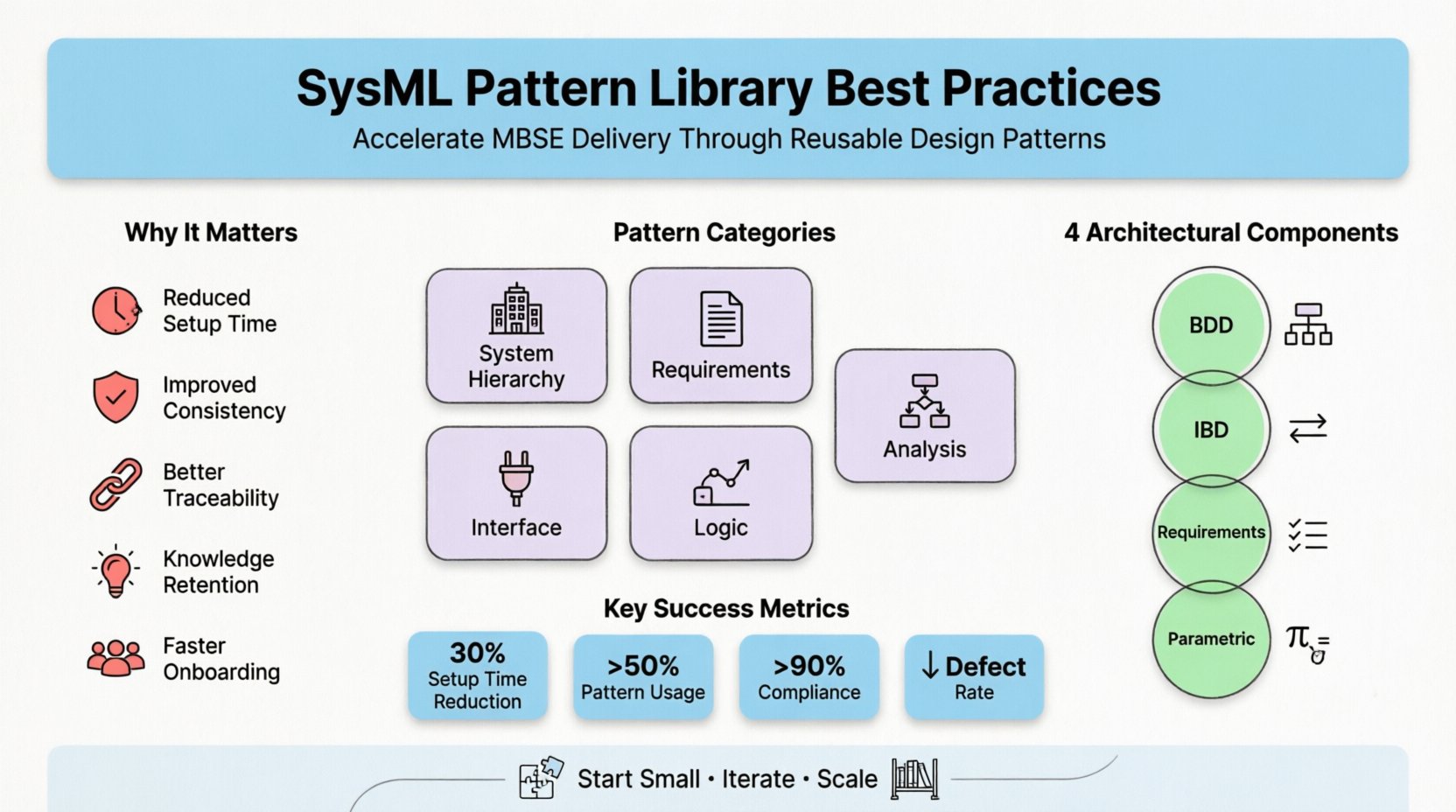
- Reduced Setup Time: Engineers start projects with validated structures already in place.
- Improved Consistency: All models adhere to the same naming conventions and diagram types.
- Better Traceability: Standardized links between requirements and design elements ensure coverage.
- Knowledge Retention: Expert modeling logic is preserved in the library rather than in individual heads.
- Faster Onboarding: New team members learn the standards by studying the library.
Defining the Scope of Your Library 🎯
Before creating any model fragments, it is necessary to define the boundaries of the library. A library that is too broad becomes unmanageable. A library that is too narrow offers little value. The scope should align with the typical projects the organization undertakes.
Identify the most frequently occurring system elements. These are the candidates for the first iteration of the library. Common candidates include power distribution systems, communication interfaces, and safety interlocks. Start with these high-frequency items to demonstrate immediate value to the team.
| Category | Example Pattern | Benefit |
|---|---|---|
| System Hierarchy | Standard Top-Level Block Structure | Ensures consistent system partitioning |
| Requirements | Standard Requirement Package Template | Guarantees compliance tracking |
| Interface | Standard Port and Connector Definition | Clarifies interaction points |
| Logic | Standard State Machine for Modes | Standardizes operational modes |
| Analysis | Standard Parametric Constraint Block | Facilitates performance calculation |
Architectural Components of a SysML Pattern 🧩
A SysML pattern is more than just a diagram. It is a collection of model elements that function together to represent a specific engineering concept. To be effective, a pattern must encapsulate the necessary semantics without being overly specific to a single project.
1. Block Definition Diagrams (BDD)
These patterns define the structural hierarchy. They include the definition of blocks, their properties, and their relationships. A reusable structural pattern might define a generic “Sensor” block with standard properties like “Signal Type” and “Interface Protocol”. This ensures every sensor in the system is modeled consistently.
2. Internal Block Diagrams (IBD)
IBDs describe the flow of information and material within a system. Patterns here define standard connectivity. For example, a “Data Flow Pattern” could specify how data enters a processing block, how it is transformed, and how it exits. This reduces the likelihood of missing connections in new models.
3. Requirement Diagrams
Requirements must be traceable. Patterns can define a standard set of requirement types. For instance, a “Safety Requirement Template” could include mandatory fields for hazard ID, severity level, and mitigation strategy. This enforces a rigorous approach to safety engineering.
4. Parametric Diagrams
Performance analysis relies on mathematical constraints. A parametric pattern can define a standard equation for a specific subsystem, such as “Battery Capacity vs. Range”. Engineers can reuse these constraint blocks, modifying only the variable values, rather than recreating the algebra.
Designing for Reusability and Adaptability ⚙️
The primary challenge in pattern design is balancing standardization with flexibility. A pattern that is too rigid will not fit new scenarios. A pattern that is too loose loses its standardization benefits. The goal is to create templates that guide structure while allowing specific instantiation.
Use stereotypes to extend the semantics of standard SysML elements. Stereotypes allow you to label blocks as “Safety Critical” or “Commercial Off-The-Shelf” without changing the underlying model structure. This makes filtering and querying easier later in the lifecycle.
- Abstract Base Classes: Define generic blocks that specific implementations inherit from.
- Parameterized Blocks: Allow values to be passed into the pattern during instantiation.
- Clear Naming Conventions: Use prefixes or suffixes to indicate the domain or type of the pattern.
- Minimal Dependencies: Patterns should not rely on external libraries unless absolutely necessary.
- Documentation: Include usage notes directly within the model to explain how to apply the pattern.
Version control is essential. When a pattern changes, it must be tracked. If a pattern evolves, older projects might break if they update automatically. Establish a policy for versioning. For example, v1.0 could be deprecated in favor of v1.1 after a specific date, but support for v1.0 remains available.
Governance, Versioning, and Maintenance 🛡️
A library is a living artifact. It requires active management to remain useful. Without governance, the library becomes a graveyard of outdated and incorrect models. Establish a core team responsible for reviewing and approving new patterns.
This team should review patterns before they are published to the main library. The review process ensures that the pattern meets the organization’s standards. It also checks for potential conflicts with existing patterns. Maintenance involves retiring obsolete patterns and updating existing ones as standards evolve.
Access Control
Not everyone should be able to modify the library. Define roles for contributors and administrators. Contributors can propose new patterns or request updates. Administrators have the authority to merge changes and publish new versions. This prevents accidental overwrites of critical standards.
Review Checklist
- Does the pattern align with current modeling standards?
- Is the documentation clear and sufficient?
- Are there any circular dependencies or broken links?
- Does it add value compared to existing patterns?
- Is the syntax valid according to the SysML specification?
Integrating Patterns into the Workflow 🔄
Having a library is not enough. It must be integrated into the daily workflow of the engineering team. If accessing the library is difficult, engineers will revert to creating models from scratch. The integration should be seamless and require minimal friction.
Integrate pattern access into the modeling interface. If the tool supports it, create a dedicated panel for browsing and inserting patterns. This places the library directly in the engineer’s view. If the tool does not support this, maintain a central repository that is easy to search and download.
Training is another critical component. Engineers need to understand how to use the library. Conduct workshops that demonstrate the library in action. Show them how to apply a pattern to a real problem. This practical application reinforces the value of the standard.
- Discovery: Make the library searchable by keyword, domain, or function.
- Insertion: Enable one-click insertion of blocks and diagrams.
- Validation: Ensure inserted patterns are validated against the project requirements.
- Feedback Loop: Allow engineers to report issues or suggest improvements to the library.
Measuring Impact and Efficiency 📊
To justify the investment in building a library, you must measure its impact. Define metrics that reflect the efficiency gains. Track the time saved during the initial setup phase of projects. Compare this to projects that did not use the library.
Monitor the consistency of the models produced. Check for compliance rates with the standards defined in the patterns. High compliance indicates that the library is being used effectively. Low compliance suggests that the library is difficult to use or does not meet the engineers’ needs.
| Metric | Definition | Target |
|---|---|---|
| Setup Time Reduction | Time to create initial model structure | 30% reduction |
| Pattern Usage Rate | Percentage of projects using library | >50% of projects |
| Model Consistency Score | Automated check for standard compliance | >90% compliance |
| Defect Rate | Errors found in model during review | Decreasing trend |
Regularly review these metrics. If a metric does not improve, investigate the cause. It may be a training issue, a tooling issue, or a library quality issue. Adjust the strategy accordingly.
Common Implementation Challenges ⚠️
Building a library is not without obstacles. Engineers may resist using the library if they perceive it as restrictive. They might feel that the patterns limit their ability to model unique requirements. To counter this, emphasize that patterns are starting points, not final destinations.
Another challenge is the evolution of standards. SysML itself evolves, and industry standards change. A pattern that was valid last year might be obsolete today. Schedule regular reviews of the library to ensure alignment with current standards.
Technical debt can accumulate if patterns are not cleaned up. Old patterns that are no longer used clutter the library and confuse users. Implement a policy for retiring patterns. If a pattern has not been used in a specific timeframe, archive it and notify the team.
- Resistance to Change: Engage users early in the design process.
- Tooling Limitations: Work within the constraints of the available software.
- Over-Engineering: Keep patterns simple and focused.
- Communication Gaps: Ensure the library team communicates updates clearly.
Final Considerations 🏁
Building a library of reusable SysML patterns is a strategic initiative that pays dividends over time. It transforms modeling from a manual task into a structured engineering discipline. The investment in governance, design, and maintenance is significant, but the return in consistency and speed is substantial.
Start small. Select a few high-value patterns and refine them. Gather feedback from the users. Expand the library gradually as confidence grows. This iterative approach minimizes risk and ensures the library evolves to meet the actual needs of the engineering team.
Ultimately, the goal is to enable the organization to deliver complex systems faster and with higher quality. By standardizing the foundational elements, engineers can focus their expertise on the innovative aspects of the system design. This is the essence of efficient Model-Based Systems Engineering.
Adopt these practices to build a sustainable modeling environment. Ensure that the library remains a valuable asset throughout the lifecycle of your systems. With the right structure and governance, your model library will become the backbone of your engineering delivery.