
Model-Based Systems Engineering (MBSE) is fundamentally changing how complex systems are designed, verified, and managed. By shifting from document-centric approaches to model-centric workflows, organizations gain visibility into system behavior that traditional methods often miss. However, as projects grow in complexity and teams expand in size, the risk of model fragmentation increases significantly. Without a disciplined approach, the SysML model can become a source of confusion rather than clarity.
Scaling Model-Based Systems Engineering requires more than just buying a tool or hiring a few architects. It demands a structured set of best practices that govern how models are created, maintained, and shared. This guide outlines proven strategies to ensure your SysML implementation remains robust, scalable, and collaborative. We will cover standardization, diagram hygiene, traceability, and team dynamics to help you maintain integrity across your engineering ecosystem.
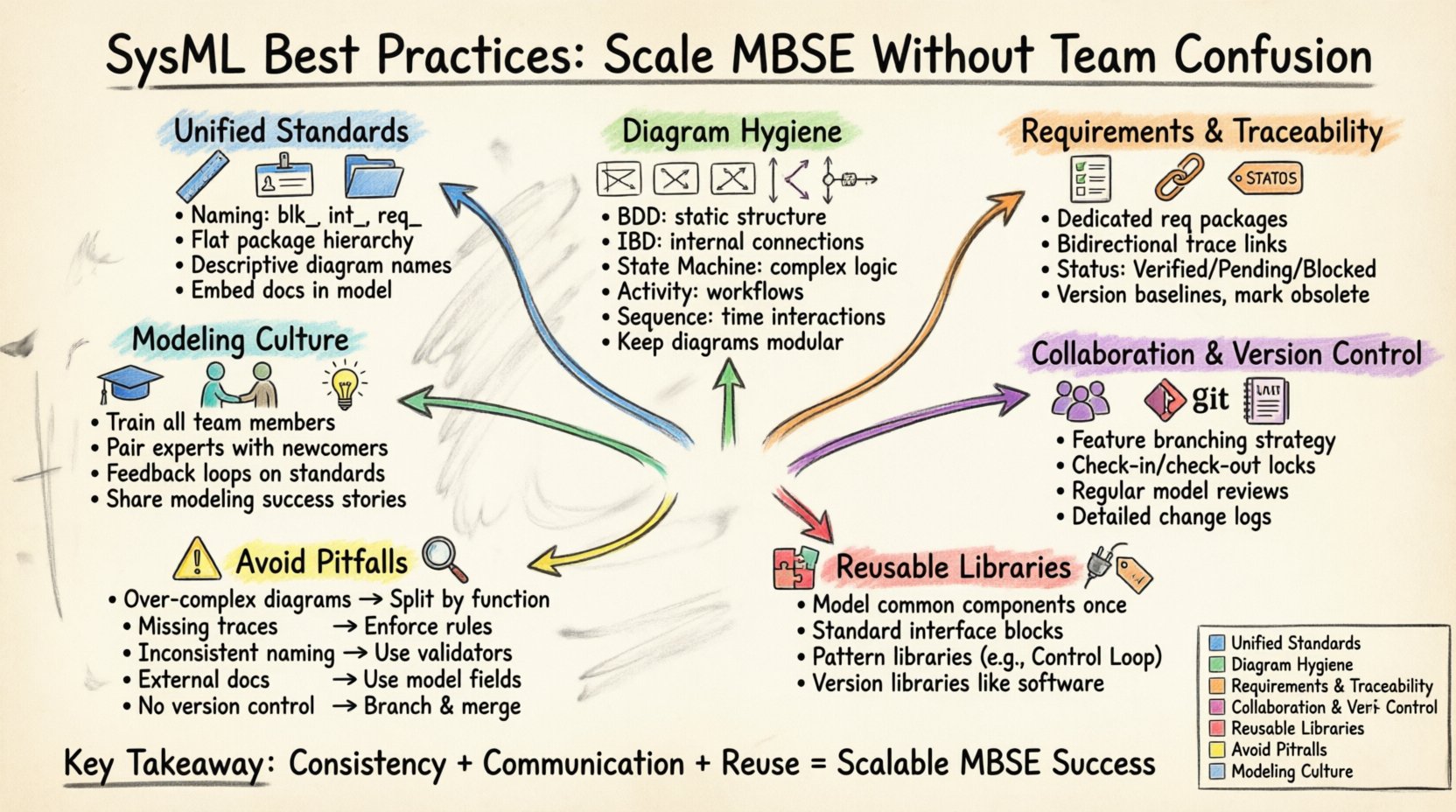
1. Establishing a Unified Modeling Standard 📏
Consistency is the bedrock of any scalable MBSE environment. When multiple engineers work on the same system, variations in notation and structure can lead to misinterpretation. A unified standard ensures that every team member reads the model in the same way.
- Naming Conventions: Adopt a strict naming scheme for all elements. Use prefixes to denote the type of element, such as
blk_for blocks,int_for interfaces, andreq_for requirements. This allows users to filter views quickly and identify element types at a glance. - Package Hierarchy: Organize your model using a logical package structure. Avoid deep nesting that makes navigation difficult. A flat hierarchy with clearly labeled sub-packages often works better for large models. Structure packages by system hierarchy (e.g., Subsystem A, Subsystem B) or by concern (e.g., Requirements, Design, Verification).
- Diagram Naming: Every diagram must have a unique and descriptive name. Avoid generic names like “Diagram 1”. Instead, use names that indicate the view’s purpose, such as “System Architecture Overview” or “Interface Definition for Unit X”.
- Documentation in Models: Embed descriptions directly into the model elements. Do not rely on external Word documents for basic definitions. Use the stereotype or description field in SysML to capture the intent of a block or requirement.
Implementing these standards early prevents technical debt from accumulating. When a new engineer joins the project, they should be able to navigate the model without needing a lengthy onboarding session regarding naming conventions.
2. Strategic Diagram Usage and Hygiene 🗺️
SysML provides a rich set of diagram types. The temptation is often to use every diagram type available, but this leads to redundancy and confusion. A disciplined approach to diagram selection ensures that information is presented clearly without overwhelming the reader.
- Block Definition Diagrams (BDD): Use these for high-level system architecture. They define the structure of the system, showing blocks, their relationships, and general properties. Keep BDDs focused on static structure. Avoid adding behavioral information here.
- Internal Block Diagrams (IBD): These are essential for showing the internal structure of a block. Use them to define connections, flows, and interfaces between parts. If a BDD shows a block, the IBD shows what is inside it. Ensure parts in IBDs are connected to the correct ports.
- State Machine Diagrams: Reserve these for complex behaviors that depend on internal state. If a system has modes of operation or complex logic, a state machine clarifies the transitions. Do not use activity diagrams for logic that requires state retention.
- Activity Diagrams: Use these for sequential flows of control or data. They are best for showing the steps of a process or a workflow. Keep activity diagrams linear and avoid excessive branching that makes the flow hard to follow.
- Sequence Diagrams: These are critical for showing interactions over time. Use them to define interface contracts between subsystems. They provide a temporal view that static diagrams cannot offer.
Diagrams should be kept to a manageable size. If a diagram becomes too crowded, it is a sign that it needs to be split. A single SysML diagram should ideally focus on one specific aspect of the system. This modularity allows for easier updates and clearer communication.
3. Managing Requirements and Traceability 📝
One of the primary benefits of MBSE is the ability to maintain traceability between requirements and design elements. Without a robust strategy, this link can break, leading to unverified features or missed requirements.
- Requirement Packages: Isolate requirements in a dedicated package structure. This makes it easier to manage changes and ensures that requirement texts are separated from design logic.
- Trace Links: Use trace links to connect requirements to design elements. A requirement should trace to at least one design element that satisfies it. Conversely, a design element should trace back to the requirement it fulfills. This creates a bidirectional verification path.
- Verification Status: Track the status of each requirement. Use tags or properties to indicate whether a requirement is “Verified”, “Pending”, or “Blocked”. This provides a quick visual indicator of the model’s completeness.
- Requirement Baselines: When requirements change, manage the versioning carefully. Ensure that old requirements are marked as obsolete rather than deleted, so historical data remains accessible for audits.
Traceability is not just about connecting lines; it is about proving that the system meets its intended goals. Regular audits of these links ensure that the model remains aligned with the project needs.
4. Collaboration and Version Management 🤝
As teams scale, collaboration becomes the biggest challenge. Multiple engineers working on the same model simultaneously can lead to conflicts. A robust version control strategy is essential to manage these interactions.
- Branching Strategies: Adopt a branching model for your models. Create branches for specific features or subsystems. This allows engineers to work in isolation without affecting the main model. Merge changes back to the main branch only after verification.
- Check-in/Check-out: Implement a check-out mechanism for model elements. This prevents two engineers from editing the same block simultaneously. If a conflict occurs, resolve it before saving the change.
- Review Cycles: Establish regular model review meetings. These should not be code reviews, but rather model walkthroughs. Focus on the integrity of the connections and the clarity of the diagrams.
- Change Logs: Maintain a log of all changes made to the model. Record who made the change, when, and why. This accountability helps in tracking down issues if the model behaves unexpectedly.
Effective collaboration requires tools and processes that support concurrency. Without these, the model becomes a bottleneck rather than a catalyst for engineering.
5. Building Reusable Libraries 🧩
Efficiency in MBSE comes from reuse. Instead of modeling the same components repeatedly, create a library of standard parts. This reduces errors and speeds up the design process.
- Common Components: Identify parts of the system that are used across multiple projects. Examples might include power supplies, communication interfaces, or standard sensors. Model these once and import them into new designs.
- Standard Interfaces: Define standard interfaces for common connections. This ensures that subsystems are compatible when integrated. Use interface blocks to define the contract between components.
- Pattern Libraries: Create libraries for common patterns. For example, a standard “Control Loop” pattern can be reused for multiple control systems. This ensures consistency in how logic is represented.
- Versioning Libraries: Treat your libraries like software. Version them and document changes. If a component changes behavior, update the library version and notify consumers of the change.
Reusability transforms the modeling effort from a one-off task into a strategic asset. It allows teams to focus on the unique aspects of the system rather than reinventing standard components.
6. Avoiding Common Modeling Pitfalls 🚫
Even with best practices in place, teams can fall into traps that degrade model quality. Recognizing these pitfalls early can save significant time and effort.
| Common Pitfall | Impact | Best Practice Solution |
|---|---|---|
| Over-complex Diagrams | Hard to read and maintain | Split diagrams by subsystem or function |
| Missing Trace Links | Unverified requirements | Enforce traceability rules during reviews |
| Inconsistent Naming | Confusion and errors | Use automated naming validators |
| Documenting Outside Model | Information gets out of sync | Use model description fields for text |
| Ignoring Version Control | Lost work and conflicts | Implement strict branching and merging |
Regularly review your model against this list. If you find one of these issues, address it immediately before it compounds. Small issues often lead to large failures in complex systems.
7. Fostering a Modeling Culture 🎓
Technical standards alone are not enough. The team culture must support the MBSE approach. Engineers need to understand why they are modeling and how it benefits their work.
- Training Programs: Invest in training for all team members. Ensure everyone understands the basics of SysML and the specific standards your organization uses.
- Mentorship: Pair experienced modelers with newcomers. This knowledge transfer helps maintain quality and spreads expertise across the team.
- Feedback Loops: Create channels for feedback on the modeling process. If a standard is causing friction, be willing to adjust it. The process should serve the team, not the other way around.
- Success Stories: Highlight cases where modeling prevented an error or saved time. This demonstrates the value of the effort and motivates continued adherence to standards.
A supportive culture turns modeling from a compliance task into a valuable engineering tool. When the team sees the benefit, they will naturally follow the best practices.
Final Thoughts on Scalability 📈
Scaling Model-Based Systems Engineering is a journey that requires discipline, clear standards, and a commitment to collaboration. By establishing unified modeling standards, optimizing diagram usage, and managing traceability rigorously, you can build a robust engineering environment. The strategies outlined here focus on maintaining clarity and integrity as your projects grow.
Remember that the model is a living artifact. It requires maintenance and care just like any other system component. By adhering to these best practices, you ensure that your SysML models remain a reliable source of truth throughout the lifecycle of your product. Focus on consistency, communication, and reuse, and you will find that your MBSE efforts become a competitive advantage rather than a source of confusion.