
Systems engineering demands precision, clarity, and rigor. As projects grow in scope, the models built to describe them inevitably expand. SysML (Systems Modeling Language) provides the structural foundation for this work, but it brings its own challenges. When a model shifts from a few hundred elements to hundreds of thousands, the relationships between them become a critical bottleneck. Managing these connections is not merely a technical detail; it is the backbone of maintainability and analysis.
This guide addresses the core difficulties encountered when scaling SysML models. It focuses on practical strategies to reduce cognitive load, improve performance, and ensure that the semantic integrity of the system remains intact. By understanding the mechanics of relationships and applying disciplined structuring techniques, engineering teams can navigate complexity without sacrificing the expressiveness of the language.
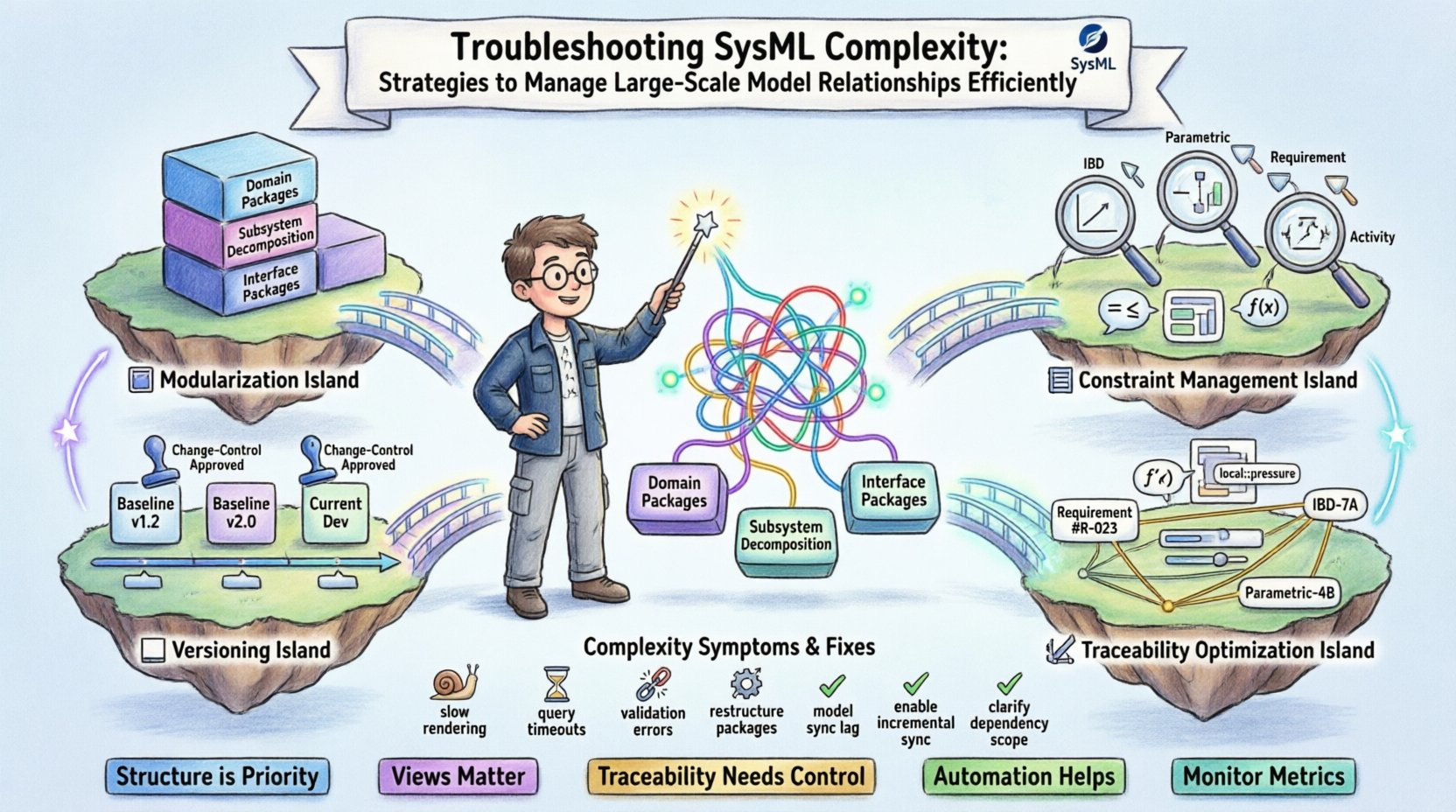
Understanding the Nature of SysML Complexity 🧩
SysML complexity arises from two primary sources: the volume of elements and the density of connections. A model with many elements is heavy. A model with many connections is tangled. In large-scale systems, these two factors compound. Every block, part, property, and requirement introduced creates potential pathways for data flow, control logic, and physical interaction.
When relationships proliferate, the model becomes difficult to visualize. Navigation slows down. Queries return unexpected results. Traceability chains become opaque. The goal of management is not to eliminate relationships, as they define the system, but to organize them so they remain intelligible.
Key Drivers of Relationship Overload
- Unrestricted Coupling: Creating direct links between distant parts of the model without intermediate abstraction layers.
- Redundant Definitions: Defining the same property or interface multiple times across different packages.
- Missing Abstraction: Failing to group related elements into packages or profiles, leading to a flat structure.
- Circular Dependencies: Situations where Block A references Block B, which references Block A, causing analysis loops.
- Inconsistent Naming: Variations in terminology that make relationship identification difficult for humans and tools.
Common Relationship Challenges in SysML ⚠️
Before applying solutions, it is necessary to identify the specific types of relationships causing friction. SysML defines several standard relationship types, each serving a distinct purpose. Misusing or overusing these types leads to structural debt.
Table 1: SysML Relationship Types and Complexity Risks
| Relationship Type | Primary Use Case | Complexity Risk | Mitigation Strategy |
|---|---|---|---|
| Association | Physical or logical links between blocks. | High density can obscure topology. | Use in specific diagrams only; hide in others. |
| Dependency | One element needs another to function. | Creates hard-to-trace change impacts. | Limit to functional requirements only. |
| Generalization | Specialization of a block or type. | Deep hierarchies can become confusing. | Keep depth to 3-4 levels maximum. |
| Realization | Interface implementation. | Orphaned interfaces cause validation errors. | Enforce interface definition before use. |
| Trace | Linking requirements to design elements. | Excessive cross-referencing slows queries. | Use views to filter traceability. |
Strategy 1: Modularization and Package Structuring 📦
The most effective way to manage complexity is to break the model into manageable units. SysML supports packages as containers for elements. A well-structured package hierarchy acts as a namespace, limiting the visibility of relationships to relevant scopes.
Best Practices for Packaging
- Domain-Based Packages: Group elements by system domain (e.g., Power, Thermal, Control) rather than by diagram type.
- Subsystem Decomposition: Align packages with the Work Breakdown Structure (WBS) of the physical system.
- Interface Packages: Isolate interfaces in their own packages to prevent coupling between implementation details.
- Profile Packages: Store custom stereotypes and extensions in dedicated packages to keep the core model clean.
When navigating a large model, the user should only see the elements relevant to their current task. By restricting scope through packages, the number of visible relationships drops significantly. This reduces cognitive load and improves model performance.
Strategy 2: Leveraging Views and Diagrams 📊
A SysML model contains the truth, but diagrams represent the view. In large-scale models, showing all relationships in every diagram is unnecessary and often counterproductive. Utilizing specific views allows engineers to focus on the relationships that matter for a specific analysis.
Diagram Selection Strategy
- Internal Block Diagrams (IBD): Use these for structural topology. Hide internal properties that are not relevant to the current flow.
- Parametric Diagrams: Use these for constraint analysis. Ensure that variables are scoped correctly to avoid referencing undefined parameters.
- Requirement Diagrams: Maintain strict separation between requirements and functional blocks to prevent clutter.
- Activity Diagrams: Focus on control flow. Avoid embedding structural details that belong in IBDs.
By treating diagrams as views rather than storage, you can hide relationships that are not currently under review. This keeps the visual representation clean. It also allows for different levels of abstraction. A high-level view might show a single block representing a subsystem, while a detailed view expands that block to show internal parts.
Strategy 3: Constraint and Parameter Management 📐
Parametric diagrams introduce a different layer of complexity: mathematical relationships. When constraints are defined, they create dependencies between variables. If these are not managed, the solver engine can become overwhelmed.
Managing Parametric Complexity
- Constraint Blocks: Define reusable constraint blocks that encapsulate logic. Do not embed raw equations directly into the model structure.
- Variable Scoping: Ensure that variables used in constraints are clearly defined within the scope of the diagram. Avoid global variable access where possible.
- Decoupling Logic: Separate the definition of the constraint from the data flow. Use connectors to link properties, keeping the logic definition distinct.
- Validation Checks: Run regular consistency checks to identify circular references in constraints. Circular constraints prevent solving.
Effective management of parameters ensures that the model remains analyzable. It prevents the scenario where a change in one parameter triggers a cascade of updates that destabilize the entire system model.
Strategy 4: Traceability Network Optimization 🔗
Traceability is essential for compliance and verification. However, a web of thousands of trace links can become a performance bottleneck. The goal is to maintain the link without creating noise.
Traceability Principles
- Granularity Control: Link requirements to high-level functions first. Drill down to specific components only when necessary.
- Aggregation: Use groupings or parent requirements to aggregate child requirements. This reduces the number of direct links to the system level.
- Filtering: Use traceability matrices or views to display only the relevant links for a specific review cycle.
- Automated Checks: Implement validation rules to flag orphaned requirements or unlinked design elements.
By optimizing the traceability network, engineers ensure that the system verification process remains efficient. It also helps in impact analysis. When a requirement changes, the system can quickly identify the affected blocks without scanning the entire model.
Strategy 5: Versioning and Baseline Management 📑
As models evolve, relationships change. New features are added, and old connections are deprecated. Without proper versioning, the model history becomes a source of confusion. Baselines allow the team to capture the state of the model at specific points in time.
Versioning Guidelines
- Change Control: Define a process for modifying relationships. Major structural changes should go through a review board.
- Snapshotting: Create snapshots before significant refactoring. This allows for rollback if the changes introduce errors.
- Difference Analysis: Use tools to compare versions and highlight changed relationships. This helps in understanding the impact of updates.
- Documentation: Maintain a log of why relationships were created or removed. This context is crucial for future maintenance.
Versioning provides stability. It ensures that the team is always working from a known state. This is particularly important in collaborative environments where multiple engineers are modifying the same model simultaneously.
Identifying and Resolving Specific Complexity Symptoms 🚨
Even with strategies in place, issues will arise. Recognizing the symptoms of complexity allows for targeted intervention. The following table outlines common indicators and their root causes.
Table 2: Complexity Indicators and Remediation
| Symptom | Probable Cause | Remediation Action |
|---|---|---|
| Slow Diagram Rendering | Too many relationship lines drawn. | Hide irrelevant associations; use abstraction. |
| Query Timeouts | Deep traversal of the element graph. | Restructure packages; limit search scope. |
| Validation Errors | Circular references or undefined targets. | Run consistency checks; fix broken links. |
| Conflicting Updates | Multiple users editing shared elements. | Implement locking mechanisms; use baselines. |
| Lost Traceability | Requirements moved without updating links. | Run integrity reports; enforce linking rules. |
Advanced Techniques for Large-Scale Models 🚀
For projects that exceed standard sizes, advanced techniques become necessary. These methods require discipline and often involve custom scripting or external tooling.
Scripting and Automation
- Model Generation: Use scripts to generate repetitive structures. This ensures consistency in naming and relationship definitions.
- Refactoring Tools: Automate the movement of elements between packages. This reduces manual errors during restructuring.
- Custom Reports: Create automated reports to monitor complexity metrics. Track the number of elements per package and the average relationship density.
External Data Integration
- Database Linking: For massive datasets, link the model to an external database. Keep the model lightweight and reference the data externally.
- API Access: Use APIs to interact with the model programmatically. This allows for batch updates without opening the model file.
- Simulation Co-Simulation: Run simulations in external environments. Use the model only for interface definitions and data exchange.
Maintaining Model Health Over Time 🛡️
Complexity management is not a one-time task. It is an ongoing activity that requires attention throughout the project lifecycle. Regular maintenance ensures that the model remains a useful asset rather than a liability.
Maintenance Routine
- Weekly Reviews: Check for broken links and orphaned elements.
- Monthly Audits: Review package structure for logical grouping.
- Quarterly Refactoring: Consolidate duplicate definitions and clean up unused relationships.
- Annual Optimization: Assess the overall model architecture for potential restructuring.
By adhering to this routine, the team prevents the accumulation of technical debt. The model remains responsive and reliable. This discipline is what separates a working model from a complex mess.
Summary of Key Takeaways 📝
- Structure is Priority: Organize elements into logical packages to limit relationship visibility.
- Views Matter: Use diagrams to filter information rather than storing it all in one place.
- Traceability Needs Control: Manage requirement links carefully to avoid performance degradation.
- Automation Helps: Use scripts to maintain consistency and reduce manual effort.
- Monitor Metrics: Track complexity indicators to identify issues early.
Managing large-scale SysML models requires a combination of structural discipline and strategic planning. By focusing on relationships and their impact, engineers can build systems that are both comprehensive and manageable. The effort invested in organization pays dividends in analysis speed and reliability. As systems grow, the ability to navigate the model efficiently becomes the defining factor of project success.
Adopting these strategies ensures that the model serves the engineering team, rather than the team serving the model. This balance is crucial for achieving the goals of modern systems engineering.