
The business landscape is shifting beneath our feet. Traditional strategic frameworks, built for stability, are struggling to keep pace with the velocity of modern change. The PEST Analysis, a staple of corporate strategy for decades, faces a critical test. Can a model designed in the mid-20th century effectively map the volatility of emerging economies and the rapid pace of digital disruption? The answer lies not in discarding the framework, but in radically adapting it.
This guide explores how to evolve the PEST Analysis into a dynamic tool capable of navigating uncertainty. We will examine the specific nuances of Political, Economic, Social, and Technological factors in high-growth, low-stability environments. We will also integrate the impact of digital transformation, ensuring your strategic planning reflects the reality of today, not the stability of yesterday.
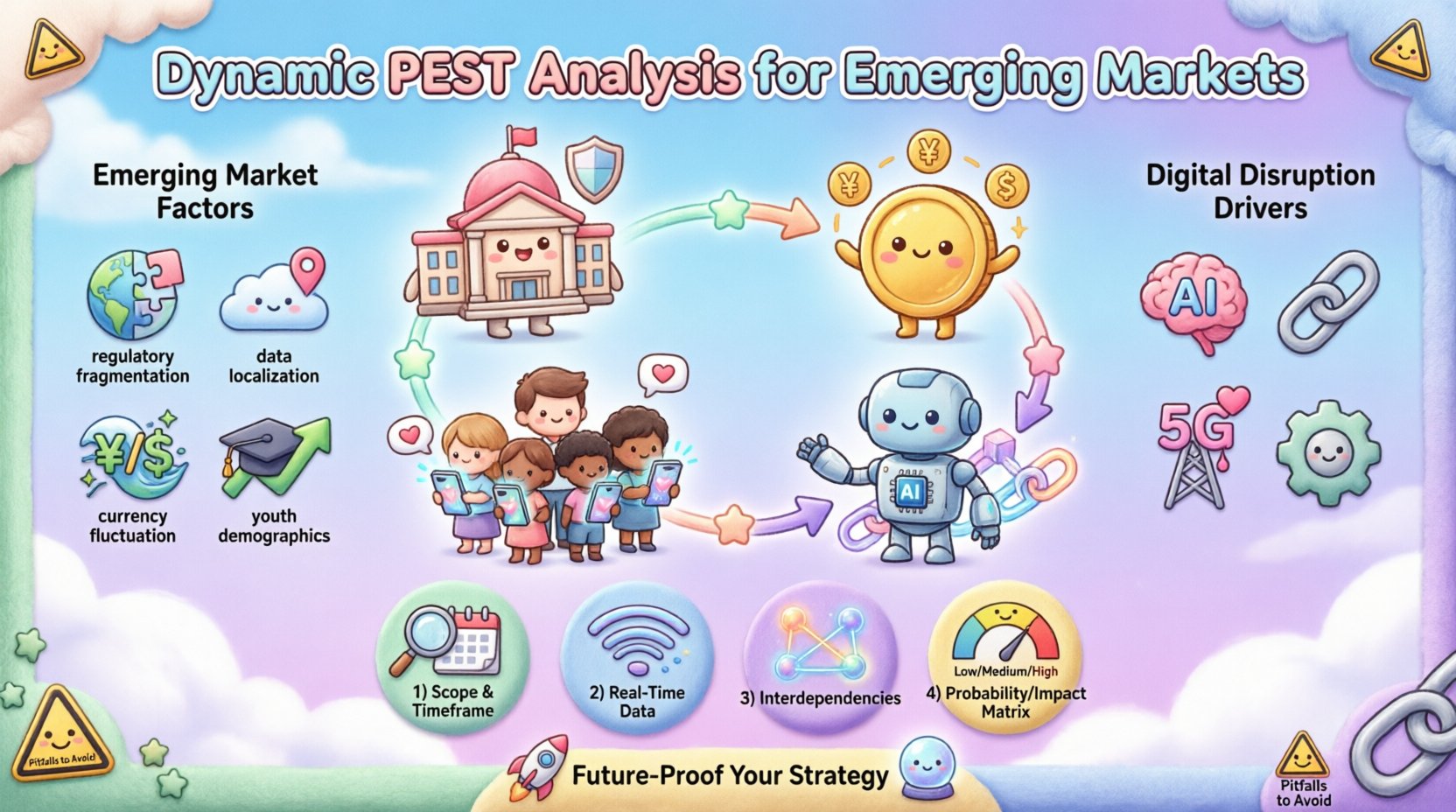
1. The Evolution of the PEST Framework 🔍
Originally developed to scan the macro-environment, the standard PEST model categorizes external factors into four buckets. However, the static nature of this approach often fails when applied to volatile markets. In a digital-first world, these factors do not operate in silos. They interact, amplify, and contradict each other.
- Political (P): No longer just about government stability. It now includes data sovereignty, digital taxation, and regulatory arbitrage.
- Economic (E): Beyond GDP. It encompasses inflation rates, currency fluctuation, and the rise of alternative currencies.
- Social (S): Demographics alone are insufficient. We must look at cultural shifts, remote work adoption, and consumer trust in technology.
- Technological (T): This is the most volatile category. It covers AI, blockchain, connectivity infrastructure, and cybersecurity threats.
When entering an emerging market, relying on a static snapshot is dangerous. You need a dynamic view that accounts for rapid shifts. A strategy that works today may be obsolete in six months due to a regulatory change or a technological breakthrough.
2. Navigating Emerging Markets: Political and Economic Realities 🏛️💰
Emerging markets offer high growth potential but come with distinct risks. The political and economic landscape here is characterized by volatility, infrastructure gaps, and rapid policy shifts. A standard PEST analysis might flag “political instability” as a risk, but it often misses the nuance of *how* that instability affects business operations.
Political Factors in Volatile Regions
Political risk in emerging markets is multifaceted. It is not merely about regime change. It involves:
- Regulatory Fragmentation: Digital services often face conflicting regulations between national and local jurisdictions. Compliance becomes a complex web of legal obligations.
- Data Localization Laws: Governments increasingly require data to be stored physically within their borders. This impacts cloud strategy and operational costs.
- Cybersecurity Mandates: New laws often require specific security protocols for critical infrastructure, affecting how technology is deployed.
- Intellectual Property Protection: The strength of IP enforcement varies widely, impacting innovation and technology transfer strategies.
Economic Factors and Currency Dynamics
Economic indicators in emerging markets require deeper scrutiny than simple GDP growth rates. Inflation and currency volatility can erode margins overnight.
- Currency Fluctuation: Hedging strategies become essential. Revenue in local currency must be carefully managed against stable foreign exchange.
- Infrastructure Gaps: Power outages and poor internet connectivity affect operational continuity. Backup systems are not optional; they are critical.
- Access to Capital: Local financing options may differ from Western standards. Understanding local banking practices is vital for cash flow management.
- Informal Economy: A significant portion of economic activity may be unrecorded. This impacts market sizing and tax compliance.
3. The Social Shift: Demographics and Cultural Nuances 👥📱
Social factors are often underestimated in strategic planning. In emerging markets, the social fabric is changing rapidly due to urbanization and digital adoption. Understanding the human element is crucial for product-market fit.
Demographic Dividends and Urbanization
- Youth Populations: Many emerging markets have young, growing workforces. This offers labor advantages but requires training investment.
- Urban Migration: People are moving to cities faster than in the past. Logistics and distribution networks must adapt to dense urban centers.
- Middle-Class Expansion: This group drives consumption. However, their expectations for quality and service are rising quickly.
Digital Culture and Trust
Digital disruption is not just a technological issue; it is a social one. How do people trust new technologies?
- Mobile-First Consumers: In many regions, smartphones are the primary internet device. Desktop-centric strategies will fail.
- Trust in Institutions: In markets with low institutional trust, peer-to-peer networks and community validation drive adoption more than corporate branding.
- Language Barriers: Localization goes beyond translation. It requires cultural adaptation of content and user interfaces.
- Privacy Concerns: Data privacy awareness is growing. Companies that mishandle data face immediate backlash.
4. Technological Disruption: The New Variable ⚙️🚀
Technology is the most dynamic component of the PEST framework. In the context of emerging markets and digital disruption, technology acts as both an enabler and a disruptor. It changes the other three factors (Political, Economic, Social) as well.
Key Technological Drivers
- Artificial Intelligence: AI is transforming decision-making. However, ethical guidelines and bias regulations are emerging globally.
- Blockchain and Fintech: Decentralized finance offers alternatives to traditional banking in underbanked regions.
- 5G and Connectivity: High-speed internet is becoming a utility. Lack of access creates digital divides.
- Automation: Labor costs are rising in some markets. Automation becomes a cost-saving measure rather than just an efficiency tool.
The Impact on Business Models
Traditional brick-and-mortar models are being replaced by digital platforms. This shift requires a different risk assessment.
| Traditional Factor | Digital Disruption Factor |
|---|---|
| Physical Infrastructure | Digital Infrastructure (Cloud, API) |
| Local Talent Pools | Remote Global Talent Access |
| Regulatory Compliance (Physical) | Regulatory Compliance (Data, Cyber) |
| Customer Acquisition (Ads) | Customer Acquisition (Digital Channels) |
| Value Chain (Linear) | Value Chain (Network Effects) |
5. Implementing a Dynamic PEST Analysis 📊
To make this framework useful, you must move from a quarterly review to continuous monitoring. A static document is useless in a dynamic environment. Here is how to structure the process.
Step 1: Define the Scope and Timeframe
Clearly define what you are analyzing. Are you looking at a 5-year market entry or a 1-year product launch? The timeframe dictates the depth of research required.
- Short-term: Focus on immediate regulatory changes and currency spikes.
- Long-term: Focus on demographic shifts and infrastructure development.
Step 2: Gather Real-Time Data
Do not rely on old reports. Use current data sources. Look for news feeds, government publications, and industry reports. Prioritize primary data where possible.
- Government Filings: Check local regulatory bodies for upcoming legislation.
- Market Reports: Use data from reputable research firms specializing in the region.
- Competitor Moves: Monitor how competitors are adapting. Their failures and successes offer clues.
Step 3: Identify Interdependencies
Factors do not exist in isolation. A technological change often triggers a political response.
- Example: A surge in cryptocurrency use (Technological) may lead to strict capital controls (Economic) and new laws on digital assets (Political).
- Example: A shift to remote work (Social) increases demand for cloud services (Technological) and changes tax obligations (Economic).
Step 4: Assign Probabilities and Impact
Not all risks are equal. Use a scoring system to prioritize.
- High Probability / High Impact: Immediate action required. Mitigation plans must be in place.
- Low Probability / High Impact: Monitor closely. Have contingency plans ready.
- High Probability / Low Impact: Accept the risk. Manage as part of normal operations.
- Low Probability / Low Impact: Ignore for now.
6. Common Pitfalls to Avoid ⚠️
Even with a robust framework, mistakes happen. Here are common errors that undermine the effectiveness of a PEST analysis in modern contexts.
- Assuming Static Conditions: Believing that a stable political environment will remain so. History shows volatility is the norm.
- Ignoring Local Context: Applying Western frameworks directly to Eastern markets without adaptation. Cultural nuance matters.
- Overlooking Informal Networks: In many emerging markets, business is conducted through personal relationships, not just formal contracts.
- Technology Fetishism: Assuming technology will solve all problems. Infrastructure and human capital are still bottlenecks.
- Data Overload: Collecting too much information without synthesizing it into actionable insights.
7. Future-Proofing Your Strategy 🔮
The goal of this analysis is not just to understand the present, but to anticipate the future. Strategic agility is the key to survival.
Building Resilience
- Diversification: Do not rely on a single market or currency. Spread risk across regions.
- Scalable Infrastructure: Build systems that can grow or shrink based on demand without significant cost penalties.
- Local Partnerships: Partner with local entities who understand the regulatory and cultural landscape.
- Continuous Learning: Establish a feedback loop. Learn from market reactions and adjust quickly.
The Role of Leadership
Leaders must be comfortable with ambiguity. They need to make decisions with incomplete information. The PEST analysis provides a structure for that decision-making, but it does not provide the answer.
- Scenario Planning: Develop multiple scenarios based on different PEST outcomes. Test your strategy against each.
- Decision Triggers: Define what events will trigger a change in strategy. For example, “If currency drops 10%, we activate hedging.”
- Transparency: Communicate risks and assumptions clearly to stakeholders. Avoid false certainty.
8. Conclusion on Strategic Adaptation 🛠️
The PEST Analysis remains a valuable tool, but its application must evolve. In a world defined by digital disruption and emerging market volatility, a static model is insufficient. Success requires a dynamic approach that integrates real-time data, acknowledges interdependencies, and prioritizes agility.
By understanding the specific nuances of political, economic, social, and technological factors in your target markets, you can build a strategy that is resilient and responsive. The future belongs to those who can adapt their frameworks to the reality of change, rather than hoping the world fits their existing models.
Start by reviewing your current strategic documents. Identify where they rely on assumptions of stability. Then, apply the dynamic PEST methodology outlined here. The goal is not perfection, but preparedness.