
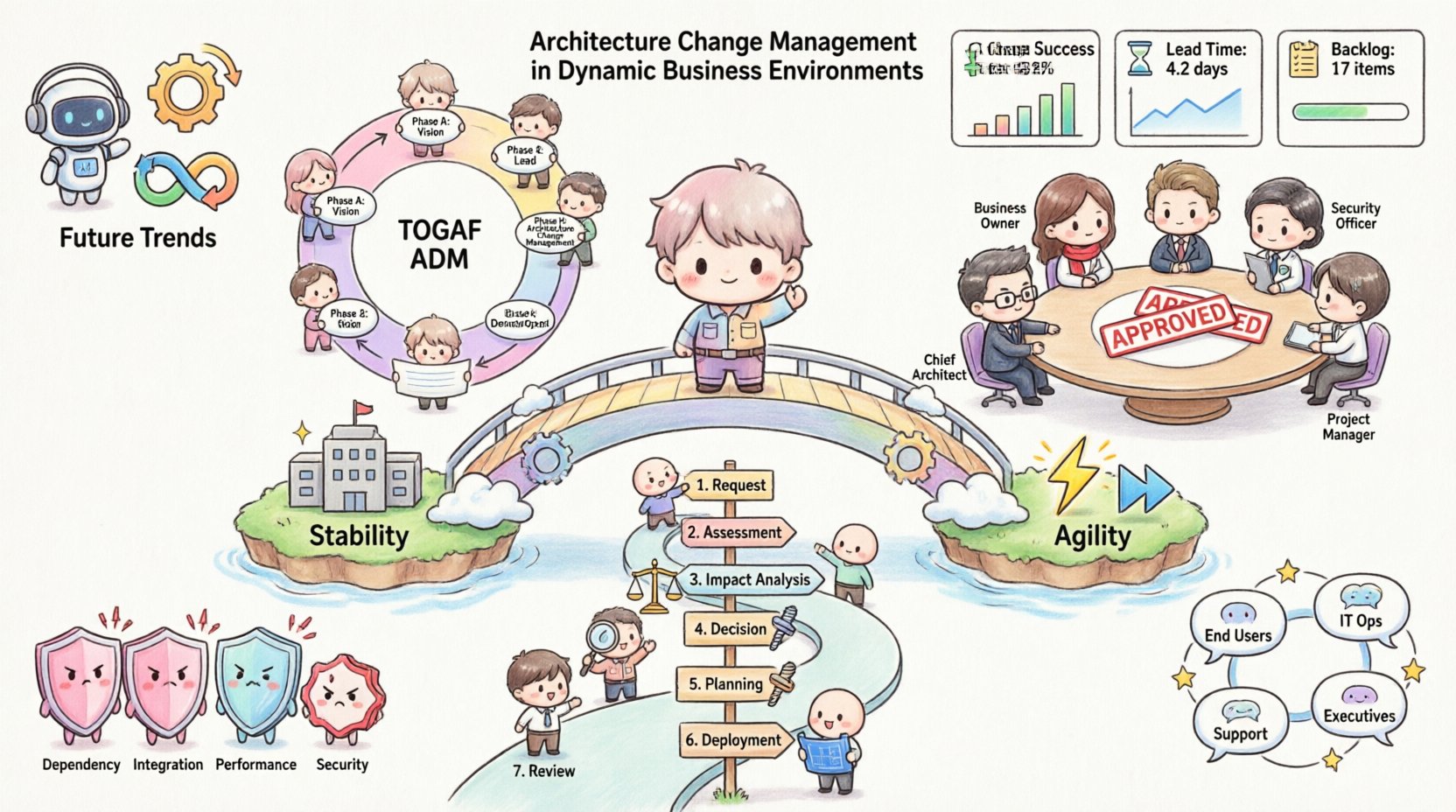
In the modern enterprise, stability and agility often feel like opposing forces. On one side, you have the need for robust, scalable systems that do not fail. On the other, the market demands rapid adaptation to new technologies and shifting customer expectations. Architecture Change Management serves as the bridge between these two needs. It is the discipline that ensures evolution happens without chaos. This guide explores how to implement effective change management within the context of the TOGAF framework, specifically tailored for dynamic environments.
Understanding the Core Challenge 🧩
Enterprise Architecture is not a static document stored on a shelf. It is a living representation of how an organization operates and plans to operate. When business requirements shift, the architecture must shift with them. However, uncontrolled changes lead to technical debt, system fragility, and misalignment with strategic goals.
Change management is the mechanism that governs these modifications. It is not about saying “no” to change. It is about ensuring every change is understood, assessed, approved, and implemented with minimal disruption. In a dynamic business environment, the speed of change accelerates. Traditional governance models often become bottlenecks. The goal is to create a governance structure that is robust yet responsive.
The TOGAF Context 🔄
The Open Group Architecture Framework (TOGAF) provides a structured approach for developing and managing enterprise architecture. Within this framework, change management is not an isolated activity; it is integrated into the Architecture Development Method (ADM).
- Phase A: Architecture Vision – Establishes the scope and constraints for future changes.
- Phase B, C, D: Business, Information Systems, and Technology Architecture – Defines the baseline and target states that may require modification.
- Phase E: Opportunities and Solutions – Evaluates potential changes against business value.
- Phase F: Migration Planning – Creates the roadmap for implementing approved changes.
- Phase G: Implementation Governance – Ensures the architecture is maintained during deployment.
- Phase H: Architecture Change Management – The specific phase dedicated to handling requests for change after the initial implementation.
Understanding where change management fits in the ADM cycle is crucial. It is not just a final step; it is a continuous loop. As the business evolves, the architecture evolves. This requires a clear understanding of the Architecture Repository, which stores all architectural assets, including models, documents, and standards.
Navigating Dynamic Environments 🌪️
Dynamic business environments are characterized by volatility, uncertainty, complexity, and ambiguity. In these conditions, long-term planning becomes difficult. Strategies that worked yesterday might be obsolete today. Architecture Change Management must adapt to this fluidity.
Consider the following drivers of change that require architectural attention:
- Regulatory Compliance – New laws often dictate how data is handled, requiring immediate architectural adjustments.
- Technology Disruption – The emergence of new tools (e.g., cloud computing, AI) can render existing infrastructure inefficient.
- Organizational Restructuring – Mergers, acquisitions, or internal shifts change the business process landscape.
- Customer Expectations – Users demand faster, more personalized experiences, pushing for API integrations and microservices.
When these drivers are present, a rigid change process will cause delays. A flexible process, however, allows for rapid iteration while maintaining control. The key is balancing the need for speed with the need for governance.
Establishing a Change Control Board 🛡️
At the heart of any change management process is the Change Control Board (CCB). This body is responsible for reviewing, approving, and rejecting change requests. In a dynamic environment, the composition and authority of the CCB must be carefully defined.
A typical CCB includes representatives from various domains:
| Role | Responsibility |
|---|---|
| Chief Architect | Ensures alignment with overall architectural principles and standards. |
| Business Owner | Validates the business value and necessity of the change. |
| Technical Lead | Assesses technical feasibility and integration complexity. |
| Security Officer | Evaluates security implications and compliance risks. |
| Project Manager | Manages timeline, resources, and delivery expectations. |
In dynamic environments, this board should operate with a sense of urgency. Meetings should be scheduled frequently, or the process should be asynchronous to avoid bottlenecks. Authority must be delegated to sub-boards for minor changes, reserving full board review for significant structural shifts.
The Change Management Workflow 📋
To manage change effectively, a standardized workflow is essential. This workflow ensures consistency and traceability. Every request must pass through specific stages before it becomes part of the production environment.
- Request Submission – A formal record of the proposed change is created. This includes the “what”, “why”, and “who”. It must reference the specific business driver.
- Initial Assessment – A preliminary review determines if the request is complete and valid. Is the impact clear? Is the cost estimated?
- Impact Analysis – A deep dive into how this change affects existing systems, processes, and data. This is where the Architecture Repository is consulted to check dependencies.
- Decision Making – The CCB reviews the analysis. They approve, reject, or request more information. If approved, a priority level is assigned.
- Implementation Planning – A detailed plan is created for execution. This includes rollback strategies in case of failure.
- Deployment – The change is applied to the target environment.
- Post-Implementation Review – After deployment, the team verifies that the change achieved the desired outcome without introducing new issues.
Each step requires documentation. This documentation lives in the Architecture Repository. It serves as an audit trail and a knowledge base for future changes.
Risk Management Strategies ⚠️
Every change introduces risk. Some risks are technical, such as system downtime or data loss. Others are business-related, such as operational disruption or revenue loss. Managing these risks is a core component of the change process.
Identifying Risks
Before approving a change, stakeholders must identify potential failure points. Common risk categories include:
- Dependency Risks – Does the change rely on another system that is unstable?
- Integration Risks – Will the new component communicate correctly with existing interfaces?
- Performance Risks – Will the change degrade response times or throughput?
- Security Risks – Does the change introduce new vulnerabilities or expose sensitive data?
Mitigating Risks
Once risks are identified, mitigation strategies must be developed. These strategies might include:
- Phased Rollouts – Deploying the change to a small group of users first to gather feedback.
- Feature Flags – Using code toggles to enable or disable features without redeploying.
- Automated Testing – Running regression tests to ensure existing functionality is not broken.
- Backup and Recovery – Ensuring data can be restored quickly if the change fails.
Risk management is not a one-time activity. It continues throughout the implementation phase. If new risks emerge, the change process may need to pause for reassessment.
Communication and Stakeholder Engagement 🗣️
Technical changes often fail due to poor communication. Stakeholders who are not informed may resist the change or be unable to adapt their processes. Effective communication is a critical success factor.
Key Stakeholders
Identify who needs to know about the change:
- End Users – They will experience the change directly.
- IT Operations – They will manage the infrastructure post-deployment.
- Support Teams – They will handle tickets and troubleshooting.
- Executive Leadership – They need to understand the strategic impact.
Communication Channels
Different groups require different types of information. Use a mix of channels to ensure reach:
- Email Updates – For formal notifications and scheduled maintenance.
- Dashboard Reports – For real-time status and progress tracking.
- Workshops – For detailed discussions and training on new processes.
- FAQ Documents – To address common questions and concerns.
Transparency builds trust. If a change is delayed or problematic, communicate this immediately. Hiding issues often leads to larger problems later.
Measuring Effectiveness 📊
How do you know the change management process is working? You need metrics. These metrics help you understand the health of your architecture and the efficiency of your governance.
Consider tracking the following Key Performance Indicators (KPIs):
- Change Success Rate – The percentage of changes implemented without causing incidents.
- Change Lead Time – The time taken from request submission to implementation.
- Backlog Size – The number of pending change requests. A growing backlog indicates a bottleneck.
- Rollback Frequency – How often changes need to be undone. High frequency suggests poor planning.
- Stakeholder Satisfaction – Feedback from users and business owners regarding the change process.
Regularly review these metrics. If lead time is too long, simplify the approval process. If success rate is low, improve the assessment phase. Data-driven adjustments lead to continuous improvement.
Common Obstacles and How to Overcome Them 🚧
Implementing change management in a dynamic environment comes with challenges. Recognizing these pitfalls early can save significant time and resources.
1. Bureaucracy vs. Speed
The Problem: Governance processes become too heavy, slowing down innovation.
The Solution: Implement tiered governance. Minor changes (e.g., configuration updates) require fewer approvals than major changes (e.g., new database schema). This allows the team to move fast on low-risk items while maintaining control on high-risk items.
2. Siloed Information
The Problem: Business and IT teams do not share the same understanding of architecture.
The Solution: Create a shared vocabulary. Use visual models that both business and technical stakeholders can understand. Regular cross-functional meetings help align perspectives.
3. Technical Debt Accumulation
The Problem: Quick fixes accumulate over time, making future changes harder.
The Solution: Allocate resources specifically for refactoring. Treat technical debt as a financial liability that must be paid down. Include debt reduction in the architecture roadmap.
4. Resistance to Change
The Problem: Teams prefer the status quo due to fear of the unknown.
The Solution: Involve teams early in the design process. Show them the benefits of the change. Provide training and support to build confidence.
Future Trends in Architecture Change 🚀
The landscape of architecture management is evolving. New methodologies are emerging to handle the increasing pace of business.
- Continuous Architecture – Architecture is no longer a phase at the beginning of a project. It is a continuous activity that runs parallel to development.
- Automation – Tools are being used to automate impact analysis and compliance checks. This reduces manual effort and human error.
- DevOps Integration – Architecture governance is being embedded into the CI/CD pipeline. Changes are validated automatically before deployment.
- AI-Assisted Analysis – Artificial intelligence helps predict the impact of changes based on historical data and patterns.
Adopting these trends requires a shift in mindset. It is not about replacing human judgment with machines. It is about empowering humans with better data and faster feedback loops.
Practical Steps for Implementation 🛠️
Ready to improve your architecture change management? Follow these actionable steps to begin the journey.
- Document Current Processes – Map out how changes happen today. Identify gaps and inefficiencies.
- Define Principles – Establish clear architectural principles that guide decision-making.
- Build the Repository – Create a central location for storing architecture artifacts and change records.
- Train the Team – Ensure everyone understands their role in the change management process.
- Start Small – Pilot the new process on a single project before rolling it out enterprise-wide.
- Review and Iterate – Regularly assess the process and make adjustments based on feedback and metrics.
Final Thoughts on Stability and Growth 🌱
Architecture Change Management is not about restricting growth. It is about enabling sustainable growth. In dynamic business environments, the ability to change quickly is a competitive advantage. However, uncontrolled change leads to instability. By applying structured governance within the TOGAF framework, organizations can achieve both speed and stability.
The journey requires commitment from leadership and collaboration across teams. It demands a culture where quality and compliance are valued alongside innovation. When these elements come together, the organization becomes resilient. It can weather market shifts and embrace new opportunities without losing its foundation.
Focus on the principles. Build the processes. Measure the outcomes. And continuously refine the approach. This is how you build an architecture function that supports the business today and tomorrow.