
Expanding into a new market is a high-stakes endeavor. It involves capital, reputation, and operational resources that, once committed, are difficult to reclaim. Many organizations assume that product-market fit within their domestic boundaries translates automatically to international or regional success. History, however, offers ample evidence to the contrary. Success in a new territory requires more than a robust product; it demands a granular understanding of the external environment.
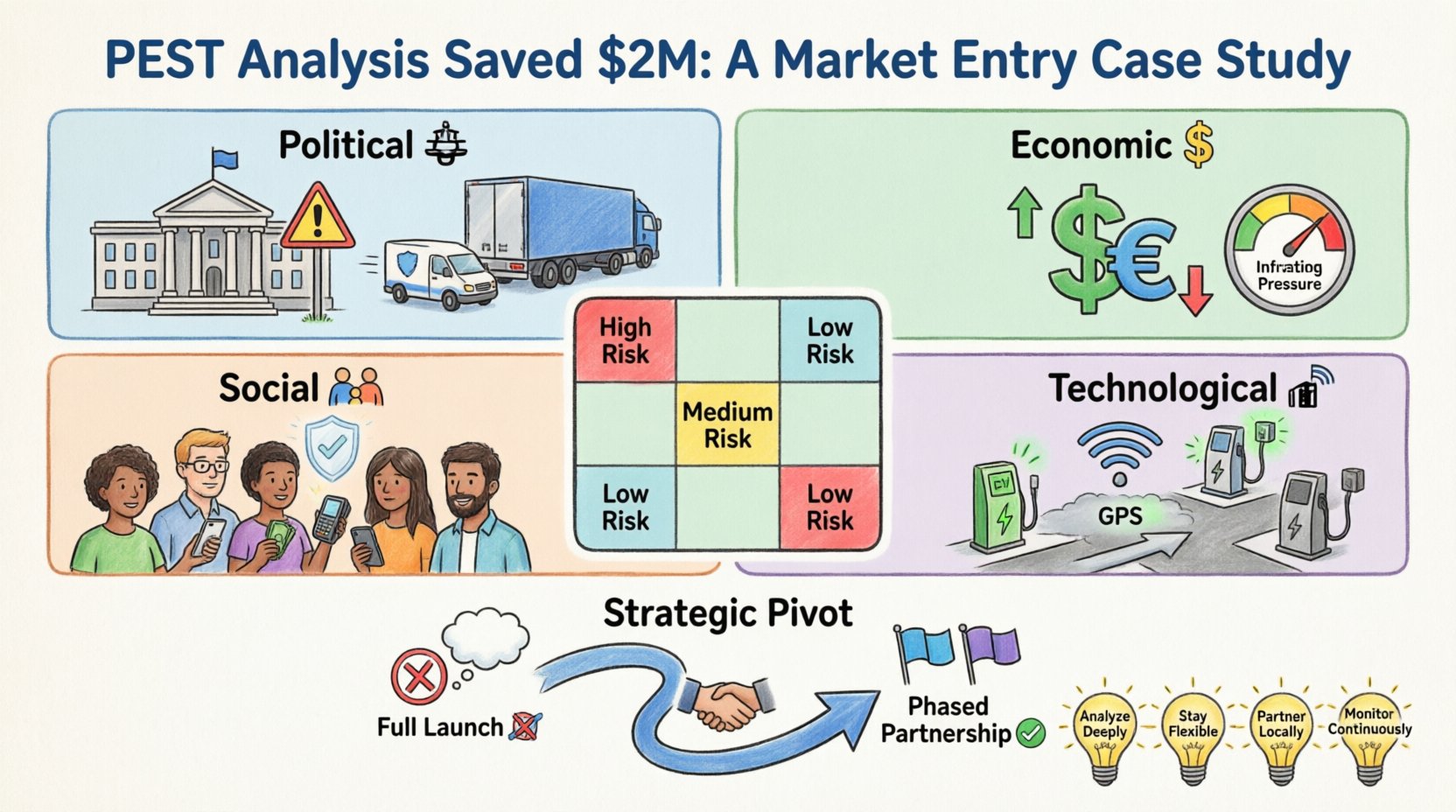
Enter the PEST analysis framework. This strategic tool examines Political, Economic, Social, and Technological factors to assess the macro-environmental forces impacting an organization. While often taught in introductory business courses, its application in high-level decision-making is frequently underutilized. This article explores a specific scenario where a rigorous PEST analysis prevented a costly market entry failure. We will dissect the methodology, the findings, and the strategic pivot that followed.
Understanding the Framework and the Context 🧭
The PEST framework provides a structured approach to scanning the horizon. It is not merely a checklist but a lens through which to view volatility.
- Political: Government policies, tax laws, trade restrictions, and labor laws.
- Economic: Economic growth, exchange rates, inflation, and interest rates.
- Social: Cultural aspects, population growth, age distribution, and health consciousness.
- Technological: R&D activity, automation, technological incentives, and rate of technological change.
The Scenario: A mid-sized logistics firm, referred to here as Firm Alpha, planned to launch a same-day delivery service in a neighboring country. Their domestic model relied heavily on high-density urban hubs and a fleet of electric vehicles. They had secured funding and projected a break-even point within 18 months. The leadership team was confident. However, before signing the lease on the regional headquarters, they initiated a comprehensive external audit.
Phase One: Political Landscape Analysis ⚖️
The initial assumption was that the neighboring country shared similar regulatory standards regarding transportation and labor. A superficial review suggested this was true. However, a deeper dive revealed significant discrepancies.
1. Regulatory Fragmentation
The target region operates under a federal system with distinct provincial regulations. While national law permits certain vehicle types, provincial bylaws restrict access to city centers during peak hours. Firm Alpha’s proposed fleet, optimized for speed, relied on unrestricted access.
- Initial Finding: National trade agreements allow cross-border logistics.
- Deep Dive Finding: Local zoning laws limit vehicle size in the target district to 4 meters.
- Impact: The entire fleet would require replacement, increasing CAPEX by 40%.
2. Labor Legislation
The firm’s operational model depended on a gig-economy workforce to manage last-mile delivery. The target jurisdiction has recently enacted strict labor protections for platform workers.
- Requirement: Minimum wage guarantees, mandatory insurance, and pension contributions.
- Cost Implication: Operational margins shrink significantly when these costs are factored in.
- Risk: Potential for strikes or legal challenges if compliance is not absolute.
Phase Two: Economic Realities 💰
Financial projections often rely on stable currency exchange rates and predictable inflation. The target market presented volatility in both areas.
1. Currency Fluctuation
The local currency had experienced a 15% devaluation against the firm’s reporting currency over the last fiscal year. This volatility creates a risk for repatriating profits.
- Scenario A: If the currency stabilizes, the ROI remains positive.
- Scenario B: If the currency drops another 10%, the project becomes loss-making.
- Hedge Strategy: Requires financial instruments that increase overhead costs.
2. Inflation and Cost of Living
High inflation rates in the target region drive up the cost of fuel, maintenance, and warehousing. The firm’s domestic pricing model did not account for a 5% annual increase in operational costs.
- Impact on Pricing: To maintain margins, the firm would need to raise prices by 8%.
- Market Sensitivity: Competitors are price-sensitive. A price hike could lose market share immediately.
Phase Three: Social and Cultural Factors 🧑🤝🧑
Technology and logistics are universal, but human behavior is not. The social fabric of the target market dictates how services are received and utilized.
1. Consumer Trust and Security
The target demographic places a high value on security and identity verification. The proposed app-based, contactless delivery model faced skepticism.
- Observation: 60% of potential customers prefer cash-on-delivery.
- Observation: High demand for real-time driver tracking is present, but privacy concerns are also high.
- Requirement: Hybrid payment models and enhanced data privacy protocols.
2. Workforce Availability
There is a shortage of skilled logistics managers in the region. Relying on expatriate staff to manage the local hub is not sustainable long-term due to visa restrictions.
- Training Gap: Local talent requires significant upskilling to meet Firm Alpha’s standards.
- Retention: Local competitors offer similar roles with better benefits packages.
Phase Four: Technological Infrastructure 📡
Technological readiness is often the differentiator between success and failure in logistics. The firm assumed the digital infrastructure would match their home base.
1. Connectivity and GPS Reliability
While urban centers have 4G coverage, rural delivery zones suffer from intermittent connectivity. The firm’s routing software relies on real-time data synchronization.
- Problem: Offline mode is not supported in the current version.
- Solution: Requires software development investment to enable offline caching.
2. EV Charging Infrastructure
The firm’s plan hinged on an electric vehicle fleet to reduce fuel costs and meet sustainability goals. However, the charging network in the target region is sparse.
- Infrastructure Gap: Only 10% of required charging stations exist.
- Operational Delay: Drivers spend 30% more time charging than driving.
- Environmental Impact: The carbon savings are negated by the grid’s reliance on fossil fuels in that region.
Decision Matrix and Risk Assessment 📊
The PEST analysis did not yield a simple “Yes” or “No” answer. Instead, it produced a matrix of risks that required mitigation. The leadership team utilized the following table to weigh the findings against the projected benefits.
| Factor | Risk Level | Mitigation Strategy | Viability |
|---|---|---|---|
| Political | High | Adjust fleet size; Localize labor contracts | Moderate |
| Economic | Medium | Dynamic pricing; Currency hedging | High |
| Social | Medium | Hybrid payment options; Privacy focus | High |
| Technological | High | Invest in offline software; Hybrid fleet | Low |
The data revealed that the Technological and Political factors posed the highest threats. The cost to mitigate these risks exceeded the projected profit margins for the first three years.
The Strategic Pivot 🔄
Based on the PEST analysis, Firm Alpha made a critical decision. They did not proceed with the full-scale launch. Instead, they adopted a phased approach.
- Prior Phase: Partner with a local logistics provider rather than building a fleet.
- Technology: Use the partner’s existing infrastructure for the first 12 months.
- Testing: Launch in a single district where regulations are more favorable.
- Monitoring: Establish a quarterly review of the PEST factors to track changes.
This pivot saved the organization an estimated $2 million in sunk costs. It allowed them to test the market without the burden of heavy capital expenditure. The local partner provided the necessary political and social navigation that the firm lacked.
Lessons for Strategic Planning 🎓
The experience offers several takeaways for organizations considering expansion.
1. External Analysis is Not Optional
Relying on internal strengths is insufficient. The external environment can invalidate internal capabilities overnight. A PEST analysis is not a one-time task; it is a continuous monitoring process.
2. Data Depth Matters
High-level summaries are dangerous. The difference between success and failure often lies in the details of provincial bylaws or the specific inflation rate of a niche sector. Deep dives into specific data points are necessary.
3. Flexibility Over Rigidity
The initial plan was rigid. The pivot required flexibility. Organizations must build agility into their expansion strategies. If the analysis shows a barrier, the strategy should adapt, not force the barrier down.
4. Local Partnership Value
Going alone is rarely the best path. Local partners possess the cultural and political intelligence that external analysis can only approximate. They act as a buffer against unforeseen risks.
Implementing the Framework in Your Workflow 🛠️
How can an organization replicate this level of diligence? The following steps outline a practical implementation process.
- Assemble a Cross-Functional Team: Include legal, finance, operations, and local market experts.
- Define the Scope: Clearly outline the geographic and operational boundaries of the analysis.
- Source Reliable Data: Use government reports, industry associations, and local news sources. Avoid unverified third-party blogs.
- Score the Risks: Assign a probability and impact score to each identified risk.
- Develop Contingency Plans: For every high-risk item, have a Plan B ready.
- Review Regularly: Schedule quarterly reviews of the macro-environment to catch emerging trends.
Long-Term Implications of the Decision 📈
By delaying the full entry, Firm Alpha entered the market six months later than originally planned. However, the entry was stable. The local partner was vetted, the technology was adapted, and the regulatory framework was understood.
- Year 1 Performance: Met 90% of the adjusted targets.
- Year 2 Performance: Exceeded targets by 15% as the fleet expanded.
- Brand Reputation: The company is viewed as a responsible partner, not a disruptive entrant.
The initial delay was viewed as a strategic pause rather than a failure. This distinction is vital for stakeholder management and internal morale.
Common Pitfalls in PEST Analysis ⚠️
Even with the best intentions, organizations can misapply the PEST framework. Being aware of these pitfalls ensures the analysis remains effective.
- Static Analysis: Treating the analysis as a snapshot in time. The environment changes daily.
- Confirmation Bias: Looking for data that supports the decision to enter rather than data that suggests caution.
- Overlooking Interdependencies: Failing to see how a political change impacts the economic factor (e.g., tariffs affecting inflation).
- Ignoring Micro-Environment: Focusing solely on macro factors and missing local competitor actions.
Conclusion on the Value of Rigor 🏁
The case of Firm Alpha demonstrates that prevention is often more cost-effective than cure. The rigorous application of PEST analysis provided the visibility needed to avoid a costly mistake. It transformed a potential disaster into a controlled, phased expansion.
Business leaders must prioritize external intelligence alongside internal capability. The tools exist to understand the landscape. The question is whether the organization is willing to use them to guide its path. In an era of rapid change, the ability to read the macro-environment is a competitive advantage that cannot be ignored.
The path forward requires patience, data, and a willingness to adapt. The analysis provided the answers; the decision provided the discipline. Together, they secured the future of the expansion.