


Strategic planning in the modern business environment requires more than just internal metrics. To navigate complex market conditions, organizations must look outward. A PEST analysis provides a structured framework for understanding the macro-environmental factors that influence an organization. However, many teams treat this as a checkbox exercise rather than a strategic imperative. This guide explores how to move beyond simple categorization to derive actionable intelligence.
By examining Political, Economic, Social, and Technological forces, leaders can anticipate shifts before they disrupt operations. The goal is not merely to list factors, but to evaluate their impact on long-term viability. This deep dive covers the nuances of data collection, the integration of advanced frameworks, and the translation of insights into concrete strategic moves.
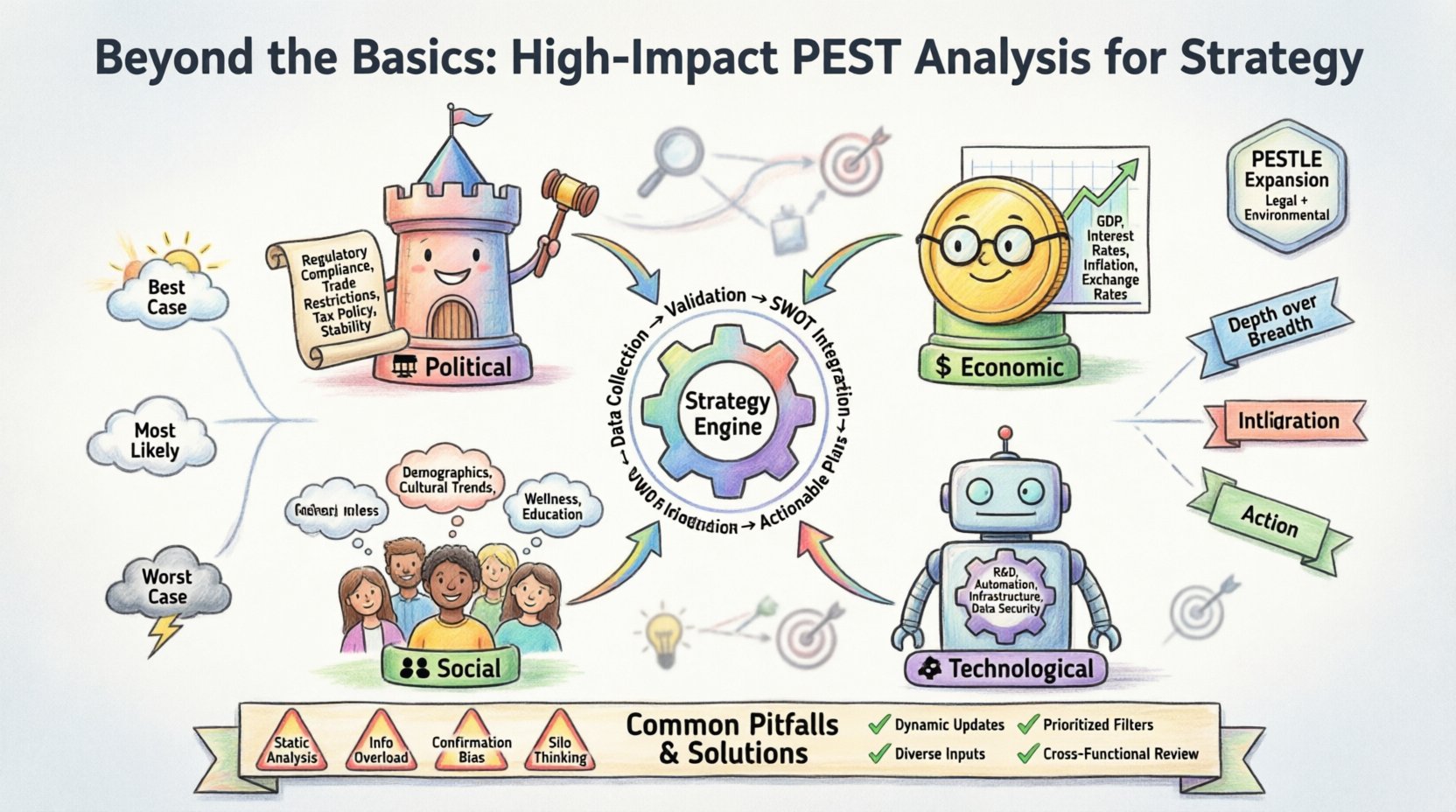
🔍 The Core Pillars: Understanding the Macro-Environment
The foundation of this analysis lies in the four primary categories. Each category represents a distinct set of external pressures. A robust analysis requires specific questions tailored to your industry, rather than generic queries.
1. Political Factors 🏛️
Political stability and government policy directly dictate the rules of engagement. These factors are often the most immediate and tangible threats or opportunities.
- Regulatory Compliance: Consider how current laws affect operational costs. Are there upcoming changes in labor laws or environmental regulations that require capital investment?
- Trade Restrictions: Evaluate tariffs, quotas, and trade agreements. How might cross-border logistics be impacted by shifting geopolitical alliances?
- Tax Policy: Corporate tax rates and incentives vary by region. How does the current fiscal landscape influence location decisions?
- Political Stability: Assess the risk of civil unrest or government turnover. Does the current administration favor your industry sector?
2. Economic Factors 💰
Economic conditions determine the purchasing power of customers and the cost of capital. These metrics are often volatile and require constant monitoring.
- Economic Growth: Is the economy expanding or contracting? How does GDP growth correlate with demand for your specific product or service?
- Interest Rates: High rates increase borrowing costs for expansion. Low rates may encourage debt-fueled growth but signal inflation risks.
- Inflation Rates: Rising prices affect input costs and consumer spending. How will you adjust pricing strategies to maintain margins?
- Exchange Rates: For international operations, currency fluctuation can erode profitability. What hedging strategies are necessary?
3. Social Factors 👥
Demographics and cultural attitudes shape consumer behavior. Understanding the human element is crucial for product-market fit.
- Population Growth: Is the market saturated or growing? How does aging demographics affect demand for healthcare or retirement services?
- Cultural Trends: Shifts in lifestyle, such as remote work or sustainability consciousness, impact brand perception.
- Health and Wellness: Consumer priorities regarding physical and mental health influence product development.
- Education Levels: A more educated workforce or consumer base may demand higher quality or more sophisticated solutions.
4. Technological Factors 🤖
Technological innovation drives disruption. It creates new markets and renders existing solutions obsolete.
- R&D Activity: What new technologies are emerging in your sector? Are you investing enough in innovation to stay competitive?
- Automation: How might automation reduce labor costs or change the skill sets required for your operations?
- Infrastructure: Is the digital infrastructure sufficient to support your growth? Are there connectivity issues in target markets?
- Data Security: With increasing cyber threats, how does technology impact risk management and customer trust?
📊 Comparative Overview of Key Factors
To visualize the interplay between these factors, consider the following breakdown of potential impacts.
| Factor | Primary Question | Strategic Impact | Data Source Type |
|---|---|---|---|
| Political | What laws will change? | Compliance & Risk | Legislative Records |
| Economic | How much can people spend? | Pricing & Growth | Financial Reports |
| Social | What do people want? | Product & Marketing | Surveys & Census |
| Technological | What is possible? | Efficiency & Innovation | Industry Reports |
🧠 Advanced Methodologies: Moving Beyond the Standard
While the basic PEST framework is useful, it often lacks depth. Advanced strategists expand the scope to capture more granular details.
Integrating PESTLE
Adding Legal and Environmental dimensions creates a PESTLE analysis. This is particularly vital for industries with heavy regulatory burdens or sustainability mandates.
- Legal: Distinguish between general political policy and specific legal precedents. Employment law, antitrust regulations, and intellectual property rights fall here.
- Environmental: Climate change, carbon footprints, and waste management are no longer optional considerations. They are core to operational continuity.
Scenario Planning
Data collection is only the first step. You must stress-test your findings. Create multiple scenarios based on the PEST variables.
- Best Case: If favorable political and economic trends align, what is the ceiling for growth?
- Worst Case: If inflation spikes and regulations tighten, what is your survival threshold?
- Most Likely: Based on current trajectories, what is the baseline forecast?
📝 Execution: Gathering and Validating Data
High-impact analysis relies on credible data. Relying on anecdotal evidence leads to flawed strategies. The process requires discipline and rigor.
Step 1: Define the Scope
Before collecting data, determine the boundaries of the analysis.
- Geographic Scope: Is this analysis for a local branch or global headquarters?
- Time Horizon: Are you planning for the next fiscal year or the next decade?
- Industry Specificity: General trends may not apply to niche markets. Focus on sector-specific drivers.
Step 2: Data Collection Channels
Identify authoritative sources for each factor. Avoid relying on a single viewpoint.
- Government Publications: Census data, economic indicators, and legislative texts.
- Industry Reports: White papers from trade associations and market research firms.
- News Aggregators: Real-time monitoring of geopolitical and economic news.
- Stakeholder Interviews: Insights from suppliers, customers, and partners regarding external pressures.
Step 3: Validation and Cross-Referencing
Information must be verified. A single data point is rarely sufficient.
- Triangulate Data: Compare government statistics with private sector research.
- Check Timeliness: Ensure data reflects the current state, not historical averages.
- Assess Bias: Identify potential bias in the source. Does a trade association have a vested interest in a specific outcome?
🔄 From Insights to Actionable Strategy
The ultimate value of this analysis lies in application. Insights must be translated into decisions.
Linking to SWOT
Connect external factors to internal capabilities. The PEST factors often inform the Opportunities and Threats in a SWOT analysis.
- Opportunities: A new technology (Technological) that reduces costs (Economic) allows for market expansion.
- Threats: Stricter regulations (Political) may increase entry barriers for competitors but raise costs for you.
Developing Mitigation Plans
For every significant threat identified, a mitigation strategy is required.
- Financial Hedging: Protect against currency fluctuation or inflation.
- Diversification: Reduce reliance on a single political region or economic sector.
- Agility: Build flexible supply chains that can adapt to social or technological shifts.
Setting Strategic Objectives
Use the findings to set specific goals.
- If demographic shifts indicate an aging population, invest in product lines targeting that segment.
- If automation is rising, allocate budget for employee upskilling programs.
- If trade barriers are increasing, consider localizing production.
⚠️ Common Pitfalls and How to Avoid Them
Even experienced strategists make mistakes. Being aware of common errors ensures the integrity of the output.
Pitfall 1: Static Analysis
Conducting a PEST analysis once and filing it away is ineffective. The external environment is dynamic.
- Solution: Schedule regular reviews. Treat the analysis as a living document updated quarterly or annually.
Pitfall 2: Information Overload
Collecting too much data without prioritization leads to paralysis.
- Solution: Focus on factors that have a direct impact on your core business model. Ignore noise.
Pitfall 3: Confirmation Bias
Only seeking data that supports a pre-existing decision undermines the process.
- Solution: Encourage dissenting views during the workshop. Assign a devil’s advocate to challenge findings.
Pitfall 4: Isolation from Operations
Strategy teams often work in silos, disconnected from day-to-day reality.
- Solution: Involve operational leaders in the data collection phase. They understand the ground-level impact of these factors.
📈 Measuring the Impact of Your Strategy
Once the strategy is implemented based on the analysis, you must measure outcomes. This closes the feedback loop.
- Leading Indicators: Monitor early signs of the external factors you anticipated. Did the regulatory change happen as predicted?
- Lagging Indicators: Review financial performance post-implementation. Did the strategic pivot improve resilience?
- Market Share: Track changes in market share relative to competitors who may have ignored these signals.
🔮 Future-Proofing Your Approach
The landscape of strategic analysis is evolving. Incorporating new methodologies ensures longevity.
- Big Data Analytics: Utilize large datasets to identify patterns in social and economic trends that are invisible to the naked eye.
- AI Prediction: Leverage machine learning models to forecast economic shifts based on historical PEST data.
- Continuous Scanning: Move from periodic analysis to continuous environmental scanning.
📌 Summary of Key Takeaways
A high-impact PEST analysis is not a one-time report. It is a continuous process of scanning, interpreting, and acting upon the external world. Success depends on the quality of data, the rigor of the analysis, and the willingness to adapt.
- Depth over Breadth: Focus on specific, actionable insights rather than generic observations.
- Integration: Connect external factors to internal capabilities through frameworks like SWOT.
- Validation: Ensure all data is cross-referenced and timely.
- Action: Translate findings into concrete strategic objectives and mitigation plans.
By adhering to these principles, organizations can navigate uncertainty with confidence. The macro-environment is unpredictable, but understanding it provides a significant competitive advantage.