
Expanding business operations across international borders requires more than just a strong product. It demands a deep understanding of the environment in which you intend to operate. The PEST analysis framework remains one of the most robust tools for this purpose. However, applying it correctly in a global context introduces complexity. This guide addresses the most critical inquiries regarding the application of Political, Economic, Social, and Technological factors in strategic planning.
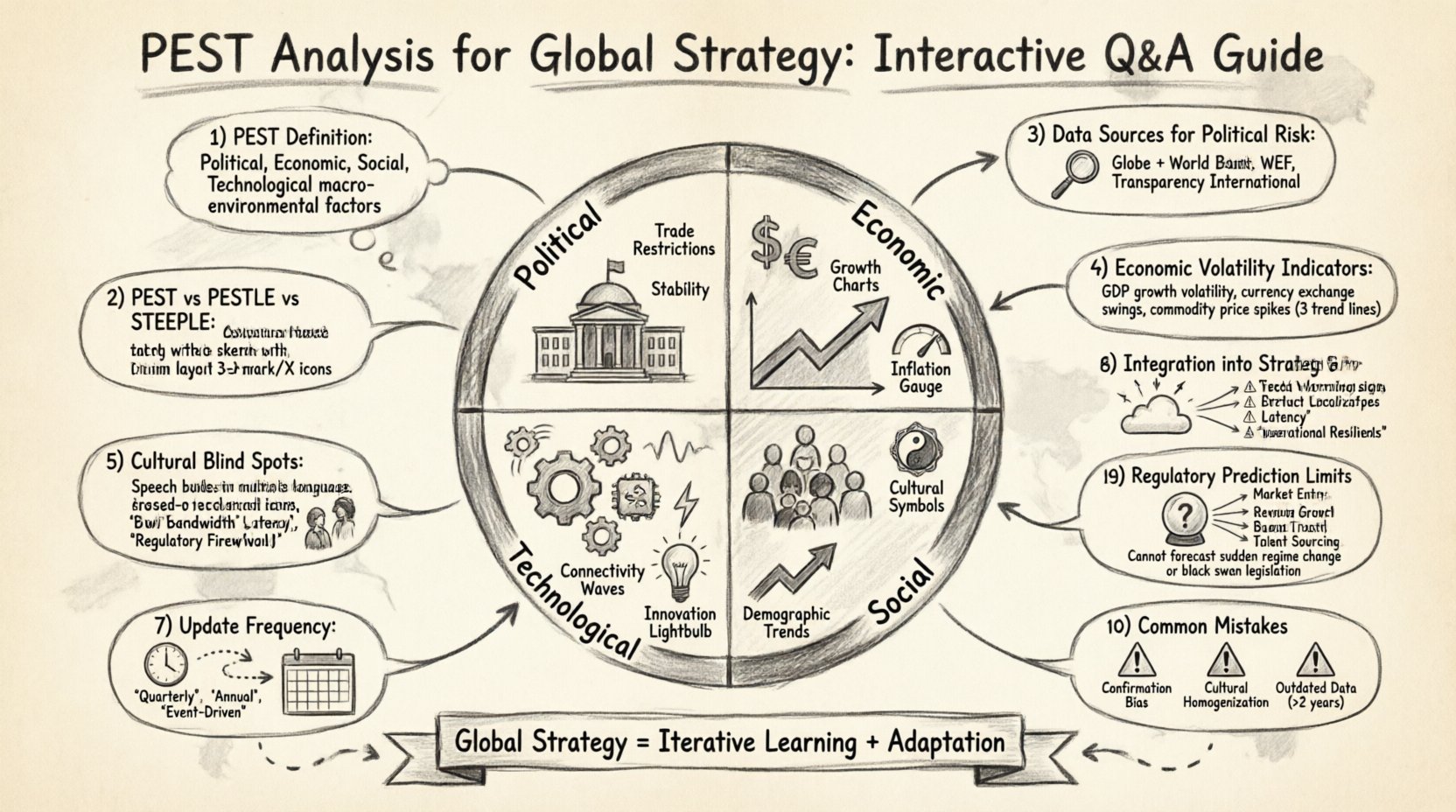
1. What exactly is PEST Analysis and why does it matter for global expansion? 🤔
PEST stands for Political, Economic, Social, and Technological. It is a strategic framework used to scan the external macro-environmental factors that impact an organization. When entering a global market, internal strengths are insufficient if external barriers are ignored.
- Political: Government policies, trade restrictions, tax laws, and stability.
- Economic: Growth rates, exchange rates, inflation, and interest rates.
- Social: Demographics, cultural norms, lifestyle trends, and population growth.
- Technological: R&D activity, automation, technological infrastructure, and innovation.
Understanding these elements allows leaders to anticipate risks before they materialize. It shifts the focus from reactive problem-solving to proactive strategic positioning. Without this visibility, companies often underestimate the friction involved in cross-border commerce.
2. How does PEST differ from PESTLE or STEEPLE? 📊
Frameworks evolve to capture more nuance. While PEST covers the foundational four, other variants add layers. The most common addition is Environmental and Legal, creating PESTLE. Another variant adds Ethical and Demographic to form STEEPLE.
For global strategy, distinguishing between these helps in scoping the analysis. Use the following table to compare their scopes:
| Framework | Components | Best Use Case |
|---|---|---|
| PEST | Political, Economic, Social, Technological | General market entry assessment |
| PESTLE | PEST + Legal, Environmental | Industries with heavy regulation or environmental impact |
| STEEPLE | PEST + Social, Technological, Economic, Environmental, Political, Legal, Ethical | Complex markets with high ethical or demographic scrutiny |
If your product involves hazardous materials, the Environmental factor in PESTLE becomes mandatory. If you are entering a market with strict labor laws, the Legal component cannot be ignored. PEST remains the baseline for general strategic alignment.
3. Where do I find reliable data for political factors in unstable regions? 🏛️
Political instability is a major risk in global expansion. Data reliability varies significantly depending on the region. Relying on a single source is insufficient. You must triangulate information from multiple channels.
- Government Reports: Department of State or Foreign Office travel advisories often contain political risk assessments.
- International Organizations: The World Bank and IMF publish stability indices and governance indicators.
- Local Partners: Engaging with local legal counsel or consultants provides ground-level insights.
- News Aggregators: Specialized feeds for geopolitical events help track real-time shifts.
Be cautious of outdated reports. Political landscapes can change overnight due to elections or civil unrest. Cross-reference historical data with current news cycles to build a comprehensive risk profile. Prioritize primary sources over secondary summaries when possible.
4. How do I assess economic volatility without getting lost in the numbers? 📉
Economic factors dictate purchasing power and cost structures. Volatility can erode margins quickly if not managed. The goal is to identify key indicators rather than analyzing every statistic available.
- Exchange Rate Fluctuation: Determine if the local currency is pegged or floating. Volatile currencies require hedging strategies.
- Inflation Rates: High inflation increases operational costs and reduces consumer spending power.
- GDP Growth: Indicates the overall health of the market and potential for growth.
- Interest Rates: Affect the cost of capital and borrowing for local expansion.
Focus on trends rather than single data points. A one-time spike in inflation may be manageable, but a sustained upward trend signals structural economic issues. Calculate the impact on your bottom line under different scenarios. This stress-testing ensures resilience against economic shocks.
5. What are the biggest social cultural blind spots to avoid? 🌐
Technology and products are not culturally neutral. Misinterpreting social norms can lead to brand failure. Social factors encompass demographics, cultural attitudes, and lifestyle trends.
- Language Nuances: Direct translation often fails. Marketing materials must be localized for tone and context.
- Consumer Behavior: Payment preferences vary (credit cards vs. cash vs. mobile wallets).
- Work Culture: Labor expectations and hierarchy structures differ significantly across nations.
- Religious Observances: Holidays and dietary restrictions impact sales cycles and product design.
Conduct deep ethnographic research. Observe how consumers interact with similar products in their daily lives. Avoid assuming that practices in your home market apply universally. Cultural intelligence is a prerequisite for successful global integration.
6. How can technology infrastructure gaps impact my launch timeline? 💻
Technological factors include the availability of hardware, internet connectivity, and digital literacy. If the infrastructure is weak, operational models relying on cloud computing or high-speed data may fail.
- Internet Penetration: Check the percentage of the population with reliable broadband access.
- Mobile Adoption: In some regions, mobile is the primary computing device.
- Logistics Tech: Track and trace capabilities may be limited in developing markets.
- Power Stability: Frequent outages affect server uptime and production schedules.
Adapt your technology stack to the local reality. If connectivity is poor, build offline-first capabilities. If mobile dominance exists, prioritize mobile optimization over desktop experiences. Infrastructure gaps can delay product launches significantly if not accounted for in the planning phase.
7. How often should I update a PEST analysis for dynamic markets? ⏳
A static analysis becomes obsolete quickly. The frequency of updates depends on the volatility of the market environment. There is no single rule, but regular intervals are necessary.
- Quarterly Reviews: Suitable for highly volatile markets or during periods of rapid change.
- Annual Deep Dives: Standard for stable markets where macro trends shift slowly.
- Event-Driven Updates: Triggered immediately by major political events or economic crises.
Integrate the analysis into your strategic planning cycle. Do not treat it as a one-time project. Assign ownership to a specific team or individual to ensure accountability for updates. Continuous monitoring prevents strategic drift and keeps the organization aligned with external realities.
8. What is the best way to integrate PEST findings into strategic planning? 🧩
Data collection is only half the battle. The insights must translate into actionable strategy. Findings should inform decision-making at every level of the organization.
- Risk Mitigation: Use political risks to define insurance or hedging requirements.
- Market Entry Mode: Economic data might suggest a joint venture over a wholly-owned subsidiary.
- Product Adaptation: Social insights dictate feature sets and pricing models.
- Investment Timing: Technological readiness influences the rollout schedule.
Present the analysis to stakeholders using clear visualizations. Connect each macro factor to a specific business outcome. This linkage ensures that the analysis is viewed as a tool for value creation rather than just an academic exercise.
9. Can PEST analysis predict regulatory changes accurately? 🔮
PEST analysis identifies current conditions and trends, but it is not a crystal ball. Predictive accuracy has limits, especially regarding sudden regulatory shifts.
- Trend Analysis: Helps anticipate long-term regulatory directions based on current laws.
- Scenario Planning: Allows preparation for multiple potential futures rather than one prediction.
- Stakeholder Engagement: Monitoring lobbying efforts and policy drafts provides early warnings.
Do not rely on PEST for certainty. Use it to understand probabilities and prepare contingency plans. Regulatory environments are often reactive to public sentiment or economic pressure. Maintain flexibility in your strategy to accommodate unexpected legal changes.
10. What are common mistakes teams make when analyzing global risks? ⚠️
Even experienced teams fall into traps when conducting macro-environmental analysis. Awareness of these pitfalls improves the quality of the output.
- Confirmation Bias: Seeking only data that supports a pre-existing decision.
- Homogenization: Treating a whole region as a single market instead of distinct countries.
- Outdated Data: Relying on reports that are older than six months.
- Internal Focus: Focusing too much on internal capabilities rather than external threats.
- Lack of Context: Analyzing data without understanding local historical or cultural context.
Encourage diverse perspectives within the analysis team. Include local market experts to challenge assumptions. Regularly audit the data sources used to ensure accuracy and relevance. This diligence minimizes the risk of strategic errors based on flawed premises.
Global strategy is an iterative process of learning and adaptation. The PEST framework provides the structure needed to navigate complexity. By answering these questions thoroughly, organizations build a foundation for sustainable growth across borders. The goal is not perfection, but informed preparedness.