
In the landscape of strategic planning, understanding the external environment is not merely a step; it is a necessity for survival and growth. Organizations that rely solely on internal metrics often miss the shifts happening just beyond their immediate view. This is where the PEST analysis framework becomes an essential tool. By examining Political, Economic, Social, and Technological factors, businesses can map the terrain before moving forward.
This guide explores how to utilize this framework effectively. It focuses on actionable insights rather than theoretical abstractions. We will break down each component, discuss how they intersect, and provide a structured approach to integrating these findings into your strategy.
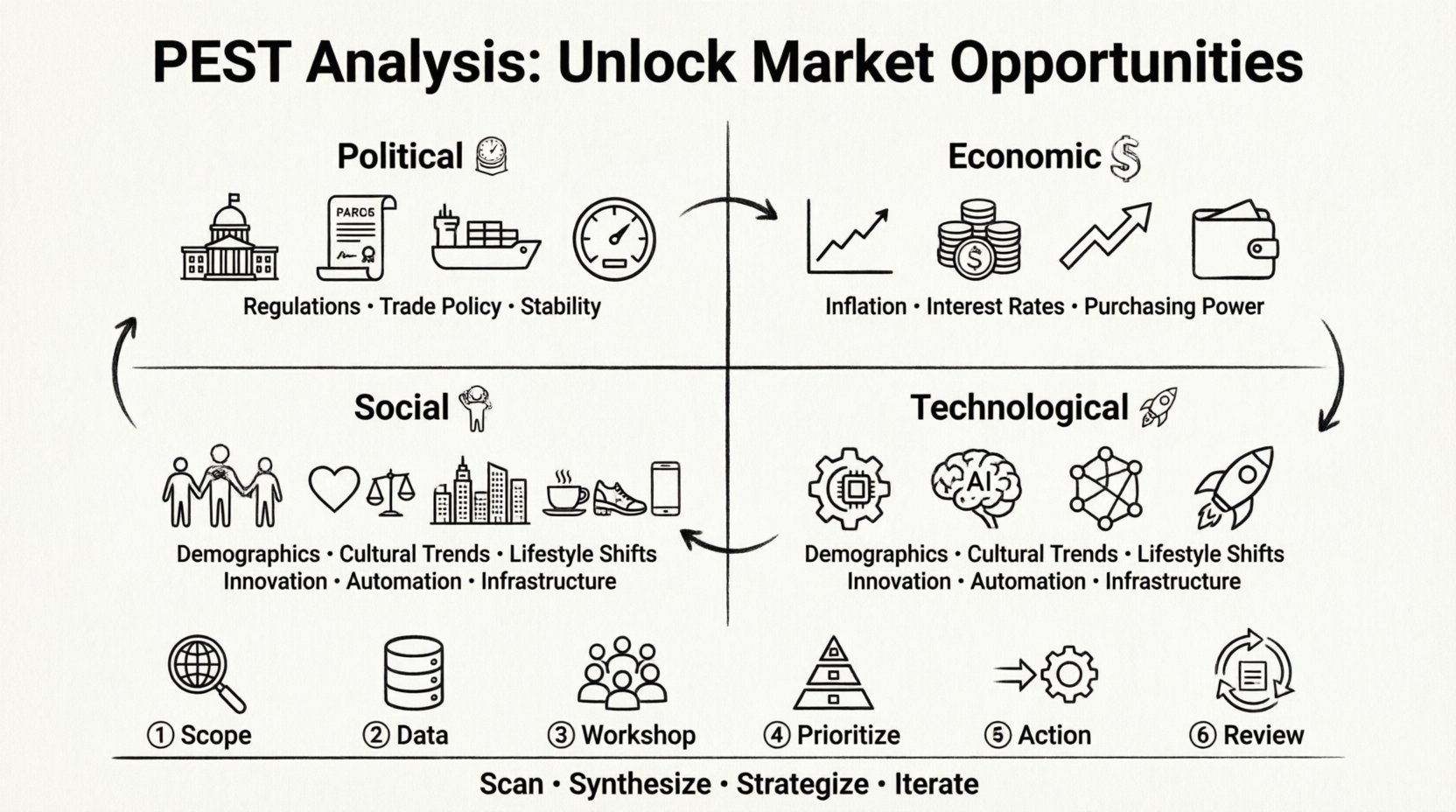
Understanding the Core Framework 🔍
PEST stands for Political, Economic, Social, and Technological. Originally developed to help organizations scan the macro-environment, it remains a cornerstone of market research. The goal is not just to list factors, but to understand the causal relationships between them and your specific industry.
- Political: Government actions, trade policies, tax regimes, and political stability.
- Economic: Interest rates, inflation, exchange rates, and economic growth rates.
- Social: Demographics, cultural trends, lifestyle changes, and health consciousness.
- Technological: Innovation rates, automation, R&D activity, and technology incentives.
When applied correctly, this framework moves beyond simple observation. It transforms data into intelligence. Below is a table summarizing the key drivers within each category.
| Category | Key Focus Areas | Strategic Question |
|---|---|---|
| Political | Regulations, Stability, Trade Barriers | How will government policy shift our costs or access? |
| Economic | Inflation, Growth, Disposable Income | Can customers afford our offering in the current climate? |
| Social | Demographics, Values, Habits | Does our product fit the changing lifestyle of the consumer? |
| Technological | Innovation, Infrastructure, Adoption | Are emerging technologies making our current solution obsolete? |
Political Factors: Navigating Regulation and Stability 🏛️
Political factors often dictate the rules of the game. These are external forces that a company cannot control but must adapt to. Ignoring this quadrant can lead to compliance failures or sudden market exits.
Regulatory Changes
Government regulations can alter cost structures overnight. Environmental laws, labor standards, and data privacy rules are common examples. When conducting an analysis, look for proposed legislation that is currently in draft stages. Early awareness allows for proactive adaptation rather than reactive scrambling.
- Tax Policy: Changes in corporate tax rates directly impact net income and pricing strategies.
- Trade Agreements: Tariffs and free trade zones affect supply chain logistics and sourcing decisions.
- Subsidies: Government support for specific industries can create artificial advantages or new market entrants.
Political Stability
Investment decisions rely heavily on the predictability of the political environment. Regions with high instability present higher risks for long-term projects. Conversely, stable environments may offer consistent demand growth. Consider the following when evaluating stability:
- Frequency of leadership changes.
- History of civil unrest or strikes.
- Corruption indices and bureaucratic efficiency.
By mapping these elements, you can identify regions where expansion is safe and markets where risk mitigation is required.
Economic Factors: The Pulse of Purchasing Power 💰
Economic conditions determine the financial health of your potential customer base. Even the best product fails if the market lacks the purchasing power to sustain it. This section requires a macroeconomic view combined with microeconomic insights.
Interest Rates and Inflation
Central bank decisions on interest rates influence borrowing costs for both businesses and consumers. High interest rates typically dampen consumer spending on discretionary items. Inflation erodes purchasing power, forcing customers to prioritize essentials.
- Borrowing Costs: High rates increase the cost of capital for your business and your clients.
- Cost of Goods: Inflation increases operational costs, potentially squeezing margins.
- Savings Rates: High rates encourage saving over spending, impacting sales volume.
Disposable Income and Employment
Employment rates are a leading indicator of economic health. High employment usually correlates with higher disposable income. However, the quality of employment matters. Gig economy growth changes how people budget for services.
When analyzing this quadrant, ask:
- What is the current trend in household savings rates?
- Are wages keeping pace with inflation in your target demographic?
- How does the exchange rate impact your supply chain costs?
Economic downturns often reveal opportunities in the value sector. Customers may trade down to cheaper alternatives, or demand for essential services may remain resilient. Identifying these shifts allows for pivot strategies.
Social Factors: Decoding Human Behavior 🧍
Social forces shape the demand for products and services. These factors are often the most subtle but can be the most disruptive. Cultural shifts happen slowly but create massive long-term trends.
Demographics and Ageing Populations
Population structure dictates market size and type. An ageing population creates demand for healthcare, leisure, and financial planning. A younger population drives demand for education, technology, and entertainment.
- Urbanization: Moving to cities changes lifestyle needs, transportation, and housing.
- Household Size: Smaller households require different product packaging and service models.
- Migration Patterns: Influx of diverse populations introduces new cultural preferences.
Cultural Values and Lifestyle
Shifts in values can render products irrelevant. For instance, the growing emphasis on sustainability has forced industries to rethink materials and sourcing. Health consciousness has shifted food and fitness markets.
Key areas to monitor include:
- Attitudes toward work-life balance and remote work.
- Consumer preference for ethical sourcing and transparency.
- Changes in dietary habits and wellness trends.
Understanding these nuances helps in positioning messaging correctly. A product that succeeds in one culture may fail in another if social norms are not respected.
Technological Factors: The Speed of Innovation 🚀
Technology is often the most volatile factor in the PEST framework. It can disrupt entire industries in a matter of years. Ignoring technological trends is a direct path to obsolescence.
Innovation and R&D
Monitor the research and development activity within your sector and adjacent industries. What is being patented? What technologies are moving from lab to market?
- Automation: Automation reduces labor costs but may displace specific job roles.
- AI and Data: Artificial intelligence offers new ways to analyze customer behavior and optimize operations.
- Connectivity: Improved internet infrastructure enables new business models like cloud services.
Infrastructure and Adoption
Technology only works if the infrastructure supports it. The availability of high-speed internet, 5G networks, or charging stations for electric vehicles dictates market readiness.
Consider the following:
- What is the cost of technology adoption for the customer?
- Is the technology reliable and secure?
- Are there legal barriers to technology implementation (e.g., data sovereignty)?
Technological factors also include the lifecycle of current solutions. If a key technology is nearing the end of its lifecycle, a transition period exists where new opportunities arise for innovators.
Integrating Findings into Strategic Planning 📊
Gathering data is only the first step. The value lies in synthesis. You must connect the dots between the four quadrants to see the full picture.
Cross-Analysis Techniques
Factors rarely exist in isolation. A technological shift often triggers a social change, which then influences economic behavior.
- Scenario Planning: Create multiple future scenarios based on different combinations of PEST factors. How does the market look if interest rates rise AND technology adoption slows?
- Impact Matrix: Rate each factor by its potential impact and likelihood. Focus resources on high-impact, high-likelihood factors.
- SWOT Alignment: Translate PEST findings into Strengths, Weaknesses, Opportunities, and Threats. External PEST data feeds directly into Opportunities and Threats.
Identifying Market Gaps
Opportunities often hide in the gaps between current offerings and external pressures. For example, if social trends show a demand for privacy but regulations are tightening, there is an opportunity for secure communication tools.
Look for:
- Unmet needs caused by regulatory changes.
- Service improvements enabled by new technology.
- New customer segments created by demographic shifts.
Common Pitfalls to Avoid ⚠️
Even with a robust framework, analysis can go wrong. Common mistakes can lead to flawed strategies and wasted resources.
- Data Overload: Collecting too much information without filtering for relevance. Focus on factors that directly impact your specific business model.
- Recency Bias: Giving too much weight to recent news while ignoring long-term trends. Economic cycles and demographic shifts take years to play out.
- Internal Bias: Interpreting external data to fit a pre-existing strategy. Be willing to change course if the data suggests it.
- Static Analysis: Treating the PEST analysis as a one-time event. The environment changes continuously, requiring regular updates.
Implementation Steps for Teams 🛠️
To ensure the analysis is actionable, follow a structured implementation process.
- Define Scope: Determine the geographic and industry boundaries. A global analysis differs significantly from a local one.
- Gather Data: Collect information from credible sources, such as government reports, industry journals, and economic forecasts.
- Workshop Sessions: Bring together cross-functional teams to interpret the data. Different departments see different impacts.
- Prioritize: Select the top three to five factors that will most influence the next 12 to 24 months.
- Action Planning: Develop specific initiatives to address the identified opportunities and threats.
- Review Cycle: Schedule quarterly reviews to update the analysis based on new data.
Case Study Application 📝
Consider a retail business expanding into a new region. A PEST analysis might reveal the following:
- Political: New import tariffs increase costs for foreign goods.
- Economic: Local currency devaluation reduces purchasing power.
- Social: High demand for locally sourced products.
- Technological: Rapid adoption of mobile payment systems.
The strategic response involves sourcing locally to mitigate tariffs and social pressure, adjusting pricing for the economic climate, and integrating mobile payment options to match technological adoption. This holistic view prevents reactive decisions and supports sustainable growth.
Measuring Success and Iteration 📈
How do you know the analysis was effective? Success is measured by the accuracy of predictions and the agility of the response.
- Market Share Growth: Did the strategy help capture new segments?
- Risk Mitigation: Did the company avoid costly regulatory fines or supply chain disruptions?
- Speed to Market: Did the team launch new products faster by anticipating trends?
Continuous improvement is key. Refine your data sources and update your frequency of analysis. The market environment is dynamic, and your tools must be equally dynamic.
Final Thoughts on Environmental Scanning 🌍
Strategic planning is not a static document but a living process. The PEST analysis provides the lens through which you view the world. By rigorously examining Political, Economic, Social, and Technological factors, you gain clarity on where the market is heading.
It empowers leadership to make decisions based on evidence rather than intuition. It highlights risks before they become crises and identifies opportunities before competitors spot them. The discipline of regular scanning ensures that your organization remains resilient and responsive.
Remember, the goal is not to predict the future with certainty, but to prepare for multiple futures. This preparation creates a competitive advantage that is difficult to replicate. Start your analysis today, and build a foundation for long-term success.