
Strategic planning is the backbone of organizational growth, yet it often falters due to flawed foundational analysis. The PEST analysis framework—examining Political, Economic, Social, and Technological factors—is a standard tool for understanding the external business environment. However, even seasoned strategists frequently stumble when applying this methodology. A single oversight in data collection or interpretation can derail a project before it begins.
This guide identifies ten critical errors that compromise the integrity of your analysis. We will explore the mechanics of each mistake, its impact on decision-making, and actionable steps to troubleshoot these issues before you present your findings. Accuracy here determines whether your strategy stands on solid ground or crumbles under scrutiny.
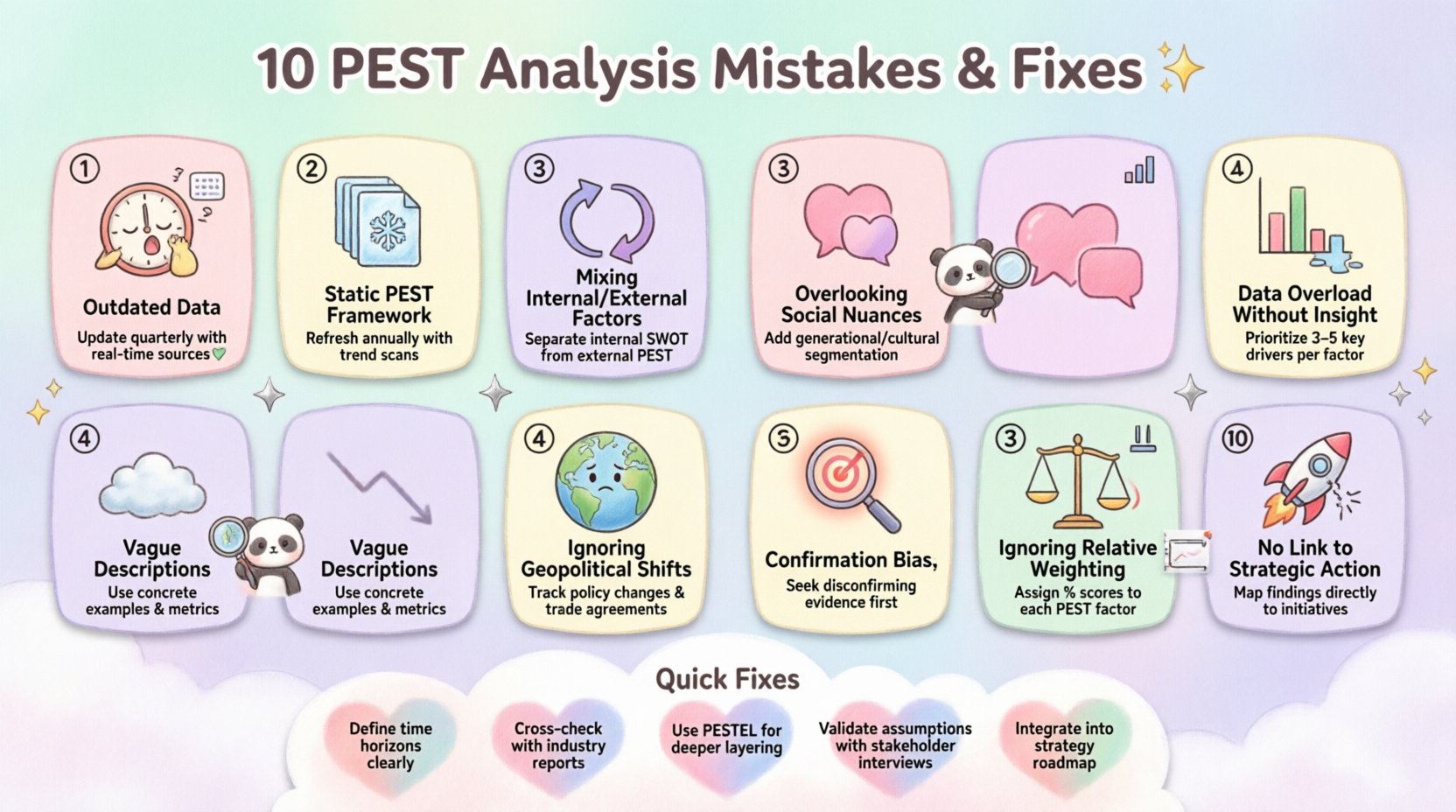
1. Relying on Outdated Data 📅
The business landscape shifts rapidly. Information that was relevant six months ago may be obsolete today. Using stale data leads to recommendations that ignore current market realities.
- The Error: Quoting economic figures or political regulations from previous fiscal years without verification.
- The Consequence: Stakeholders lose confidence in the analysis when they spot discrepancies with current news.
- The Fix: Establish a rigorous data validation protocol. Cross-reference primary sources, such as government publications and industry reports, to ensure currency.
Always check the publication date of every source. If a report is older than twelve months, treat it as historical context, not current fact. For economic indicators, look for the latest quarterly releases. For political shifts, monitor legislative trackers. Verification is not a one-time task; it is a continuous process.
2. Treating PEST as a Static List 🧊
A PEST analysis is often treated as a checklist to be completed once and filed away. This approach ignores the dynamic nature of external factors.
- The Error: Creating a static document that does not reflect ongoing changes.
- The Consequence: The strategy becomes rigid and unable to adapt to sudden market shocks.
- The Fix: Design the analysis as a living document. Schedule periodic reviews (quarterly or bi-annually) to update factors.
External environments are fluid. A political election, a new trade agreement, or a technological breakthrough can alter the playing field overnight. By treating the analysis as a snapshot, you miss the trajectory. Instead, focus on trends and momentum. Ask: Is this factor growing, shrinking, or stabilizing? This temporal dimension adds depth to your strategic view.
3. Confusing Internal and External Factors 🔄
Confusion between what the organization controls and what it cannot control is a fundamental flaw. PEST focuses strictly on the external macro-environment.
- The Error: Including operational strengths, weaknesses, or internal resources within the PEST categories.
- The Consequence: Dilutes the focus of the analysis and muddies the strategic narrative.
- The Fix: Strictly segregate internal capabilities (SWOT) from external forces (PEST). Use separate frameworks for each.
When you mix internal competencies with external threats, you lose clarity on where to apply effort. If a factor is within your control, it belongs in an internal audit. If it is outside your control, it belongs in the PEST framework. Clear boundaries ensure that your strategic responses are targeted correctly. For example, a change in tax law is external (Political), but how you adjust your pricing strategy is internal.
4. Lack of Specificity and Vagueness 📉
General statements like “Economy is growing” or “Technology is advancing” provide no actionable intelligence. Strategy requires precision.
- The Error: Using broad, non-quantifiable descriptors without supporting evidence.
- The Consequence: Decision-makers cannot prioritize actions based on vague insights.
- The Fix: Quantify every claim. Use percentages, growth rates, and specific regulatory names.
Instead of saying “Social trends are changing,” specify that “Millennial spending habits have shifted 15% toward sustainable goods.” Instead of “Technology is advancing,” note that “5G adoption rates have reached 40% in key urban centers.” Specificity allows for risk assessment. You can measure the impact of a 5% tax increase, but you cannot measure a “change in economy.” Precision builds credibility.
5. Ignoring Geopolitical Shifts 🌍
Global interconnectedness means local strategies often have international ripple effects. Focusing solely on domestic politics misses the bigger picture.
- The Error: Limiting the “Political” section to local or national legislation.
- The Consequence: Supply chain disruptions or trade sanctions are overlooked.
- The Fix: Expand the scope to include international relations, trade tariffs, and geopolitical stability.
Supply chains rarely stay within borders. A trade war between two major economies can raise costs for a local manufacturer. Political instability in a resource-rich region can halt production. You must map the dependencies of your supply chain against global political landscapes. This broader view prevents blind spots regarding logistics and cost structures.
6. Overlooking Social Nuances 🗣️
The “S” in PEST represents Social factors, but this is often reduced to demographics. It requires a deeper dive into cultural shifts and consumer behavior.
- The Error: Focusing only on population density and age brackets.
- The Consequence: Missing cultural movements that drive demand or rejection of products.
- The Fix: Analyze lifestyle trends, values, and sentiment analysis from social channels.
Demographics tell you who the customer is; sociology tells you what they want. Consider work-life balance trends, health consciousness, or ethical consumption. If a society values privacy more highly, a data-heavy product strategy might fail. If remote work becomes cultural, real estate strategies must adapt. Social factors are the heartbeat of market demand. Ignoring them leads to products that miss the cultural moment.
7. Data Overload Without Insight 📊
Collecting every possible data point creates noise, not signal. Analysis is about synthesis, not just aggregation.
- The Error: Dumping large volumes of statistics without filtering for relevance.
- The Consequence: Stakeholders become overwhelmed and miss the critical takeaways.
- The Fix: Apply a relevance filter. Only include factors that directly impact the business objective.
Not all economic indicators matter to every industry. Interest rates might be crucial for a bank, but less relevant for a software startup. Curate your data. For every data point included, ask: “So what?” If the answer does not lead to a strategic implication, remove it. Insight comes from connecting the dots, not counting them. Present only the data that drives the narrative forward.
8. Confirmation Bias in Interpretation 🎯
Analysts often subconsciously seek data that supports a preconceived conclusion. This undermines the objectivity of the framework.
- The Error: Selecting only positive indicators or ignoring negative trends that contradict the desired outcome.
- The Consequence: Strategic plans are built on false optimism, leading to failure upon execution.
- The Fix: Implement a peer review process. Have a colleague challenge the findings and seek contradictory data.
It is human nature to want a successful strategy. However, a robust analysis must acknowledge threats. If you know you want to launch a product, do not ignore regulatory hurdles that could block it. Actively search for disconfirming evidence. If the data suggests a headwind, analyze it. This honesty strengthens the final recommendation and prepares the team for challenges.
9. Neglecting Weighting of Factors ⚖️
Not all external factors carry the same level of impact. Treating every point equally dilutes the strategic focus.
- The Error: Listing all factors with equal importance regardless of their potential impact.
- The Consequence: Resources are spread too thin across low-impact issues.
- The Fix: Assign a weight or priority score to each factor based on probability and impact.
Use a matrix to score factors. High Impact/High Probability factors demand immediate attention. Low Impact/Low Probability factors can be monitored. This prioritization ensures that leadership resources are allocated to the areas that truly move the needle. It turns a list of observations into a prioritized action plan.
10. No Link to Actionable Strategy 🚀
An analysis that ends with a list of observations without strategic output is useless. PEST is a tool for planning, not just reporting.
- The Error: Presenting the analysis without connecting it to specific strategic moves.
- The Consequence: The report is shelved without influencing decision-making.
- The Fix: Conclude with specific strategic implications. What do we do differently because of this data?
For every Political factor, identify a compliance strategy. For every Technological factor, identify an investment or innovation path. The output must be actionable. If a new regulation is found, the strategy should include a compliance roadmap. If a technology is emerging, the strategy should include an R&D pilot. Close the loop between insight and execution.
Quick Reference: Common Pitfalls vs. Corrective Actions
| Mistake Category | Typical Symptom | Corrective Action |
|---|---|---|
| Data Currency | Outdated statistics | Verify publication dates; use latest quarterly reports |
| Scope | Mixing internal/external | Segregate PEST from SWOT analysis |
| Depth | Vague generalizations | Quantify trends; use specific examples |
| Relevance | Data overload | Filter for direct business impact |
| Objectivity | Confirmation bias | Peer review; seek contradictory evidence |
Ensuring Strategic Rigor
Conducting a PEST analysis is not merely an administrative task; it is a critical exercise in risk management and opportunity identification. The value lies in the rigor applied to the process. By avoiding these ten common pitfalls, you ensure that your strategic planning is grounded in reality rather than assumption.
Before pitching your findings, run a final audit. Does the data reflect the current moment? Are the distinctions between internal and external clear? Have you prioritized the factors that matter most? These questions serve as a checkpoint for quality assurance.
Strategic success depends on the quality of the intelligence driving it. A flawed analysis leads to flawed execution. By troubleshooting these errors, you transform the PEST framework from a generic template into a powerful tool for navigating complex business environments. This preparation builds the trust of your stakeholders and sets the stage for effective implementation.
Remember, the goal is not just to complete the analysis, but to derive clarity. When you strip away the noise and focus on high-impact, verified external factors, your strategic recommendations become robust. This level of detail distinguishes a standard report from a decisive strategic asset.
Keep the analysis dynamic. Update it as the environment changes. Stay vigilant against bias. And always connect the dots back to actionable business outcomes. With these practices in place, your strategic planning will be resilient, informed, and ready for the challenges ahead.