


Expanding a business beyond domestic borders introduces a complex web of variables that can make or break an international venture. While financial models and market research provide the numbers, understanding the environment is where strategy lives. PEST Analysis offers a structured framework to evaluate the external macro-environmental factors influencing a business. When applied to multi-country entry strategies, it becomes an essential tool for risk mitigation and opportunity identification.
This guide details how to utilize PEST Analysis effectively. It moves beyond basic definitions to practical application across diverse regulatory and cultural landscapes. The goal is to equip decision-makers with a clear method for assessing viability before committing resources.
Why PEST Analysis Matters for Cross-Border Growth 📈
Domestic operations often rely on familiar infrastructure and predictable regulations. International expansion disrupts this comfort zone. A strategy that works in one jurisdiction may fail in another due to subtle shifts in law, currency, or consumer behavior. PEST Analysis provides a standardized lens to examine these differences systematically.
- Standardization: It creates a consistent evaluation process across target markets.
- Risk Identification: It highlights external threats before they become operational crises.
- Resource Allocation: It helps prioritize markets based on environmental fit rather than just revenue potential.
- Strategic Alignment: It ensures internal capabilities match external realities.
Without this framework, organizations risk entering markets where political instability, economic volatility, or cultural mismatches render the business model unsustainable. The analysis forces a pause for critical thinking, moving the conversation from “can we sell here?” to “should we sell here?”.
Political Factors: Navigating Stability and Regulation 🏛️
Political factors encompass the influence of government policy, trade restrictions, and the stability of the political system. In a multi-country context, these elements vary drastically.
Political Stability and Risk
Investors need to assess the likelihood of regime change, civil unrest, or policy volatility. A stable government suggests consistent enforcement of laws, whereas instability introduces unpredictability.
- Regime Change: How quickly do policies shift when leadership changes?
- Corruption Levels: Does the business face bribery risks or opaque bureaucracy?
- Geopolitical Tensions: Are there trade wars or sanctions affecting the region?
Trade and Tax Policies
Tariffs and import/export regulations directly impact cost structures. Free trade agreements can lower barriers, while protectionist policies can raise them.
| Factor | Impact on Entry | Example Scenario |
|---|---|---|
| Tariffs | Increases cost of goods | Steel tariffs affecting manufacturing costs |
| Tax Incentives | Reduces operational overhead | Tech hub grants in specific regions |
| Local Content Laws | Mandates local hiring/sourcing | Oil sectors requiring local partners |
Labor and Employment Laws
Political will often manifests in labor legislation. Some countries enforce strict unionization, while others prioritize flexible labor markets. Understanding the legal framework for hiring, firing, and benefits is critical.
- Minimum Wage Laws: Compliance costs vary significantly.
- Work Hours: Mandated breaks and maximum hours affect productivity.
- Termination Rules: Severance pay requirements can be substantial.
Economic Factors: Assessing Financial Viability 💰
Economic indicators determine the purchasing power and financial health of a target market. This section requires deep diving into macroeconomic data to forecast demand.
Gross Domestic Product (GDP) and Growth
GDP indicates the size of the economy, while growth rates suggest future potential. A shrinking economy may signal recession, while high growth might indicate saturation risks or opportunity.
- GDP per Capita: Measures average wealth and spending power.
- Growth Rate: Indicates the pace of market expansion.
- Stability: Consistent growth is preferred over volatile spikes.
Exchange Rates and Inflation
Currency fluctuation impacts profitability when repatriating earnings. High inflation erodes consumer purchasing power and increases input costs.
- Currency Volatility: Can hedge strategies mitigate risk?
- Inflation Rate: Does it outpace wage growth?
- Interest Rates: High rates increase borrowing costs for expansion.
Cost of Labor and Infrastructure
Even with low wages, infrastructure quality affects efficiency. Poor logistics, energy instability, or lack of reliable internet can negate labor cost advantages.
- Logistics Networks: Port efficiency and road quality.
- Energy Reliability: Frequency of power outages.
- Real Estate Costs: Commercial rent in key business districts.
Social Factors: Understanding Culture and Demographics 👥
Social factors analyze the demographic and cultural aspects of the target market. A product that succeeds in one culture may fail in another due to values, lifestyle, or language barriers.
Demographic Trends
Population structure dictates demand. An aging population requires different products than a youth-heavy demographic.
- Age Distribution: Median age and dependency ratios.
- Population Growth: Future market size potential.
- Urbanization: Concentration of consumers in cities.
Cultural Norms and Values
Language, religion, and social etiquette influence marketing and sales. Missteps here can lead to brand damage.
- Language: Localization costs and translation needs.
- Religious Observances: Holidays and dietary restrictions.
- Business Etiquette: Negotiation styles and hierarchy.
Consumer Behavior
How people buy differs globally. Some markets prefer cash, others rely on digital wallets. Brand loyalty and price sensitivity vary.
- Purchasing Power: Disposable income levels.
- Shopping Habits: Online vs. brick-and-mortar preference.
- Social Responsibility: Demand for ethical sourcing and sustainability.
Technological Factors: Infrastructure and Innovation 📡
Technological factors cover the innovation environment, infrastructure, and the rate of technological change. This is often the most dynamic category in modern expansion.
Infrastructure Quality
Technology relies on physical and digital infrastructure. Without reliable internet or hardware, digital business models fail.
- Internet Penetration: Percentage of the population online.
- Mobile Connectivity: Smartphone adoption rates.
- Payment Systems: Availability of digital banking or cards.
Regulatory Environment for Tech
Data privacy laws, intellectual property rights, and cybersecurity regulations vary widely.
- Data Privacy: Compliance with local data sovereignty laws.
- IP Protection: Enforcement of patents and trademarks.
- Content Restrictions: Censorship or blocked platforms.
Innovation and Adoption Rates
Is the market ready for new technology? Early adopters differ from late majority users.
- Speed of Adoption: How quickly do users accept new tools?
- Competitive Tech Landscape: Presence of local tech giants.
- Support Ecosystem: Availability of developers and IT support.
Integrating PEST with Other Strategic Tools 🔗
While PEST Analysis provides a macro view, it works best when combined with other frameworks. This creates a holistic strategy.
- SWOT Analysis: Use PEST findings to inform Strengths, Weaknesses, Opportunities, and Threats.
- Porter’s Five Forces: Combine macro factors with industry competition analysis.
- Market Segmentation: Use social data to define target customer profiles.
For example, a high inflation rate (Economic) might reduce demand (SWOT Threat), requiring a shift in pricing strategy (Porter’s Five Forces).
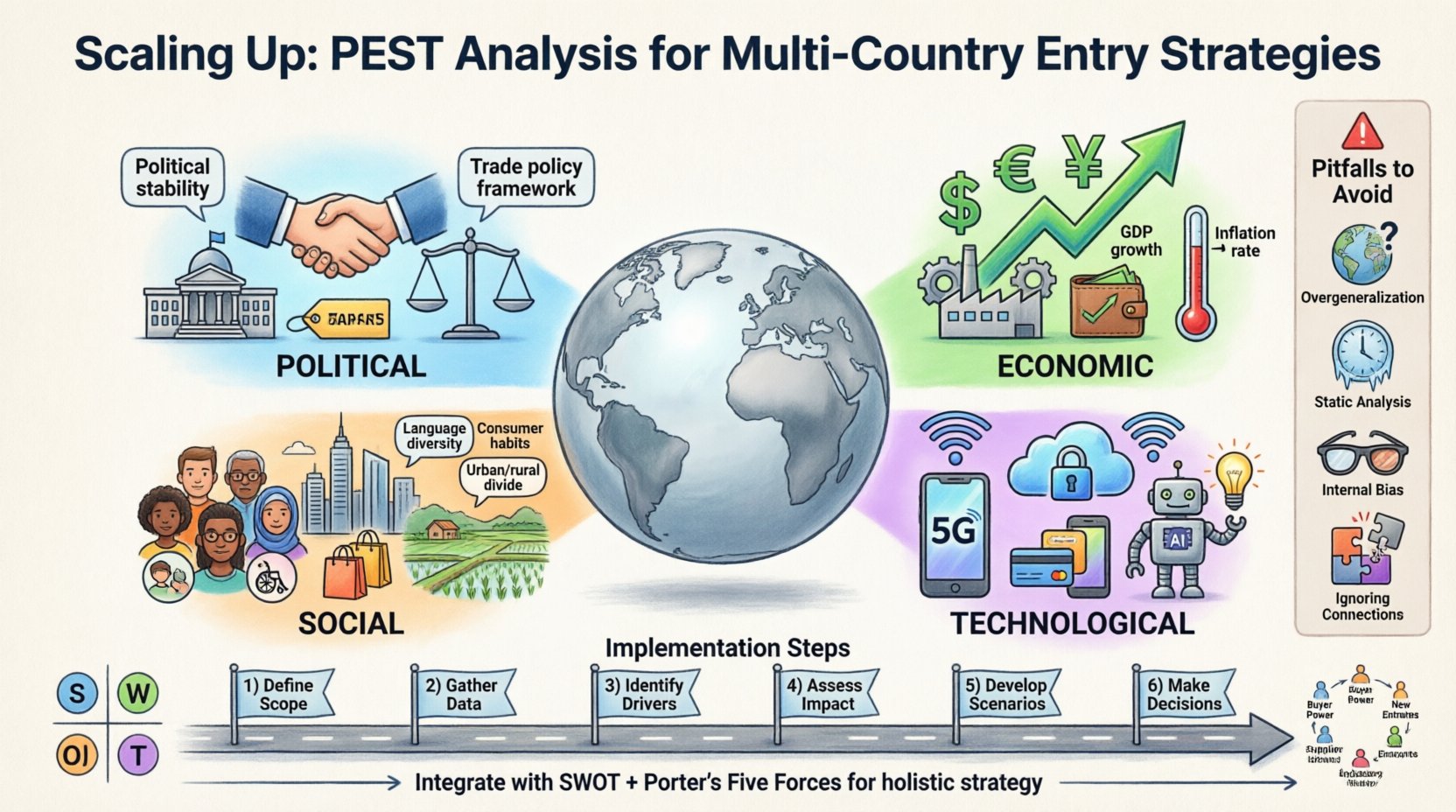
Step-by-Step Implementation Guide 🛠️
Executing a PEST Analysis requires discipline and data gathering. Follow this structured approach to ensure accuracy.
- Define the Scope: Identify the specific country or region. Broad analysis dilutes insights.
- Gather Data: Collect reports from government bodies, international organizations, and local industry associations.
- Identify Key Drivers: Pinpoint the top three factors for each PEST category that impact your specific industry.
- Assess Impact: Rate each factor on a scale of influence (High, Medium, Low).
- Develop Scenarios: Create best-case, worst-case, and most-likely scenarios based on the factors.
- Make Decisions: Use the findings to approve, delay, or abandon market entry.
Common Pitfalls to Avoid ⚠️
Even experienced teams make mistakes during this analysis. Awareness of these traps improves outcomes.
- Overgeneralization: Assuming a country is a monolith. Brazil varies significantly from Argentina. Regional differences matter.
- Static Analysis: Treating data as fixed. Economic conditions change monthly. The analysis must be updated regularly.
- Internal Bias: Focusing only on factors that confirm the desire to enter. Seek disconfirming evidence.
- Ignoring Interconnectivity: Political decisions often drive economic changes. Analyze the relationships between factors.
Real-World Application Examples 🌐
Consider a retail company entering Southeast Asia. Political stability in the region is generally high, but labor laws differ between Thailand and Vietnam. Economic growth is strong, but currency volatility in Indonesia requires hedging. Socially, the population is young and mobile-first, favoring digital marketing. Technologically, logistics infrastructure is improving but remains a bottleneck in rural areas.
Conversely, a tech firm entering a European market faces strict GDPR regulations (Technological/Political). High labor costs (Economic) require automation. Socially, privacy concerns are high (Social). The PEST Analysis highlights that while the market is wealthy, compliance costs are the primary barrier.
Final Thoughts on Strategic Expansion 🚀
Multi-country entry is a high-stakes endeavor. PEST Analysis does not guarantee success, but it significantly reduces the probability of failure by illuminating hidden risks. It transforms vague concerns into actionable data points.
By rigorously applying this framework, organizations can build entry strategies that are resilient to external shocks. The focus remains on long-term sustainability rather than quick wins. Continuous monitoring ensures that as the environment shifts, the strategy evolves accordingly.
Use this tool to validate assumptions. Let the data guide the investment. In international business, preparation is the only true competitive advantage.