
Strategic planning forms the backbone of modern business management. For MBA students and emerging leaders, understanding the tools used to assess business environments is not optional; it is essential. Two frameworks dominate this landscape: PEST Analysis and SWOT Analysis. While often used interchangeably by novices, these tools serve distinct purposes and require different approaches to execution.
This guide provides a rigorous examination of both methodologies. We will explore their structural differences, application contexts, and the specific pitfalls that frequently undermine student projects. By understanding the mechanics behind each framework, you can apply them with precision and authority.
Understanding PEST Analysis 🌍
PEST Analysis is an external strategic tool used to evaluate the macro-environmental factors influencing an organization. It stands for Political, Economic, Social, and Technological. The primary objective is to scan the horizon for external forces that create opportunities or pose threats. Unlike internal assessments, PEST looks outward, beyond the organization’s direct control.
1. Political Factors 🏛️
Political factors involve the extent to which a government intervenes in the economy. This includes tax policy, labour laws, trade restrictions, and political stability. For a multinational corporation, changes in trade tariffs can alter profit margins overnight. For a local startup, zoning laws might dictate operational feasibility.
- Regulatory Compliance: Are there pending regulations that could increase costs?
- Stability: Is the political environment stable, or is there a risk of upheaval?
- Subsidies: Does the government offer financial support for specific industries?
2. Economic Factors 📈
Economic factors determine the purchasing power of potential customers and the firm’s cost of capital. These are often cyclical. Inflation rates, exchange rates, and economic growth are critical indicators.
- Inflation: High inflation erodes consumer purchasing power and increases input costs.
- Interest Rates: High rates increase the cost of borrowing for expansion.
- Disposable Income: How much money does the target demographic have available for spending?
3. Social Factors 👥
These factors relate to the socio-cultural environment. They include population growth, age distribution, health consciousness, and cultural barriers. Understanding the target market’s values is vital for product positioning.
- Demographics: An aging population may increase demand for healthcare services.
- Lifestyle Changes: Shifts towards remote work impact real estate and technology sectors.
- Cultural Norms: What is considered acceptable behavior in the market?
4. Technological Factors 🚀
Technological factors concern innovation and research and development. This includes the rate of technological change, automation, and the impact of digitalization on business models.
- Automation: Will AI replace current workforce roles?
- Infrastructure: Is the digital infrastructure robust enough to support operations?
- R&D Activity: Is the industry stagnant or rapidly evolving?
Understanding SWOT Analysis 🔄
SWOT Analysis stands for Strengths, Weaknesses, Opportunities, and Threats. It is a hybrid framework that combines internal and external assessments. While the first two components (Strengths and Weaknesses) look inward, the latter two (Opportunities and Threats) mirror the external focus of PEST.
1. Strengths (Internal) 💪
Strengths are attributes of the organization that are helpful to achieving the objective. These are resources and capabilities under management’s control.
- Brand Reputation: Do customers trust the company name?
- Patents: Does the firm hold exclusive rights to technology?
- Financial Health: Is there strong cash flow to fund growth?
2. Weaknesses (Internal) 📉
Weaknesses are attributes that place the organization at a disadvantage relative to others. These are areas where the organization lacks resources or capabilities.
- Limited Budget: Inability to compete on marketing spend.
- Outdated Technology: Legacy systems slowing down production.
- Staff Turnover: High churn rates affecting institutional knowledge.
3. Opportunities (External) 🎯
Opportunities are elements in the external environment that the organization could exploit to its advantage. These often align with the Opportunities found in PEST.
- New Markets: Entering a developing region.
- Competitor Failure: A rival firm exiting the market.
- Regulatory Changes: New laws that favor your specific business model.
4. Threats (External) ⚠️
Threats are elements in the external environment that could cause trouble for the business. These are risks that management cannot directly control.
- New Competitors: Disruptors entering the space.
- Economic Downturns: Recession reducing demand.
- Supply Chain Disruption: Reliance on unstable vendors.
Direct Comparison: PEST vs. SWOT 📊
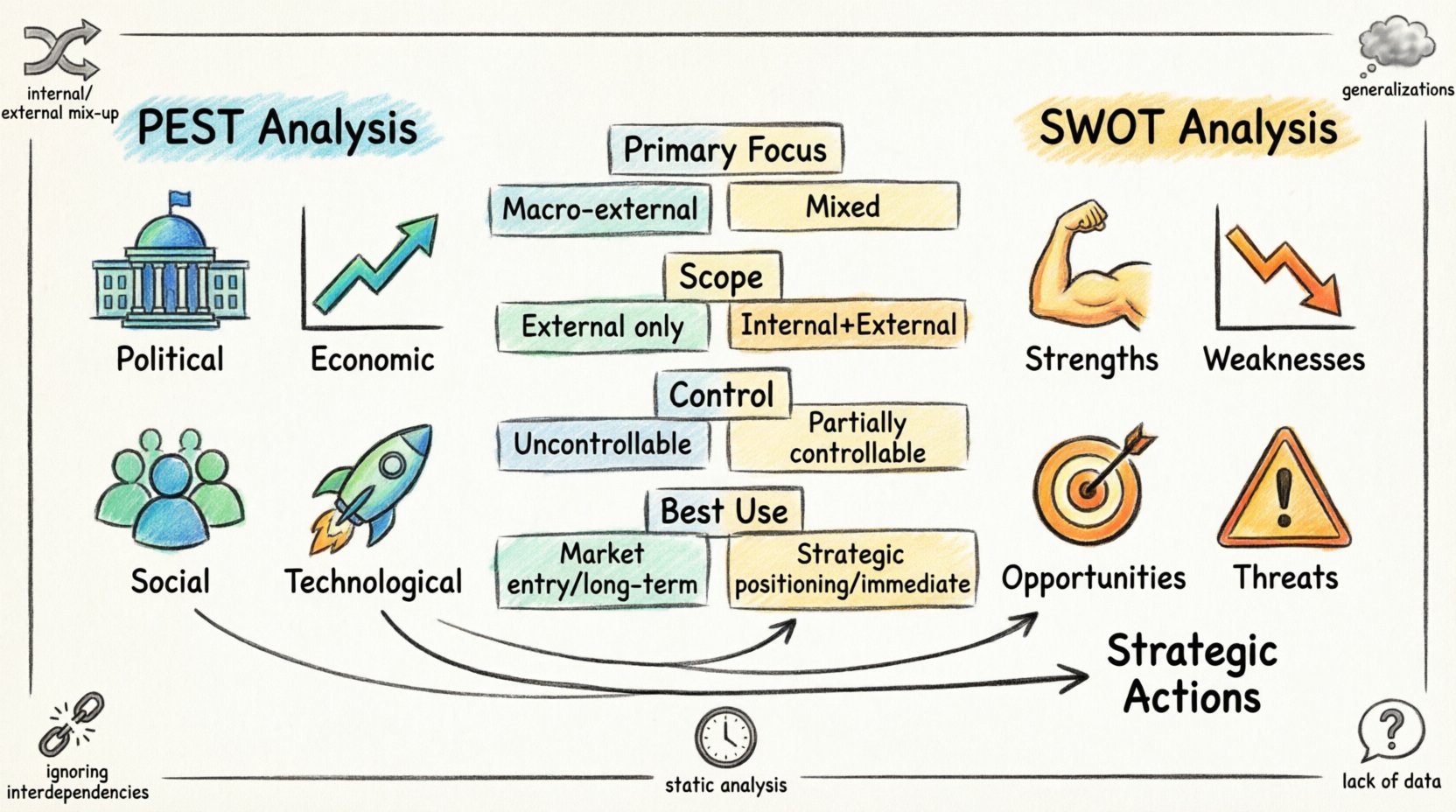
While both frameworks aim to inform strategy, their scope and utility differ significantly. MBA students often struggle to distinguish when to use which tool. The following table outlines the structural distinctions.
| Feature | PEST Analysis | SWOT Analysis |
|---|---|---|
| Primary Focus | Macro-environmental (External) | Mixed (Internal & External) |
| Scope | External factors only | Internal strengths/weaknesses + External factors |
| Control | Factors are uncontrollable | Strengths/Weaknesses are controllable |
| Granularity | Broad industry or country level | Specific to the organization |
| Best Used For | Market entry, long-term planning | Strategic positioning, immediate action |
| Time Horizon | Long-term | Short to Medium-term |
The critical distinction lies in control. PEST factors are uncontrollable. You cannot change the inflation rate or the political landscape. You can only adapt. SWOT includes internal factors that you can change. You can hire better staff or improve technology.
Common Pitfalls for MBA Students 🚫
Even experienced strategists make mistakes. Students frequently fall into specific traps that invalidate their analysis. Avoiding these errors requires discipline and rigorous data validation.
1. Confusing Internal and External Factors
This is the most frequent error. Students often place “Competitor Pricing” under Strengths or Weaknesses. Competitor pricing is an external factor (Opportunity/Threat). If a competitor lowers prices, you cannot control that; you can only react. Similarly, “Government Policy” is never a Strength. It is an external constraint.
2. Vague Generalizations
Phrases like “Good management” or “High quality” are useless in a formal analysis. These are subjective and lack evidence. Instead, use specific metrics. For example, “Management turnover is below industry average by 15%” or “Product defect rate is 0.5%, well below the 2% industry standard.”
3. Ignoring Interdependencies
Strategic factors do not exist in a vacuum. A technological shift (PEST) might render a specific internal strength (SWOT) obsolete. For instance, if a new regulation (Political) bans a certain chemical, a cost advantage (Economic) derived from that chemical becomes irrelevant. Students often list factors without linking them.
4. Lack of Data Support
A strategy based on assumptions is a guess. Every point in a PEST or SWOT analysis should ideally be backed by market research, financial data, or credible reports. Relying on anecdotal evidence weakens the credibility of the entire document.
5. Static Analysis
Business environments are dynamic. A PEST analysis conducted five years ago is likely obsolete today. Students often treat these frameworks as one-time exercises. They must be updated regularly to reflect changing realities. A static document provides a snapshot, not a movie of the business landscape.
Integrating PEST and SWOT 🧩
The most powerful strategic approach involves using PEST to feed the Opportunities and Threats sections of a SWOT analysis. This creates a logical flow from broad environmental scanning to specific organizational assessment.
Step 1: Conduct the PEST Scan
Begin by identifying the macro-environmental factors. List the Political, Economic, Social, and Technological changes occurring in the target market. This creates a comprehensive list of external variables.
Step 2: Map to Opportunities and Threats
Take the PEST list and categorize each item. Does it represent a chance to grow (Opportunity) or a risk to mitigate (Threat)?
- Example: If the Economic PEST factor is “Rising Disposable Income,” this is an Opportunity.
- Example: If the Political PEST factor is “Stricter Environmental Laws,” this is a Threat to current manufacturing processes.
Step 3: Assess Internal Capabilities
Once the external landscape is clear, evaluate the organization’s internal Strengths and Weaknesses. Ask: Do we have the resources to seize the Opportunities? Do we have the resilience to withstand the Threats?
Step 4: Develop Strategic Actions
Combine the findings. If an Opportunity exists (from PEST/SWOT) and a Strength exists (Internal), formulate a strategy to exploit it. If a Threat exists and a Weakness exists, formulate a risk mitigation plan.
Real-World Application Scenarios 🏢
To clarify the utility of each framework, consider specific business scenarios where one might take precedence over the other.
Scenario A: Market Entry for a New Product
If a company plans to launch a product in a new country, PEST Analysis is the primary tool. The internal capabilities of the company are secondary to the external environment of the new country. You must understand the tax laws, cultural preferences, and economic stability before worrying about your own marketing budget.
Scenario B: Restructuring a Failing Division
If a division is underperforming, SWOT Analysis is more appropriate. The focus shifts inward. Why are sales down? Is the product outdated? Is the team demotivated? While external threats exist, the primary diagnostic tool must address the internal weaknesses causing the decline.
Scenario C: Long-Term Capital Investment
For a decision to build a new factory that will operate for 20 years, PEST Analysis is critical. The long-term horizon makes macro-environmental factors (like climate change policies or demographic shifts) more important than current internal strengths.
Data Collection and Research Methods 🔍
Executing these frameworks requires accurate data. Here are reliable methods for gathering information without relying on proprietary software.
1. Primary Research
Conducting interviews with industry experts, customers, and employees provides unique insights. Surveys can quantify social trends and customer satisfaction levels. This data is fresh and specific to your situation.
2. Secondary Research
Utilize government publications, industry reports, and academic journals. Central banks publish inflation data. Trade associations publish market growth forecasts. These sources offer validated macroeconomic data.
3. Competitive Intelligence
Analyze competitor annual reports, press releases, and public filings. This helps identify their strengths and weaknesses without needing access to their internal data.
4. Trend Analysis
Review historical data to identify patterns. If a social trend has been growing for a decade, it is likely to continue. This helps in forecasting future Opportunities.
Critique and Limitations ⚖️
While valuable, neither framework is perfect. MBA students must acknowledge limitations to provide a balanced strategic view.
Limitations of PEST
- Lack of Prioritization: PEST lists factors but does not indicate which are most critical. A minor political change might be listed alongside a massive economic shift.
- Static Nature: Like SWOT, it represents a point in time.
- Complexity: In highly globalized companies, the “Political” factor might differ by region, making a single PEST analysis insufficient.
Limitations of SWOT
- Subjectivity: Determining what constitutes a Strength is often subjective. What one manager sees as a strength, another might see as a weakness.
- No Actionable Strategy: SWOT identifies the situation but does not prescribe the solution. It requires further strategic planning to become useful.
- Over-simplification: Reducing complex business dynamics to four quadrants can obscure nuance.
Final Considerations for Strategic Success 🎯
Choosing between PEST and SWOT is not about selecting the better tool, but the right tool for the specific strategic question. PEST provides the context; SWOT provides the assessment. Together, they form a robust foundation for decision-making.
For MBA students, the value lies not just in the output, but in the process. The discipline of separating internal capabilities from external constraints forces a clarity of thought that is essential for leadership. By rigorously applying these frameworks and avoiding common pitfalls, you can develop strategies that are resilient, data-driven, and actionable.
Remember that strategy is a continuous cycle. As the environment shifts, so must your analysis. Regularly revisit these frameworks to ensure your organization remains aligned with the realities of the market. This iterative approach distinguishes a theoretical exercise from a practical business tool.
When presenting these findings to stakeholders, focus on the implications. Do not simply list factors; explain what they mean for the organization’s future. Connect the dots between the macro environment and the micro capabilities. This synthesis is where true strategic value is created.
Ultimately, the goal is informed decision-making. Whether you are evaluating a market entry or restructuring a division, these tools provide the structure needed to navigate complexity. Use them with precision, validate your data, and remain open to updating your assumptions as new information emerges.