
Strategic planning requires a clear view of the horizon. For decades, business leaders have relied on PEST analysis to map external factors influencing an organization. However, the modern landscape shifts with unprecedented speed. Technology disrupts markets overnight, and legal frameworks expand to cover digital frontiers. Relying solely on the traditional model often leaves critical blind spots.
This guide explores the PEST Plus Framework. It refines the standard approach by injecting specific, deep-dive scrutiny into technological and legal dimensions. This method ensures decisions rest on comprehensive data rather than general assumptions.
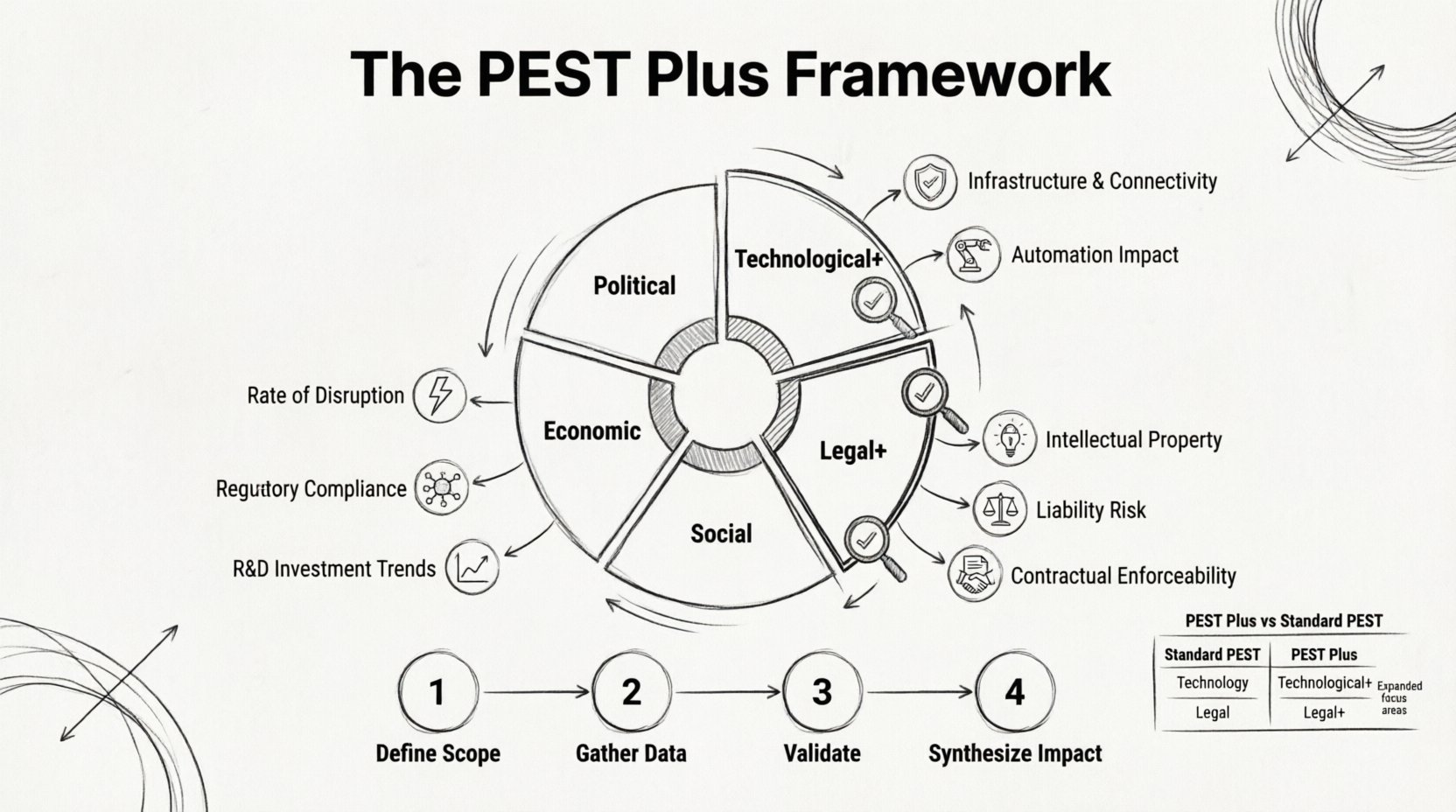
📊 Understanding the Baseline: Standard PEST
Before expanding, one must understand the foundation. PEST stands for Political, Economic, Social, and Technological. It is a macro-environmental scanning tool. Each letter represents a category of external forces that a business cannot control but must navigate.
- Political: Government stability, tax policies, trade restrictions, and labor laws.
- Economic: Growth rates, interest rates, inflation, and exchange rates.
- Social: Demographics, cultural trends, health consciousness, and lifestyle changes.
- Technological: R&D activity, automation, technological incentives, and rate of technological change.
While useful, standard PEST often treats Technology as a single checkbox. In the current era, technology is not just a factor; it is the engine. Similarly, Legal considerations are often subsumed under Political, yet they require distinct attention due to the complexity of data privacy, intellectual property, and cross-border compliance.
⚙️ The Evolution: Why PEST Plus?
Standard frameworks assume stability. The modern environment assumes volatility. The PEST Plus Framework addresses this by elevating two specific areas: Technology and Law. This distinction forces teams to move beyond surface-level observations.
Consider a scenario where a company plans to expand into a new market. A standard analysis might note that the economic climate is stable. A PEST Plus analysis would question whether the local data sovereignty laws allow the transfer of customer information. It would also assess whether the local infrastructure supports high-speed cloud connectivity required for operations.
This nuance transforms the analysis from a generic report into a strategic asset. It identifies risks that would otherwise remain hidden until they become crises.
🔍 Deep Dive: Technological Nuance
Technology is no longer just about hardware. It encompasses the ecosystem of innovation that surrounds an industry. In the PEST Plus model, this section demands granular detail.
1. Rate of Disruption
Some industries change slowly; others evolve daily. Analyzing the velocity of change in your specific sector is vital. If competitors are adopting artificial intelligence to cut costs, your standard technology assessment is insufficient. You must evaluate the specific capabilities of new tools and their adoption curve.
2. Infrastructure and Connectivity
Operational continuity depends on the physical and digital backbone of a region. This includes:
- Reliability of power grids.
- Bandwidth availability and latency.
- Hardware accessibility for maintenance and deployment.
- Cybersecurity resilience of local networks.
3. Automation and Workforce Impact
Technology reshapes labor. When analyzing the technological factor, you must ask how automation affects the local workforce. High levels of automation might reduce labor costs but could trigger regulatory backlash or social unrest. Understanding this balance is crucial for long-term sustainability.
4. R&D Investment Trends
Look at where funding is flowing. Are public and private sectors investing heavily in biotechnology, green energy, or fintech? Aligning your strategy with these investment trends can open doors to grants, partnerships, and early-mover advantages.
⚖️ Deep Dive: Legal Nuance
Legal factors are often grouped under Political in traditional models. In PEST Plus, they stand alone. This separation acknowledges that law operates with a different rhythm than politics. Laws are codified, enforceable, and carry specific financial penalties for non-compliance.
1. Regulatory Compliance
Different jurisdictions have vastly different requirements. Key areas include:
- Data protection regulations (e.g., GDPR equivalents).
- Employment contracts and termination laws.
- Environmental compliance standards.
- Industry-specific licensing requirements.
2. Intellectual Property Rights
Protecting innovation is a legal matter. In some regions, IP enforcement is weak. This poses a risk to proprietary technology. A robust analysis must evaluate the strength of local IP courts and the ability to enforce patents or trademarks.
3. Liability and Litigation Risk
Understand the litigation culture of the target market. Is the system adversarial? Are class action lawsuits common? This influences how you structure contracts and manage risk exposure.
4. Contractual Enforceability
Business relies on agreements. If a contract cannot be enforced reliably, the business model is fragile. Assess the efficiency of the local court system in resolving commercial disputes.
🛠️ Execution: Conducting the Analysis
Implementing the PEST Plus Framework requires a structured process. It is not a one-time event but a cyclical review.
Step 1: Define Scope and Boundaries
Start by clarifying the objective. Are you evaluating a new product launch, a market entry, or a strategic pivot? The scope dictates the depth of the analysis. A broad scope requires high-level data; a narrow scope requires specific technical and legal metrics.
Step 2: Data Gathering
Collect information from diverse sources. Avoid relying on a single news outlet. Utilize:
- Government white papers and policy documents.
- Industry reports from independent research firms.
- Legal databases for regulatory updates.
- Technical journals for innovation trends.
Step 3: Validation and Cross-Referencing
Data can be outdated or biased. Cross-reference findings. If a report claims a technology is widely adopted, verify this with on-the-ground observations or multiple sources. In the legal section, confirm interpretations with local counsel rather than relying solely on general guides.
Step 4: Synthesis and Impact Assessment
Organize the data into the framework. Determine the impact of each factor. Is it a threat or an opportunity? Is it immediate or long-term? Use a scoring system to prioritize factors based on their potential influence on the business.
📋 Comparative Analysis Matrix
The following table illustrates how PEST Plus differs from standard analysis regarding specific factors.
| Factor Category | Standard PEST Focus | PEST Plus Nuance |
|---|---|---|
| Technology | General innovation trends | Specific infrastructure, AI adoption, and R&D investment levels |
| Legal | Subsumed under Political | Separate analysis of compliance, IP, and liability |
| Political | Government stability and taxes | Policy continuity and regulatory intent behind laws |
| Economic | GDP and inflation rates | Currency volatility and purchasing power parity |
| Social | Demographics and culture | Consumer behavior shifts and ethical expectations |
🚫 Common Pitfalls to Avoid
Even with a robust framework, errors can occur. Awareness of common mistakes ensures the integrity of your findings.
- Confirmation Bias: Seeking only data that supports a pre-existing decision. Challenge your own assumptions.
- Outdated Information: Technology and law change rapidly. A report from two years ago may be obsolete. Always check dates.
- Overgeneralization: Assuming national laws apply uniformly across a region. Local jurisdictions often have specific rules.
- Ignoring Interconnectivity: Technology impacts law. For example, new tech creates new privacy laws. Do not analyze these factors in isolation.
- Lack of Actionability: Producing a report that sits on a shelf. Every finding must link to a strategic decision or risk mitigation plan.
🔄 Integration with Other Strategies
The output of a PEST Plus analysis feeds into broader strategic models. It is rarely used alone.
SWOT Analysis
PEST Plus findings often populate the Opportunities and Threats quadrants of a SWOT analysis. Strong technological insights highlight opportunities for automation. Legal risks define threats regarding compliance.
Scenario Planning
Use the data to build scenarios. What happens if a new data regulation passes? What if a competitor releases a disruptive technology? These scenarios help prepare contingency plans.
Risk Management
The Legal and Technological sections directly inform risk registers. They help quantify potential exposure and prioritize mitigation efforts.
🌍 Real-World Application Example
Imagine a logistics company planning expansion into Southeast Asia. A standard analysis notes the economic growth and political stability.
The PEST Plus analysis digs deeper:
- Technology: Mobile wallet adoption is high, but cross-border payment gateways have technical latency issues. The company must invest in local server infrastructure.
- Legal: Labor laws regarding gig workers are evolving rapidly. Contracts need flexible clauses to accommodate potential regulatory shifts.
- Political: Trade tariffs on electronic components fluctuate. Supply chain sourcing must remain diversified.
This level of detail prevents costly operational failures and ensures the expansion is built on solid ground.
📈 Long-Term Adaptation
Frameworks are tools, not crystal balls. The external environment is dynamic. A PEST Plus analysis should be reviewed quarterly or semi-annually. As new technologies emerge, the “Technological” section requires immediate updates. As laws are passed, the “Legal” section must be revised.
Building a culture of continuous scanning ensures the organization remains agile. Leaders who rely on static analysis risk making decisions based on yesterday’s reality.
🧭 Final Thoughts
Strategic clarity comes from depth. The PEST Plus Framework offers a method to achieve that depth without losing sight of the macro environment. By isolating and scrutinizing Technology and Legal factors, organizations gain a competitive edge.
This approach demands discipline and rigorous data gathering. It requires leaders to look beyond the surface. However, the reward is a strategy grounded in the actual conditions of the market. In an era of constant change, nuance is the most valuable asset you can possess.
Commit to the process. Gather the data. Analyze with care. Execute with confidence.