
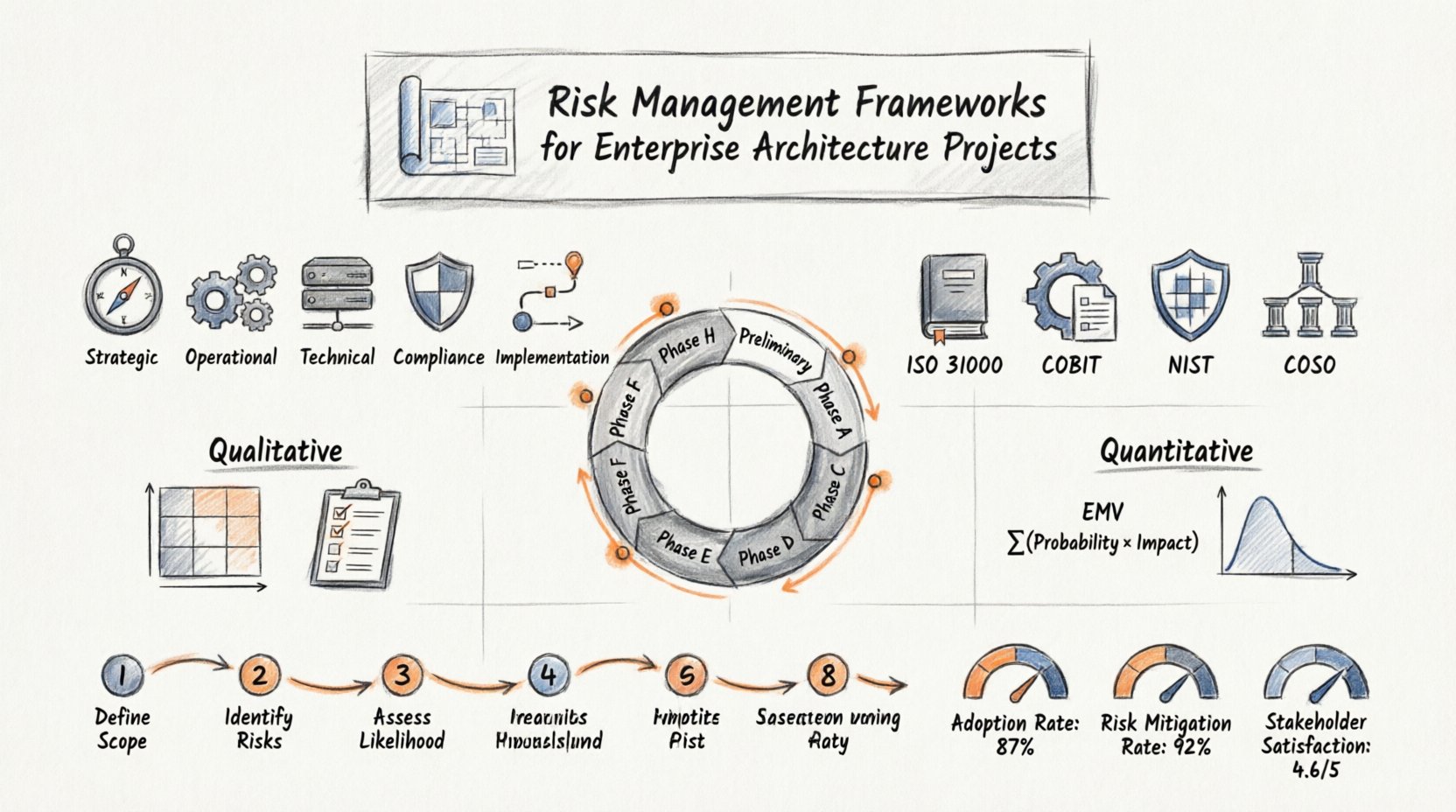
Enterprise Architecture (EA) serves as the blueprint for organizational structure, information systems, and technology infrastructure. However, the complexity of modern IT landscapes introduces significant uncertainty. Without a structured approach to identifying and mitigating these uncertainties, projects often face delays, budget overruns, or strategic misalignment. This guide explores robust risk management frameworks tailored for Enterprise Architecture projects, with a specific focus on the TOGAF (The Open Group Architecture Framework) methodology.
Integrating risk management into the architectural lifecycle is not about avoiding failure; it is about ensuring resilience. By embedding risk assessment into the Architecture Development Method (ADM), organizations can navigate change with confidence and maintain alignment with business goals. This comprehensive analysis details how to structure risk governance, select appropriate frameworks, and execute mitigation strategies without relying on proprietary software solutions.
🧠 Understanding Risk in Enterprise Architecture
Risk in the context of Enterprise Architecture extends beyond simple IT outages. It encompasses strategic, operational, technical, and compliance-related threats. An effective risk management framework must address the intersection of business objectives and technical capabilities.
Categories of Architectural Risk
- Strategic Risk: Misalignment between the architecture and long-term business goals. This occurs when the EA does not support the company’s vision or market positioning.
- Operational Risk: Disruptions to daily business processes caused by system failures, integration issues, or resource constraints during implementation.
- Technical Risk: Challenges related to technology choices, legacy system integration, security vulnerabilities, and scalability limitations.
- Compliance Risk: Failure to adhere to regulatory requirements, industry standards, or internal governance policies.
- Implementation Risk: Issues arising during the deployment phase, such as scope creep, budget overruns, or resistance to change from stakeholders.
Each category requires a distinct approach to identification and mitigation. A framework that addresses only technical risks will leave the organization vulnerable to strategic drift or operational disruption.
🔄 Integrating Risk into the TOGAF ADM
The TOGAF Architecture Development Method (ADM) provides a cyclical process for developing enterprise architecture. Risk management is not a standalone phase but a cross-cutting concern that permeates the entire lifecycle. Integrating risk into the ADM ensures that potential issues are identified early and managed continuously.
Phase-Specific Risk Activities
- Preliminary Phase: Define the risk management approach. Establish principles, governance structures, and the risk register template. Identify key stakeholders and their risk tolerance levels.
- Phase A (Architecture Vision): Assess high-level risks associated with the proposed scope. Identify potential barriers to the vision and define the initial risk appetite.
- Phase B, C, D (Business, Information Systems, Technology): Conduct detailed risk assessments for specific domains. Evaluate the risk of proposed solutions against existing capabilities. Document risks in the Architecture Requirements Specification.
- Phase E (Opportunities and Solutions): Evaluate migration scenarios for risk exposure. Determine the impact of transitioning from the Baseline to the Target Architecture.
- Phase F (Migration Planning): Develop a detailed plan for risk mitigation during implementation. Prioritize work packages based on risk reduction potential.
- Phase G (Implementation Governance): Monitor risks during the actual deployment. Ensure compliance with the architecture and address emerging issues in real-time.
- Phase H (Architecture Change Management): Review the effectiveness of risk controls. Update the risk register based on lessons learned and changing business conditions.
This phased approach ensures that risk is not an afterthought but a foundational element of the architectural design. It allows for iterative refinement as the architecture evolves.
📚 Core Risk Management Frameworks
While TOGAF provides the structural process, it does not prescribe specific risk methodologies. Organizations often integrate established risk management frameworks to enhance their EA practice. Below is a comparison of widely adopted frameworks suitable for Enterprise Architecture.
| Framework | Primary Focus | Best Suited For | Key Benefit |
|---|---|---|---|
| ISO 31000 | General Risk Management Principles | Organizations seeking a universal standard | Provides a flexible, high-level guideline applicable to any industry |
| COBIT 5/2019 | IT Governance and Control | IT-focused risk management | Aligns IT risks directly with business objectives and control requirements |
| NIST SP 800-37 | Security Risk Management | Government and regulated sectors | Strong emphasis on security controls and authorization processes |
| COSO ERM | Enterprise Risk Management | Corporate governance and financial risk | Integrates risk with strategy and performance management |
For EA projects, a hybrid approach is often most effective. For example, using ISO 31000 for the general process and COBIT for IT-specific controls within the TOGAF ADM structure. This combination ensures comprehensive coverage without redundancy.
🔍 Risk Assessment Methodologies
Once the framework is selected, specific methodologies must be applied to assess and quantify risk. Qualitative and quantitative methods offer different levels of detail and precision.
Qualitative Assessment
Qualitative risk assessment relies on expert judgment and experience to categorize risks. This method is useful in the early phases of the ADM when data is scarce.
- Risk Matrix: Plot risks based on likelihood and impact. Colors (Red, Amber, Green) indicate priority levels.
- Delphi Technique: Gather anonymous expert opinions to reach a consensus on risk probability.
- Checklist Analysis: Use historical data from similar projects to identify potential risks.
Quantitative Assessment
Quantitative assessment uses numerical data to calculate risk exposure. This is critical for major investments and high-stakes architectural decisions.
- Expected Monetary Value (EMV): Calculate the financial impact of a risk by multiplying probability by cost.
- Sensitivity Analysis: Determine how changes in one variable affect the overall project outcome.
- Monte Carlo Simulation: Model the probability of different outcomes in a process that cannot easily be predicted due to the intervention of random variables.
In the context of Enterprise Architecture, a mix of both is recommended. Use qualitative methods for strategic alignment risks and quantitative methods for budget and timeline risks.
👁️ Governance and Continuous Monitoring
Risk management is not a one-time activity. It requires continuous governance to remain effective as the business environment changes. Governance structures ensure that risk management activities are performed consistently and that decisions are made transparently.
Key Governance Components
- Risk Committee: A cross-functional group responsible for reviewing significant risks and approving mitigation strategies.
- Risk Register: A living document that tracks identified risks, their status, owners, and mitigation actions.
- Architecture Board: Reviews architectural decisions for risk compliance before approval.
- Reporting Mechanisms: Regular dashboards that provide visibility into risk exposure to senior leadership.
Monitoring involves tracking key risk indicators (KRIs). These metrics provide early warning signs that a risk is materializing. For example, a rising number of integration defects might indicate a technical risk that needs immediate attention.
🛣️ Implementation Roadmap
Implementing a risk management framework within an EA practice requires a structured approach. The following steps outline the process for integration.
- Assess Current State: Evaluate existing risk practices. Identify gaps between current capabilities and desired maturity levels.
- Define Policy: Create a risk management policy that defines roles, responsibilities, and risk tolerance.
- Train Teams: Ensure architects and stakeholders understand their role in risk management. Conduct workshops on using the risk register.
- Integrate Tools: Embed risk assessment steps into existing architecture tools or documentation templates.
- Pilot Program: Run a pilot on a specific architecture project to test the framework.
- Refine Process: Gather feedback from the pilot and adjust the methodology accordingly.
- Scale Up: Roll out the framework across all EA projects and initiatives.
- Review and Iterate: Conduct periodic reviews to ensure the framework remains relevant.
⚠️ Common Challenges and Mitigations
Even with a robust framework, challenges can arise during implementation. Recognizing these potential pitfalls allows for proactive mitigation.
Challenge 1: Risk Fatigue
Teams may feel overwhelmed by excessive documentation and reporting requirements. This leads to non-compliance or superficial risk assessments.
- Mitigation: Focus on high-impact risks. Automate reporting where possible. Keep the risk register concise and actionable.
Challenge 2: Lack of Ownership
When risk management is viewed solely as the responsibility of the EA team, business stakeholders disengage.
- Mitigation: Assign risk owners from business units. Ensure risk accountability is part of performance metrics.
Challenge 3: Static Risk Registers
Risk registers are often created at the start of a project and never updated, rendering them obsolete.
- Mitigation: Schedule regular reviews (e.g., monthly or per phase gate). Update the register during every architecture review.
Challenge 4: Over-Engineering Controls
Organizations sometimes implement excessive controls that slow down delivery without significantly reducing risk.
- Mitigation: Align control complexity with risk severity. Ensure cost-benefit analysis is performed for each control measure.
📈 Measuring Success
To determine if the risk management framework is effective, organizations must measure specific outcomes. Success is not just the absence of incidents but the ability to navigate uncertainty successfully.
- Reduction in Project Delays: Track the number of projects delayed due to unforeseen risks.
- Stakeholder Confidence: Survey stakeholders on their confidence in the architecture delivery.
- Cost Avoidance: Estimate the cost of issues that were prevented through early risk identification.
- Compliance Adherence: Monitor the rate of compliance violations during architecture implementation.
- Framework Adoption: Measure the percentage of projects that actively use the risk management process.
These metrics provide objective evidence of value. They help justify the investment in risk management capabilities and drive continuous improvement.
🏁 Moving Forward
Effective risk management in Enterprise Architecture is a discipline that balances caution with agility. By leveraging TOGAF and integrating established frameworks like ISO 31000 or COBIT, organizations can build resilience into their digital transformation efforts. The goal is not to eliminate all risk, which is impossible, but to manage it intelligently to support business innovation.
Start by assessing your current maturity, define clear policies, and ensure accountability across the enterprise. With a structured approach, risk becomes a strategic asset rather than a hindrance. This empowers architects to make informed decisions that drive long-term value and stability.