
Enterprise architecture (EA) has long been constrained by the manual, time-intensive nature of diagramming. In 2026, a paradigm shift is underway—driven by generative AI and certified modeling standards. At the forefront of this transformation is Visual Paradigm’s AI-powered ArchiMate tool, a next-generation solution that redefines how architects create, refine, and communicate enterprise models.

The Challenge: From Blank Canvas to Business Strategy
Traditional EA modeling—especially within the ArchiMate3.2 framework—requires meticulous attention to notation, syntactic precision, and semantic consistency. Teams frequently start with a blank canvas, spending hours placing elements, drawing relationships, and ensuring compliance with the Open Group’s 26 official viewpoints. This process is not only laborious but often leads to cognitive overload, especially when stakeholders have divergent needs or organizational complexities are involved.
Enter Visual Paradigm’s AI ArchiMate platform—an evolution of the company’s legacy as a certified ArchiMate tool. Since its rollout in late 2025 through the Visual Paradigm Desktop (Enterprise Edition), the tool has reimagined EA workflows by automating the initial model generation from natural language inputs, thereby transforming architects from diagram drawers to strategic analysts.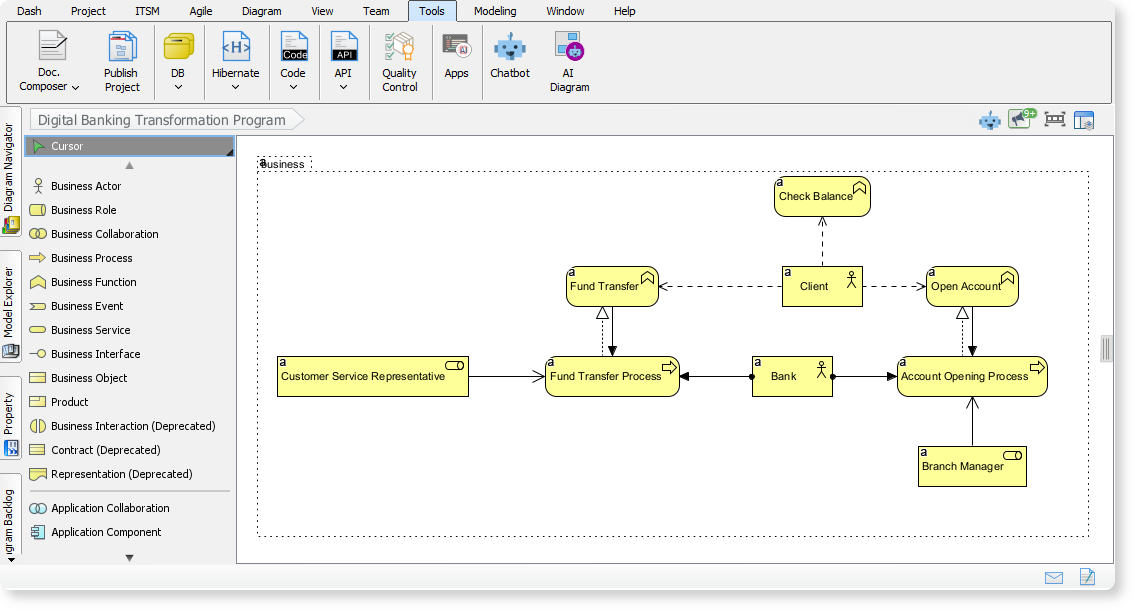
Core Capabilities: How AI Powers ArchiMate Modeling
TheAI ArchiMate engine leverages large language models trained on ArchiMate 3.2 semantics, enabling seamless translation of plain English prompts into fully compliant, multi-layered diagrams across all six key domains: Business, Application, Technology, Strategy, Physical, and Implementation.
Text-to-Diagram Generation: From Sentence to Strategic Model
Users input descriptive scenarios—such as:
“Generate an ArchiMate model for a mid-sized retail organization transitioning to a cloud-native e-commerce platform, including order fulfillment, inventory synchronization, payment processing, and integration with third-party logistics systems.”
The AI parses the prompt, identifies domain-specific elements, and constructs a structured, compliant model that spans all relevant layers. It automatically maps relationships (e.g., Business Process → Application Service → Cloud Infrastructure) and ensures adherence to ArchiMate syntax, including correct use of viewpoints, elements, and relationships.
Comprehensive Support for All 26 Official Viewpoints
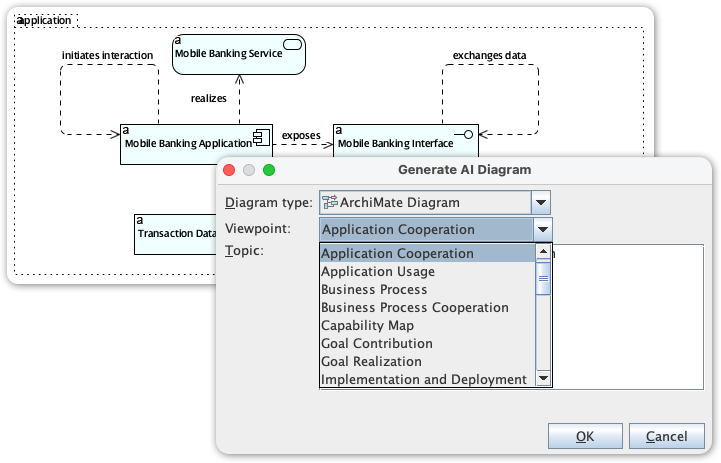
One of the most powerful features is the tool’s ability to generate diagrams tailored to specific stakeholder needs. For instance:
- Capability Map (Viewpoint): For executives, showing high-level strategic capabilities and business outcomes.
- Physical Infrastructure (Viewpoint): For operations teams, detailing data center layouts, network topologies, and hardware deployments.
- Implementation Viewpoint: For project managers, capturing timelines, dependencies, and rollout phases.
- Motivation Viewpoint: For change leaders, illustrating drivers and incentives behind strategic shifts.
This viewpoint-specific generation eliminates the need for architects to manually build or justify diagrams for each audience—accelerating communication and alignment across business, IT, and executive levels.
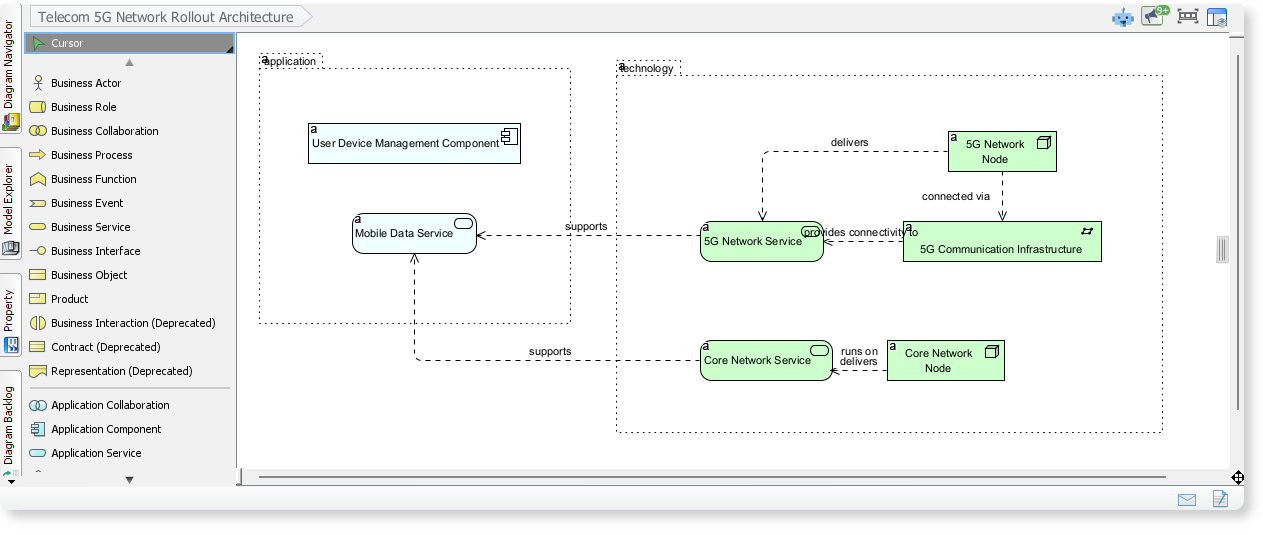
Conversational AI Co-Pilot: Dynamic Refinement and What-If Analysis
Using the integrated AI chatbot(accessible at chat.visual-paradigm.com or within the desktop interface), users engage in real-time dialogue with the model. For example: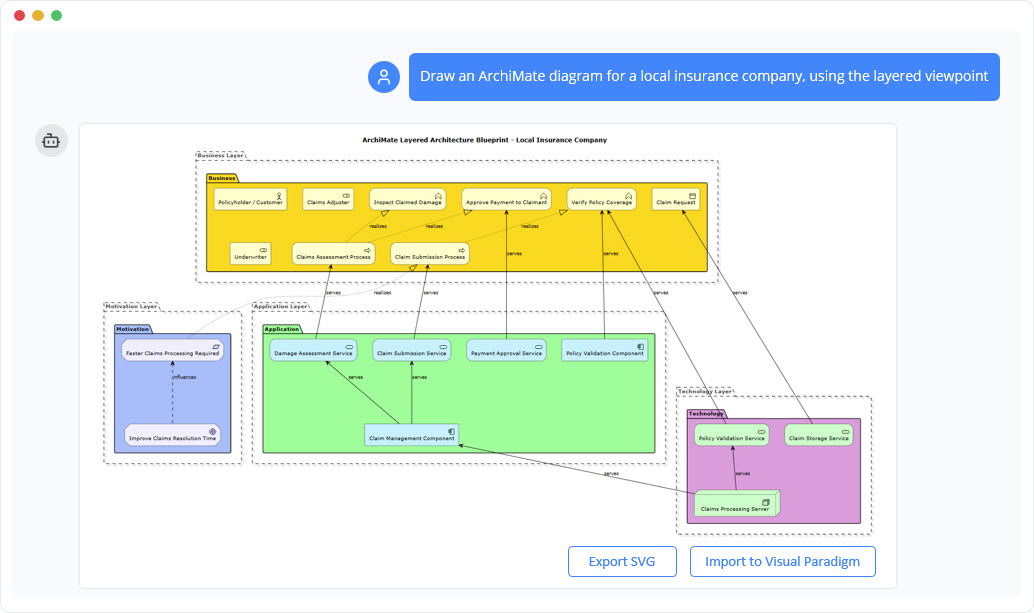
“What if we replace the current payment gateway with a third-party provider? How does this affect the order fulfillment chain?”
The AI conducts an impact analysis, traces dependencies, updates relationships in the model, and suggests necessary modifications—such as introducing new service busses, data flows, or security policies. It also identifies gaps or inconsistencies (e.g., missing service interfaces or compliance rules), enabling proactive risk assessment.
This feature transforms EA modeling from a static exercise into a dynamic, interactive process—turning abstract requirements into testable scenarios with immediate feedback.
Compliance, Accuracy, and Integration with Enterprise Frameworks
Every generated model strictly follows ArchiMate 3.2 standards, including element classification, relationship types (e.g., realization, dependency, instance), and view structure. This eliminates common errors in notation, which often arise from manual input or lack of visibility into standard semantics.
Moreover, the tool is designed to integrate seamlessly with other enterprise methodologies:
- TOGAF ADM: AI-generated diagrams can be synchronized with ADM phases (e.g., Investment, Transition, Governance), helping architects map initiatives to governance cycles.
- BPMN for Process Modeling: The AI can generate process flows (e.g., order-to-cash) and link them to ArchiMate business processes.
- UML for Detailed Design: For in-depth technical design, users can extend models with UML components or data classes.
This interoperability ensures that ArchiMate is not a standalone model but a central component of a broader EA ecosystem.
Benefits: A Strategic Shift in EA Productivity
Visual Paradigm’s AI ArchiMate tool delivers tangible improvements across multiple dimensions of EA practice:
1. Massive Productivity Gains
Manual ArchiMate modeling is notoriously time-consuming, requiring hours of precision work just to create a basic model. With the AI tool, teams can generate a complete, compliant model in minutes—reducing routine diagramming effort by up to 90%.
2. Democratization of EA Access
Junior team members, business analysts, and even non-technical stakeholders can now contribute meaningfully to EA discussions using natural language. This lowers the entry barrier and fosters broader ownership of enterprise strategies.
3. Enhanced Stakeholder Communication
By generating viewpoint-specific visuals on demand, the tool improves alignment across functions. Executives receive high-level capability maps; IT teams receive detailed technology layers; and operations see physical infrastructure plans—all without requiring architectural expertise to interpret.
4. Improved Accuracy and Standardization
ArchiMate has strict rules about element types, relationship semantics, and layer hierarchy. The AI enforces these rules automatically, reducing human error and ensuring that every model is traceable, auditable, and compliant with official standards.
5. Flexible Deployment and Scalability
Visual Paradigm offers a tiered approach:
| Product Edition | AI Features | Primary Use Case |
|---|---|---|
| Free Online Version | Basic ArchiMate diagramming (no AI) | Entry-level learning, simple modeling |
| Visual Paradigm Desktop (Standard) | Manual modeling with standard tools | Small teams, non-automated workflows |
| Visual Paradigm Desktop (Enterprise Edition) | Full AI capabilities: text-to-diagram, chat-based refinement, viewpoint automation | Enterprise-grade EA teams, digital transformation projects |
The free version is ideal for learning and initial exploration, while the Enterprise Edition supports complex, large-scale modeling with full AI support.
Limitations and Practical Considerations
While the AI tool is revolutionary, it is not a silver bullet. Key limitations include:
- Requires Enterprise Edition: Full generative AI and chat refinement are only available in Visual Paradigm Desktop Enterprise Edition. Basic diagramming remains accessible in free or standard editions.
- Initial Output May Be Generic: If the prompt lacks specificity or context (e.g., “Generate a model for a company” without domain details), the AI may produce a default, generic model that requires manual refinement.
- Complex Scenarios Require Human Oversight: Highly unique, domain-specific, or regulated environments (e.g., financial services with strict compliance) may still require expert validation of elements, relationships, or security implications.
- Prompt Engineering Is Key: Crafting effective prompts—such as specifying layers, actors, or constraints—requires some understanding of ArchiMate and enterprise contexts. Training on prompt design is essential for optimal results.
Moreover, while most AI-generated diagrams are fully editable, early versions of certain elements (e.g., custom viewpoints or policy rules) may need full manual adjustment to meet organizational standards.
Best Practices for Integrating AI ArchiMate into Your EA Workflow
To maximize impact, EA teams should adopt a structured, iterative approach:
1. Start with Rapid Prototyping
Begin every modeling session with AI-generated model drafts based on high-level business scenarios or strategic goals. This eliminates the blank canvas and allows immediate exploration of architecture options.
2. Use Viewpoints to Align Stakeholders
Generate targeted diagrams for specific audiences using the 26 viewpoints. For example:
- Use the Strategy Viewpoint to present a digital transformation vision to executives.
- Use the Technology Viewpoint to explain platform transitions to IT leadership.
- Use the Physical Viewpoint to guide infrastructure decisions for operations.
3. Implement Conversational Refinement Workflows
Integrate the AI chatbot into daily modeling sessions. Train teams to ask “What-if” questions and trace impacts. This enables real-time validation, risk assessment, and gap analysis—turning modeling into a collaborative dialogue.
4. Establish Validation and Review Checkpoints
While AI accelerates creation, it does not replace human judgment. Implement standard validation steps:
- Review for semantic accuracy and viewpoint compliance.
- Validate business logic and alignment with organizational goals.
- Ensure traceability between layers (e.g., business capability → application service).
5. Enable Collaboration and Knowledge Sharing
Share AI-generated models in real time using the online interface. Enable team members to comment, suggest changes, and track revisions through version history. Automatically export models to PDF, images, or integrate with project management tools like Jira or Confluence.
6. Measure Time and Value Gains
Quantify the impact by tracking:
- Time spent on diagramming before and after AI adoption.
- Reduction in task completion time.
- Number of stakeholder alignment meetings reduced due to clearer visualizations.
- ROI from faster decision cycles and fewer modeling errors.
7. Upskill the Team
Provide training modules on:
- Understanding the 26 ArchiMate viewpoints.
- Writing effective prompts with clarity, specificity, and context.
- Using the chatbot for impact analysis and scenario testing.
This ensures that both new and experienced team members can contribute effectively—balancing automation with strategic insight.
Conclusion: The Future of Enterprise Architecture
Visual Paradigm’s AI-powered ArchiMate tool represents more than a technological upgrade—it signals a fundamental shift in how enterprises approach architecture. By automating repetitive, error-prone modeling tasks, the tool frees architects to focus on higher-value activities: stakeholder alignment, impact analysis, strategic decision-making, and innovation.
It is particularly well-suited for organizations undergoing digital transformation, cloud migration, or digital service adoption, where rapid iteration and clarity of architecture are critical.
With its certification in ArchiMate 3.2, integration with TOGAF, support for all 26 viewpoints, and conversational AI co-pilot, Visual Paradigm stands as one of the most capable and future-ready tools in the EA landscape for 2026 and beyond.
Next Step: Organizations interested in evaluating the tool can access a free trial at www.visual-paradigm.com to explore AI-driven modeling capabilities in real-world scenarios.
Articles and resources Visual Paradigm AI
-
AI-Powered Visual Modeling and Design Solutions by Visual Paradigm: This portal allows users to explore cutting-edge AI-driven tools for visual modeling, diagramming, and software design to enable faster, smarter development workflows.
-
Visual Paradigm – All-in-One Visual Development Platform: This is a comprehensive platform for visual modeling, software design, and business process modeling that integrates various AI-powered development tools.
-
AI Chatbot Feature – Intelligent Assistance for Visual Paradigm Users: Users can leverage this AI-powered chatbot functionality to get instant guidance, automate tasks, and enhance productivity within the modeling environment.
-
Visual Paradigm Chat – AI-Powered Interactive Design Assistant: This interactive AI chat interface helps users generate diagrams, write code, and solve complex design challenges in real time.
-
AI Textual Analysis – Transform Text into Visual Models Automatically: This tool uses AI to analyze text documents and automatically generate diagrams such as UML, BPMN, and ERD for faster modeling and documentation.
-
AI Brainstorming Features – Visual Paradigm: These features enhance the idea generation process by providing intelligent suggestions and supporting collaborative workflows.
-
AI-Powered Use Case Diagram Refinement Tool – Smart Diagram Enhancement: This tool leverages AI to automatically refine and optimize use case diagrams for improved clarity, consistency, and completeness.
-
AI Fishbone Diagram Generator: This AI-powered tool identifies the root causes of complex problems by automatically generating Fishbone (Ishikawa) diagrams.
-
AI Development Plan Generator – Visual Paradigm: This tool is designed to revolutionize project planning by empowering users to quickly transform ideas into actionable roadmaps and visualized timelines.
-
AI-Powered 3-Aspect Infographic Designer Tool: This AI-driven designer tool enables the instant generation of professional infographics based on user input.