
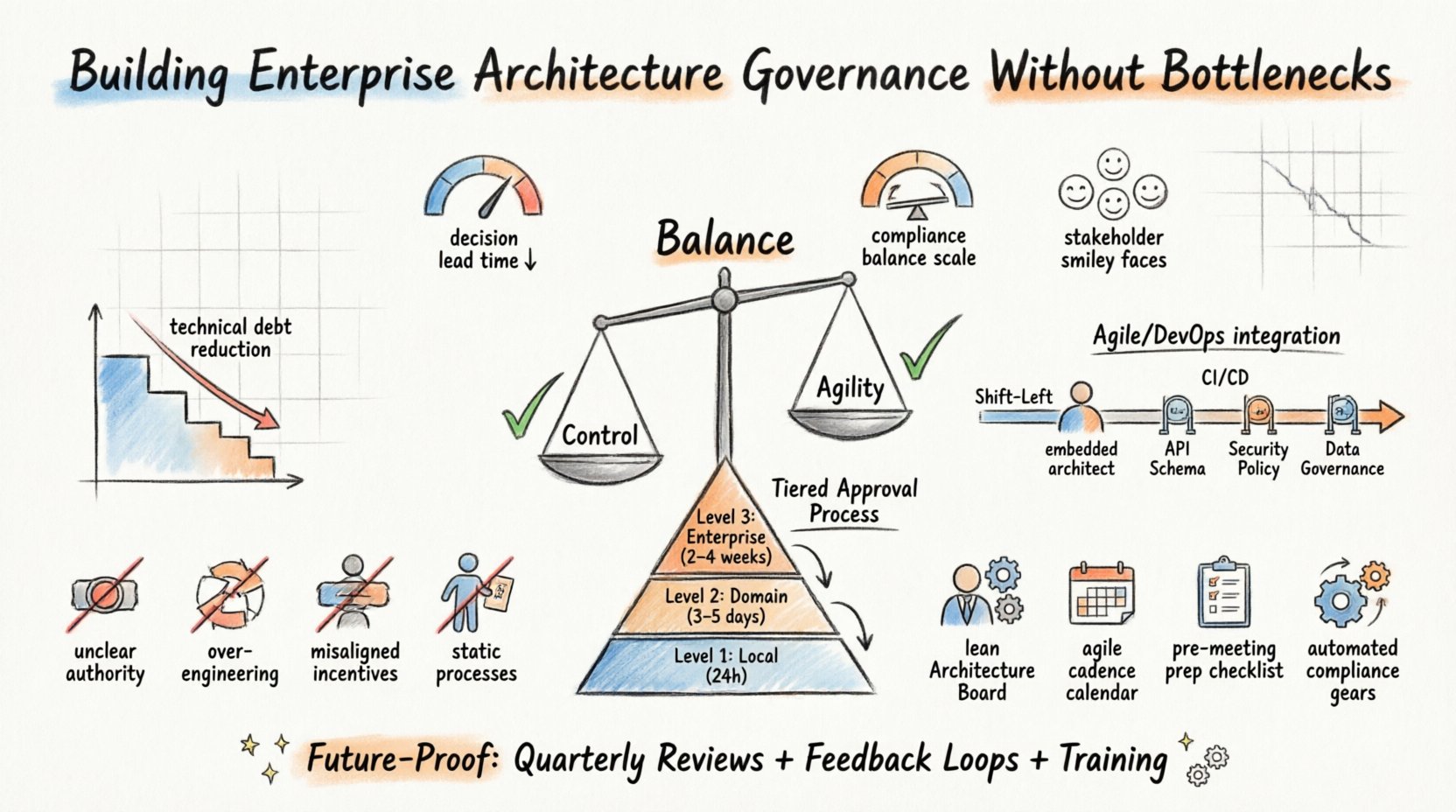
In the modern digital landscape, the tension between stability and speed is a constant struggle. Enterprise Architecture (EA) teams often find themselves caught in the middle, tasked with maintaining structure while enabling rapid innovation. When governance becomes a barrier rather than a facilitator, projects stall, stakeholders grow frustrated, and the strategic value of architecture diminishes. This guide explores how to construct a robust governance framework that supports business agility without sacrificing control.
The objective is not to eliminate governance, but to refine it. By applying the principles of the TOGAF framework with a focus on efficiency, organizations can ensure that architecture decisions are made quickly, transparently, and with minimal friction. We will examine the mechanisms that cause delays, the structural changes required to mitigate them, and the metrics that prove success.
Understanding the Governance Landscape 🧩
Enterprise Architecture Governance is the set of responsibilities and practices that ensure the organization’s technology architecture aligns with its business strategy. It is not merely about enforcing rules; it is about ensuring that investments yield returns and that technical debt does not accumulate unchecked. When implemented correctly, governance acts as a compass. When implemented poorly, it becomes a speed bump.
In the context of TOGAF, governance is primarily managed through the Architecture Governance Framework. This framework defines the organizational structures, processes, and responsibilities required to direct the architecture effort. However, many organizations struggle to balance the rigor of the framework with the need for operational speed.
Key Components of the Framework
- Architecture Board: A group of senior stakeholders responsible for making high-level architecture decisions and overseeing compliance.
- Architecture Compliance Review: A formal process to assess whether proposed solutions adhere to defined standards and principles.
- Architecture Repository: A central store for architecture documentation, standards, and models, ensuring transparency.
- Architecture Contract: A formal agreement between the architecture function and the business or project teams regarding deliverables and responsibilities.
Each of these components plays a critical role. If the Architecture Board is too large or meets too infrequently, decisions pile up. If the Compliance Review is too rigid, it stifles innovation. The goal is to calibrate these components to match the velocity of the business.
The Core Challenge: Why Bottlenecks Occur 🐌
Before solving the problem of bottlenecks, it is necessary to diagnose the root causes. Delays in architecture governance rarely happen by accident. They are usually the result of systemic issues within the governance model.
1. Lack of Clear Authority
When the scope of the Architecture Board is undefined, teams spend excessive time debating who has the final say. If a project manager believes they can bypass the architecture team for a minor component, but the architecture team insists on review, the project stalls in a gray area.
2. Over-Engineering Reviews
Requiring a full Architecture Definition Document (ADD) for every small change is a classic mistake. Not every decision carries the same risk. Treating a database migration the same as a core platform overhaul creates unnecessary work for both the architects and the requesters.
3. Misaligned Incentives
If the business is rewarded for speed and the architecture team is rewarded for compliance, the two groups are working at cross-purposes. The architecture team may reject proposals to protect their metrics, while the business team may hide work to avoid scrutiny. Governance must align incentives to shared goals.
4. Static Processes
Governance processes that were designed five years ago often do not fit the current technology stack. Manual approval workflows that relied on email chains are obsolete in a digital-first environment. Automation is essential for reducing administrative overhead.
Designing a Tiered Approval Process 📊
The most effective way to reduce bottlenecks is to introduce a tiered governance model. This approach categorizes changes based on their impact, risk, and cost, ensuring that the right level of scrutiny is applied to the right decision.
Instead of a single gate for all architecture changes, organizations should implement multiple levels of review. This allows low-risk decisions to proceed quickly while high-risk decisions receive the necessary depth of analysis.
Levels of Governance Authority
| Level | Authority | Typical Scope | Decision Time |
|---|---|---|---|
| Level 1: Local | Project Lead / Team Architect | Minor component changes, non-strategic tools | 24 Hours |
| Level 2: Domain | Domain Architecture Board | Service integration, cross-team dependencies | 3-5 Days |
| Level 3: Enterprise | Chief Architecture Board | Core platform shifts, major budget approvals, standards | 2-4 Weeks |
By clearly defining these levels, teams know exactly where to direct their requests. This transparency eliminates the confusion that often leads to delays. It also empowers lower-level architects to make decisions without waiting for top-level approval, fostering a culture of ownership.
Empowering the Architecture Board 👥
The Architecture Board is the engine of governance. If the engine is inefficient, the whole vehicle moves slowly. To optimize the board, organizations must focus on composition, frequency, and preparation.
Optimizing Composition
A board that includes too many members will take too long to reach a consensus. It should be lean and representative. Key members typically include:
- Chief Architect: Provides strategic direction.
- Business Stakeholder: Ensures business viability.
- Security Lead: Ensures security and compliance requirements are met.
- Project Lead: Represents the delivery team.
Guest speakers can be invited for specific topics, but core membership should remain stable to build institutional memory and speed up decision-making.
Agile Meeting Cadence
Waiting a month for a board meeting is a recipe for delay. Consider adopting a rolling calendar or sprint-based review cycle. If the business operates in two-week sprints, the board should ideally review architecture decisions within that same timeframe to keep pace.
Pre-Meeting Preparation
Meetings should be for discussion and decision, not for reading documents. Requesters must submit materials in a standardized format at least 48 hours in advance. This allows board members to review the material before the meeting, ensuring that the meeting time is used for debate and resolution.
Metrics That Matter 📈
You cannot improve what you do not measure. Traditional metrics like “number of reviews” often lead to gaming the system (more reviews, more metrics). Instead, focus on metrics that reflect efficiency and value.
1. Lead Time for Architecture Decisions
Track the time from the submission of an architecture request to the final approval. A declining trend indicates that governance is becoming more efficient. If this number rises, it signals a bottleneck.
2. Compliance Rate vs. Rejection Rate
A high rejection rate might indicate that standards are too difficult to meet, or that communication is poor. A low compliance rate suggests governance is not being enforced. The goal is a balanced ratio where most submissions are compliant, and rejections are meaningful.
3. Architectural Debt Reduction
Measure the reduction in identified architectural debt over time. This shows that governance is not just blocking work, but actively improving the health of the IT landscape.
4. Stakeholder Satisfaction
Surveys sent to project managers and business leaders can provide qualitative data on how they perceive the governance process. If they feel supported, the governance is likely effective. If they feel obstructed, adjustments are needed.
Integrating with Agile and DevOps 🔄
Traditional EA governance often clashes with Agile and DevOps methodologies. Agile teams expect to move fast and iterate frequently, while governance expects documentation and sign-off before changes occur. Bridging this gap requires a shift in mindset.
Shift-Left Governance
Instead of reviewing architecture at the end of a project, integrate checks earlier. Embed architects into Agile teams as embedded resources. This allows them to guide design decisions as they happen, rather than reviewing them retrospectively. This approach is often called “Architecture as Code” or “Continuous Architecture”.
Automated Compliance Checks
Use tooling to automate the verification of standards. For example, if a standard requires all databases to be encrypted, a script can scan the infrastructure and report violations automatically. This removes the manual burden from the Architecture Board and allows them to focus on strategic decisions.
Definition of Done
Update the Definition of Done (DoD) for user stories to include architectural compliance. This ensures that developers are aware of architectural requirements from the start. If a story is not architecturally compliant, it cannot be marked as done. This shifts the responsibility to the delivery team while providing the guardrails they need.
Avoiding Common Implementation Traps 🚧
Even with a well-designed plan, organizations often stumble during execution. Awareness of these common pitfalls can help you steer clear of them.
- Perfectionism: Do not wait for a perfect architecture before starting. Aim for the “good enough” solution that meets current needs and allows for future evolution.
- Siloed Teams: Ensure the Enterprise Architecture team communicates with Domain Architecture teams. If Enterprise dictates rules without understanding Domain realities, the rules will be ignored.
- Ignoring Culture: Governance is cultural as much as it is procedural. If the culture values speed over quality, no amount of process will fix it. Leadership must model the behavior they expect.
- Lack of Visibility: If stakeholders do not know the status of their requests, they will create shadow IT solutions. Ensure there is a portal or dashboard where request status is visible.
Future-Proofing the Governance Model 🚀
The technology landscape changes rapidly. Governance models that work today may be obsolete in three years. To ensure longevity, the governance framework must be adaptable.
Regular Reviews
Schedule a quarterly review of the governance framework itself. Ask the team: Are the rules still relevant? Are the processes still efficient? Be willing to sunset old standards that no longer add value.
Feedback Loops
Create formal channels for feedback from the delivery teams. When a rule causes a delay, document it and investigate. Is the rule necessary, or is it legacy baggage? Use this data to refine the framework continuously.
Training and Enablement
Governance fails when people do not understand it. Invest in training for architects and project managers. Ensure everyone understands the “why” behind the rules, not just the “what.” When people understand the value, they become advocates rather than obstacles.
Final Thoughts on Sustainable Governance 🌱
Building an effective governance model is a journey, not a destination. It requires a delicate balance between control and freedom. By implementing a tiered approach, empowering the Architecture Board, and integrating with modern delivery practices, organizations can avoid the pitfalls of bureaucracy.
The goal is to create an environment where architecture enables business value rather than hindering it. When governance is invisible to the end-user but visible to the decision-makers, it has achieved its purpose. Focus on value, measure efficiency, and remain willing to adapt. This is the path to a resilient and responsive enterprise architecture function.
Remember, the best governance is the kind that gets out of the way while keeping the ship on course. By adhering to these principles, you can build a system that supports growth and innovation without creating friction.