
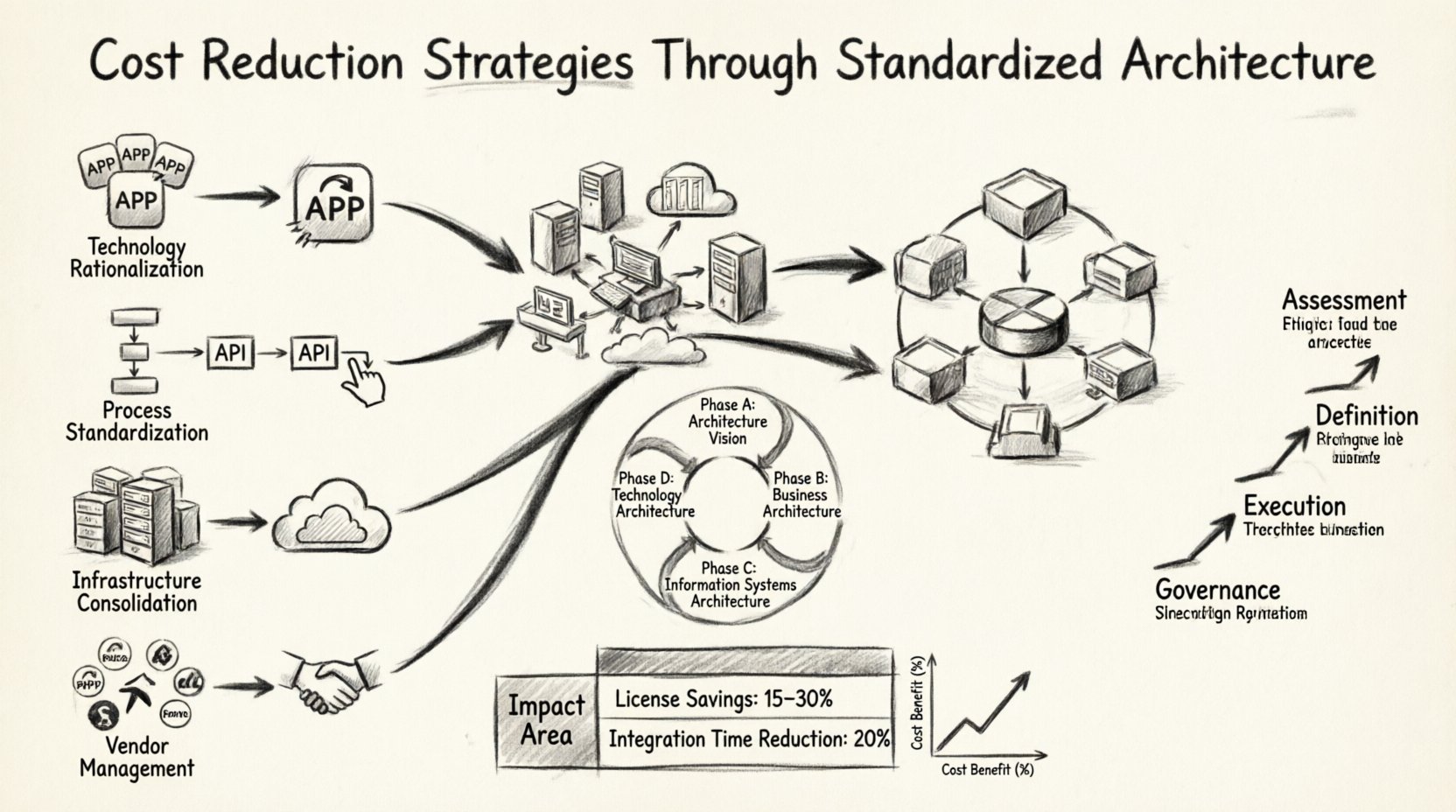
Enterprise technology landscapes often resemble a complex web of interconnected systems, each contributing to operational capability while simultaneously driving up expenditure. As organizations scale, the proliferation of disparate tools, redundant processes, and fragmented data structures creates significant financial friction. This is where the concept of standardized architecture becomes critical. By aligning technical structures with business goals through established frameworks, organizations can systematically identify waste and streamline operations.
Standardization does not imply rigidity. Instead, it establishes a baseline for consistency that allows for scalable growth without proportional cost increases. When applied within the context of TOGAF (The Open Group Architecture Framework), this approach offers a structured method for evaluating current states, defining target models, and managing the transition. The goal is not merely to cut budgets, but to optimize the value derived from every dollar spent on technology infrastructure.
🧩 The Link Between Architecture and Budget
There is a direct correlation between architectural chaos and financial inefficiency. When teams build solutions without adhering to a common standard, the result is often “shadow IT”—systems deployed without central oversight. These unauthorized deployments accumulate hidden costs in licensing, maintenance, security patches, and integration efforts.
- Redundant Licensing: Multiple departments purchasing similar tools independently leads to paying for functionality that could be shared.
- Integration Overhead: Unique interfaces require custom connectors, increasing development time and ongoing maintenance.
- Security Complexity: A fragmented environment presents more attack surfaces, requiring more resources for protection.
- Talent Scarcity: Maintaining a wide variety of niche technologies demands specialized skills that are expensive to recruit and retain.
Architecture acts as the governing body for these decisions. It ensures that every new investment is vetted against existing standards. This prevents the accumulation of technical debt, which often manifests as future costs that are far higher than the initial savings.
🛠️ TOGAF: A Foundation for Stability
The TOGAF framework provides a comprehensive methodology for designing, planning, implementing, and governing an enterprise information architecture. It is not a software product but a set of standards and best practices. Within the TOGAF Architecture Development Method (ADM), cost reduction is woven into several phases, particularly during the pre-architecture and transition phases.
Phase A: Architecture Vision sets the scope and constraints. Here, business objectives regarding cost efficiency are defined alongside performance targets. If the business case requires a 15% reduction in IT spend, the architecture must be designed to meet that constraint.
Phase B: Business Architecture ensures that the business processes are streamlined before technology is introduced. Often, cost reductions come from eliminating unnecessary steps in a workflow rather than buying cheaper software.
Phase C: Information Systems Architectures focuses on data and applications. This is where standardization is most visible. It dictates which application portfolios are retained, which are retired, and how data flows between them.
Phase D: Technology Architecture defines the hardware, network, and cloud infrastructure. Standardizing on a limited set of cloud providers or hardware types reduces the complexity of management.
💰 Core Strategies for Financial Efficiency
Implementing standardized architecture requires specific tactical moves. These strategies focus on rationalizing the technology portfolio and aligning it with business capabilities.
1. Technology Rationalization
Organizations often end up with multiple tools serving the same purpose. A systematic review can identify these overlaps. The process involves cataloging all active applications, assessing their usage, and determining their strategic value.
- Categorization: Group applications by function (e.g., CRM, HR, Finance).
- Usage Analysis: Identify which tools have low adoption rates.
- Consolidation: Select the best-performing tool and migrate users, retiring the rest.
- Renegotiation: Use the consolidated user base to negotiate better volume licensing terms with vendors.
2. Process Standardization
Technology costs are often driven by inefficient processes. If a process requires manual data entry across five different systems, the cost includes the labor hours plus the error correction time. Standardizing the architecture forces the standardization of the process.
- API-First Design: Define standard interfaces for data exchange to reduce custom coding.
- Common Data Models: Ensure all systems use the same definitions for key entities (e.g., “Customer,” “Product”).
- Automation: Identify manual touchpoints in the standard flow and introduce automation.
3. Infrastructure Consolidation
Moving from a multi-cloud or hybrid environment to a more standardized infrastructure can reduce management overhead. While flexibility is valuable, too many environments dilute security focus and increase operational costs.
- Cloud Strategy: Define a preferred list of cloud providers and services.
- Containerization: Standardize on container technologies to ensure portability and reduce environment-specific configuration.
- Network Topology: Simplify network architecture to reduce latency and management complexity.
4. Vendor Management Optimization
Managing relationships with many vendors is costly. A standardized architecture naturally reduces the vendor count. This allows for stronger negotiation leverage and consolidated support contracts.
- Single Point of Contact: Reduce the number of account managers to streamline communication.
- Performance Reviews: Conduct regular reviews of vendor performance against service level agreements.
- Exit Strategies: Plan for vendor transitions to prevent lock-in costs.
📊 Impact Analysis Table
The following table outlines how specific standardization initiatives translate into financial outcomes.
| Initiative | Area of Impact | Estimated Cost Benefit | Time to Realize |
|---|---|---|---|
| License Consolidation | Software Spend | 15-30% reduction in recurring costs | Immediate to 6 Months |
| API Standardization | Development Costs | 20% reduction in integration time | 6-12 Months |
| Infrastructure Rationalization | Cloud/Server Spend | 10-25% reduction in compute costs | 3-9 Months |
| Talent Cross-Training | HR & Operations | Reduced need for specialized contractors | 12-18 Months |
| Technical Debt Reduction | Maintenance | Significant long-term savings on bug fixes | 18+ Months |
📏 Measuring Architectural ROI
To ensure that standardization efforts are delivering value, key performance indicators (KPIs) must be established. Financial metrics alone are insufficient; operational metrics provide context for the savings.
- Cost Per Transaction: Measure the IT cost required to process a single business transaction (e.g., an order, a support ticket).
- System Availability: Standardized systems often have higher reliability, reducing downtime costs.
- Time to Provision: How long does it take to spin up a new environment? Standardization should decrease this time.
- Integration Complexity Score: A qualitative or quantitative measure of how many custom connections exist between systems.
- License Utilization Rate: The percentage of purchased licenses that are actively used.
⚠️ Risks of Over-Standardization
While standardization drives cost efficiency, it must not stifle innovation or business agility. There are risks to consider when enforcing rigid standards.
- Innovation Lag: Strict adherence to current standards may prevent the adoption of emerging technologies that could offer competitive advantages.
- Business Mismatch: A standard solution might not fit a specific niche business unit, leading to workarounds that bypass the architecture.
- Vendor Dependency: Standardizing on a single vendor creates a monopoly risk where price increases cannot be mitigated by switching.
- Implementation Friction: Moving teams to new standards requires training and change management, which has an upfront cost.
To mitigate these risks, architecture boards should include representatives from business units and innovation teams. Regular reviews should be scheduled to assess whether standards need to evolve based on market changes.
🚀 Implementation Roadmap
Executing a cost reduction strategy through standardized architecture is a multi-phase journey. It requires executive sponsorship, clear communication, and disciplined execution.
Phase 1: Assessment
Begin with a comprehensive inventory of the current state. Document all applications, infrastructure components, and data flows. Assess the current level of adherence to any existing standards.
- Conduct surveys with department heads regarding their pain points.
- Analyze financial records to identify high-cost areas.
- Map the current architecture against the TOGAF model to find gaps.
Phase 2: Definition
Define the target state architecture. This involves setting the standards for technology, data, and security. The architecture vision document should clearly state the cost reduction goals.
- Create a reference architecture that outlines approved technologies.
- Develop a catalog of standard services and APIs.
- Establish a governance process for approving exceptions.
Phase 3: Execution
Begin the migration from the current state to the target state. This is often the most resource-intensive phase.
- Phase out redundant systems first to realize immediate savings.
- Implement new projects according to the new standards.
- Provide training to development teams on the new standards.
Phase 4: Governance
Once the standards are in place, maintain them. Architecture review boards should evaluate new initiatives to ensure compliance.
- Conduct quarterly architecture reviews.
- Monitor KPIs to ensure cost targets are met.
- Update standards based on feedback and technological shifts.
🔍 Technical Debt and Long-Term Savings
A critical component of cost reduction is addressing technical debt. This refers to the implied cost of additional rework caused by choosing an easy solution now instead of using a better approach that would take longer. Standardized architecture directly combats the accumulation of technical debt.
When systems are built without standards, they often become incompatible with future systems. This forces organizations to build “bridges” or “spaghetti code” to make them talk to each other. Over time, these bridges become expensive to maintain. By enforcing standard interfaces and data models from the start, organizations build a foundation that supports future growth without requiring constant reconstruction.
Consider the lifecycle cost of a system. The initial development cost is often less than 20% of the total cost of ownership. The remaining 80% is spent on maintenance, support, and upgrades. Standardization reduces the maintenance burden by ensuring that components are predictable, documented, and supported by a common skill set.
🤝 Collaboration and Culture
Technical standards cannot be imposed by a central team alone. They require collaboration across the organization. Developers, operations, and business stakeholders must agree on what constitutes a standard.
- Developer Empowerment: Provide self-service tools that make following standards the path of least resistance.
- Feedback Loops: Create channels for teams to suggest improvements to standards.
- Education: Invest in training so that teams understand the “why” behind the standards, not just the “what”.
Cultural resistance is the most common barrier to architectural standardization. Teams may fear that standardization limits their creativity. It is essential to communicate that standards provide guardrails, not cages. They allow teams to focus on business logic rather than reinventing infrastructure components.
🌐 Global and Scalable Considerations
For organizations operating in multiple regions, standardization becomes even more critical. Regulatory requirements, data sovereignty laws, and local infrastructure capabilities vary by location. A standardized architecture framework can accommodate these variations without creating a fragmented system.
- Regional Exceptions: Define a clear process for handling regional deviations from the global standard.
- Data Localization: Ensure data architecture supports local storage requirements without breaking global integrations.
- Language and Time Zones: Standardize on systems that support internationalization and localization features.
By building flexibility into the standards themselves, organizations can scale globally while maintaining a unified cost structure. This prevents the scenario where a regional expansion doubles the IT operational costs due to unique local requirements.
📈 Final Thoughts on Architectural Efficiency
Reducing costs through standardized architecture is not a one-time event but an ongoing discipline. It requires continuous monitoring, adaptation, and governance. By leveraging frameworks like TOGAF, organizations can approach this challenge with a structured methodology that aligns technology spending with business value.
The benefits extend beyond immediate budget cuts. They include improved agility, better security posture, and a more resilient infrastructure. When architecture is treated as a strategic asset rather than a technical constraint, the organization gains the ability to pivot quickly in response to market changes without incurring prohibitive costs.
Success in this area depends on visibility and transparency. Leaders must have clear visibility into where money is being spent and how it correlates with architectural decisions. With the right tools and processes in place, standardized architecture becomes a powerful engine for sustainable financial health.