
In the complex landscape of enterprise transformation, consistency acts as the bedrock for sustainable success. Organizations often face fragmentation where disparate departments pursue conflicting technical strategies, leading to redundant investments and operational friction. This is where the concept of Architecture Principles becomes critical. Within the framework of TOGAF (The Open Group Architecture Framework), principles serve as the fundamental rules and guidelines that drive decision-making across the enterprise. They ensure that every system, process, and service aligns with the broader strategic intent of the organization.
This guide explores the mechanics of establishing, governing, and maintaining a robust set of architecture principles. We will examine how these principles function as a compass for architects, developers, and business leaders, ensuring that technological evolution does not stray from organizational goals.
Understanding Architecture Principles in TOGAF 🧭
Architecture principles are not merely suggestions or best practices. They are authoritative statements that define the constraints within which the enterprise operates. In TOGAF, these principles are documented within the Architecture Principles Repository. They provide the foundation for the Architecture Development Method (ADM), influencing decisions from the initial visioning phase through to implementation.
Core Characteristics
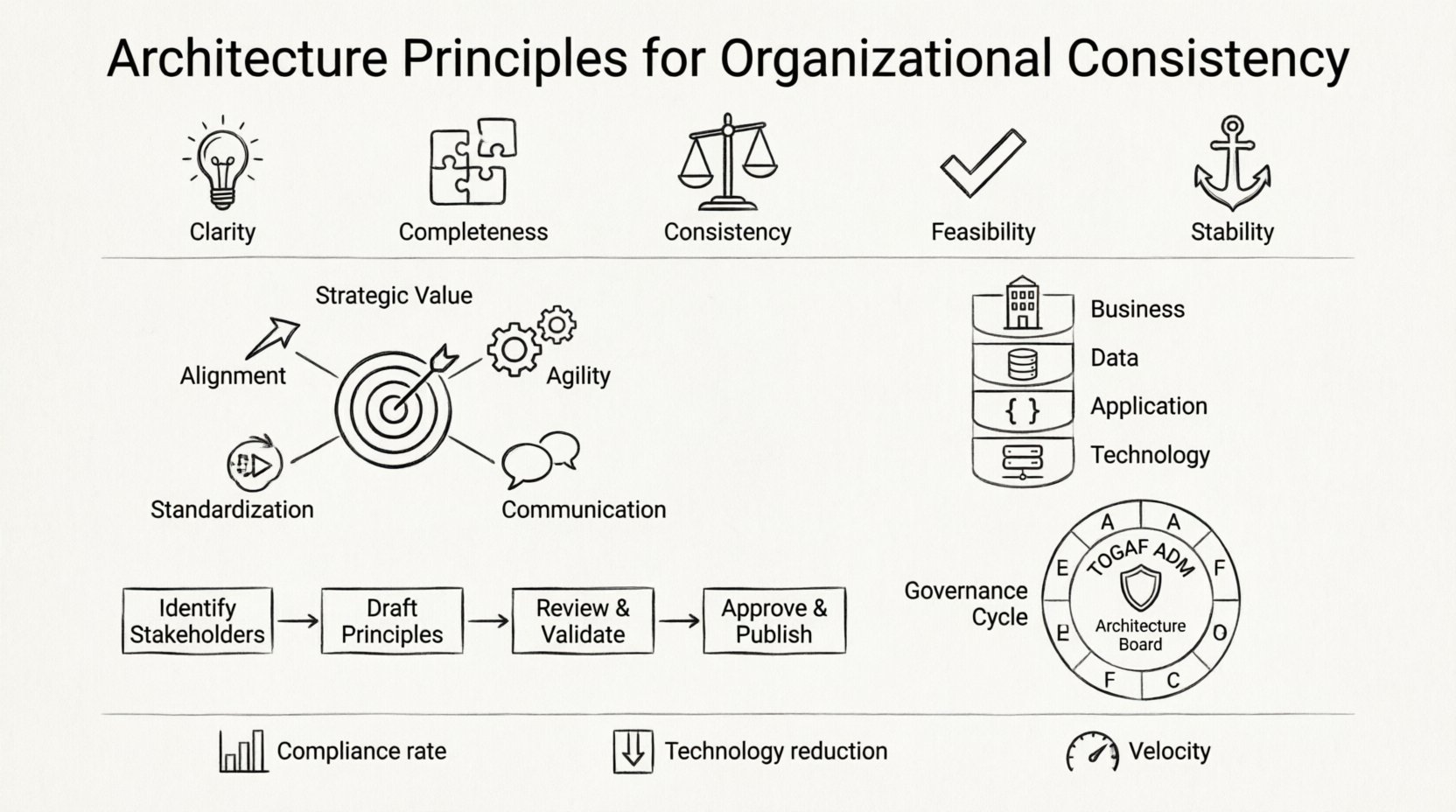
For principles to be effective, they must possess specific attributes. A vague guideline like “build secure systems” lacks the precision required for enforcement. Effective principles adhere to the following criteria:
- Clarity: They must be unambiguous and easily understood by all stakeholders.
- Completeness: They should cover the necessary scope without leaving critical gaps.
- Consistency: Principles must not contradict one another.
- Feasibility: They must be achievable within the current technological and business environment.
- Stability: They should remain valid over a reasonable period, avoiding frequent changes that confuse the workforce.
When principles meet these standards, they become stable anchors in a sea of changing market conditions.
The Strategic Value of Principles 📈
Why invest time in defining these rules? The answer lies in risk reduction and efficiency. Without principles, architectural decisions become reactive rather than proactive. Teams may select technologies based on short-term convenience rather than long-term viability. This leads to technical debt, where the cost of maintaining legacy systems outweighs the benefits of innovation.
Clear principles offer several strategic advantages:
- Alignment: They ensure IT capabilities map directly to business strategy.
- Standardization: They reduce the variety of technologies and platforms, lowering maintenance costs.
- Agility: By establishing boundaries, teams can move faster within those constraints without needing constant approval.
- Communication: They provide a shared vocabulary between technical and non-technical stakeholders.
Categorizing Principles for Holistic Coverage 📂
Principles span different layers of the enterprise architecture. TOGAF recommends categorizing them to ensure comprehensive coverage. A principle focusing on hardware may not address data privacy. Therefore, a layered approach is necessary.
Principle Categories
| Category | Focus Area | Example Principle |
|---|---|---|
| Business Principles | Organizational strategy, goals, and policies | “Customer data is owned by the business, not the IT department.” |
| Data Principles | Information management, quality, and governance | “Data is a shared asset; it must be accessible to authorized users.” |
| Application Principles | Software development, integration, and lifecycle | “Applications must be interoperable and loosely coupled.” |
| Technology Principles | Infrastructure, platforms, and tools | “Infrastructure must be scalable and resilient.” |
By covering these domains, the organization ensures that consistency is not siloed within a single department but permeates the entire value chain.
The Process of Developing Principles 🛠️
Creating principles is a collaborative effort. It requires input from various levels of the organization to ensure buy-in and practicality. The process generally follows a structured workflow.
Step 1: Identify Stakeholders and Context
Before writing a single rule, identify who will be affected by them. This includes executive leadership, department heads, architects, and key developers. Understanding the current state of the enterprise is vital. Are there existing policies that conflict with new ideas? Is the culture resistant to standardization?
Step 2: Drafting the Principles
Each principle should be stated clearly. A standard format often includes a Name, Statement, Rationale, and Business Implication. This structure forces the writer to justify why the rule exists and what it impacts.
- Name: A concise label for the principle.
- Statement: The directive itself (e.g., “Buy before Build”).
- Rationale: The reason behind the directive.
- Implication: The action required to comply.
Step 3: Review and Validation
Once drafted, principles must be reviewed by a representative group. They are tested against real-world scenarios. If a principle is too rigid, it may hinder innovation. If it is too loose, it offers no guidance. This iteration phase is crucial for tuning the balance between control and flexibility.
Step 4: Approval and Publication
Final approval comes from the Architecture Board or senior management. Once approved, the principles are published in a central repository. Accessibility is key. If stakeholders cannot find the principles, they cannot follow them.
Governance and Enforcement 🛡️
A set of principles without governance is merely a suggestion. Governance ensures that principles are applied consistently. In the TOGAF context, this is often managed by the Architecture Board.
The Role of the Architecture Board
The Architecture Board is a cross-functional body responsible for overseeing the architecture. Their duties include:
- Reviewing Proposals: Evaluating major projects to ensure they align with established principles.
- Resolving Conflicts: Deciding when a business need outweighs a technical principle.
- Monitoring Compliance: Tracking adherence through audits and assessments.
Compliance Assessment
Compliance does not mean policing every line of code. It means establishing checkpoints in the project lifecycle. These checkpoints act as gates. If a project proposes a solution that violates a principle, it must undergo a formal trade-off analysis.
This analysis documents the risk of non-compliance. If the business risk of compliance is too high, a waiver may be granted. However, waivers should be rare and time-bound. This maintains the integrity of the principles while allowing for necessary exceptions.
Implementing Principles in the ADM Cycle ⚙️
The Architecture Development Method (ADM) is the core process of TOGAF. Principles influence specific phases of this cycle.
Phase A: Architecture Vision
Principles are defined early here. They set the boundaries for the architecture scope. If the vision contradicts a core principle, the vision must be adjusted.
Phase B, C, D: Business, Information Systems, Technology
During the development of specific architectures, principles act as constraints. Architects use them to select models, technologies, and standards. They prevent the drift toward custom solutions that cannot be maintained.
Phase E, F: Opportunities and Solutions, Migration Planning
When planning transitions, principles guide the prioritization of work. Projects that reinforce principles are often prioritized over those that create new debt.
Phase G: Implementation Governance
This phase ensures that the built solution matches the design. Principles are referenced here to validate that the deployment has not deviated from the architectural intent.
Phase H: Change Management
As the enterprise evolves, principles may need adjustment. Phase H provides the mechanism to review the architecture and its governing rules periodically.
Maintaining the Principle Repository 📚
Principles are living documents. They require maintenance to remain relevant. A principle that was valid five years ago might be obsolete today due to cloud adoption or security shifts.
Lifecycle of a Principle
| Stage | Description |
|---|---|
| Proposed | The principle is drafted and under review. |
| Approved | Formal authorization has been granted. |
| Published | The principle is available to the organization. |
| Retired | The principle is no longer applicable and is archived. |
Regular audits are necessary to identify retired principles. Cluttering the repository with outdated rules creates confusion. Organizations should schedule annual reviews of their principle set.
Common Pitfalls to Avoid 🚫
Even well-intentioned initiatives can fail due to common mistakes. Awareness of these pitfalls helps in crafting a more effective framework.
- Too Many Principles: A list of fifty principles is as good as none. Focus on the essential rules that drive the most value. Quality over quantity.
- Technical Jargon: Principles should be understandable by business leaders. Avoid acronyms and overly technical language.
- Lack of Enforcement: If principles are ignored without consequence, they lose credibility. Governance must be active.
- Static Mindset: Treating principles as permanent laws rather than adaptable guidelines. The market changes, and principles must evolve.
- Isolation: Developing principles without consulting the teams who will use them. This leads to resistance and rejection.
Measuring the Impact of Principles 📊
How do you know if the principles are working? Metrics provide the evidence. While principles are qualitative, their impact can be measured quantitatively.
Consider tracking the following indicators:
- Compliance Rate: The percentage of projects that adhere to principles without waivers.
- Technology Reduction: A decrease in the number of distinct technologies in use.
- Project Velocity: An increase in delivery speed due to reduced decision-making friction.
- Technical Debt: A stabilization or reduction in the backlog of technical debt.
- Stakeholder Satisfaction: Feedback from business units regarding the clarity and support provided by architecture.
Fostering a Culture of Architectural Discipline 🧠
Tools and processes are insufficient without the right culture. The organization must value consistency. This involves training and continuous education.
Education and Training
Architects and developers need to understand the why behind the principles. Workshops and documentation should explain the rationale. When people understand the business value, compliance becomes a natural behavior rather than a bureaucratic hurdle.
Communication Channels
Regular newsletters, town halls, and internal portals keep principles top-of-mind. Celebrating success stories where principles saved time or money reinforces their value. Recognizing teams that adhere to standards encourages others to follow suit.
Adapting to Modern Architectural Trends 🔄
The environment for architecture is shifting. Cloud-native technologies, microservices, and AI are changing how systems are built. Principles must reflect these realities.
For instance, a legacy principle might state “Centralize data.” In a modern context, this might evolve to “Distribute data logically for low latency, while maintaining centralized governance.” The core value (governance) remains, but the implementation constraint changes.
Agile and DevOps practices also influence principles. Traditional waterfall governance may need to be adapted to fit continuous integration pipelines. Principles should support automation, not hinder it. They must enable the speed of modern delivery while maintaining the stability required for enterprise operations.
Conclusion on Consistency and Success 🎯
Defining clear architecture principles is not an administrative exercise. It is a strategic imperative. It provides the framework within which innovation can safely occur. By establishing a clear set of rules, an organization reduces risk, lowers costs, and improves the quality of its digital assets.
The journey requires commitment from leadership and participation from the technical workforce. It demands regular review and a willingness to adapt. However, the payoff is an organization that moves with purpose. Technology serves the business, rather than the business chasing technology. Through disciplined application of architecture principles, consistency becomes a competitive advantage.
Start by auditing your current state. Identify the gaps. Engage your stakeholders. Draft the rules that matter. Govern them rigorously. And evolve them as the enterprise grows. This is the path to architectural maturity and sustained organizational success.