
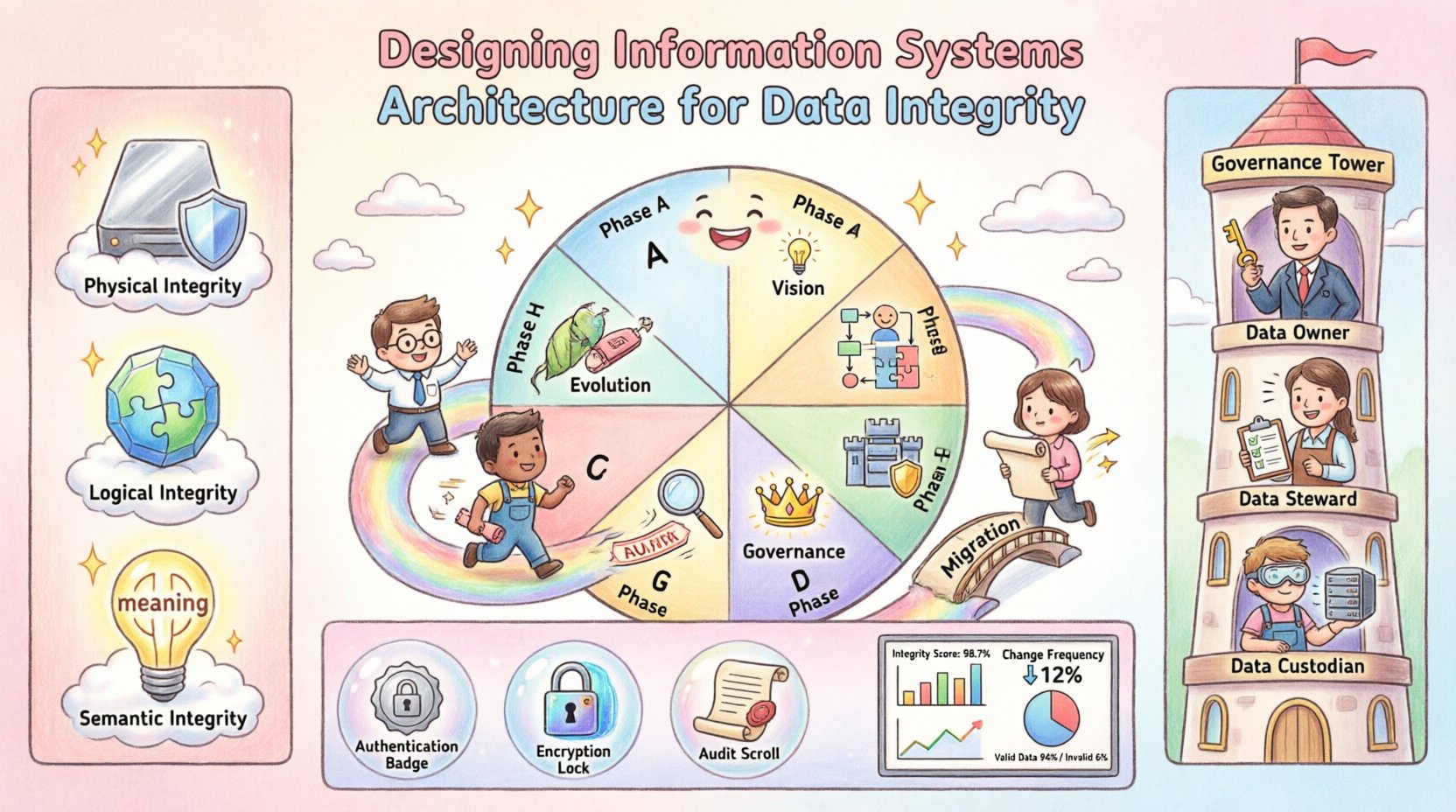
In the modern enterprise, data is not merely a byproduct of operations; it is a critical asset that drives decision-making, regulatory compliance, and competitive advantage. However, the value of this asset is contingent upon its integrity. Ensuring that data remains accurate, consistent, and trustworthy throughout its lifecycle requires a deliberate architectural approach. This guide explores the structural principles necessary to embed data integrity into the core of information systems, specifically utilizing the framework provided by The Open Group Architecture Framework (TOGAF).
Building a robust architecture involves more than just selecting storage solutions. It demands a holistic view that spans business strategy, logical data models, physical infrastructure, and governance policies. By aligning technical implementation with business requirements, organizations can mitigate risks associated with data corruption, loss, and unauthorized modification. The following sections detail the comprehensive steps required to achieve this alignment.
💎 Understanding Data Integrity in Enterprise Architecture
Before integrating data integrity into the architecture, it is essential to define what integrity means within the context of information systems. Integrity is not a singular state but a collection of attributes that ensure data reliability.
Types of Integrity
- Physical Integrity: This concerns the protection of data on storage media. It involves hardware reliability, redundancy, and protection against physical damage or environmental hazards.
- Logical Integrity: This relates to the accuracy and consistency of data within the system. It includes rules such as entity integrity (unique identifiers), referential integrity (relationships between tables), and domain integrity (valid data types).
- Semantic Integrity: This ensures that data accurately reflects the real-world entities it represents. It involves business rules and context that give meaning to the raw data.
The Cost of Compromised Integrity
When data integrity is weak, the consequences ripple across the organization. Financial discrepancies, operational errors, and compliance failures are common outcomes. Furthermore, trust in the system erodes, leading to reduced adoption of new tools and hesitation in data-driven initiatives. A strong architecture prevents these issues at the design stage rather than attempting to fix them after deployment.
📐 The TOGAF Framework Connection
The Open Group Architecture Framework (TOGAF) provides a standardized method for designing, planning, implementing, and governing enterprise information architecture. While TOGAF is broad, its Architecture Development Method (ADM) offers specific touchpoints where data integrity must be addressed.
TOGAF views data as a shared resource that must be managed consistently across the enterprise. This perspective aligns perfectly with the need for integrity. By treating data architecture as a distinct but interconnected domain within the Information Systems Architecture, architects can ensure that integrity controls are woven into every layer of the system.
Key TOGAF Components for Data Integrity
- Enterprise Data Model: A high-level abstraction of the data entities and relationships across the organization.
- Data Standards: Defined rules for data formats, naming conventions, and validation logic.
- Data Governance: The organizational structure responsible for managing data quality and security.
- Security Architecture: Mechanisms to protect data from unauthorized access and tampering.
🔄 Integrating Data Integrity into the ADM
The Architecture Development Method (ADM) is the core cycle of TOGAF. It consists of several phases, each offering opportunities to strengthen data integrity. Below is a detailed breakdown of how integrity considerations fit into each phase.
Phase A: Architecture Vision
This initial phase sets the scope and objectives. Here, the need for data integrity must be articulated as a business driver. Stakeholders define the risks associated with poor data quality and establish the vision for a trustworthy information environment. Key activities include:
- Identifying critical data assets that require high levels of protection.
- Defining integrity requirements in terms of accuracy, timeliness, and consistency.
- Establishing the business case for investing in robust data controls.
Phase B: Business Architecture
In this phase, the focus shifts to business processes and capabilities. Data integrity is supported by defining the business rules that govern how data is created and used. Activities include:
- Mapping business processes to data flows to identify touchpoints where errors might occur.
- Defining roles and responsibilities for data ownership within business units.
- Ensuring that business rules are unambiguous and enforceable.
Phase C: Information Systems Architecture
This is the most critical phase for data integrity, as it involves the detailed design of data and application architectures. It is divided into Data Architecture and Application Architecture.
Data Architecture
- Designing the logical data model to enforce entity and referential integrity.
- Specifying constraints on data entry to prevent invalid values from entering the system.
- Planning for data replication strategies that maintain consistency across distributed systems.
- Defining data retention and archival policies to preserve historical accuracy.
Application Architecture
- Ensuring applications validate data before processing or storage.
- Implementing transaction management to guarantee atomicity (all-or-nothing operations).
- Designing interfaces that prevent data corruption during transmission between systems.
Phase D: Technology Architecture
This phase deals with the hardware and software infrastructure. Integrity is supported by selecting technologies that offer reliability features. Considerations include:
- Choosing storage solutions with built-in redundancy and error correction.
- Implementing network protocols that ensure secure and reliable data transmission.
- Configuring backup and recovery systems to restore data integrity in the event of failure.
Phase E: Opportunities and Solutions
Here, the organization determines the best approach to achieve the architecture. This involves selecting standards and governance mechanisms. Key actions include:
- Establishing data quality standards that will be measured and monitored.
- Defining the governance structure to oversee data integrity initiatives.
- Planning for incremental improvements to existing systems to enhance integrity controls.
Phase F: Migration Planning
This phase outlines how to transition from the current state to the target state. Integrity must be maintained during migration. Strategies include:
- Creating validation scripts to verify data accuracy before and after migration.
- Implementing parallel runs to compare outputs from old and new systems.
- Establishing rollback plans if data corruption is detected during the transition.
Phase G: Implementation Governance
During the build and deployment phases, governance ensures that the architecture is followed. This involves:
- Auditing code and configurations for adherence to integrity standards.
- Monitoring performance to ensure that integrity checks do not degrade system speed.
- Managing changes to the data schema to prevent unintended side effects.
Phase H: Architecture Change Management
The final phase ensures the architecture evolves over time. As business needs change, integrity controls must adapt. Activities include:
- Reviewing data governance policies periodically.
- Assessing new threats to data integrity and updating controls accordingly.
- Continuing to refine data models based on usage patterns.
📜 Governance and Policy Framework
Technical controls alone are insufficient without a strong governance framework. Governance provides the authority and accountability needed to enforce integrity standards.
Data Governance Roles
- Data Owners: Senior executives responsible for specific data domains. They define what data means and who can access it.
- Data Stewards: Operational roles responsible for data quality and integrity. They enforce policies and resolve data issues.
- Data Custodians: Technical teams responsible for the storage and maintenance of data assets.
Policy Implementation
Policies must be clear and actionable. They should cover:
- Acceptable use of data.
- Protocols for handling data errors.
- Requirements for audit trails and logging.
- Standards for data entry and validation.
🔒 Security and Access Control
Security and integrity are closely linked. Unauthorized access can lead to intentional corruption or accidental modification. A layered security approach is necessary.
Authentication and Authorization
- Implementing strict identity verification before granting access to systems.
- Using the principle of least privilege to ensure users only access data necessary for their role.
- Enforcing multi-factor authentication for sensitive data operations.
Encryption
- Encrypting data at rest to protect against physical theft of storage media.
- Encrypting data in transit to prevent interception and tampering during transmission.
- Managing encryption keys securely to ensure data can be recovered when needed.
Audit and Logging
Every modification to critical data should be recorded. Logs provide the evidence needed to investigate incidents and verify compliance.
- Logging who accessed data and when.
- Logging what changes were made to specific records.
- Protecting logs from modification to ensure their integrity.
📈 Monitoring and Continuous Improvement
Data integrity is not a one-time achievement; it requires ongoing monitoring. Organizations must establish metrics to track the health of their data.
Key Performance Indicators (KPIs)
- Percentage of records with validation errors.
- Frequency of data reconciliation failures.
- Time taken to detect and resolve integrity issues.
- Number of unauthorized access attempts.
Automated Quality Checks
Automation reduces the burden on human operators and ensures checks are performed consistently.
- Scheduled scripts to check for orphaned records.
- Real-time validation at the point of entry.
- Anomaly detection systems to flag unusual data patterns.
📊 TOGAF Phases and Data Integrity Activities
The following table summarizes the relationship between TOGAF phases and specific integrity activities.
| TOGAF Phase | Focus Area | Key Integrity Activities |
|---|---|---|
| Phase A | Vision | Define integrity requirements and business risks. |
| Phase B | Business | Map processes to data flows and define business rules. |
| Phase C | Information Systems | Design logical models, constraints, and transaction logic. |
| Phase D | Technology | Select reliable infrastructure and backup mechanisms. |
| Phase E | Opportunities | Establish governance and quality standards. |
| Phase F | Migration | Validate data during transition and plan rollbacks. |
| Phase G | Implementation | Audit code for compliance and monitor performance. |
| Phase H | Change Mgmt | Review policies and adapt to new threats. |
⚠️ Risk Management and Resilience
Even with strong controls, risks remain. A resilient architecture anticipates failure and has mechanisms to recover.
Threat Modeling
Architects should analyze potential threats to data integrity. Common threats include:
- Human Error: Accidental deletion or modification.
- Malicious Activity: Insider threats or external attacks.
- System Failure: Hardware crashes or software bugs.
- Network Issues: Data corruption during transmission.
Disaster Recovery
Recovery plans must ensure that data can be restored to a consistent state. This involves regular testing of backup restoration procedures to verify that data integrity is preserved over time.
🛠️ Best Practices for Implementation
To ensure success, organizations should adopt specific best practices throughout the design and operation of their systems.
- Standardize Data Definitions: Avoid ambiguity by using a centralized data dictionary.
- Enforce Validation Early: Check data validity at the user interface level, not just in the database.
- Design for Auditability: Build logging capabilities into the core system, not as an afterthought.
- Separation of Duties: Ensure that the person who writes code is not the same person who approves changes to production data.
- Regular Reviews: Conduct periodic architecture reviews to ensure integrity controls remain effective.
🚀 Conclusion
Designing information systems architecture for data integrity is a complex task that requires coordination between business strategy and technical execution. By leveraging the structured approach of TOGAF, organizations can ensure that data integrity is not an afterthought but a foundational element of their enterprise architecture. Through careful planning, robust governance, and continuous monitoring, systems can be built to maintain the accuracy and trustworthiness of data over the long term. This commitment to integrity ultimately supports better decision-making, regulatory compliance, and organizational resilience.
As the volume and velocity of data continue to grow, the principles outlined here remain relevant. The goal is not perfection, but a state of managed risk where data remains a reliable asset for the enterprise. By following these guidelines, architects can build systems that stand the test of time and change.