
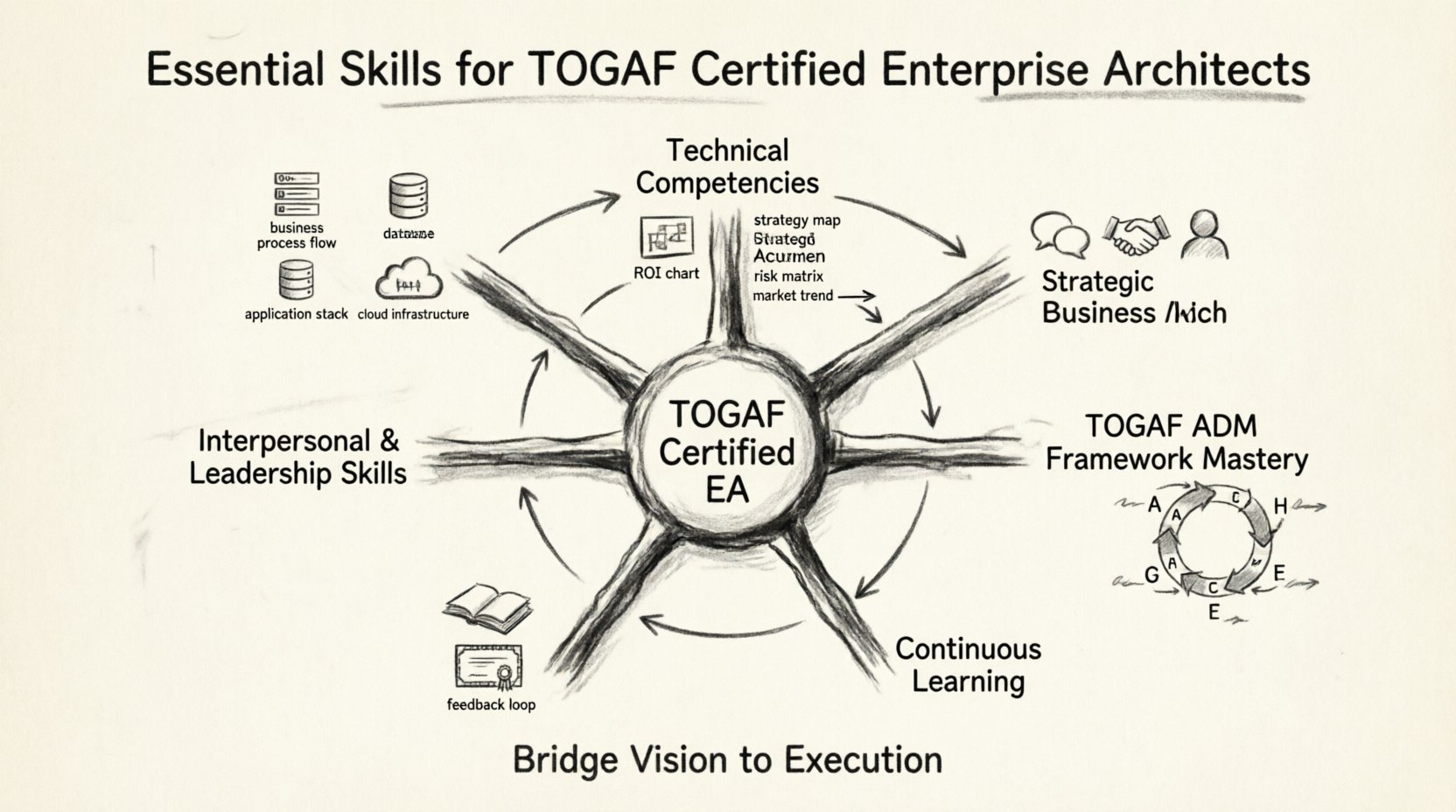
The landscape of modern enterprise technology is complex, dynamic, and ever-evolving. In this environment, the role of the Enterprise Architect (EA) has become pivotal in aligning business strategy with IT capabilities. The TOGAF Certified Enterprise Architect certification stands as a benchmark for professional competence, signaling a deep understanding of frameworks, methodologies, and best practices. However, certification alone does not guarantee success. A practitioner must cultivate a robust set of skills that span technical depth, strategic vision, and interpersonal agility.
This guide outlines the core competencies required to excel in this discipline. It moves beyond theoretical knowledge to address the practical application of the TOGAF standard within real-world organizational contexts. By focusing on these essential areas, architects can drive meaningful transformation and sustainable value.
Understanding the TOGAF Framework 📚
Before diving into specific skills, it is necessary to grasp the foundation upon which the role is built. TOGAF (The Open Group Architecture Framework) provides a structured approach for designing, planning, implementing, and governing an enterprise information architecture. It is not merely a checklist but a comprehensive methodology.
- The Architecture Development Method (ADM): The heart of TOGAF, the ADM is an iterative process used to develop an enterprise architecture. It consists of distinct phases, from Preliminary to Architecture Change Management.
- The Enterprise Continuum: A mechanism for organizing and classifying architecture assets, ensuring consistency and reusability across the organization.
- The Architecture Repository: A central store of information that captures the outputs of the ADM process, including models, standards, and guidelines.
A certified architect must understand how these components interact. The ADM is not a linear path; it requires iteration and feedback loops. Mastery of this cycle ensures that architectural decisions remain aligned with shifting business needs.
Core Technical & Architectural Competencies 🔧
Technical proficiency is the bedrock of enterprise architecture. Without a solid grasp of the underlying technologies and modeling techniques, an architect cannot effectively guide development teams or evaluate solutions. These skills ensure that the proposed architecture is feasible, scalable, and secure.
1. Business Architecture Alignment 🏢
The first layer of the TOGAF Content Metamodel focuses on Business Architecture. This involves defining the business strategy, governance, organization, and key business processes.
- Process Modeling: Ability to map current and future state business processes using standard notation. This helps identify inefficiencies and opportunities for automation.
- Value Streams: Understanding how value is delivered to customers. Architects must trace the flow of value from initiation to delivery to ensure IT supports these flows.
- Organizational Mapping: Defining how the organization is structured to deliver its mission. This includes stakeholder identification and responsibility allocation.
2. Data & Information Management 📊
Data is the lifeblood of modern enterprises. An EA must understand how data is created, stored, moved, and consumed.
- Data Governance: Establishing policies and standards for data quality, security, and accessibility.
- Information Systems: Designing the logical and physical structures that manage data. This includes database design and data flow management.
- Data Integration: Ensuring disparate systems can exchange information seamlessly. This often involves understanding APIs, middleware, and data exchange formats.
3. Application Architecture 🖥️
This domain focuses on the software applications that support business processes and data management.
- Portfolio Management: Managing the lifecycle of applications, deciding what to build, buy, or retire.
- Integration Patterns: Knowledge of how applications communicate, such as microservices, event-driven architectures, or service-oriented architectures.
- Functional Requirements: Translating business needs into functional specifications that developers can implement.
4. Technology Architecture 💻
The final layer addresses the hardware, software, and network infrastructure required to support the applications and data.
- Infrastructure Design: Planning for cloud, on-premise, or hybrid environments. This includes capacity planning and redundancy strategies.
- Security Architecture: Embedding security controls into the infrastructure design. This covers identity management, encryption, and network segmentation.
- Standards Compliance: Ensuring technology choices adhere to industry standards and regulatory requirements.
The Architecture Development Method (ADM) Phases ⚙️
To apply these technical skills effectively, an architect must navigate the ADM phases. Each phase demands specific actions and deliverables.
- Phase A: Architecture Vision: Defining the scope, constraints, and stakeholders. Creating the initial architecture statement of work.
- Phase B: Business Architecture: Developing the business model and process maps.
- Phase C: Information Systems Architectures: Designing the data and application architectures.
- Phase D: Technology Architecture: Defining the technical infrastructure.
- Phase E: Opportunities & Solutions: Identifying implementation projects and migration strategies.
- Phase F: Migration Planning: Creating a detailed roadmap for moving from current to target state.
- Phase G: Implementation Governance: Ensuring the projects align with the architecture during execution.
- Phase H: Architecture Change Management: Managing changes to the architecture over time.
Proficiency in these phases ensures that the architecture is not just a theoretical document but a living guide for implementation.
Strategic & Business Acumen 🧠
Enterprise architects are not just technical experts; they are strategic partners. They must understand the business context deeply to make decisions that drive revenue, reduce costs, or mitigate risk.
- Financial Literacy: Understanding budgeting, ROI analysis, and total cost of ownership. Architects must justify investments in technology based on business value.
- Risk Management: Identifying potential risks associated with new technologies or architectural changes. This includes compliance risks and operational stability.
- Market Trends: Staying informed about industry shifts. Understanding where the market is going helps in future-proofing the enterprise architecture.
- Change Management: Implementing architecture often requires significant cultural and operational changes. Architects must plan for adoption and resistance.
Interpersonal & Leadership Skills 🤝
The most complex part of the job is often the human element. An architect must influence stakeholders who may not share their technical vocabulary. Soft skills are critical for success in this role.
1. Communication 🗣️
Effective communication involves translating technical concepts into business language.
- Storytelling: Using narratives to explain the value of the architecture to non-technical audiences.
- Visual Communication: Using diagrams and models to simplify complex relationships.
- Active Listening: Understanding the underlying concerns of stakeholders, not just their stated requirements.
2. Stakeholder Management 🤝
Identifying and engaging with the right people is essential.
- Power Mapping: Understanding who has influence and who has interest in the architecture decisions.
- Negotiation: Balancing conflicting requirements from different departments.
- Consensus Building: Facilitating agreement among diverse groups to move forward with a unified direction.
3. Leadership & Mentorship 👔
Architects often lead without direct authority.
- Inspiration: Motivating teams to adopt new standards and practices.
- Mentoring: Guiding junior architects and developers in best practices.
- Critical Thinking: Challenging assumptions and questioning the status quo to find better solutions.
Competency Matrix for TOGAF Architects 📋
To summarize the skills required, the following matrix categorizes competencies by their impact on the organization.
| Category | Key Skill | Impact on Organization |
|---|---|---|
| Technical | System Modeling | Ensures systems are interoperable and scalable. |
| Strategic | Business Alignment | Guarantees IT investments support business goals. |
| Interpersonal | Stakeholder Communication | Reduces friction and increases adoption rates. |
| Governance | Compliance Monitoring | Minimizes legal and regulatory risks. |
| Adaptability | Change Management | Facilitates smooth transitions during digital transformation. |
Continuous Learning & Adaptation 🔄
The technology landscape does not stand still. New paradigms such as cloud computing, artificial intelligence, and edge computing constantly reshape the architecture environment. A certified architect must commit to lifelong learning.
- Industry Certifications: Pursuing additional credentials to validate expertise in specific domains like security or cloud.
- Community Engagement: Participating in forums, conferences, and user groups to exchange knowledge.
- Experimentation: Allocating time to test new tools and methodologies in sandbox environments.
- Feedback Loops: Actively seeking feedback on architectural decisions to improve future outcomes.
Staying current is not optional; it is a requirement for maintaining relevance and effectiveness. The TOGAF standard itself is updated periodically, and architects must keep pace with these revisions to ensure their practices remain valid.
Building an Architecture Capability Framework 🏗️
Beyond individual skills, the organization needs a structured capability to support architecture efforts. This involves defining roles, responsibilities, and processes.
- Architecture Board: A governance body that reviews and approves architectural decisions.
- Standards Library: A centralized repository of approved technologies and patterns.
- Assessment Tools: Mechanisms to evaluate the health of the architecture against defined metrics.
- Training Programs: Initiatives to upskill staff on architectural principles and tools.
Establishing this framework ensures that the skills of individual architects are leveraged effectively across the enterprise. It transforms architecture from an ad-hoc activity into a disciplined function.
Practical Application of Skills in the Field 🛠️
Theoretical knowledge must be translated into action. Here is how these skills manifest in day-to-day work.
Scenario 1: Digital Transformation Initiative
When an organization decides to move to a cloud-native model, the architect uses Business Architecture to define the target operating model. They apply Data Architecture principles to plan data migration strategies. They engage stakeholders to manage expectations regarding downtime and performance. This requires a blend of technical foresight and people management.
Scenario 2: Legacy System Modernization
Modernizing old systems involves significant risk. The architect utilizes the ADM to assess the current state. They identify dependencies and integration points. They negotiate with vendors for new solutions while ensuring internal teams understand the changes. This scenario highlights the importance of risk management and communication.
Scenario 3: Security Compliance Audit
During an audit, the architect demonstrates how the architecture meets regulatory requirements. They present evidence from the Architecture Repository. They propose remediation plans for any gaps found. This showcases the governance and compliance aspects of the role.
Overcoming Common Challenges 🚧
Even skilled architects face obstacles. Recognizing these challenges allows for better preparation.
- Lack of Executive Support: Without sponsorship, architectural initiatives stall. Architects must demonstrate value clearly to secure buy-in.
- Siloed Information: Data often resides in disconnected departments. Architects must work to break down these silos through integration and shared standards.
- Resistance to Change: Teams may prefer familiar tools over new architectures. Training and clear communication of benefits are essential here.
- Budget Constraints: Resources are often limited. Architects must prioritize initiatives that offer the highest return on investment.
Final Thoughts on Professional Growth 🌱
Becoming a proficient Enterprise Architect is a journey that combines technical rigor with strategic insight. It requires a commitment to understanding the business, mastering the tools of the trade, and leading with empathy. The TOGAF certification provides a strong foundation, but the skills developed through practice define true expertise.
By focusing on the areas outlined in this guide—technical depth, strategic alignment, and interpersonal agility—architects can navigate the complexities of modern enterprise environments. They become the bridge between vision and execution, ensuring that technology serves the organization effectively. Continuous improvement remains the key to long-term success in this dynamic field.
The path forward involves staying curious, remaining adaptable, and always prioritizing the value delivered to the business. With these skills in place, the role of the Enterprise Architect becomes not just a job, but a catalyst for innovation and stability.