
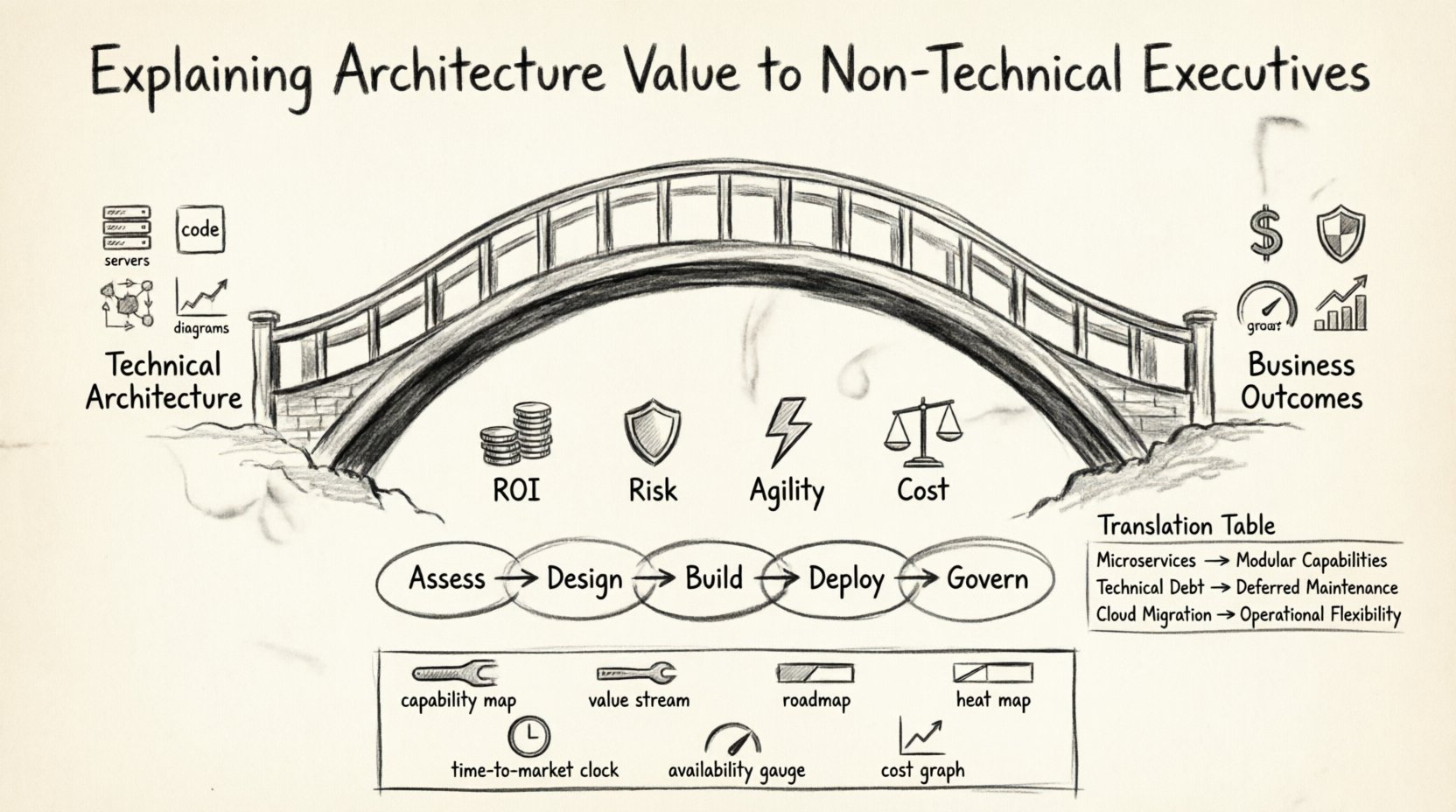
Enterprise Architecture often gets stuck in the technical weeds, buried under acronyms, diagrams, and frameworks that mean nothing to a CEO or CFO. When an architect speaks to a board member, the conversation must shift from infrastructure to impact. This guide provides a structured approach to translating complex architectural concepts into business language that drives decision-making. We will explore how to leverage the TOGAF framework without drowning your audience in theory.
🤔 The Communication Gap: Why It Matters
Executives do not manage technology; they manage risk, growth, and capital. They view technology as a means to an end, not the end itself. When you present an architecture proposal focused on refactoring a legacy database or upgrading a server cluster, you risk losing their attention immediately. They need to understand the strategic implication of that change.
- The Problem: Technical teams often default to feature lists and technical debt metrics.
- The Solution: Map every technical activity to a business outcome.
- The Goal: Enable informed investment decisions based on capability and risk.
Without this translation, architecture looks like a cost center that slows down delivery. With it, architecture becomes the blueprint for strategic agility.
🎯 The Executive Perspective: What They Actually Want
To communicate effectively, you must understand the priorities of the C-suite. These priorities generally fall into four categories: Financial Performance, Risk Management, Operational Efficiency, and Market Speed.
When discussing architecture, frame your points within these buckets. For example, do not say “We need to migrate to a microservices architecture.” Say, “This change will reduce the time required to launch new products by 30% and allow us to scale infrastructure costs based on actual usage.”
Key Executive Priorities:
- ROI: How does this investment generate revenue or save money?
- Risk: Are we exposing the company to compliance issues or security breaches?
- Agility: Can we pivot quickly if market conditions change?
- Cost: Are we spending money efficiently on technology?
🔄 Simplifying TOGAF for the Boardroom
The TOGAF Architecture Development Method (ADM) is a powerful cycle, but explaining its phases verbatim can be confusing. Instead, treat the ADM as a business planning cycle.
- Preliminary Phase: Setting the rules of engagement. Business equivalent: Defining governance and standards.
- Architecture Vision: Defining the goal. Business equivalent: Strategic vision and scope.
- Business Architecture: Understanding capabilities. Business equivalent: Organizational capabilities and processes.
- Information Systems: Data and applications. Business equivalent: Tools and data assets needed to run the business.
- Technology: Infrastructure. Business equivalent: The underlying platform supporting the tools.
- Implementation: Execution. Business equivalent: Project delivery and change management.
By mapping these phases to business planning steps, you make the framework familiar. You are not asking them to learn a new method; you are showing them how their existing strategy is supported by a structured process.
💰 Financial Translation: From Cost to Investment
One of the hardest tasks is converting technical debt into financial terms. Executives understand the cost of debt, but they do not understand the cost of technical debt. You must quantify the risk of inaction.
Example Scenarios:
- Scenario A: “Our legacy system takes 4 hours to patch.”
Translation: “Patching takes 4 hours of downtime, which results in lost sales of $5,000 per incident. We estimate 4 incidents a year, totaling $20,000 in lost revenue plus labor costs.” - Scenario B: “We have 50 redundant applications.”
Translation: “Maintaining 50 redundant applications costs $500,000 annually in licenses and support. Consolidating them will save $300,000 in the first year.” - Scenario C: “We need to improve security architecture.”
Translation: “Current controls leave us vulnerable to data breaches. A breach could cost us $5 million in fines and reputation damage. This investment reduces that probability significantly.”
🛡️ Risk Communication: Security and Compliance
Regulatory compliance is a language executives understand. In many industries, failing to comply means fines or loss of license. Architecture plays a critical role in ensuring these requirements are met.
When discussing architecture, highlight how it enables compliance rather than just blocking progress.
- Standardization: Reduces complexity, making audits easier and cheaper.
- Data Governance: Ensures customer data is handled according to legal requirements (e.g., GDPR, CCPA).
- Vendor Management: Architecture ensures third-party tools meet security standards.
Presenting architecture as a shield against regulatory fines is often more effective than presenting it as a technical improvement.
📊 The Language of Architecture: A Translation Table
To avoid jargon, use a consistent translation table during presentations. This ensures everyone speaks the same language.
| Technical Term | Business Equivalent | Why It Matters |
|---|---|---|
| Microservices | Modular Capabilities | Allows independent updates without breaking the whole system. |
| APIs | Business Interfaces | Standardized ways for different departments to share data. |
| Cloud Migration | Operational Flexibility | Shifts costs from fixed capital to variable operational expenses. |
| Legacy System | Outdated Process | Slows down new initiatives due to maintenance overhead. |
| Technical Debt | Deferred Maintenance | Future cost that is higher than the cost of fixing it now. |
| Scalability | Growth Capacity | Ability to handle more customers without service failure. |
| High Availability | Business Continuity | Ensures the business stays open even if parts fail. |
| Integration | Process Automation | Reduces manual work and errors between departments. |
🎨 Visualizing the Intangible: Diagrams and Roadmaps
Executives are visual learners, but they do not want to read complex UML diagrams. Use simplified visuals that tell a story.
- Capability Maps: Show which business functions exist and which are weak.
- Value Streams: Show how value is created from start to finish, highlighting bottlenecks.
- Investment Roadmaps: Show where money will be spent over time to achieve goals.
- Heat Maps: Highlight areas of high risk or high opportunity visually.
A roadmap should look like a project plan, not a network diagram. Use milestones that align with fiscal quarters or business planning cycles. This makes the timeline feel familiar and actionable.
🚀 Strategic Alignment: Connecting IT to Market Goals
Architecture must serve the business strategy, not the other way around. If the company strategy is “Market Expansion,” the architecture must support rapid deployment in new regions. If the strategy is “Cost Leadership,” the architecture must prioritize efficiency and consolidation.
Steps to Align:
- Review the Corporate Strategy: Read the annual report or strategic plan.
- Identify Enablers: What technology capabilities are needed to achieve these goals?
- Gap Analysis: What is missing in the current state?
- Propose Solutions: Present architectural changes as the bridge to fill the gap.
This approach ensures that every dollar spent on architecture is tied directly to a corporate objective. It moves the conversation from “What do we need?” to “What do we need to win?”
🗣️ Handling Objections and Pushback
You will face resistance. Common objections include “This is too slow” and “Why do we need a plan?”
Objection: “This is too slow.”
- Response: “Short term, we are setting standards. Long term, we reduce rework. If we build without a plan, we will have to tear it down in six months. This saves time later.”
Objection: “Why do we need a plan?”
- Response: “Without a plan, we are building on shifting sand. If a competitor changes the market, we need to know how our systems will hold up. This is risk management.”
Objection: “It costs too much.”
- Response: “We are comparing the cost of this project to the cost of technical debt. The debt is a hidden tax on every new project we launch. This investment removes that tax.”
📈 Measuring Architecture Success
How do you prove the value of architecture? You need metrics that matter to the business.
- Time to Market: How long does it take to launch a new feature?
- System Availability: How often is the system down?
- Cost per Transaction: How much does it cost to process a sale?
- Compliance Pass Rate: How many audits are passed without issues?
- Developer Productivity: How long does it take to provision a new environment?
Track these metrics over time. Show the trend line. If Time to Market decreases after an architectural intervention, you have proof of value. Data speaks louder than opinions.
🤝 Building Long-Term Trust
Trust is built over time through consistency and honesty. Do not promise what you cannot deliver. If a project will take longer than expected, communicate it early.
Best Practices for Trust:
- Speak Plainly: Avoid jargon unless you define it immediately.
- Listen First: Understand their concerns before proposing a solution.
- Be Honest About Trade-offs: If a choice has a downside, admit it. This shows integrity.
- Follow Up: Report on the status of your initiatives regularly.
When executives trust the architect, they view the architecture function as a strategic partner rather than a roadblock. This shift in perception is the ultimate goal of communication.
🛑 Common Pitfalls to Avoid
Avoid these common mistakes when presenting to non-technical leaders.
- Too Much Detail: Do not show the configuration settings. Show the business outcome.
- Acronym Soup: Never use an acronym without defining it first, or better yet, do not use it at all.
- Focusing on the “How”: Spend 80% of the time on the “Why” and 20% on the “How”.
- Ignoring the Business Context: Do not discuss technology in a vacuum. Always tie it back to revenue, cost, or risk.
- Being Defensive: If challenged, listen. Do not argue. Explain the reasoning behind the recommendation.
🚦 Creating a Sustainable Dialogue
Architecture is not a one-time presentation. It is an ongoing conversation. Schedule regular reviews with key stakeholders.
- Quarterly Business Reviews: Review architectural progress against business goals.
- Advisory Boards: Form a group of business leaders to guide architectural direction.
- Newsletters: Send brief updates on major architectural changes and their benefits.
Consistency keeps the topic top of mind. It prevents architecture from being seen as an afterthought when a crisis hits.
🏁 Final Thoughts on Value
Explaining architecture value is not about simplifying the work; it is about clarifying the impact. When you successfully translate technical decisions into business outcomes, you empower leaders to make better choices. This alignment ensures that technology serves the organization’s mission.
Remember, your goal is not to prove you are right. Your goal is to help the business succeed. When the business succeeds, the architecture succeeds by definition. Keep the focus on the mission, the metrics, and the market. That is where the value lives.