
Expanding into foreign markets demands precision. It is not merely about selling a product elsewhere; it is about navigating a complex web of external forces. A PEST Analysis remains one of the most reliable frameworks for mapping these forces. For international business strategy, understanding the Political, Economic, Social, and Technological landscapes is critical. This guide provides a step-by-step walkthrough to execute this analysis effectively.
Without this groundwork, organizations risk misallocating resources or facing unforeseen regulatory hurdles. We will explore each dimension with a focus on cross-border operations, ensuring your expansion plan rests on solid data rather than assumptions. Let us begin the process.
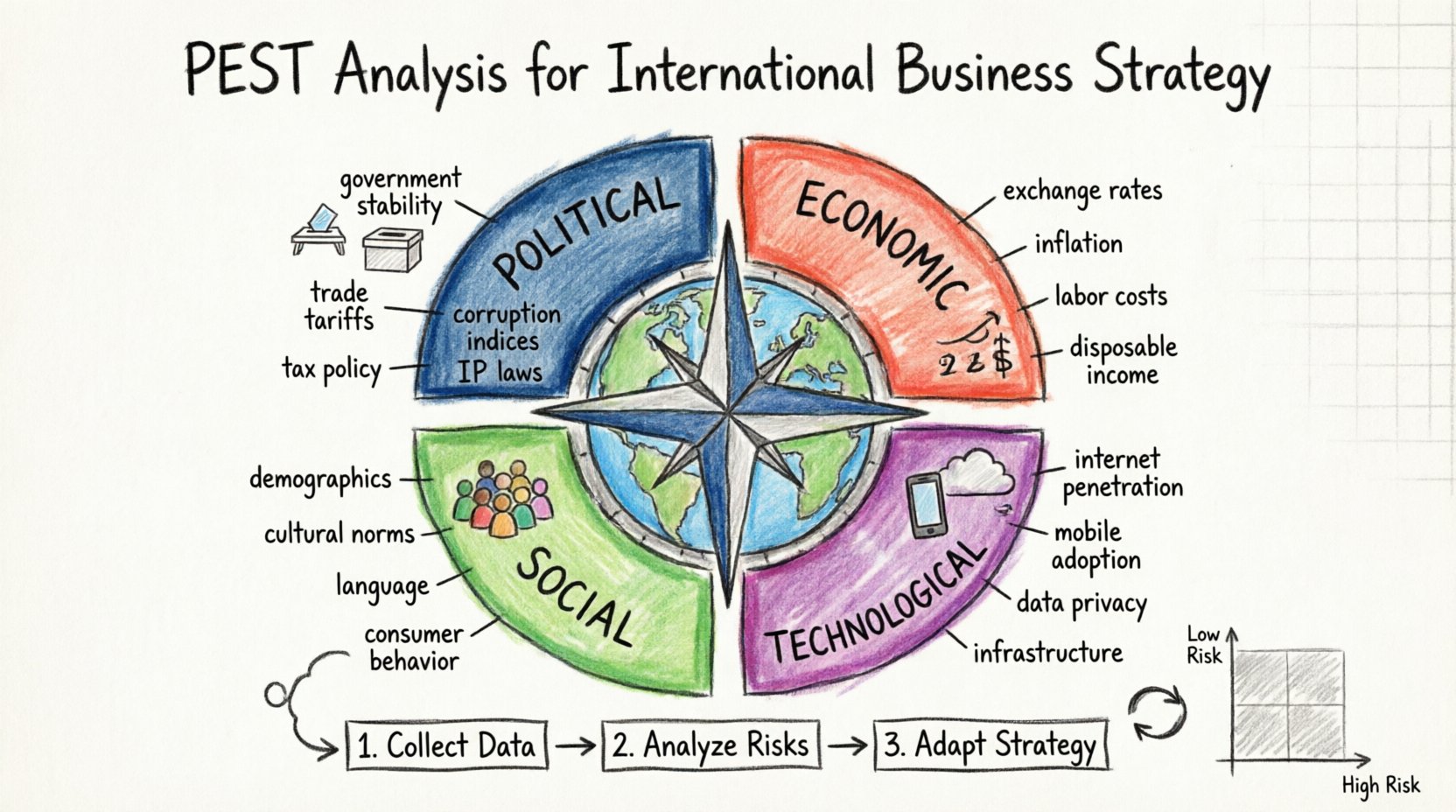
1. Understanding the Framework for Global Markets 🧭
PEST stands for Political, Economic, Social, and Technological. While the acronym is familiar, the application changes significantly when moving from domestic to international contexts. In a local setting, regulations and culture are often static. Globally, they are dynamic and fragmented.
- Political: Involves government stability, trade tariffs, and foreign policy.
- Economic: Covers exchange rates, inflation, and labor costs across borders.
- Social: Relates to cultural norms, demographics, and language barriers.
- Technological: Encompasses infrastructure, digital adoption, and IP laws.
When planning international growth, you must treat each country as a unique ecosystem. A strategy that works in one region may fail in another due to these macro-environmental factors.
2. The Political Dimension: Navigating Stability and Regulation ⚖️
Political factors dictate the rules of engagement. In international business, this is often the highest risk category. You must assess the stability of the government and the predictability of policy changes.
Key Areas of Investigation
- Government Stability: Is the regime likely to change soon? Frequent elections or coups can disrupt business continuity.
- Trade Regulations: Are there import/export restrictions? Look for quotas, embargoes, or sanctions.
- Tax Policy: Understand corporate tax rates, withholding taxes on dividends, and VAT structures.
- Corruption Indices: High corruption can increase operational costs and legal risks.
- Intellectual Property Laws: How strictly are patents and copyrights enforced in the target region?
Practical Application
When evaluating a potential market, create a risk matrix. Assign scores based on the severity of political risks. For example, a country with a strong democracy and stable trade agreements scores lower risk than one with volatile policies.
| Factor | Low Risk Indicator | High Risk Indicator |
|---|---|---|
| Government Stability | Long-serving administration, peaceful transitions | Frequent elections, history of unrest |
| Trade Barriers | Free trade agreements, low tariffs | Protectionist policies, high tariffs |
| Legal Enforcement | Independent judiciary, transparent courts | Corrupt judiciary, arbitrary rulings |
Consider the geopolitical relationship between your home country and the target market. Diplomatic tensions can lead to sudden changes in visa requirements for staff or restrictions on capital flow.
3. The Economic Dimension: Assessing Financial Viability 💰
Economic factors determine whether your business model is financially sustainable in a new territory. You must look beyond simple GDP figures to understand the purchasing power and cost structure.
Critical Economic Indicators
- Exchange Rates: Volatility can wipe out profit margins. Is the currency pegged or floating?
- Inflation Rates: High inflation erodes purchasing power and increases input costs.
- Interest Rates: Affects the cost of borrowing capital for expansion.
- Labor Costs: Compare wage levels against productivity and skill availability.
- Disposable Income: Does the population have the money to buy your product?
Regional Economic Nuances
Developed markets often have high labor costs but stable currencies. Emerging markets might offer lower costs but carry higher inflation risks. You must decide which metric aligns with your strategic goals.
- For Cost Leadership: Look for regions with low labor costs and favorable tax incentives.
- For Market Penetration: Focus on regions with high GDP growth and rising middle classes.
- For Stability: Prioritize economies with low inflation and strong currency reserves.
It is also vital to understand the banking infrastructure. Can you easily repatriate profits? Are there restrictions on foreign currency conversion? These operational details often become bottlenecks later in the process.
4. The Social Dimension: Culture and Demographics 🧑🤝🧑
Social factors are often the most underestimated aspect of international strategy. A product that succeeds at home might fail abroad if it clashes with local values or habits.
Demographic Analysis
- Population Growth: Is the market expanding or shrinking?
- Age Distribution: A younger population might prefer digital solutions, while an older one might prefer traditional service models.
- Urbanization: High urbanization rates suggest easier logistics and distribution networks.
Cultural Considerations
Language is the first barrier. Beyond translation, consider localization. Humor, colors, and imagery have different meanings in different cultures.
- Communication Styles: Some cultures value directness, while others prefer indirect communication.
- Religious Practices: Holidays and dietary restrictions can impact operations and marketing calendars.
- Work Ethic: Understanding local expectations regarding hours, weekends, and hierarchy is essential for HR management.
- Consumer Behavior: How do people shop? Do they prefer online or brick-and-mortar? Do they value brand prestige or price?
| Cultural Aspect | Question to Ask | Impact on Strategy |
|---|---|---|
| Language | Is English widely spoken or is a local language required? | Marketing budget allocation for translation |
| Values | Is individualism or collectivism prioritized? | Team structure and marketing messaging |
| Time Perception | Is time viewed linearly or flexibly? | Scheduling and deadline management |
Conducting focus groups with local consumers is a recommended step to validate assumptions before launching. Relying solely on home-market data is a common pitfall.
5. The Technological Dimension: Infrastructure and Innovation 📱
Technological factors define how your product is delivered and consumed. In international expansion, infrastructure gaps can be the biggest hurdle.
Infrastructure Assessment
- Internet Penetration: Is high-speed connectivity available in your target cities?
- Mobile Adoption: In some regions, mobile is the primary device for internet access.
- Logistics Network: How reliable is the shipping and delivery infrastructure?
- Power Reliability: Are there frequent outages that require backup generators?
Regulatory Tech Environment
Technology laws vary widely. Data sovereignty is a major concern. Some countries require that customer data be stored locally within their borders.
- Data Privacy: Does the region have GDPR-like regulations?
- Cybersecurity Laws: What are the reporting requirements for breaches?
- Technology Bans: Are certain foreign technologies restricted or banned?
If your business relies on cloud services, verify the latency and availability of servers in the target region. If you are selling hardware, consider the voltage standards and plug types.
6. Data Collection Strategies 🔍
Gathering accurate information is the foundation of a valid analysis. You need a mix of qualitative and quantitative data.
Primary Research Methods
- Expert Interviews: Consult with local industry experts or consultants.
- Surveys: Gather direct feedback from potential customers.
- Site Visits: Physical observation of retail environments and infrastructure.
Secondary Research Sources
- Government Reports: Census data, trade statistics, and economic outlooks.
- International Organizations: World Bank, IMF, and UN provide standardized data.
- Industry Associations: Local chambers of commerce often have market insights.
- News Media: Monitor local news for emerging regulatory changes.
Avoid relying on a single source. Cross-reference data points to ensure accuracy. For instance, if a government report claims high growth, check if private sector analysts agree.
7. Synthesizing Findings into Strategy 📝
Once you have gathered the data, the analysis phase begins. You must translate findings into actionable business decisions.
Identifying Opportunities and Threats
- Opportunities: Look for gaps in the market where local competition is weak.
- Threats: Identify regulatory changes that could block entry.
Strategic Scenarios
Develop scenarios based on your findings. What happens if the currency devalues by 10%? What if a new trade agreement is signed?
- Best Case: Favorable regulations and strong demand.
- Worst Case: Economic downturn and political instability.
- Most Likely: A balanced projection based on current trends.
Use this analysis to decide on the mode of entry. A high-risk political environment might suggest a joint venture with a local partner rather than a wholly-owned subsidiary.
8. Implementation and Monitoring 🔄
A PEST Analysis is not a one-time exercise. The international landscape changes rapidly. You must establish a system to monitor these factors continuously.
Setting Up Monitoring
- Key Indicators: Define specific metrics to watch, such as exchange rates or election dates.
- Alert Systems: Subscribe to newsletters or set up news alerts for your target countries.
- Regular Reviews: Schedule quarterly reviews of your PEST data.
Adapting the Strategy
If a significant change occurs, such as a new tariff, you must be ready to pivot. Flexibility is a core component of international strategy.
- Adjust pricing models if currency fluctuates.
- Modify supply chains if trade policies shift.
- Reallocate marketing budgets if consumer sentiment changes.
9. Common Pitfalls to Avoid ⚠️
Even with a solid framework, mistakes happen. Being aware of common errors helps you navigate the process more safely.
- Overgeneralization: Assuming a country is a monolith. Brazil is not the same as Argentina.
- Home Bias: Judging foreign markets by your own country’s standards.
- Ignoring Soft Factors: Focusing only on hard data like GDP and ignoring cultural nuances.
- Static Analysis: Treating the report as a static document rather than a living tool.
- Insufficient Localization: Failing to adapt products to local tastes or regulations.
10. Final Thoughts on Global Expansion 🌏
Executing a PEST Analysis for international business strategy requires patience and diligence. It is a tool for risk mitigation and opportunity identification. By systematically analyzing political, economic, social, and technological factors, you build a foundation for sustainable growth.
Remember that no market is perfectly predictable. The goal is not to eliminate risk but to understand it well enough to manage it. Continuous learning and adaptation are the keys to long-term success in foreign markets. Start your analysis today, and proceed with data-driven confidence.