
In the complex landscape of modern business strategy, relying on a single analytical framework often leads to blind spots. The PEST analysis provides a solid foundation for understanding macro-environmental factors, yet it operates best when combined with other strategic tools. This guide explores how to integrate PEST with complementary models to create a robust, hybrid approach for comprehensive business analysis.
Strategic decision-making requires a multi-dimensional view. By weaving together external environmental scanning with internal capability assessments and industry-specific dynamics, organizations can build a clearer picture of their operational reality. This document details the mechanics of combining these frameworks without relying on specific software tools, focusing on process, logic, and human insight.
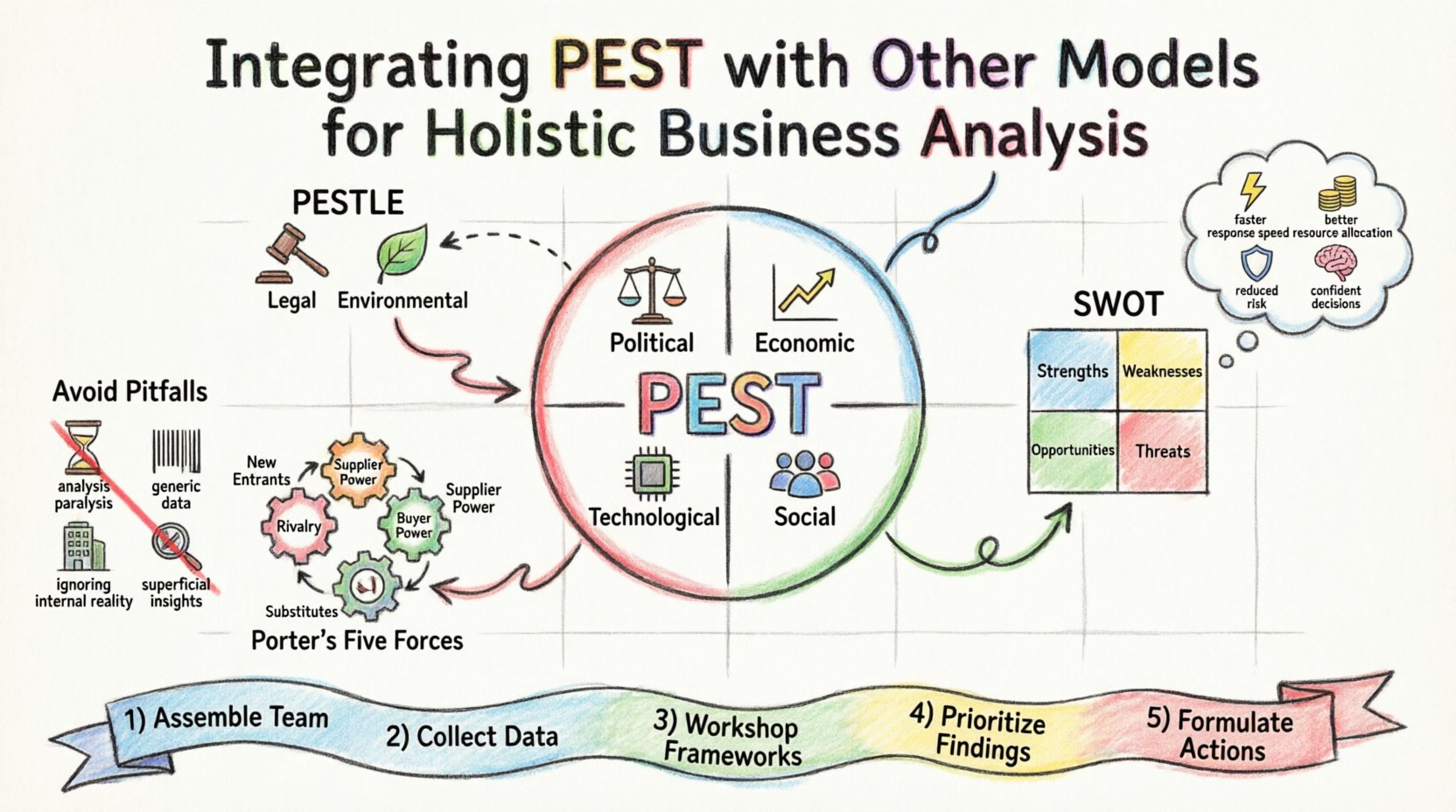
📋 Understanding the Core PEST Framework
Before merging frameworks, it is essential to revisit the core components of the PEST model. This acronym stands for Political, Economic, Social, and Technological factors. These represent the external forces that influence an organization but are beyond its direct control.
- Political: Government policies, tax laws, trade restrictions, labor laws, and political stability.
- Economic: Interest rates, inflation rates, economic growth, exchange rates, and disposable income.
- Social: Demographic shifts, cultural trends, population growth, age distribution, and health consciousness.
- Technological: R&D activity, automation, technological incentives, and the rate of technological change.
While these categories are distinct, they often overlap in real-world scenarios. For instance, a technological shift (Technological) might be driven by government funding (Political) or impact the workforce (Social). Recognizing these interconnections is the first step toward hybrid analysis.
🚫 The Limitation of Isolation
Using PEST in isolation creates a gap between the external environment and internal organizational capacity. A company might identify a favorable economic trend but lack the resources to capitalize on it. Conversely, a strong internal team might be irrelevant if the political climate shifts unfavorably. To mitigate this, integration is necessary.
Common limitations of standalone PEST include:
- Lack of focus on industry-specific competition.
- No assessment of internal strengths or weaknesses.
- Potential for information overload without prioritization.
- Static view that may not account for rapid change.
🔗 Integrating PEST with SWOT Analysis
The most common hybrid model pairs PEST with SWOT (Strengths, Weaknesses, Opportunities, Threats). This combination bridges the gap between macro-environmental factors and micro-organizational factors.
The Mapping Process
To integrate these effectively, follow a structured mapping exercise:
- Identify External Factors: List all relevant PEST factors.
- Categorize as Opportunities or Threats: Determine if each PEST factor aids or hinders the organization.
- Match with Internal Factors: Align Opportunities with Strengths and Threats with Weaknesses.
Example Integration Table
| PEST Factor | Classification | Internal Strength/Weakness | Strategic Action |
|---|---|---|---|
| Rising Interest Rates (Economic) | Threat | High Debt Load (Weakness) | Refinance debt or reduce leverage. |
| Growing Remote Work Culture (Social) | Opportunity | Strong Digital Infrastructure (Strength) | Expand remote hiring and office reduction. |
| New Data Privacy Laws (Political) | Threat | Legacy IT Systems (Weakness) | Invest in compliance technology immediately. |
| AI Advancements (Technological) | Opportunity | Strong Data Science Team (Strength) | Launch AI-driven product features. |
This matrix forces leadership to consider not just what is happening outside, but how the organization stands to react. It transforms abstract data into actionable strategy.
🏭 Adding Porter’s Five Forces
While PEST looks at the macro-environment and SWOT looks at internal health, Porter’s Five Forces examines the specific industry dynamics. Integrating all three provides a 360-degree view of the market.
The Five Forces Defined
- Threat of New Entrants: How easy is it for new competitors to enter the market?
- Bargaining Power of Suppliers: Can suppliers drive up prices or reduce quality?
- Bargaining Power of Buyers: Can customers drive down prices or demand more service?
- Threat of Substitute Products: Are there alternative solutions to the problem being solved?
- Rivalry Among Existing Competitors: How intense is the current competition?
Connecting the Dots
PEST factors often drive changes in Porter’s Five Forces. For example, a technological breakthrough (Technological) might lower the barrier to entry (Threat of New Entrants). A shift in social values (Social) might increase the bargaining power of buyers who demand ethical sourcing.
When conducting this hybrid analysis, consider the following workflow:
- Step 1: Conduct the PEST analysis to identify macro shifts.
- Step 2: Evaluate how these shifts impact the five forces.
- Step 3: Assess internal capabilities (SWOT) to respond to the new force landscape.
- Step 4: Develop a strategic response that addresses all three layers.
This layered approach prevents organizations from optimizing for the industry while ignoring the broader economy, or vice versa.
🌿 Expanding to PESTLE
Sometimes, the standard PEST model feels too narrow. The PESTLE framework adds Legal and Environmental factors. This is particularly relevant for industries facing strict regulatory scrutiny or sustainability mandates.
Legal Factors
Legal considerations often overlap with Political factors but are distinct. They include consumer protection laws, employment law, health and safety regulations, and intellectual property rights. When integrating PESTLE with SWOT, legal compliance becomes a specific operational constraint.
Environmental Factors
Environmental factors cover ecological and environmental aspects such as carbon footprint, climate change, waste management, and energy consumption. In a hybrid model, these factors should be treated as critical risks or opportunities depending on the industry.
For example, a manufacturing firm might find that:
- Environmental (PESTLE): Stricter emissions regulations are incoming.
- Porter’s (Industry): Competitors are already investing in green tech.
- SWOT (Internal): The firm currently lacks green technology (Weakness).
- Action: Partner with a green tech provider to mitigate risk.
🔮 Scenario Planning and PEST
Static analysis assumes the future looks like the past. Scenario planning challenges this by creating multiple potential futures. PEST is an ideal tool for scenario building because macro factors often change in waves.
Developing Scenarios
Use the PEST factors to define the axes of your scenarios. For instance:
- Scenario A (High Growth): Strong economic growth, low interest rates, rapid tech adoption.
- Scenario B (Stagflation): High inflation, low growth, supply chain disruptions.
- Scenario C (Regulatory Shift): New government policies, strict labor laws, political instability.
Once scenarios are defined, apply the SWOT and Porter’s models to each one. This tests the resilience of your strategy against different external realities. It answers the question: “Does our strategy hold up if the Economic factor shifts dramatically?”
⚙️ Implementation Guide: A Step-by-Step Process
Executing a hybrid analysis requires discipline and collaboration. Below is a practical workflow for conducting this analysis without relying on proprietary software platforms.
1. Assemble the Cross-Functional Team
Strategy is not the sole responsibility of the executive suite. Include representatives from:
- Finance (for Economic data)
- Operations (for Technological and Legal constraints)
- Marketing (for Social trends)
- Human Resources (for Labor laws and demographics)
- Legal (for Regulatory compliance)
2. Data Collection and Validation
Gather information from reliable sources. Avoid speculation. Use:
- Government reports and census data.
- Industry publications and market research.
- Internal performance metrics.
- Customer feedback and sales data.
3. Workshop the Frameworks
Conduct a series of workshops. Start with PEST to set the context. Move to Porter’s to define industry pressure. Finish with SWOT to define internal readiness. Use physical whiteboards or digital collaboration tools to map connections visually.
4. Prioritize Findings
You will generate a significant amount of data. Use a prioritization matrix to rank factors based on:
- Impact: How much will this factor affect the business?
- Probability: How likely is this factor to occur or change?
5. Formulate Strategic Actions
Translate the insights into specific initiatives. Ensure every action traces back to at least one factor identified in the PEST, Porter’s, or SWOT analysis. This maintains alignment and prevents strategic drift.
⚠️ Common Pitfalls to Avoid
Even with a robust framework, execution can go wrong. Be wary of these common mistakes.
- Analysis Paralysis: Spending too much time collecting data and not enough time deciding. Set time limits for each phase.
- Generic Data: Avoid vague statements like “Economy is good.” Use specific metrics like “GDP growth is projected at 2.5%.”
- Ignoring Internal Reality: An opportunity is useless if the organization lacks the capacity to seize it. Always cross-reference with internal capabilities.
- Static Mindset: Treat the analysis as a snapshot, not a permanent document. Schedule regular reviews (quarterly or semi-annually).
- Disconnecting Departments: If Marketing identifies a social trend but Finance does not understand the cost implications, the strategy will fail. Ensure cross-departmental communication.
📈 Measuring the Impact of the Hybrid Approach
How do you know if this integrated method is working? Look for improvements in strategic agility and risk mitigation.
- Speed of Response: Does the organization adapt faster to market changes?
- Resource Allocation: Are capital and talent directed toward the highest-impact opportunities?
- Risk Reduction: Are there fewer unexpected disruptions due to unmonitored external factors?
- Decision Confidence: Does leadership feel more certain about long-term bets?
Tracking these metrics helps validate the investment of time in the hybrid analysis process. It moves the conversation from “we did the analysis” to “the analysis improved our outcomes”.
🤝 Collaboration and Communication
The success of a hybrid model relies heavily on how well the findings are communicated. A complex matrix is useless if stakeholders cannot understand it.
- Visual Summaries: Create one-page summaries that highlight key connections between PEST and internal capabilities.
- Storytelling: Frame the data as a narrative. Explain the “why” behind the strategy, not just the “what”.
- Feedback Loops: Allow teams to challenge the analysis. Frontline employees often spot trends before executives do.
🌐 Global Considerations
For organizations operating across borders, the PEST analysis must be localized. A factor that is positive in one region might be negative in another.
- Political: Stability varies by country.
- Economic: Currency volatility differs by market.
- Social: Cultural norms dictate consumer behavior.
- Technological: Infrastructure maturity varies widely.
When integrating this globally, use a tiered approach. Conduct a global PEST for overarching strategy, then drill down into country-specific PESTs for regional execution. This ensures consistency without sacrificing local relevance.
🔄 Iterative Refinement
Business is dynamic. The hybrid model should not be a one-time event. It requires a cycle of continuous improvement.
- Monitor Triggers: Define specific events that trigger a re-evaluation (e.g., a new law passes, a competitor launches a product).
- Update Data: Refresh the underlying data points regularly.
- Reassess Priorities: What was a high priority last year might be low priority today. Re-rank factors.
- Learn from Outcomes: Review past decisions. Did the analysis predict the outcome? If not, why? Adjust the model.
🛠 Tools for Execution
While specific software is not required, certain tools can aid the process.
- Spreadsheet Software: Excellent for building matrices, calculating scores, and managing large datasets.
- Whiteboarding: Physical or digital boards allow for flexible arrangement of ideas during workshops.
- Project Management Boards: Useful for tracking the implementation of strategic actions derived from the analysis.
- Survey Tools: Gather stakeholder opinions on risk and opportunity likelihood.
📉 Financial Implications
Strategic alignment has a direct impact on the bottom line. Integrating these models helps in:
- Capital Budgeting: Directing investment toward areas with the highest external and internal alignment.
- Cost Control: Identifying external risks that could lead to unexpected costs (e.g., tariff changes).
- Revenue Forecasting: Creating more accurate revenue models based on economic and social trends.
🌱 Sustainability and Ethics
Modern business analysis cannot ignore ethical considerations. As part of the Social and Legal factors, consider the ethical implications of strategic choices.
- Does the strategy align with consumer values?
- Are there environmental costs that are currently unpriced?
- Is the labor model sustainable in the long term?
Integrating these ethical dimensions into the PESTLE framework ensures that the business remains viable and respected in the future market.
🎯 Final Considerations
Building a holistic business analysis requires patience and rigor. The integration of PEST with SWOT, Porter’s Five Forces, and Scenario Planning creates a safety net against strategic blindness. It forces leaders to look outward, inward, and forward simultaneously.
By adhering to a structured process and avoiding common pitfalls, organizations can turn raw data into clear direction. The goal is not to predict the future with certainty, but to prepare for multiple possibilities with confidence. This hybrid approach remains a cornerstone of effective strategic planning in an uncertain world.