
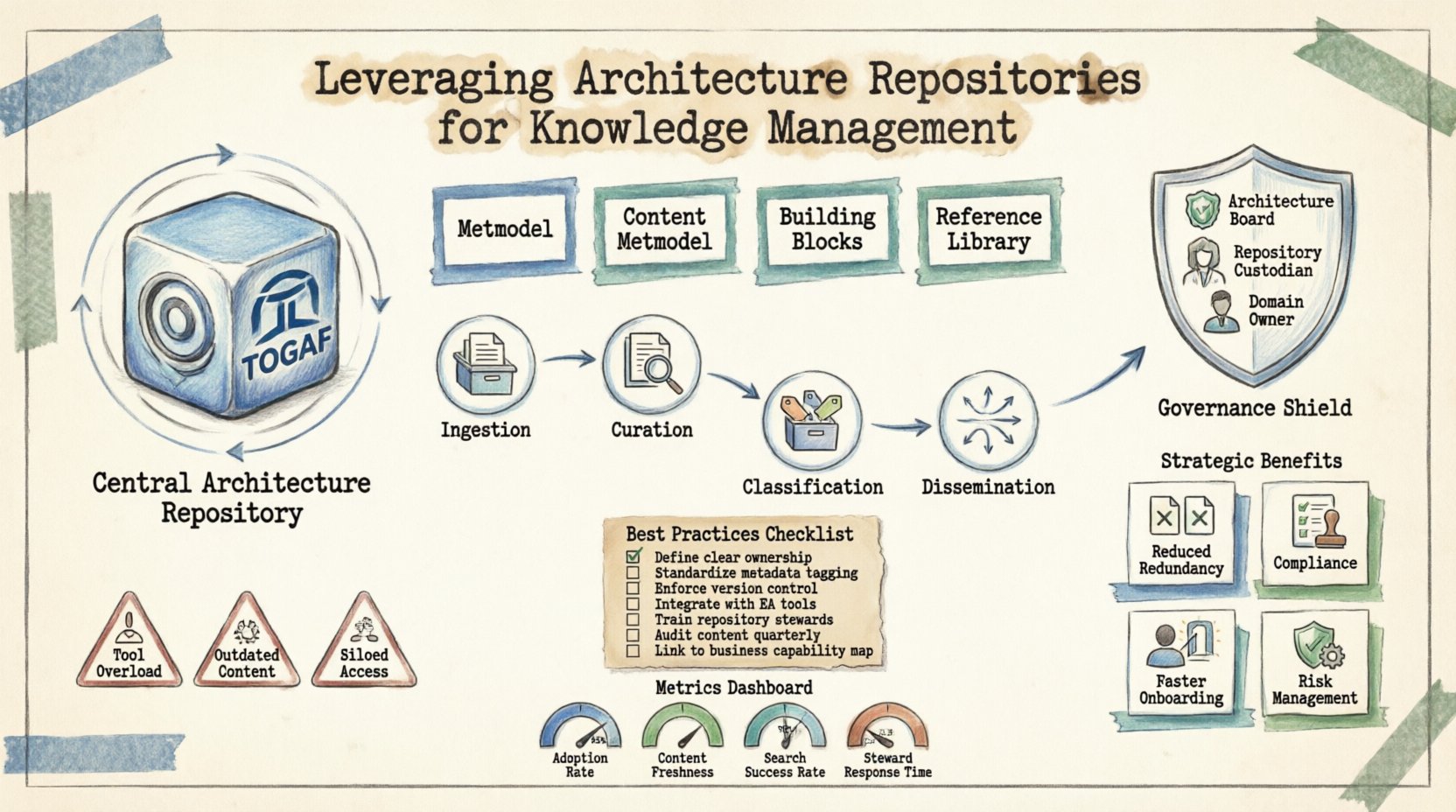
In the complex landscape of enterprise operations, information often becomes fragmented. Data lives in disparate systems, documents sit in shared drives, and critical architectural decisions remain trapped in individual minds. This fragmentation creates significant risk and inefficiency. To address this, organizations turn to structured frameworks. The Open Group Architecture Framework (TOGAF) offers a robust approach to managing these assets through the Architecture Repository. By treating architectural information as a strategic asset, companies can ensure consistency, compliance, and agility across their digital transformation journeys.
This guide explores how to effectively leverage the Architecture Repository for knowledge management. We will examine the core components, governance models, and practical steps to build a sustainable environment. The goal is not merely storage, but the active curation and utilization of knowledge to support business strategy.
Understanding the Architecture Repository in TOGAF 📚
The Architecture Repository serves as the central storage mechanism for all architectural artifacts. It is distinct from the Architecture Metamodel, which defines the structure, and the Architecture Content Metamodel, which defines the specific content types. The Repository acts as the physical or logical location where these definitions are applied.
Within the TOGAF framework, the repository is a critical component of the Architecture Development Method (ADM). It supports the entire lifecycle of an architecture project. When an organization begins a cycle of development, the repository provides the baseline. It holds the current state, the target state, and the migration plan. Without this centralization, architects risk rebuilding solutions that already exist or ignoring standards that have been established.
Key functions include:
- Storage: Holding models, diagrams, requirements, and standards.
- Version Control: Tracking changes over time to maintain audit trails.
- Access Control: Ensuring the right people see the right information.
- Search and Retrieval: Enabling efficient discovery of assets.
Effective knowledge management relies on the repository being a living system. It is not a static archive. It must evolve as the enterprise evolves. If the repository becomes obsolete, it loses its value. Stakeholders will stop consulting it, and the cycle of reuse begins to break down.
Structural Components of the Repository 🧱
To function correctly, the repository requires a defined structure. TOGAF outlines specific zones and categories that organize the content. Understanding these zones is essential for proper implementation. Each zone serves a specific purpose in the governance and usage lifecycle.
The repository is generally divided into four primary areas:
- Architecture Metamodel: Defines the structure of the architecture data itself.
- Content Metamodel: Defines the specific types of content that can be stored.
- Repository Building Blocks: The actual instances of architecture components.
- Reference Library: Standards, policies, and patterns that guide development.
Organizations must map their specific assets to these zones. This mapping ensures that when a stakeholder searches for a standard, they find the authoritative version. When they search for a specific application, they find its architectural context. Below is a breakdown of how content typically fits into the repository structure.
| Zone | Content Type | Purpose |
|---|---|---|
| Architecture Repository | Standards, Policies, Models | Establish rules and definitions |
| Standards Information Base | Industry Standards, Internal Policies | Ensure compliance with external and internal rules |
| Product Library | Software Products, Hardware Specs | Manage technology choices and constraints |
| Architecture Landscape | Current State, Target State, Baseline | Visualize the evolution of the enterprise |
| Building Blocks | Reused Components, Solutions | Enable reuse and reduce redundancy |
| Reference Library | Patterns, Best Practices | Guide future development decisions |
By categorizing content this way, the organization creates a logical flow for information. A developer looking for a pattern will not be confused by a compliance policy. A manager looking for the target state will not be distracted by specific product specs. This separation of concerns is vital for maintainability.
Integrating Knowledge Management Processes 🔄
Storage alone does not constitute knowledge management. The repository requires active processes to maintain its integrity. Knowledge management involves the capture, organization, and dissemination of information. In the context of enterprise architecture, this means ensuring that the repository reflects the reality of the business.
Several processes are critical for integration:
- Ingestion: How does new information enter the system? This often happens at the end of an ADM cycle. Deliverables must be formally submitted for storage.
- Curation: Who reviews the information? A governance board or architecture review board should validate the accuracy and relevance before it is published.
- Classification: Metadata must be applied consistently. Tags, categories, and relationships help users find what they need.
- Dissemination: How is information shared? Dashboards, reports, and search interfaces make the content accessible to stakeholders.
Automating these processes reduces the administrative burden. Manual entry leads to errors and delays. Integration with other enterprise systems, such as project management or service management tools, ensures that architectural data stays synchronized with operational data. When a project is approved, the repository should automatically reflect the new architecture. When a project is cancelled, the assets should be archived or marked as obsolete.
Knowledge management also involves people. Training is required to ensure that architects know how to use the repository. They must understand the metadata standards and the submission workflows. If the process is too complex, adoption will fail. The system must be intuitive enough to encourage use, not just mandate it.
Governance and Lifecycle Management 🛡️
Governance ensures that the repository is used correctly. It defines who can create, modify, or delete content. Without governance, the repository becomes a dumping ground for outdated or incorrect information. Trust in the system erodes quickly if users find errors.
Key governance activities include:
- Role Definition: Clearly define roles such as Curator, Architect, Reviewer, and Consumer.
- Approval Workflows: Establish formal steps for publishing new content. Changes to standards require higher-level approval than updates to a specific diagram.
- Retention Policies: Define how long historical data is kept. Some data must be retained for compliance, while other data can be purged to save space.
- Access Control Lists: Restrict sensitive information to authorized personnel.
Lifecycle management focuses on the status of the content. Content moves through states such as Draft, Review, Approved, and Obsolete. The system should enforce these states. A user should not be able to reference an “Obsolete” standard without a warning. This ensures that the enterprise does not build upon outdated foundations.
Regular audits are necessary. A quarterly review of the repository can identify stale content. Items that have not been updated in two years should be flagged. Are they still relevant? Do they reflect the current business environment? If not, they should be retired. This pruning process keeps the repository lean and relevant.
Strategic Benefits for Enterprise Decision-Making 📊
When implemented correctly, the Architecture Repository delivers tangible value to the organization. It moves architecture from a theoretical exercise to a practical tool for decision-making. Leaders can make choices based on data rather than intuition.
The strategic advantages include:
- Reduced Redundancy: By seeing what already exists, teams avoid building duplicate solutions. This saves time and money.
- Improved Compliance: Standards are centrally stored and easily referenced. Auditors can verify adherence to policies without hunting through disparate files.
- Faster Onboarding: New employees can access the repository to understand the technology landscape and business context quickly.
- Risk Management: Dependencies are visible. Risks associated with specific technologies or vendors can be tracked over time.
Furthermore, the repository supports the alignment of IT and business. By documenting business capabilities and linking them to technology, leaders can see gaps in the portfolio. They can identify where investment is needed to support strategic goals. This alignment is a core objective of the Architecture Development Method.
Decision support is enhanced when the repository is linked to performance metrics. If a specific technology stack consistently causes delays, this information is recorded in the repository. Future decisions can weigh this historical data. This creates a feedback loop that continuously improves the quality of architectural decisions.
Common Implementation Challenges ⚠️
Despite the benefits, many organizations struggle to implement an effective repository. The challenges are often cultural rather than technical. Understanding these obstacles helps in planning mitigation strategies.
Common issues include:
- Lack of Ownership: If no one is responsible for the repository, it becomes neglected. A dedicated role or team must be assigned.
- Tool Complexity: Systems that are difficult to use discourage input. The interface should be simple and focused on the user’s workflow.
- Resistance to Change: Architects may prefer their local tools over a centralized system. They must be convinced of the value.
- Data Quality: Incomplete or inaccurate data reduces trust. Validation checks are necessary during the ingestion process.
Another significant challenge is integration. The repository does not exist in a vacuum. It must integrate with the broader IT ecosystem. If it is siloed, it will not be used. APIs and connectors should be explored to allow data flow between the repository and other management tools.
Cost is also a factor. Maintaining a repository requires resources. Staff time, storage, and potentially licensing fees must be budgeted. The return on investment must be clear to secure ongoing funding. Demonstrating cost savings from reduced redundancy is a strong argument for continued support.
Best Practices for Sustainable Adoption ✅
To overcome challenges and ensure long-term success, organizations should follow established best practices. These guidelines help build a culture of knowledge sharing and rigorous management.
- Start Small: Do not attempt to migrate all historical data at once. Begin with a pilot project or a specific domain. Prove the value before expanding.
- Define Metadata Standards: Establish a controlled vocabulary. Ensure everyone uses the same terms for the same concepts. This improves searchability.
- Automate Where Possible: Use scripts or integration points to capture data automatically. Reduce manual entry to minimize errors.
- Engage Stakeholders: Involve business leaders and technical teams in the design. Their input ensures the system meets real needs.
- Provide Training: Offer regular workshops and documentation. Support users as they learn the new processes.
Communication is key. Regular updates on repository improvements and new features keep interest high. Highlight success stories where the repository saved time or prevented a mistake. Positive reinforcement drives adoption.
Additionally, maintain a clear roadmap. The repository should evolve with the framework. As TOGAF updates or the business strategy shifts, the repository structure should adapt. Flexibility is essential for longevity.
Measuring Effectiveness and Value 📈
How do you know if the repository is working? Metrics provide the answer. Quantitative and qualitative measures help assess performance and guide improvements.
Key performance indicators include:
- Usage Rates: How often is the repository accessed?
- Content Contribution: How many assets are submitted per quarter?
- Search Success: How many searches result in a click or download?
- Time to Find: How long does it take to locate a specific asset?
- Reuse Frequency: How often are building blocks reused in new projects?
Qualitative feedback is equally important. Surveys can gauge user satisfaction. Interviews can uncover specific pain points. If users find the search function frustrating, that is a priority for improvement. If they find the metadata confusing, training is required.
Regular reporting to leadership demonstrates value. A dashboard showing the number of assets, the volume of reuse, and the time saved can justify the investment. It transforms the repository from a cost center into a value driver.
Continuous improvement is the final step. Use the metrics to identify trends. If submission rates drop, investigate why. If search success is low, refine the metadata. The repository is a living entity that requires constant care to remain useful.
Building a robust Architecture Repository for knowledge management is a significant undertaking. It requires discipline, strategy, and commitment. However, the payoff is a more agile, compliant, and efficient enterprise. By centralizing knowledge and managing it effectively, organizations gain the visibility needed to navigate complex changes. The repository becomes the backbone of architectural governance, supporting the enterprise through every transformation.