
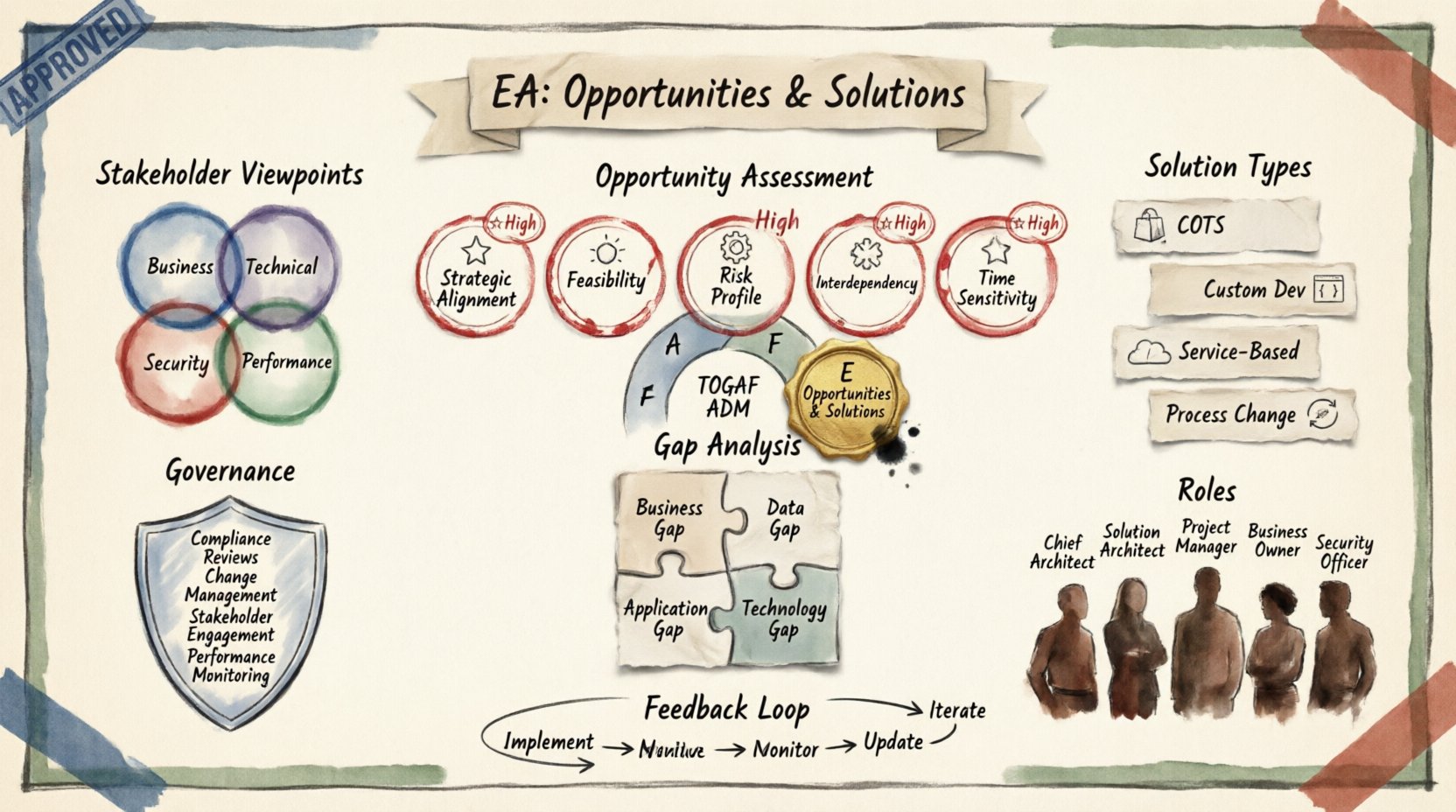
Enterprise Architecture (EA) serves as the blueprint for organizational transformation. Within the TOGAF framework, the management of opportunities and solutions is not merely a technical exercise; it is a strategic necessity that bridges the gap between business intent and technical reality. This guide explores the mechanics of identifying viable opportunities and defining robust solutions across the Architecture Development Method (ADM).
Organizations face constant change. Market shifts, regulatory updates, and technological advancements create pressure to adapt. EA provides the structure to evaluate these pressures systematically. By focusing on opportunities and solutions, architects ensure that investments align with long-term goals rather than short-term fixes.
🧭 The Architecture Development Method and Opportunity Management
The TOGAF ADM is a cyclical process designed to create and manage enterprise architecture. While often associated with design phases, the management of opportunities begins earlier, often during Phase A: Architecture Vision. Here, the focus shifts from static documentation to dynamic capability development.
- Phase A (Vision): Establishes the scope and constraints for the project. It identifies the business drivers that necessitate change.
- Phase B (Business Architecture): Analyzes the business strategy to find gaps between current and desired states.
- Phase C (Information Systems): Defines the data and application architectures required to support the business.
- Phase D (Technology Architecture): Outlines the infrastructure needed to host the applications.
- Phase E (Opportunities and Solutions): The critical juncture where projects are identified and grouped.
- Phase F (Migration Planning): Determines the sequence of implementation.
Phase E is often where the concept of “Opportunities” becomes tangible. It is not enough to identify a problem; the organization must define the solution space. This phase involves cataloging projects, assessing their value, and prioritizing them against available resources.
🔍 Identifying and Assessing Strategic Opportunities
An opportunity in EA is a potential course of action that delivers value. It is distinct from a project; an opportunity represents the capability to be built, while a project is the vehicle to build it. To manage these effectively, organizations must employ rigorous assessment criteria.
When evaluating potential opportunities, architects look for alignment with the strategic plan. Does this initiative move the needle on revenue, efficiency, or compliance? If the answer is unclear, the opportunity should be deferred.
📊 Opportunity Assessment Criteria
| Criteria | Description | Priority |
|---|---|---|
| Strategic Alignment | Does this support core business goals? | High |
| Feasibility | Do we have the technical and financial capacity? | Medium |
| Risk Profile | What are the potential negative outcomes? | High |
| Interdependency | Does this affect other systems or processes? | Medium |
| Time Sensitivity | Is there a deadline or regulatory window? | High |
Using a weighted scoring system for these criteria helps remove bias from decision-making. It allows stakeholders to compare disparate initiatives on a common scale. For example, a project with high strategic alignment but high risk might be prioritized differently than a low-risk, low-value maintenance task.
🏗️ Defining Solutions within the Architecture
Once opportunities are identified, the next step is defining the solution. In TOGAF, a solution is the combination of business, data, application, and technology architectures required to realize the opportunity. This definition must be clear enough to guide implementation teams but flexible enough to allow for technical evolution.
Types of Solutions
- Commercial Off-The-Shelf (COTS): Purchasing existing software to meet needs. This often requires customization to fit the architecture.
- Custom Development: Building specific functionality from scratch. This offers flexibility but requires significant maintenance.
- Service-Based: Leveraging external APIs or cloud services to extend capabilities without owning the infrastructure.
- Process Change: Sometimes the solution is not technical. Redefining workflows can yield higher value than new software.
The architecture team must document the baseline architecture (where we are) and the target architecture (where we want to be). The difference between these states is the gap. Solving this gap is the primary function of the solution definition phase.
🔄 Transition Planning and Gap Analysis
Transition planning is the bridge between the current state and the target state. It requires a detailed understanding of the gap analysis results. This process involves breaking down the solution into manageable work packages.
A work package is a collection of related activities that achieve a specific outcome. These packages are sequenced to minimize risk and maximize value delivery. Early packages should focus on foundational capabilities that enable later, more complex features.
🛠️ Gap Analysis Components
- Business Gaps: Processes that are missing or inefficient.
- Data Gaps: Information silos or missing data models.
- Application Gaps: Software that does not support required functions.
- Technology Gaps: Hardware or network infrastructure limitations.
Addressing these gaps requires a coordinated effort. For instance, a new application (Application Gap) cannot function without the correct data model (Data Gap) and the necessary server capacity (Technology Gap). The transition plan must account for these dependencies.
🛡️ Solution Governance and Risk Management
Implementation is where architecture often loses control. Without governance, projects drift away from the defined architecture, leading to technical debt and fragmentation. Governance ensures that the solution remains true to the architectural vision.
Risk management is integral to this process. Every solution carries inherent risks, from security vulnerabilities to performance bottlenecks. These risks must be identified early and mitigated through design decisions.
🛑 Key Governance Activities
- Architecture Compliance Reviews: Regular checks to ensure projects adhere to standards.
- Change Management: Controlling modifications to the baseline architecture.
- Stakeholder Engagement: Ensuring all parties understand the implications of changes.
- Performance Monitoring: Tracking the solution after deployment to verify it meets requirements.
Effective governance is not about policing; it is about enabling. It provides the guardrails that allow teams to innovate safely. When a team knows the boundaries, they can move faster within them.
🤝 Roles and Responsibilities in Architecture Execution
Success depends on clear roles. Confusion leads to delays and errors. In the context of managing opportunities and solutions, specific responsibilities must be assigned.
- Chief Architect: Owns the overall vision and ensures alignment with business strategy.
- Solution Architect: Designs the specific solution components and ensures they fit the enterprise architecture.
- Project Manager: Manages the timeline, budget, and resources for the work package.
- Business Owner: Defines the requirements and validates the value of the solution.
- Security Officer: Ensures the solution meets security and compliance standards.
Collaboration between these roles is essential. The Solution Architect cannot design in a vacuum; they need input from the Business Owner. The Project Manager cannot plan without knowing the scope defined by the Architect.
📈 Continuous Improvement and Iteration
Enterprise Architecture is not a one-time event. It is a continuous cycle. Once a solution is implemented, the architecture must be updated to reflect the new reality. This is the “Architecture Contract” phase, where the agreement between the business and IT is formalized and then reviewed.
Feedback loops are critical. If a solution fails to deliver the expected value, the opportunity management process must capture this learning. Future opportunities should be adjusted based on these lessons. This iterative approach ensures the organization evolves with its environment.
🔄 The Feedback Loop
- Implement: Deploy the solution.
- Monitor: Track performance against KPIs.
- Evaluate: Assess if business value was realized.
- Update: Revise the architecture baseline.
- Iterate: Plan the next cycle of improvements.
This loop prevents stagnation. It ensures that the architecture remains relevant and useful. Without it, the architecture becomes a museum piece—interesting but not practical.
🌐 Integrating Stakeholder Concerns
Managing solutions is also about managing people. Different stakeholders have different concerns. The finance team cares about cost. The operations team cares about stability. The security team cares about compliance.
A comprehensive architecture view addresses these concerns through specific viewpoints. A viewpoint is a representation of a system from the perspective of a particular stakeholder. By creating multiple viewpoints, architects ensure that all concerns are visible and addressed.
- Business Viewpoint: Focuses on processes and organizational structure.
- Technical Viewpoint: Focuses on infrastructure and integration.
- Security Viewpoint: Focuses on data protection and access control.
- Performance Viewpoint: Focuses on speed and reliability.
When an opportunity is presented, the architect must map it against these viewpoints. If a solution improves performance but compromises security, the trade-off must be explicitly managed. There is no perfect solution, only optimized trade-offs.
📝 Documentation and Knowledge Management
Knowledge is an asset. If the architecture exists only in the minds of a few individuals, it is fragile. Documentation ensures that the logic behind decisions is preserved. This is vital for onboarding new team members and for auditing past decisions.
Documentation should be concise and accessible. Excessive detail deters use. The goal is to provide enough information to make decisions without overwhelming the reader. Architecture repositories help centralize this information, making it searchable and version-controlled.
Essential Artifacts
- Architecture Principles: The rules that guide decision-making.
- Standards: Specific technical requirements and constraints.
- Patterns: Proven solutions to common problems.
- Models: Visual representations of the architecture.
Regular reviews of these artifacts ensure they remain accurate. As the business changes, the principles and standards may need to evolve. Static documentation leads to obsolescence.
🚀 Conclusion
Managing opportunities and solutions is the engine of enterprise transformation. It requires a balance of strategic vision and practical execution. By following a structured approach, organizations can navigate complexity and deliver value consistently.
The TOGAF framework provides the methodology, but the people provide the insight. Architects must remain adaptable, listening to business needs while maintaining technical integrity. This dual focus ensures that architecture serves the enterprise, rather than the other way around.
Success is not measured by the number of diagrams drawn, but by the quality of the solutions delivered. When opportunities are managed well, the organization becomes more agile, resilient, and capable of meeting future challenges.
Continual learning and adaptation are the keys to longevity. As technology evolves, so too must the architecture. The process of managing opportunities never truly ends; it simply evolves into the next cycle of improvement.