
Understanding the external environment is fundamental to strategic planning. Organizations that ignore the macro-environmental factors surrounding their operations risk making decisions based on incomplete data. The PEST analysis framework provides a structured approach to examining these external influences. This guide breaks down the four core components: Political, Economic, Social, and Technological.
By analyzing these elements, businesses gain clarity on the forces shaping their market. This clarity supports better risk management and opportunity identification. The following sections detail each factor with specific examples and actionable insights.
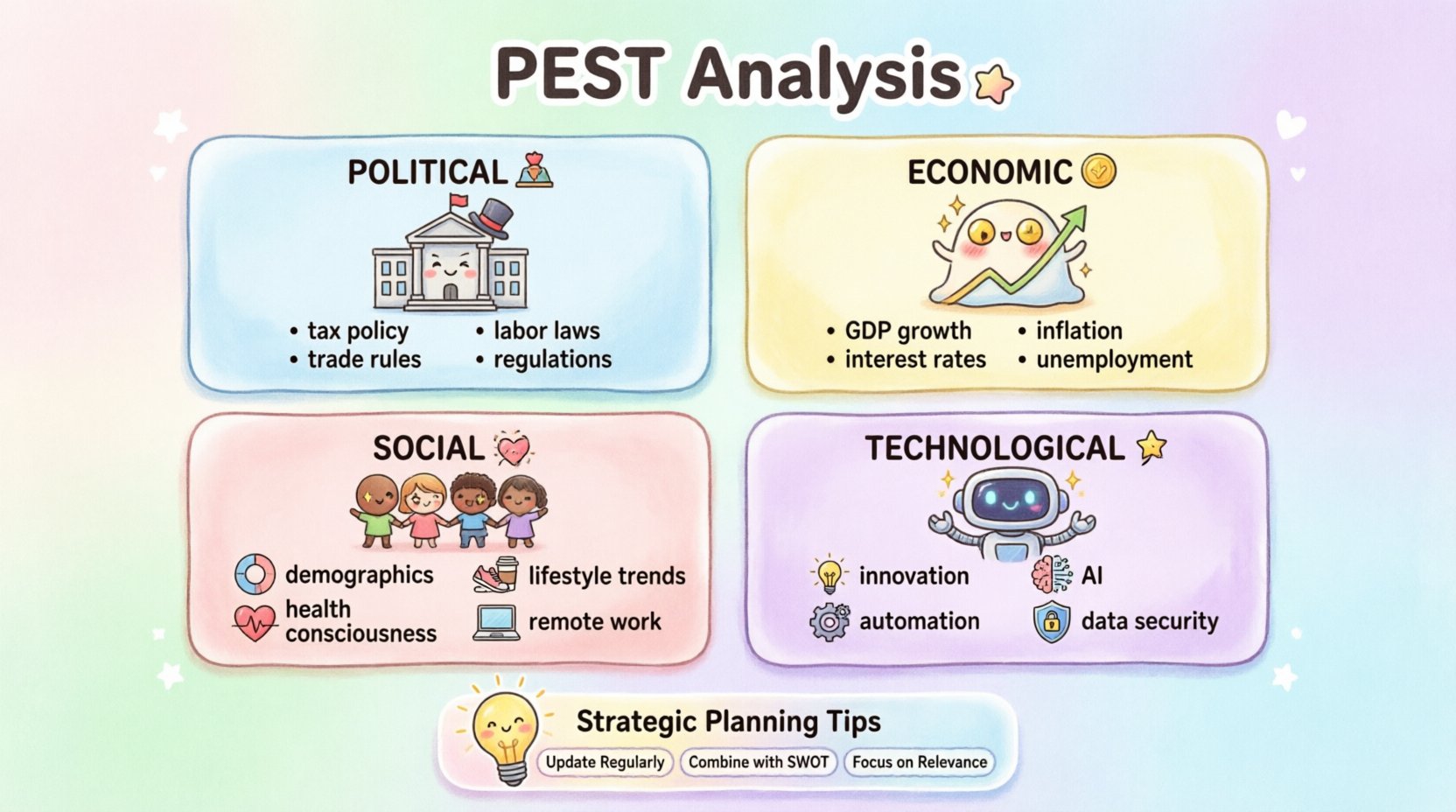
What is PEST Analysis? 🤔
PEST stands for Political, Economic, Social, and Technological. It is a strategic tool used to evaluate the external macro-environmental factors that impact an organization. Unlike internal audits, which focus on resources and capabilities, PEST looks outward.
- Political: Government policies, stability, and regulations.
- Economic: Growth rates, interest rates, and inflation.
- Social: Demographics, culture, and lifestyle trends.
- Technological: Innovation, automation, and R&D activity.
Conducting this analysis helps teams anticipate changes before they disrupt operations. It is particularly useful during product launches, market entry, or long-term strategic planning.
Political Factors: The Regulatory Landscape 🏛️
Political factors encompass the extent to which government intervention influences the economy. These factors often determine the rules of the game for businesses. Stability is a key component here. A stable government allows for long-term planning, whereas political turmoil creates uncertainty.
Key Elements to Consider
- Government Stability: Assess the risk of regime change, civil unrest, or policy volatility.
- Tax Policy: Corporate tax rates affect profitability. Changes in taxation can alter cash flow projections significantly.
- Trade Restrictions: Tariffs, quotas, and embargoes impact supply chains. Understanding trade agreements is vital for import/export businesses.
- Labour Laws: Regulations regarding minimum wage, working hours, and unions dictate operational costs.
- Environmental Regulations: Compliance with environmental standards can require significant capital investment.
- Intellectual Property Rights: The strength of IP protection determines how safely innovations can be commercialized.
Practical Application
When evaluating political factors, avoid general assumptions. Look at specific legislation affecting your industry. For example, a pharmaceutical company must monitor FDA regulations, while a tech firm focuses on data privacy laws like GDPR. Changes in these areas can create barriers to entry or open new markets.
| Factor | Impact Area | Example Question |
|---|---|---|
| Tax Policy | Profitability | Are corporate tax rates rising or falling? |
| Trade Barriers | Supply Chain | Will tariffs increase the cost of raw materials? |
| Labour Laws | Operational Costs | Is the minimum wage scheduled to increase? |
| Regulatory Compliance | Legal Risk | Do new environmental laws require equipment upgrades? |
Economic Factors: The Financial Engine 📈
Economic factors influence the purchasing power of potential customers and the cost of capital for the business. These indicators help determine the overall attractiveness of a market. Even a well-run company can struggle if the economic environment is hostile.
Core Economic Indicators
- Economic Growth: Measured by GDP. High growth usually signals increased consumer spending.
- Exchange Rates: Fluctuations affect the cost of imports and the competitiveness of exports.
- Inflation: Rising prices erode purchasing power. High inflation may lead to higher interest rates.
- Interest Rates: The cost of borrowing money. High rates discourage expansion and investment.
- Unemployment Rates: High unemployment increases the labor supply but reduces consumer demand.
- Cyclical Trends: Recession vs. Boom cycles dictate when to expand or conserve cash.
Analyzing Market Demand
During an economic downturn, consumers become more price-sensitive. Luxury goods may see a drop in demand, while essential goods remain stable. Conversely, in a booming economy, credit is easier to obtain, and spending increases. Understanding these cycles helps in timing market entry.
For international expansion, currency stability is critical. A volatile currency can wipe out profit margins even if sales volume remains high. Hedging strategies or local currency pricing may be necessary.
Social Factors: The Human Element 👥
Social factors relate to the demographic and cultural aspects of the external environment. These are often the most difficult to predict but have profound effects on product acceptance. Understanding the society you are serving is essential for marketing and product development.
Demographic Shifts
- Population Growth: Rapid growth creates demand for housing, food, and education. Slow growth may indicate an aging population.
- Age Distribution: An aging society requires different products than a youth-dominated one.
- Population Density: Urbanization trends affect logistics and retail strategies.
- Income Distribution: Wealth gaps determine the size of the middle class and luxury markets.
Cultural Trends
- Lifestyle Changes: Shifts in how people live, work, and spend leisure time.
- Health Consciousness: Increasing demand for organic foods and fitness services.
- Educational Attainment: Higher education levels often correlate with higher demand for premium services.
- Religious and Cultural Norms: Local customs dictate product design, marketing messages, and availability.
- Attitudes Toward Work: The shift toward remote work impacts real estate and communication tool needs.
| Trend | Business Implication | Industry Example |
|---|---|---|
| Aging Population | Healthcare & Retirement Services | Pharma companies developing geriatric drugs |
| Urbanization | Logistics & Retail | Warehouses moving closer to city centers |
| Sustainability Focus | Supply Chain Management | Brands adopting eco-friendly packaging |
| Remote Work | Office Real Estate | Reduction in commercial lease requirements |
Technological Factors: The Disruption Driver 🚀
Technological factors involve the rate of technological innovation and its impact on the industry. This is often the fastest-changing component of the PEST analysis. Ignoring technological shifts can lead to obsolescence.
Innovation and Infrastructure
- R&D Activity: The volume of research spending in your sector indicates future product pipelines.
- Automation: The ability to automate processes reduces costs but may impact employment levels.
- Technology Incentives: Government grants or tax breaks for adopting new tech.
- Rate of Obsolescence: How quickly products become outdated. Fast in tech, slow in utilities.
- Internet Access: Connectivity levels determine the viability of e-commerce and digital services.
- Data Security: The need to protect customer data against cyber threats.
Disruptive Technologies
New technologies can render existing business models unsustainable. For example, streaming services disrupted the media rental industry. Companies must monitor emerging technologies to decide whether to adopt, ignore, or invest in them.
Artificial intelligence, blockchain, and the Internet of Things are current examples. Each offers opportunities for efficiency but requires significant adaptation. Assessing the maturity of these technologies is key. Adopting too early can be costly; adopting too late can be fatal.
Integrating PEST into Strategic Planning 🧩
Gathering data is only the first step. The value lies in synthesis. How do these factors combine to affect your specific business goals?
From Analysis to Action
- Identify Opportunities: A new technology might allow a cheaper production method.
- Spot Threats: A political change might introduce a new tariff.
- Resource Allocation: Direct budget toward areas with the highest potential return based on external factors.
- Risk Mitigation: Develop contingency plans for high-risk political or economic scenarios.
It is common to combine PEST with a SWOT analysis. The PEST factors feed into the Opportunities and Threats sections of the SWOT matrix. This ensures that external risks are accounted for when evaluating internal strengths and weaknesses.
Common Pitfalls and Best Practices ⚠️
Even experienced analysts make mistakes. Recognizing common errors ensures the analysis remains accurate and useful.
What to Avoid
- Outdated Data: Economic and political landscapes change rapidly. Use the most recent reports available.
- Generalization: Avoid broad statements like “the economy is good.” Be specific about sectors and regions.
- Internal Bias: Do not ignore factors that contradict your desired outcome. Objectivity is crucial.
- Static View: PEST is not a one-time exercise. Update it regularly as conditions shift.
- Isolation: Do not treat the four factors in isolation. They often interact. Economic policy affects social welfare, which influences political stability.
Best Practices for Success
- Diverse Input: Involve stakeholders from different departments to get varied perspectives.
- Quantify Where Possible: Use data to support qualitative observations. Cite statistics where available.
- Focus on Relevance: Filter out noise. Not every global trend matters to your local operation.
- Regular Review: Schedule quarterly or annual reviews of the PEST analysis.
- Scenario Planning: Create scenarios based on different PEST outcomes to test strategy resilience.
Case Study: A Retailer’s Perspective 🛍️
Consider a retail chain planning to expand into a new country. A PEST analysis reveals the following:
- Political: The government offers tax incentives for foreign investment, but labor laws are strict regarding hiring.
- Economic: The local currency is volatile, posing a risk to profit repatriation.
- Social: There is a strong cultural preference for in-store shopping over online.
- Technological: Mobile payment adoption is low, requiring investment in point-of-sale systems.
Based on this, the retailer decides to invest in local POS technology and adjust pricing strategies to account for currency risk. They prioritize physical locations over digital marketing initially.
Frequently Asked Questions ❓
How often should I conduct a PEST analysis?
Conduct a deep dive annually. However, monitor specific factors monthly, especially in volatile sectors like tech or finance.
Can PEST be used for non-profits?
Yes. Non-profits face political funding changes, economic donor behavior, social needs, and technological communication tools.
What is the difference between PEST and PESTLE?
PESTLE adds Legal and Environmental factors. These are increasingly important and often split from the Political and Social categories in modern analysis.
Is PEST analysis enough for strategy?
No. It is a starting point. Combine it with internal analysis, competitor analysis, and financial modeling for a complete picture.
Final Thoughts 💡
External factors are beyond your control, but your reaction to them is within your power. A thorough PEST analysis equips your team with the knowledge to navigate uncertainty. It transforms vague worries into manageable variables.
By systematically reviewing Political, Economic, Social, and Technological elements, you build a resilient strategy. This foundation supports sustainable growth and long-term viability in a complex world.