
Strategic planning is the backbone of organizational longevity. Among the various frameworks available, the PEST analysis has long stood as a staple for examining macro-environmental factors. It offers a structured way to look at Political, Economic, Social, and Technological forces. However, relying solely on this model can lead to significant blind spots, especially when navigating volatile or highly competitive landscapes. Understanding PEST analysis limitations is crucial for leaders who demand precision in their decision-making processes. This guide explores where the model falters and introduces robust complementary strategic tools to ensure a holistic view.
Understanding the Core Framework 🏗️
Before dissecting its failures, we must establish what the framework actually does. The acronym stands for:
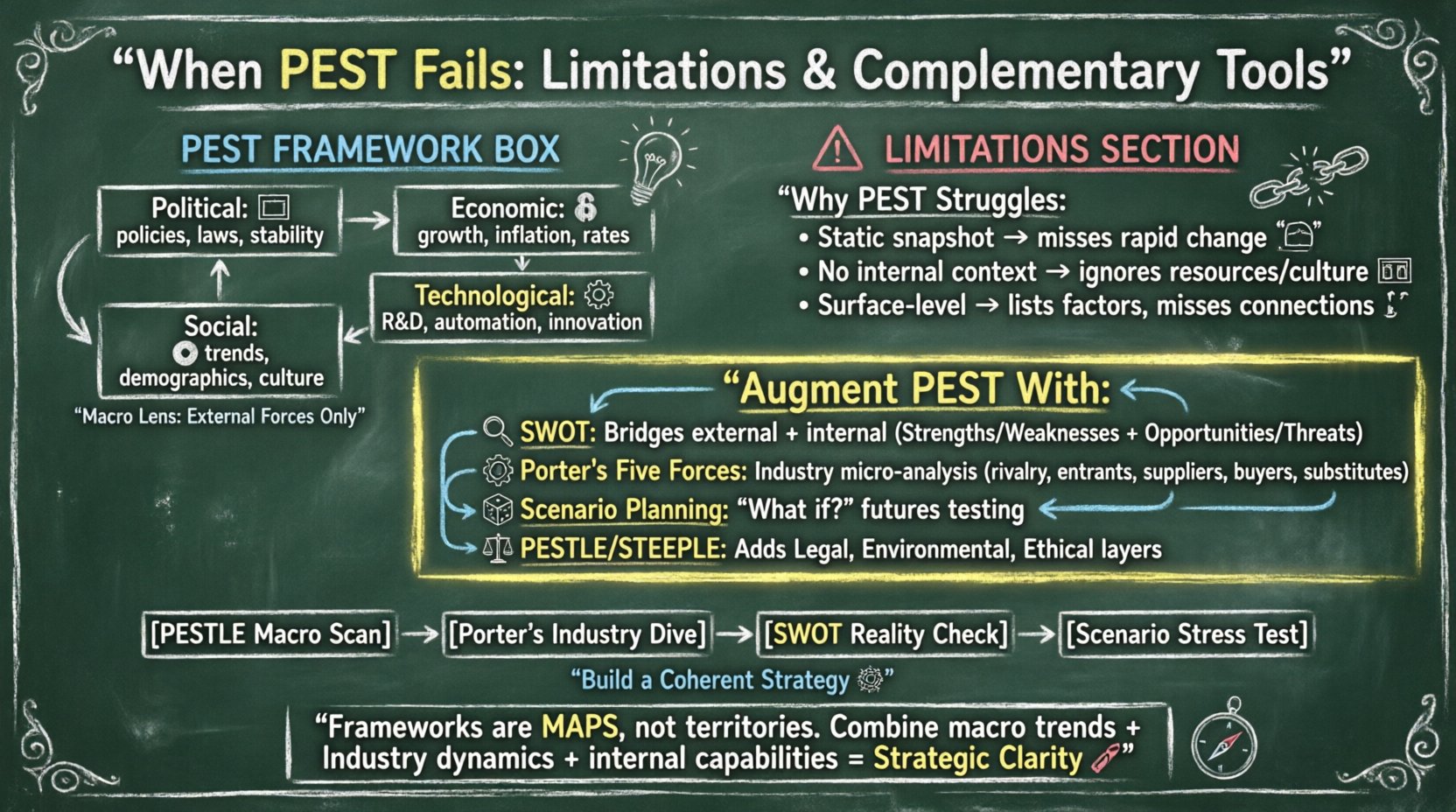
- Political: Government policies, tax laws, trade restrictions, and political stability.
- Economic: Economic growth, exchange rates, inflation, and interest rates.
- Social: Cultural trends, population growth, age distribution, and health consciousness.
- Technological: R&D activity, automation, technological incentives, and rate of technological change.
These categories provide a macro lens. They are excellent for identifying broad trends that exist outside the organization’s direct control. When used correctly, they help organizations anticipate shifts in the external environment. Yet, the simplicity of the acronym often masks the complexity of the reality it attempts to represent. In many instances, the model serves as a checklist rather than a diagnostic tool.
Why PEST Struggles in Modern Environments 🛑
The business landscape has evolved rapidly over the last decade. Factors that were once stable are now shifting with unprecedented speed. Here are the primary reasons why the traditional model often falls short in complex markets.
1. Static Nature vs. Dynamic Reality
A significant limitation of the PEST framework is its tendency to be static. It often functions as a snapshot in time. Once a report is written, the data begins to age immediately.
- Time Lag: Collecting and analyzing data takes time. By the time insights are actionable, the market conditions may have changed.
- No Feedback Loop: The model does not inherently suggest how to react to the findings. It identifies the what, not the how.
- Frequency: Most organizations perform this analysis annually or quarterly. In hyper-competitive sectors, a quarterly review is insufficient.
2. Lack of Internal Context 🏢
PEST looks exclusively outward. It ignores the internal capabilities of the organization. A company might identify a massive technological shift (Technological factor) that presents a threat, but if the company lacks the R&D budget to respond, the analysis is incomplete.
- No Resource Assessment: It does not evaluate whether the organization has the skills or capital to capitalize on an opportunity.
- Ignored Culture: Internal organizational culture can be a barrier to adapting to external social or political changes, yet PEST does not account for this.
- Competitor Blindness: It treats the market as a monolith rather than analyzing specific competitor moves.
3. Surface-Level Insights
It is easy to list factors without understanding the causal relationships between them. For example, a change in Political regulation might lead to an Economic shift, which alters Social behavior. PEST often lists these as separate bullet points without connecting the dots.
- Correlation vs. Causation: Leaders may mistake a correlation for a direct cause-and-effect relationship.
- Qualitative Bias: The data is often qualitative and subjective, leading to potential bias in interpretation.
- Missing Micro-Economics: It overlooks industry-specific dynamics that are not strictly macro-level.
The Challenge of Complex Markets 🌐
Complex markets are defined by high interconnectivity, rapid change, and non-linear outcomes. In these environments, linear thinking fails. The VUCA framework (Volatility, Uncertainty, Complexity, Ambiguity) describes these conditions well.
When Standard Models Break Down
In stable industries, PEST works adequately. However, in sectors like technology, fintech, or healthcare, the following issues arise:
- Disruption Speed: A technological breakthrough can render a market obsolete in months, not years.
- Regulatory Flux: Political landscapes shift rapidly in response to social movements.
- Global Interdependence: A local Economic downturn can cascade into a global crisis due to supply chain integration.
When these factors combine, a static PEST report provides a false sense of security. It suggests that because you have mapped the environment, you understand it. This is rarely true in complex scenarios.
Complementary Tools for Deeper Insight 🔍
To overcome these limitations, strategic planners must integrate other frameworks. These tools should not replace PEST but augment it. They provide the internal context and industry-specific detail that PEST lacks.
1. SWOT Analysis (Strengths, Weaknesses, Opportunities, Threats)
SWOT bridges the gap between the external environment and internal reality. While PEST feeds into the Opportunities and Threats quadrants, SWOT forces a confrontation with Strengths and Weaknesses.
- Integration: Use PEST to fill the external quadrants of SWOT.
- Internal Audit: Require honest assessment of internal capabilities before strategizing.
- Actionable: Helps match internal strengths to external opportunities.
2. Porter’s Five Forces
PEST looks at the macro environment. Porter’s Five Forces looks at the micro industry environment. This is critical for understanding profitability and competitive intensity.
- Rivalry Among Competitors: How aggressive are current players?
- Threat of New Entrants: How easy is it for new competitors to enter?
- Bargaining Power of Suppliers: Can suppliers dictate terms?
- Bargaining Power of Buyers: Can customers drive prices down?
- Threat of Substitutes: Are there alternative solutions to the product?
3. Scenario Planning 🎲
Because PEST is static, Scenario Planning adds the dimension of time and probability. It asks: “What if” questions rather than “What is”.
- Multiple Futures: Develop best-case, worst-case, and most-likely scenarios.
- Stress Testing: Test strategies against different economic or political outcomes.
- Resilience: Helps organizations build robust plans that survive unexpected shocks.
4. PESTLE and STEEPLE
Extensions of the original model address specific gaps.
- PESTLE: Adds Legal and Environmental factors. Crucial for compliance-heavy industries.
- STEEPLE: Adds Ethical and Ethical considerations. Important for brand reputation and CSR.
Comparing Strategic Frameworks 📊
Not all tools serve the same purpose. Understanding when to deploy which model is key to effective planning.
| Tool | Primary Focus | Best Used For | Limitation |
|---|---|---|---|
| PEST Analysis | Macro External | Initial market entry or long-term trend spotting | Static, ignores internal capabilities |
| SWOT | Internal & External | Matching resources to opportunities | Can be generic without deep data |
| Porter’s Five Forces | Industry Micro | Assessing profitability and competition | Does not account for macro shifts |
| Scenario Planning | Future Probability | Managing uncertainty and risk | Resource intensive to execute |
| Blue Ocean Strategy | Market Creation | Finding uncontested market space | Does not analyze existing market constraints |
Integrating Tools into a Coherent Strategy 🧩
Using these tools in isolation leads to fragmented insights. The goal is integration. Here is a workflow for combining them effectively.
Step 1: Macro Scanning
Begin with PESTLE to identify the broad forces. This sets the boundaries for the strategic conversation. Ensure you capture Legal and Environmental factors if they are relevant to the sector.
- Review current political stability.
- Analyze economic indicators like inflation and GDP.
- Identify social shifts in consumer behavior.
Step 2: Industry Deep Dive
Apply Porter’s Five Forces to the industry context. This narrows the focus from the general economy to the specific competitive landscape.
- Determine the intensity of rivalry.
- Assess supplier power within the specific supply chain.
- Identify potential substitutes from adjacent industries.
Step 3: Internal Reality Check
Conduct a SWOT analysis. Map the external findings from Steps 1 and 2 against internal capabilities.
- List internal Strengths that leverage external Opportunities.
- Identify Weaknesses that make the organization vulnerable to external Threats.
- Ensure the strategy matches the organization’s capacity.
Step 4: Future Stress Testing
Finally, use Scenario Planning to test the proposed strategy. Ask what happens if a key assumption fails.
- What if a major political regulation changes next year?
- What if a new technology disrupts the market faster than expected?
- What if the economic downturn hits harder than forecast?
Common Pitfalls in Implementation ⚠️
Even with the right tools, execution often falters. Be aware of these common mistakes.
- Confirmation Bias: Selecting data that supports a preconceived strategy. Ensure data collection is neutral.
- Over-Analysis: Spending too much time on analysis and not enough on action. Analysis is a means to an end.
- Ignoring the Human Element: Strategies fail when employees do not buy in. Change management is as important as strategic mapping.
- One-Time Exercise: Treat strategy as a living document. Update frameworks regularly.
Case Application: The Digital Transformation Context 💻
Consider a traditional retailer attempting a digital transformation. A standard PEST analysis might show:
- Political: Data privacy laws.
- Economic: E-commerce growth rates.
- Social: Shift to mobile shopping.
- Technological: AI and logistics automation.
This looks comprehensive. However, it misses the internal struggle. Without SWOT, the retailer might not realize their legacy IT systems are a Weakness that cannot support the Technological Opportunity. Without Porter’s, they might ignore the threat of pure-play competitors who have lower overhead. Without Scenario Planning, they might assume a linear growth path for online sales. The combination of tools reveals the true risk profile.
Building a Culture of Strategic Agility 🚀
The goal of these frameworks is not just to produce a document. It is to build a mindset. Organizations that thrive in complex markets are those that view strategy as a continuous loop rather than a linear path.
- Data-Driven: Rely on real-time data rather than anecdotal evidence.
- Collaborative: Involve cross-functional teams in the analysis process.
- Iterative: Review and refine strategies quarterly, not just annually.
- Transparent: Share the findings and the reasoning with the wider organization.
Final Considerations for Strategic Leaders 👔
Frameworks are maps, not territories. They simplify reality to make it manageable, but they can never capture the full complexity of human behavior and market dynamics. PEST is a valuable starting point, but it is not a destination.
By acknowledging the limitations of PEST and integrating complementary tools like SWOT, Porter’s Five Forces, and Scenario Planning, leaders can construct a more robust strategic foundation. This multi-layered approach reduces blind spots and increases the likelihood of successful execution. The most effective strategy is one that remains flexible enough to adapt as the external environment shifts.
Remember that no single model holds all the answers. The value lies in the synthesis of multiple perspectives. When you combine macro trends with industry dynamics and internal capabilities, you move from guessing to planning with clarity. This is the path to sustainable growth in an unpredictable world.