
Strategic planning frameworks often carry a bias toward new ventures. Many business leaders associate tools like PEST Analysis with early-stage startups seeking market fit. However, established organizations face distinct external pressures that require the same rigorous environmental scanning. When a mature company engages in mergers and acquisitions (M&A) or navigates a financial turnaround, the external environment dictates success more than internal efficiency alone. This guide details how to apply the PEST framework to non-startup contexts, focusing on due diligence, restructuring, and long-term stability.
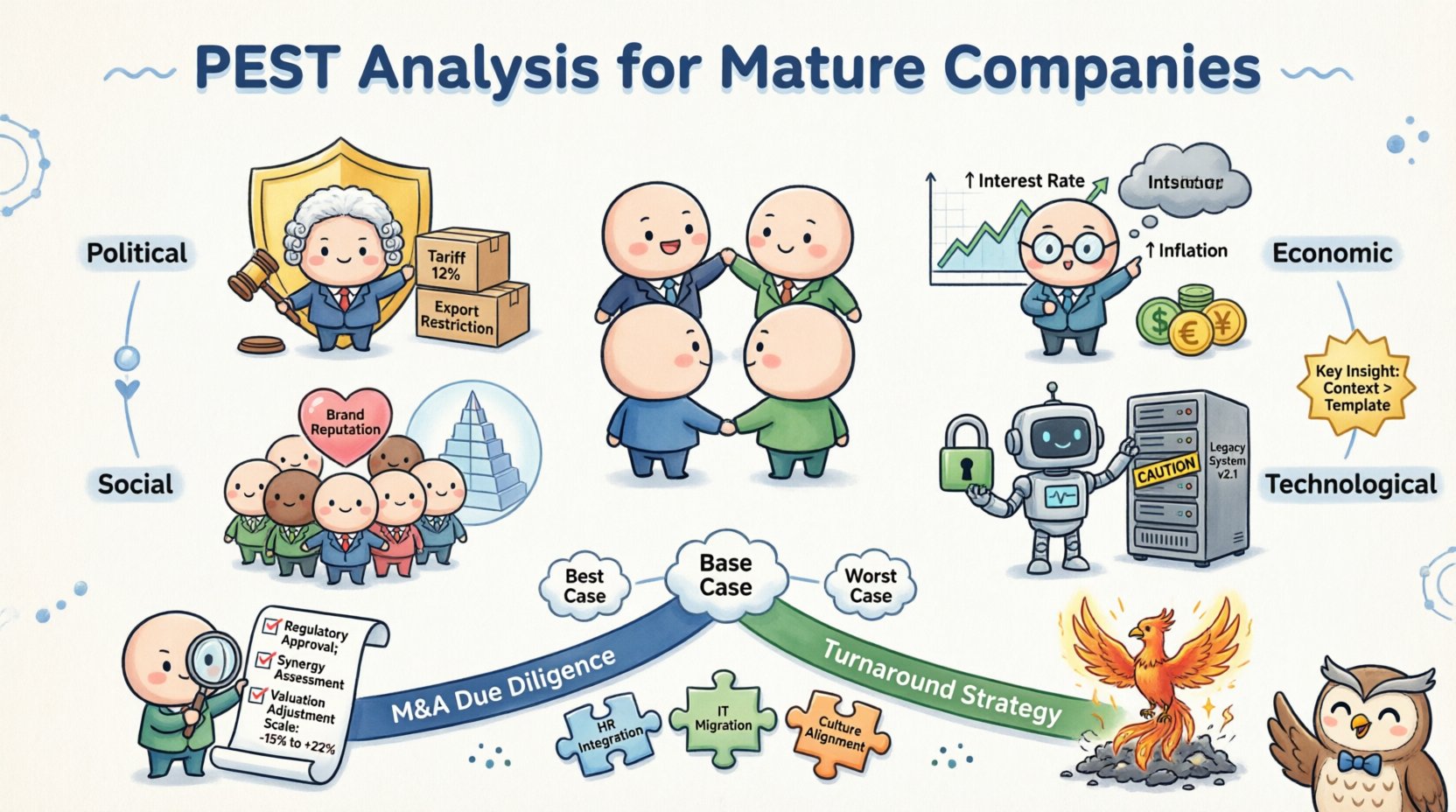
🔍 Understanding the Framework in a Mature Context
The PEST model examines four critical external factors: Political, Economic, Social, and Technological. For a startup, these factors often represent opportunities for growth. For an established entity facing M&A or decline, these factors represent risks to be mitigated or structural shifts to be leveraged. The goal is not merely identification, but the quantification of impact on valuation, integration, or operational viability.
🏛️ Political Factors in Corporate Strategy
Political stability and regulatory landscapes directly influence the cost of capital and operational continuity. In the context of M&A, this extends beyond simple compliance.
- Antitrust and Competition Law: Regulatory bodies scrutinize market consolidation. A political shift toward stricter antitrust enforcement can delay or block a deal entirely.
- Trade Tariffs and Sanctions: Cross-border acquisitions require understanding trade barriers. Tariffs can alter the projected margin of a target company, invalidating financial models.
- Labor Legislation: Changes in minimum wage, union rights, or gig-economy classifications affect the cost base of a target entity during a turnaround.
- Geopolitical Stability: In global deals, political unrest in the target region poses a risk to asset security and supply chain continuity.
💰 Economic Factors and Valuation
Economic conditions determine the feasibility of a transaction and the runway for a restructuring effort. Unlike startups, mature companies often carry significant debt loads, making them sensitive to macroeconomic shifts.
- Interest Rate Fluctuations: Higher rates increase the cost of debt financing used for acquisitions or working capital during a turnaround.
- Inflation Pressures: Rising input costs can erode margins. In a turnaround scenario, inflation may require immediate pricing adjustments that impact customer retention.
- Currency Exchange Rates: For international M&A, currency volatility affects the purchase price and future repatriation of profits.
- Consumer Spending Power: In a downturn, demand for non-essential goods drops. A turnaround strategy must account for reduced purchasing power in the target market.
👥 Social Dynamics and Cultural Integration
While often overlooked in financial modeling, social factors are critical for post-merger integration and employee retention during a crisis.
- Demographic Shifts: An aging workforce or changing generational preferences may render a legacy business model obsolete.
- Workforce Sentiment: During a turnaround, morale is fragile. External social trends regarding remote work or diversity can impact recruitment and retention strategies.
- Brand Reputation: Social movements can rapidly alter brand perception. A target company with poor ESG (Environmental, Social, and Governance) standing faces higher reputational risk.
- Consumer Behavior Changes: A shift toward sustainability or digital consumption requires the acquiring entity to adapt its product portfolio.
💻 Technological Disruption and Legacy Debt
Technology is not just an enabler for growth; it is a liability for legacy systems. In M&A, technology due diligence is paramount.
- Legacy Infrastructure: Older companies often rely on outdated systems that are costly to maintain and integrate.
- Cybersecurity Posture: A target company with poor security protocols poses a direct threat to the acquiring entity’s network.
- Automation Potential: Turnaround situations often require cost-cutting. Automation technologies can reduce headcount requirements, but implementation carries risk.
- Competitive Disruption: New entrants using modern tech stacks may render the mature company’s offerings uncompetitive before the deal closes.
🤝 Applying PEST to Mergers and Acquisitions
When evaluating a potential acquisition, the PEST framework shifts from a planning tool to a risk assessment instrument. It helps answer whether the external environment supports the transaction.
Due Diligence Integration
Standard financial due diligence focuses on the balance sheet. PEST due diligence focuses on the balance sheet’s vulnerability to external forces.
- Regulatory Risk Assessment: Map all pending legislation that could affect the target’s revenue stream post-closing.
- Market Saturation Analysis: Determine if the economic cycle is peaking or troughing. Buying at a peak during a downturn risk is dangerous.
- Integration Complexity: Assess social and cultural differences between the buyer and target to predict integration friction.
- Technology Roadmap Alignment: Verify if the target’s tech stack complements the acquirer’s or if it requires immediate heavy investment.
Valuation Adjustments
External factors should adjust the multiple applied to earnings. A company operating in a high-regulation environment might warrant a lower multiple due to compliance costs.
| Factor | Impact on Valuation | Example Scenario |
|---|---|---|
| Political | Reduced Multiple | New trade tariffs increase supply chain costs. |
| Economic | Discounted Cash Flow | Rising interest rates increase cost of capital. |
| Social | Brand Risk Premium | Target faces public backlash regarding labor practices. |
| Technological | CapEx Adjustment | Target requires immediate migration to cloud infrastructure. |
🔄 Using PEST in Turnaround Situations
A turnaround strategy often begins with diagnosing why a profitable company is failing. External factors are frequently the root cause, disguised as internal inefficiency.
Identifying External Drivers of Decline
Leadership often blames internal management for poor performance. A PEST analysis provides objective evidence of external headwinds.
- Is the market shrinking? (Social/Economic)
- Has regulation changed the rules? (Political)
- Did a competitor disrupt the model? (Technological)
- Are input costs unsustainable? (Economic)
Strategic Pivots Based on Analysis
Once the external threats are identified, the turnaround plan must pivot accordingly.
- Exit or Contract: If Political or Economic factors make a market unviable, divestment may be the only option.
- Innovation Investment: If Technological disruption is the threat, capital must be diverted to R&D rather than cost-cutting.
- Rebranding: If Social sentiment has turned against the brand, a public relations overhaul is necessary alongside financial fixes.
- Supply Chain Restructuring: If Economic factors cause inflation, renegotiating contracts or sourcing locally may be required.
🛠️ Implementation Steps for Mature Organizations
Executing a PEST analysis for an established entity requires a different approach than for a new venture. The data is historical, and the stakes are higher.
- Assemble a Cross-Functional Team: Involve legal, finance, operations, and HR. Political factors require legal insight; Economic factors require finance; Social factors require HR.
- Gather Historical Data: Look at the last 5-10 years of external performance data. How did the company react to previous economic cycles?
- Conduct Scenario Planning: Do not predict the future. Create three scenarios: Best Case, Base Case, and Worst Case based on PEST variables.
- Quantify the Impact: Assign monetary values to risks where possible. A potential regulation change might cost $X in compliance or $Y in lost revenue.
- Review and Update: External environments change rapidly. Schedule quarterly reviews of the PEST analysis during M&A integration or turnaround execution.
⚠️ Common Pitfalls to Avoid
Even experienced strategists make mistakes when applying external frameworks to internal problems.
- Internal Bias: Attributing external market failures to internal incompetence. Acknowledge when the tide is against you.
- Static Analysis: Treating the analysis as a one-time event. M&A integration and turnarounds are dynamic processes requiring dynamic monitoring.
- Ignoring Soft Data: Focusing only on hard numbers like interest rates and ignoring social sentiment or political stability indices.
- Overlooking Secondary Effects: A change in Technology might cause a shift in Social behavior, which then alters Political regulation. Trace the chain reaction.
📊 PEST vs. Traditional SWOT Analysis
Many organizations confuse PEST with SWOT. While SWOT covers Internal Strengths and Weaknesses, PEST covers only the External Opportunities and Threats. For M&A and Turnarounds, distinguishing these is crucial.
- SWOT: “We have strong cash reserves (Strength) but weak tech (Weakness).”
- PEST: “Competitors are moving to AI (Technological Threat) and regulations are tightening (Political Threat).”
- Combined: Use SWOT to assess internal capability and PEST to assess external environment. The intersection determines strategic viability.
🌐 Global Considerations for Non-Domestic Deals
M&A and Turnarounds often cross borders. A domestic PEST analysis is insufficient for international expansion or acquisition.
- Cultural Nuances: Social factors vary wildly between countries. What works in one market may fail in another.
- Legal Jurisdictions: Political factors include local laws regarding data privacy, employment, and intellectual property.
- Economic Sovereignty: Currency controls and capital flight risks in certain regions.
- Technological Infrastructure: The maturity of internet and logistics infrastructure affects operational plans.
📈 Measuring the Success of the Framework
How do you know if the PEST analysis added value to the M&A or Turnaround process?
- Risk Avoidance: Did the analysis prevent a bad acquisition or identify a fatal flaw in a turnaround plan?
- Integration Speed: Did understanding Social and Political factors speed up employee and stakeholder buy-in?
- Financial Performance: Did the strategy align with economic realities, preserving cash flow during the transition?
- Agility: Did the organization react faster to external shocks because the framework was in place?
🔗 Integrating with Other Strategic Tools
PEST should not exist in isolation. It serves as the foundation for broader strategic planning.
- Porter’s Five Forces: PEST sets the macro context; Porter’s analyzes industry competition within that context.
- BCG Matrix: Use PEST to determine if a “Dog” or “Cash Cow” product should be divested based on external threats.
- Scenario Planning: Use PEST variables to build the parameters for different future scenarios.
🚀 Final Thoughts on External Scanning
Mature organizations often become insular. They focus on operational excellence and internal optimization. However, no internal optimization can save a company if the external environment shifts beneath it. Whether acquiring a competitor or saving a failing division, the PEST framework provides the necessary lens to see the horizon.
By rigorously applying Political, Economic, Social, and Technological analysis, leaders can make informed decisions grounded in reality rather than hope. This approach reduces the risk of integration failure and increases the probability of a successful restructuring. The framework is not a magic solution, but it is a necessary discipline for navigating complex business landscapes.
Remember that data is only as good as the interpretation. Combine quantitative economic data with qualitative social insights. Ensure the analysis is updated regularly. And always remember that the goal is not just to survive the external environment, but to position the organization to thrive within it.