
Strategic planning in today’s market requires more than a snapshot. It demands a motion picture. Traditional frameworks often capture a static moment, but business conditions shift rapidly. This is where the PEST analysis roadmap becomes essential. By integrating a timeline approach into the classic Political, Economic, Social, and Technological framework, organizations can anticipate changes rather than merely react to them.
This guide details how to structure your external environmental scanning process. We move beyond simple lists to create a dynamic strategy document. The focus is on clarity, depth, and actionable foresight.
Why Standard PEST Falls Short in Volatile Markets 📉
Many teams conduct PEST analysis as a once-a-year event. They list factors and file the report away. This static view misses the velocity of change. In a dynamic environment, a political shift today could alter economic conditions tomorrow. A social trend now might drive technological adoption in five years.
Here are the limitations of a standard approach:
- Lack of Temporal Context: It does not distinguish between immediate threats and long-term opportunities.
- Disconnected Insights: Factors are often treated in isolation rather than as interrelated systems.
- Stale Data: By the time the analysis is published, the data may already be outdated.
- Predictive Blindness: It identifies current states but fails to project future trajectories.
To address this, we introduce a timeline methodology. This method maps factors across specific horizons, allowing leaders to see how variables evolve.
The Core Framework: Breaking Down P-E-S-T 🔍
Before adding time to the equation, we must define the four pillars. Each represents a distinct category of external influence.
1. Political Factors 🏛️
These relate to government intervention and policy. They dictate the rules of engagement for business operations.
- Trade Restrictions: Tariffs, embargoes, and trade agreements.
- Tax Policy: Corporate tax rates and incentives for specific industries.
- Labor Laws: Regulations regarding hiring, firing, and worker rights.
- Political Stability: The risk of unrest or regime change affecting operations.
2. Economic Factors 💰
Economic conditions determine the purchasing power and cost of capital.
- Interest Rates: The cost of borrowing money for expansion.
- Inflation Rates: The impact on input costs and consumer pricing.
- GDP Growth: The overall health of the economy and demand potential.
- Exchange Rates: The value of currency relative to competitors or suppliers.
3. Social Factors 🧑🤝🧑
Social forces shape consumer behavior and workforce expectations.
- Demographics: Age distribution, population growth, and migration.
- Cultural Trends: Shifts in values, lifestyle preferences, and health consciousness.
- Education Levels: The skill availability and literacy rates in the market.
- Work-Life Balance: Changing expectations regarding remote work and flexibility.
4. Technological Factors 🤖
Technology drives innovation and disrupts existing business models.
- R&D Activity: The pace of innovation in your sector.
- Automation: The potential for replacing manual labor with machines.
- Infrastructure: The availability of internet, energy, and logistics networks.
- Disruption: Emerging technologies that could render current products obsolete.
Implementing the Timeline Roadmap 📅
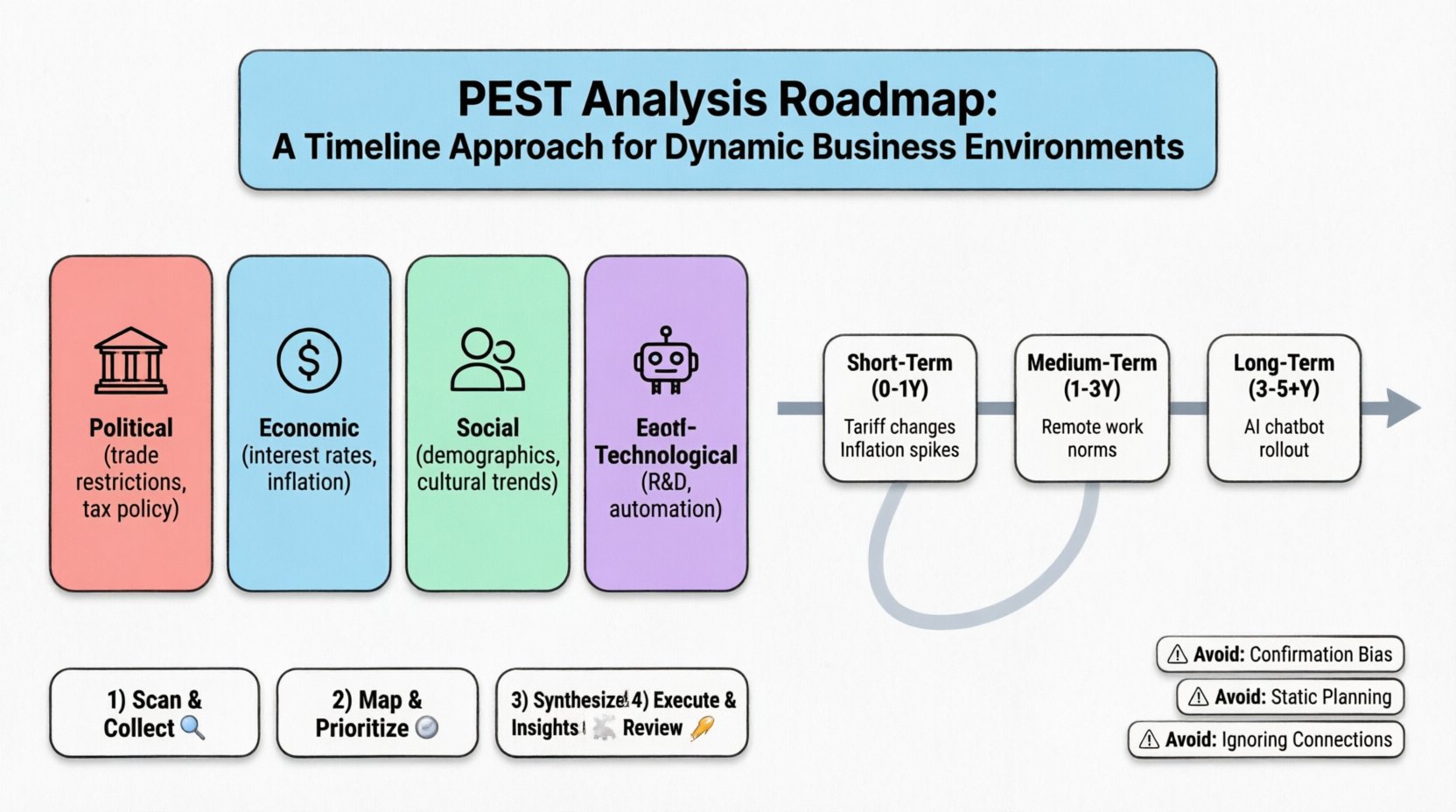
Adding time transforms the analysis from a static report into a strategic roadmap. We divide the timeline into three distinct phases: Short-Term (0-12 months), Medium-Term (1-3 years), and Long-Term (3-5+ years).
This structure helps teams prioritize actions. Short-term actions secure survival. Medium-term actions build capacity. Long-term actions define legacy.
The PEST Timeline Matrix
Use this table to organize your findings during the planning session.
| Category | Short-Term (0-1 Year) | Medium-Term (1-3 Years) | Long-Term (3-5+ Years) |
|---|---|---|---|
| Political | Immediate regulatory changes | Legislative trends and elections | Geopolitical shifts and treaties |
| Economic | Cash flow and interest rates | Inflation cycles and GDP trends | Global market integration |
| Social | Consumer sentiment shifts | Demographic transitions | Cultural paradigm shifts |
| Technological | Software updates and security | Adoption of new platforms | Breakthrough innovations |
Phase 1: Environmental Scanning and Data Collection 🕵️♂️
The foundation of a robust roadmap is high-quality data. You do not need expensive software to gather intelligence. The goal is breadth and depth.
Identify Information Sources
- Government Publications: Review annual reports from central banks and trade departments.
- Industry Reports: Leverage white papers from professional associations.
- News Aggregation: Monitor headlines across multiple regions to catch regional shifts early.
- Customer Feedback: Direct input from the frontline reveals social and economic pressures.
- Competitor Moves: Analyze where competitors are investing to understand technological trends.
Conduct Stakeholder Interviews
Internal teams possess valuable context. Engage with:
- Sales Teams: They hear directly about pricing sensitivity and competitor pricing.
- Legal Counsel: They track regulatory compliance risks.
- IT Leadership: They monitor infrastructure and security threats.
- HR Managers: They understand labor market shifts and talent availability.
Phase 2: Mapping Factors to Time Horizons ⏳
Once data is collected, it must be categorized by time. A factor affecting the business today might not matter in five years, or vice versa.
Assessing Impact and Probability
Not all factors carry equal weight. Use a scoring system to prioritize.
- Impact Score (1-5): How severely would this factor affect operations?
- Probability Score (1-5): How likely is this factor to occur within the timeline?
Factors with high impact and high probability require immediate strategy adjustments. Factors with high impact but low probability require contingency planning.
Connecting the Dots
Look for correlations between categories. For example:
- Political to Economic: A new trade policy (Political) might increase import costs (Economic).
- Social to Technological: A demand for privacy (Social) drives encryption tech investment (Technological).
- Economic to Social: High inflation (Economic) reduces disposable income (Social).
Phase 3: Synthesizing Insights for Strategy 🧩
Data without synthesis is noise. This phase converts the roadmap into actionable strategy.
Identify Strategic Themes
Group findings into broader themes to simplify decision-making.
- Cost Leadership: Are economic factors forcing a need for efficiency?
- Differentiation: Are social trends allowing for premium positioning?
- Market Expansion: Are political or economic shifts opening new regions?
- Disruption: Is technological change threatening the core business model?
Develop Contingency Plans
For every high-risk factor identified, create a backup plan.
- Scenario A (Optimistic): Conditions improve faster than expected.
- Scenario B (Neutral): Conditions remain stable or grow linearly.
- Scenario C (Pessimistic): Conditions worsen or volatility increases.
Phase 4: Action and Execution 🚀
A roadmap is useless without execution. Assign ownership for each strategic initiative derived from the analysis.
Key Action Items
- Update Financial Models: Adjust forecasts based on new economic and political projections.
- Revise Marketing Plans: Align messaging with current social sentiments and values.
- Invest in R&D: Allocate resources to address technological threats or opportunities.
- Review Supply Chains: Mitigate political or economic risks by diversifying suppliers.
Deep Dive: Navigating Specific Environmental Shifts 🌍
Let us explore how specific factors manifest across the timeline in a dynamic environment.
Political Volatility and Regulation
Political landscapes are rarely static. In the short term, focus on compliance. In the medium term, prepare for legislative changes. In the long term, consider geopolitical alliances.
- Example: A change in environmental regulations might require immediate equipment upgrades (Short) but could open new markets for green tech (Long).
Economic Cycles and Inflation
Economic factors fluctuate with business cycles. Short-term cash management is critical during downturns. Medium-term, focus on debt restructuring. Long-term, look for emerging markets.
- Example: Rising interest rates (Short) reduce borrowing capacity, forcing a focus on organic growth rather than acquisition.
Social Shifts and Consumer Behavior
Social trends move slowly but have massive impact. Short-term, monitor brand sentiment. Medium-term, adapt product features. Long-term, rebrand or pivot the mission.
- Example: A shift toward sustainability (Long) may start with consumer complaints (Short) and require supply chain overhaul (Medium).
Technological Disruption
Technology moves fastest. Short-term, ensure security. Medium-term, adopt new tools. Long-term, innovate or risk obsolescence.
- Example: The rise of AI (Long) creates immediate efficiency gains (Short) but requires workforce reskilling (Medium).
Common Pitfalls to Avoid ⚠️
Even with a roadmap, teams make mistakes. Awareness of these traps ensures a cleaner analysis.
1. Confirmation Bias
Looking only for data that supports pre-existing beliefs. Challenge assumptions with contradictory evidence.
2. Overlooking Weak Signals
Focusing only on loud news and missing subtle trends that indicate future shifts. Look for niche reports and early adopter behaviors.
3. Ignoring Interdependencies
Viewing Political, Economic, Social, and Technological factors in silos. Always ask how one category influences another.
4. Static Planning
Creating the roadmap and forgetting it. The plan must be a living document. Revisit it quarterly.
5. Lack of Stakeholder Buy-In
Conducting the analysis in a vacuum. Ensure key leaders understand the findings and feel ownership of the resulting strategy.
Review and Iterate 🔁
The dynamic nature of business means the roadmap must evolve. Establish a review cadence.
Quarterly Check-Ins
- Review the short-term factors. Have they materialized as predicted?
- Shift medium-term factors into the short-term horizon.
- Identify new data points that require updating the long-term view.
Annual Deep Dive
- Conduct a full refresh of the PEST analysis.
- Update the timeline horizons based on strategic milestones achieved.
- Reassess the strategic themes and pivot if necessary.
Integrating with Broader Strategic Planning 📊
The PEST roadmap does not exist in isolation. It feeds into the wider strategic planning ecosystem.
SWOT Alignment
Translate PEST findings into Strengths, Weaknesses, Opportunities, and Threats.
- Opportunities: Derived from favorable social and technological trends.
- Threats: Derived from political and economic risks.
- Strengths: Internal capabilities to handle economic pressures.
- Weaknesses: Internal gaps exposed by technological shifts.
Resource Allocation
Use the timeline to decide where to spend money.
- Short-Term: Operational efficiency and risk mitigation.
- Medium-Term: Capital expenditure and talent acquisition.
- Long-Term: Research, development, and market entry.
Final Thoughts on Strategic Foresight 🔮
Building a PEST analysis roadmap is an exercise in discipline. It requires the humility to admit you do not know the future, combined with the rigor to prepare for multiple possibilities. By mapping factors across time, you create a buffer against uncertainty.
This approach moves strategy from reactive to proactive. It allows teams to see the horizon before they reach the bend in the road. In a dynamic environment, the ability to anticipate is a competitive advantage.
Start with the data. Map the time. Define the actions. Review the results. The path forward is clearer when you understand the forces shaping it.