
Entering the global marketplace requires more than just a quality product or a competitive price. It demands a deep understanding of the external environment where your business will operate. For students of international business, strategic frameworks are essential tools for navigating complexity. Among the most widely used models for scanning the macro-environment is the PEST framework. This guide provides a comprehensive look at Political, Economic, Social, and Technological factors, helping you build a solid foundation for strategic analysis.
Understanding these external forces allows organizations to anticipate changes rather than simply reacting to them. Whether you are analyzing a market entry strategy for a new region or evaluating the long-term viability of an existing operation, this framework offers clarity. We will explore each component in detail, provide practical examples, and discuss how to apply this knowledge effectively without relying on software-specific solutions.
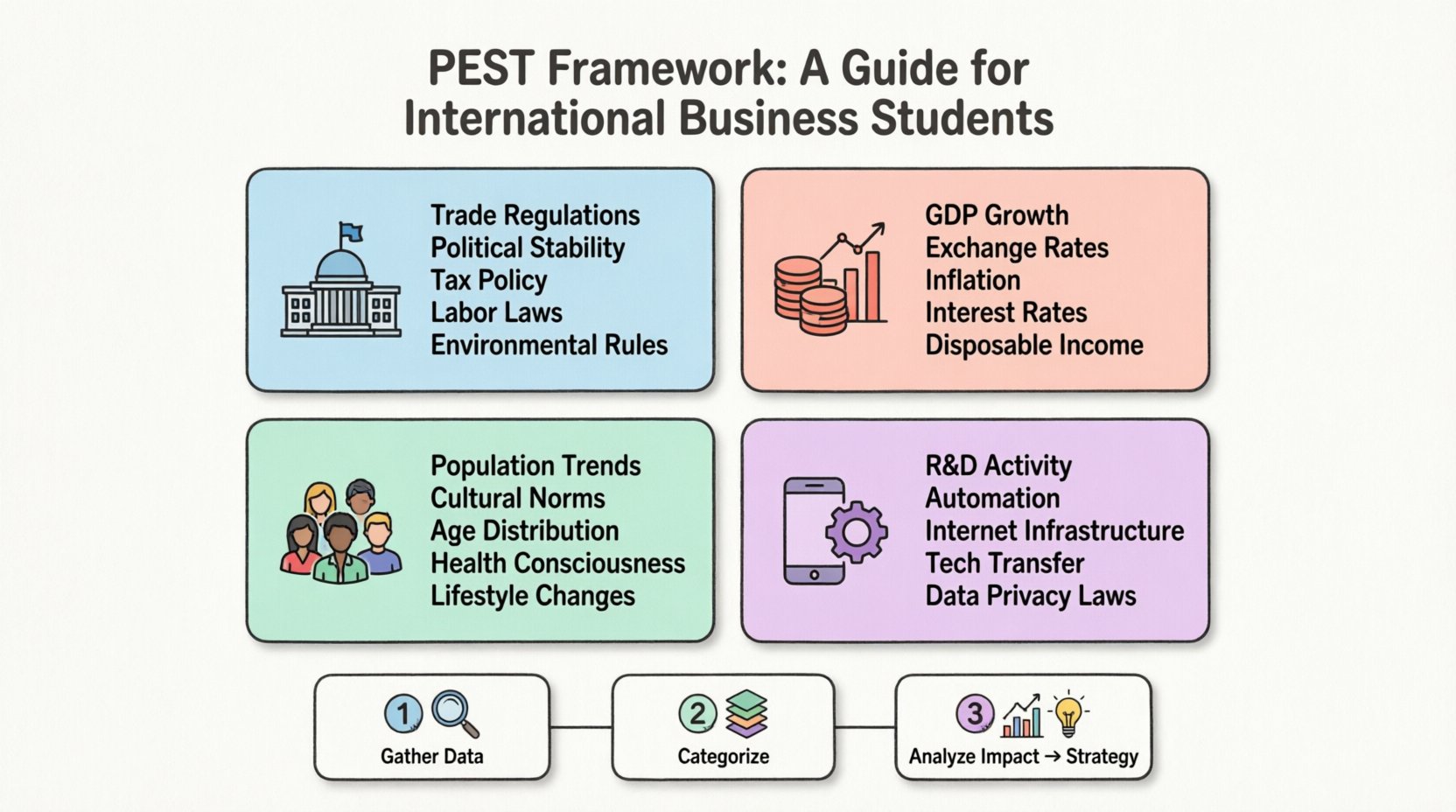
📚 What is the PEST Framework?
The PEST analysis is a strategic tool used to scan the external macro-environmental factors that can influence an organization. It helps businesses identify opportunities and threats that exist outside of their direct control. The acronym stands for:
- Political
- Economic
- Social
- Technological
While often associated with market research, its roots lie in strategic management. It forces analysts to look beyond the internal operations of a company and consider the broader landscape. For an international business student, this distinction is critical. Domestic success does not guarantee international success because the macro-environment varies significantly across borders.
This framework is not a standalone strategy. Instead, it serves as an input for broader strategic planning. It answers the question: “What external forces might impact our business in the coming years?” By systematically reviewing these four categories, students can develop a more robust and resilient business plan.
🏛️ Deep Dive: The Four Pillars of PEST
To truly master this concept, one must understand the specific nuances of each letter. Each category represents a distinct set of variables that interact with one another. Let us break them down.
1. Political Factors 🏛️
Political factors refer to how government intervention affects the economy and business. In international contexts, this is often the most volatile category. Stability is key for long-term investment, making this a primary concern for global firms.
- Trade Regulations: Tariffs, quotas, and embargoes directly impact the cost of goods moving across borders.
- Political Stability: The risk of civil unrest, regime changes, or policy inconsistency can disrupt supply chains.
- Tax Policy: Corporate tax rates vary widely between nations, affecting profit margins and repatriation of earnings.
- Labor Laws: Regulations regarding unions, minimum wages, and working conditions differ by country.
- Environmental Regulations: Compliance with local environmental standards can require significant capital investment.
For example, a company looking to expand into a new region must assess whether the current government favors foreign direct investment or protects domestic industries. A shift in administration can lead to immediate changes in trade agreements.
2. Economic Factors 💰
Economic factors determine the purchasing power of potential customers and the cost of capital. These indicators are often quantitative, making them easier to measure than social trends, yet they are highly dynamic.
- Economic Growth: Measured by GDP, this indicates the health of the market and demand for goods.
- Exchange Rates: Fluctuations in currency value affect the cost of imports and the competitiveness of exports.
- Inflation Rates: High inflation can erode consumer purchasing power and increase operational costs.
- Interest Rates: Central bank policies influence borrowing costs for expansion and working capital.
- Disposable Income: The amount of money households have available for spending on non-essentials.
When analyzing an emerging market, economic indicators often look promising on paper. However, currency volatility can turn a profitable venture into a loss if the local currency devalues rapidly against the home currency.
3. Social Factors 👥
Social factors are perhaps the most difficult to quantify but are often the most critical for long-term acceptance. This category covers the cultural, demographic, and psychological aspects of a market.
- Population Growth: A growing population may indicate a larger future workforce and consumer base.
- Age Distribution: An aging population requires different products than a youth-heavy demographic.
- Cultural Norms: Language, religion, and social attitudes dictate consumer behavior and marketing messages.
- Health Consciousness: Trends in wellness can drive demand for specific product categories.
- Lifestyle Changes: Shifts in work-life balance, urbanization, and family structures impact consumption patterns.
For instance, a food product that succeeds in one country might fail in another due to dietary restrictions or cultural taboos. Understanding these social nuances prevents costly marketing errors.
4. Technological Factors 💻
Technological factors relate to innovation, automation, and the rate of technological change. In the modern economy, this category evolves faster than the others.
- R&D Activity: The level of innovation in a region indicates future competitive threats.
- Automation: The availability of automated processes affects labor costs and production efficiency.
- Internet Infrastructure: Connectivity levels determine the viability of e-commerce and digital services.
- Technology Transfer: The ease with which technology moves across borders affects competitive advantage.
- Regulatory Environment: Laws regarding data privacy and digital rights impact tech-heavy industries.
Consider the smartphone market. A strategy that relies on high-speed internet access will fail in regions where infrastructure is underdeveloped. Conversely, mobile-first strategies are essential in markets where traditional banking is low but mobile penetration is high.
📊 Visualizing the Factors
Organizing these factors helps in maintaining clarity during analysis. The following table summarizes the key considerations for each category in an international context.
| Category | Key Question | Example Impact |
|---|---|---|
| Political | How does government policy affect operations? | Import tariffs increase product costs by 15%. |
| Economic | What is the financial health of the market? | High inflation reduces consumer purchasing power. |
| Social | How do people live and think? | Preference for local brands over foreign ones. |
| Technological | What tools drive the industry? | Lack of reliable internet hinders digital sales. |
🛠️ How to Conduct a PEST Analysis
Implementing this framework requires a structured approach. There is no single correct method, but following a logical process ensures comprehensive coverage. Here is a step-by-step guide for students and professionals.
Step 1: Define the Scope
Before gathering data, determine the specific market or product you are analyzing. A global strategy differs from a regional one. Clarify the timeline as well; short-term tactical decisions require different data than long-term strategic planning.
Step 2: Gather Data
Collect information from reliable sources. This may involve government publications, economic reports, academic journals, and industry news. Focus on recent data, as the macro-environment changes quickly. For international business, look for data specific to the target country, not just regional averages.
Step 3: Categorize Information
Sort the collected data into the four PEST categories. Be careful not to overlap factors. For example, a new technology law is technological, but the cost of compliance is economic. Make a judgment call based on the primary driver.
Step 4: Analyze Impact
Assess the significance of each factor. Not all factors are created equal. Some may pose a direct threat to viability, while others are merely background noise. Use a scoring system to prioritize which factors require immediate attention.
Step 5: Develop Strategies
Translate the analysis into action. If a political factor indicates rising trade barriers, the strategy might involve localizing production. If a social trend shows a demand for sustainability, adjust the product line accordingly.
🔄 PEST vs. SWOT: Understanding the Difference
Students often confuse PEST with SWOT (Strengths, Weaknesses, Opportunities, Threats). While they are related, they serve different purposes.
- PEST is external. It looks at the environment outside the organization.
- SWOT includes both internal and external factors.
The typical workflow is to conduct a PEST analysis first. The “Opportunities” and “Threats” from the PEST output often feed directly into the SWOT matrix. This ensures that the external factors in your SWOT are grounded in reality.
Using PEST alone does not tell you how your company compares to competitors. It only tells you what the landscape looks like. Using SWOT alone might lead to internal bias. Combining them provides a holistic view of the strategic position.
🌐 Extended Frameworks: PESTLE and STEEPLE
As business environments become more complex, the original PEST model has evolved. It is important to know these variations for comprehensive analysis.
- PESTLE: Adds Legal and Environmental factors. This is crucial for industries with heavy regulatory oversight or sustainability concerns.
- STEEPLE: Adds Ethical and Demographic factors. This provides a deeper look at social responsibility and population shifts.
While these extended models offer more detail, the core four elements of PEST remain the foundation. Students should start with PEST to understand the fundamentals before adding layers of complexity.
⚠️ Common Pitfalls to Avoid
Even experienced analysts can make mistakes when applying this framework. Being aware of these common errors can improve the quality of your work.
- Generic Data: Using global averages instead of local data leads to inaccurate conclusions. A country is not a monolith.
- Static Analysis: Treating the analysis as a one-time event. The environment is dynamic and requires regular updates.
- Ignoring Interconnectivity: Factors influence each other. Economic instability often leads to political unrest. Analyze them in isolation to miss the bigger picture.
- Overlooking Weak Signals: Focusing only on current trends and missing emerging technologies or cultural shifts that will matter in five years.
- Lack of Objectivity: Letting internal biases influence the interpretation of external data. Ensure the analysis is evidence-based.
📈 Real-World Application Example
Consider a hypothetical retail company planning to enter the Southeast Asian market. How would they apply this framework?
- Political: They assess trade agreements between their home country and the target region. They check for corruption indices and ease of doing business.
- Economic: They analyze the GDP growth of the specific country and the disposable income of the middle class.
- Social: They research shopping habits, preference for brick-and-mortar vs. online, and cultural sensitivity regarding branding.
- Technological: They evaluate mobile payment adoption rates and logistics infrastructure capabilities.
By synthesizing this information, the company might decide to partner with a local firm to navigate political complexities while investing in a mobile-first customer experience to match technological trends.
🔮 The Future of Strategic Analysis
The tools we use to analyze business will continue to evolve. However, the fundamental need to understand the macro-environment remains constant. Data availability is increasing, allowing for more precise forecasting. Artificial intelligence is beginning to assist in pattern recognition within large datasets.
Despite technological advances, human judgment remains vital. Context matters. Numbers do not tell the whole story of cultural sentiment or political will. The PEST framework provides the structure, but the analyst provides the insight.
📝 Final Thoughts on Strategic Preparation
Mastering the PEST framework is a journey of continuous learning. It requires staying informed about global events and developing the ability to see patterns in chaos. For international business students, this skill set is non-negotiable. It forms the bedrock of strategic thinking.
By systematically examining Political, Economic, Social, and Technological factors, you equip yourself to make informed decisions. You move from guessing to planning. You move from reacting to anticipating. This shift in mindset is what separates successful international leaders from those who struggle to adapt.
Keep your analysis current. Revisit your assumptions regularly. And remember that while you cannot control the external environment, you can prepare for it. This preparation is the essence of strategic management.
As you move forward in your career, use this framework to guide your thinking. Whether you are launching a startup or managing a division of a multinational corporation, the macro-environment will always be there. Understanding it is the first step toward success.
Start analyzing today. Look at the world around you through the lens of PEST. You will begin to see opportunities and threats that others might miss. This perspective is your competitive advantage in the global economy.