
Effective data modeling is the backbone of any robust application architecture. When teams collaborate on database schemas, the Entity Relationship Diagram (ERD) serves as the single source of truth. However, without standardized documentation practices, these diagrams often become sources of confusion rather than clarity. Ambiguity in structure leads to inconsistent development, increased bugs, and slower deployment cycles. This guide outlines the essential standards for creating ERD documentation that supports seamless teamwork.
Data modeling is not merely about drawing boxes and lines. It is a communication protocol between database administrators, backend engineers, and product managers. When everyone speaks the same visual language, the risk of misinterpretation drops significantly. The following sections detail the structural, syntactic, and procedural standards necessary to maintain high-quality documentation.
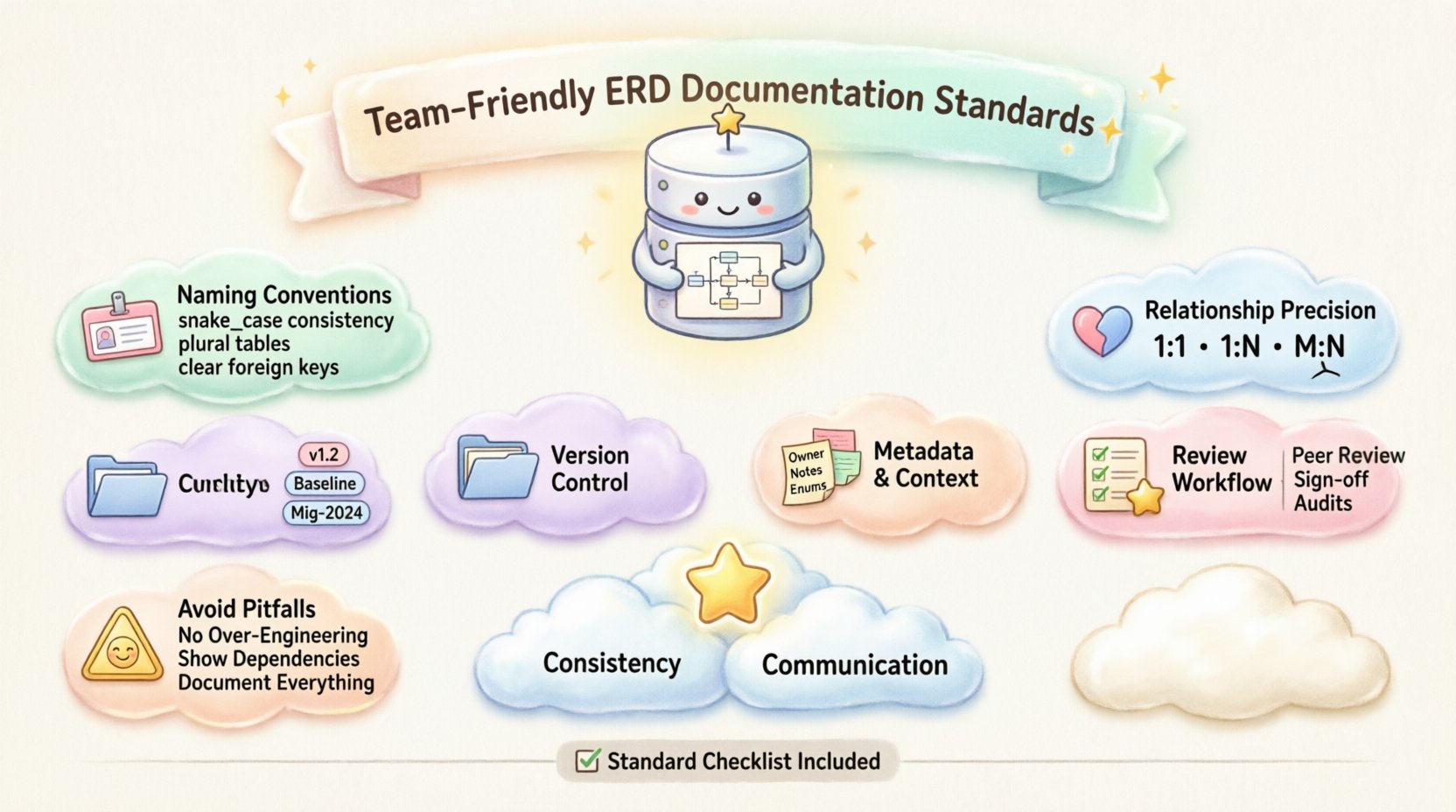
📝 Foundational Naming Conventions
Naming conventions form the first layer of clarity in any documentation set. Inconsistent naming creates cognitive friction. A developer reading a schema should not have to guess what a column name represents. Standardization ensures that names are predictable across the entire project.
- Consistency is Key: Adopt a single style guide for the entire organization. Whether choosing snake_case, camelCase, or PascalCase, the decision should be made once and applied universally.
- Plural vs. Singular: Tables generally represent collections of entities, so plural naming (e.g.,
users,orders) is often preferred. Columns within those tables should be singular (e.g.,user_id,order_date). - Foreign Key Clarity: Naming relationships explicitly helps understanding. A column referencing the
userstable should ideally be nameduser_idrather than justid. This removes ambiguity about which table the relationship belongs to. - Special Characters: Avoid spaces and special characters in table or column names. These require quoting in SQL queries and can cause errors in automated tools. Use underscores or camelCase instead.
- Case Sensitivity: Be aware of the underlying database engine. Some systems are case-sensitive, while others are not. Documenting the standard case style prevents deployment issues across different environments.
Consider the impact of naming on long-term maintenance. As the system grows, new developers will join the team. Clear names reduce the onboarding time required to understand the data structure. It is better to be verbose than cryptic. A name like customer_primary_email_address is clearer than cp_email, even if the latter is shorter.
🔗 Defining Relationships with Precision
The relationships between entities define the integrity of the data model. An ERD must clearly communicate how data points connect. Vague lines and missing labels lead to assumptions that often prove incorrect during implementation.
Cardinality Notation
Cardinality describes the numerical relationship between entities. Standardizing the notation used in the diagram prevents misinterpretation.
- One-to-One (1:1): Indicates that a record in one table corresponds to exactly one record in another. This is common for sensitive data separation or specific profile extensions.
- One-to-Many (1:N): The most common relationship. One record in the parent table relates to multiple records in the child table. For example, one
customercan place manyorders. - Many-to-Many (M:N): Requires an intermediate junction table. This should never be represented as a direct line in a logical model without a bridge entity. Explicitly show the junction table to clarify the structure.
Optionality and Constraints
Not all relationships are mandatory. The diagram should indicate whether a relationship is optional or required.
- Mandatory Participation: Every record in the child table must have a parent. For example, every
line_itemmust belong to anorder. - Optional Participation: A record may exist without a parent. For example, a
userprofile might not have a linkedpayment_methodimmediately upon registration.
Visual notation matters here. Use specific symbols (like crow’s feet or specific line terminators) to denote these constraints. Do not rely on text alone to explain the rules. The visual representation should be self-explanatory to a technical audience.
📂 Version Control for Database Schemas
Just as application code requires version control, database schemas do as well. Documentation is not a static artifact; it evolves with the system. Without a process for tracking changes, the diagram will inevitably drift away from the actual database state.
- Change Logs: Every modification to the ERD should be recorded. This includes the date, the author, the nature of the change, and the reason for the change.
- Baseline Versions: Establish a baseline for specific releases. If a feature is being built, the documentation should reflect the state of the schema required for that feature.
- Migration Tracking: Link the documentation to migration scripts. If a column is added, the documentation should reference the migration script that implements this change.
- Conflict Resolution: When multiple teams modify the schema, a versioning strategy prevents overwrites. Identify the owner of each schema segment to avoid accidental conflicts.
It is essential to maintain the integrity of the diagram over time. An outdated diagram is worse than no diagram, as it creates a false sense of security. Teams may build features based on information that no longer exists.
📄 Metadata and Contextual Information
Technical details are not enough. Documentation must include metadata that provides context for decision-making. Why was a specific design choice made? Who owns this data?
Ownership and Stewardship
Assign ownership for specific tables or schemas. This clarifies who to contact for questions or changes.
- Data Steward: Identify the individual responsible for the accuracy of the data within a table.
- Technical Owner: Identify the lead engineer responsible for the maintenance of the schema structure.
- Business Owner: Identify the product or business stakeholder who defines the requirements for the data.
Descriptive Notes
Complex business logic often cannot be represented by lines alone. Add notes to explain specific rules.
- Calculation Logic: If a column is a computed value, document the formula used.
- Enum Values: For columns with restricted sets of values (e.g.,
status), list the allowed values and their meanings. - Deprecated Fields: Clearly mark fields that are no longer in use. Indicate when they were deprecated and when they are scheduled for removal.
This context turns a technical diagram into a business asset. It helps new team members understand the *why* behind the *what*.
🔄 Workflow for Review and Approval
Standards are useless without a process to enforce them. Establishing a review workflow ensures that documentation remains accurate and aligned with project goals.
- Peer Review: Require at least one peer review before merging schema changes. This catches naming inconsistencies and logic errors.
- Stakeholder Sign-off: For major structural changes, business stakeholders should review the impact on data reporting and user experience.
- Automated Checks: Where possible, use tools to validate that the actual database matches the documentation. This reduces manual verification effort.
- Regular Audits: Schedule periodic audits to ensure the documentation has not drifted from the production environment.
Collaboration is a continuous loop. It is not a one-time activity at the start of a project. As requirements shift, the documentation must shift with them.
⚠️ Common Pitfalls in ERD Design
Even with standards in place, teams often fall into common traps. Recognizing these pitfalls early can save significant time and effort.
- Over-Engineering: Designing for every possible future scenario leads to unnecessary complexity. Focus on current requirements and leave room for growth without over-complicating the structure.
- Ignoring Performance: A perfect schema on paper might perform poorly in production. Consider indexing strategies and query patterns during the design phase.
- Hidden Dependencies: Ensure that all foreign key relationships are explicit. Hidden logic creates fragile systems that break easily.
- 缺乏 Documentation: Relying solely on the diagram without supporting text is risky. Contextual notes are essential for complex logic.
📋 A Comprehensive Standard Checklist
Use this table to verify your documentation against established standards before publication.
| Category | Requirement | Priority |
|---|---|---|
| Naming | All table names are plural and snake_case | High |
| Naming | Foreign keys follow the pattern _id |
High |
| Relationships | Cardinality is explicitly marked | High |
| Relationships | Many-to-Many relationships use junction tables | High |
| Metadata | Column data types are specified | Medium |
| Metadata | Default values are documented | Medium |
| Versioning | Change log is up to date | Medium |
| Versioning | Version number is visible on the diagram | High |
| Accessibility | Diagram is accessible to all team members | High |
| Accessibility | Legend is included for symbols | Medium |
Implementation Guidelines
Adopting these standards requires discipline. It is not enough to have the rules; they must be integrated into the daily workflow.
- Onboarding: Include the documentation standards in the new hire orientation. Explain the reasoning behind each rule.
- Templates: Create templates for ERDs that include the necessary headers, legends, and metadata sections.
- Code Reviews: Treat schema documentation as part of the code review process. Do not merge schema changes without updated documentation.
- Feedback Loop: Encourage team members to suggest improvements to the standards themselves. The process should evolve.
🚀 Sustaining Quality Over Time
Maintaining high-quality ERD documentation is an ongoing effort. It requires a commitment to clarity and a willingness to refactor both the data and the documentation when necessary.
When teams invest in these standards, the payoff is evident. Development speeds up because there is less time spent clarifying requirements. Errors decrease because the constraints are clear. Communication improves because the visual language is shared.
Start by auditing your current documentation. Identify the areas where confusion arises most often. Apply the standards outlined in this guide to those specific areas first. Gradually expand the coverage until the entire system adheres to the new norms.
Data is an asset. Protecting its integrity through clear documentation is one of the most valuable contributions a technical team can make. By following these guidelines, you ensure that your data model remains a reliable foundation for the entire application ecosystem.
Focus on clarity, consistency, and communication. These three pillars support a documentation strategy that serves the team well throughout the lifecycle of the software.