
Designing a robust data structure is the foundation of any reliable application. At the heart of this design lies the Entity-Relationship Diagram (ERD), where the distinction between entity types dictates how data is stored, related, and retrieved. Understanding the nuances between weak and strong entities is not merely academic; it determines the integrity of your data lifecycle. This guide provides a detailed examination of these concepts, focusing on practical implementation and structural logic.
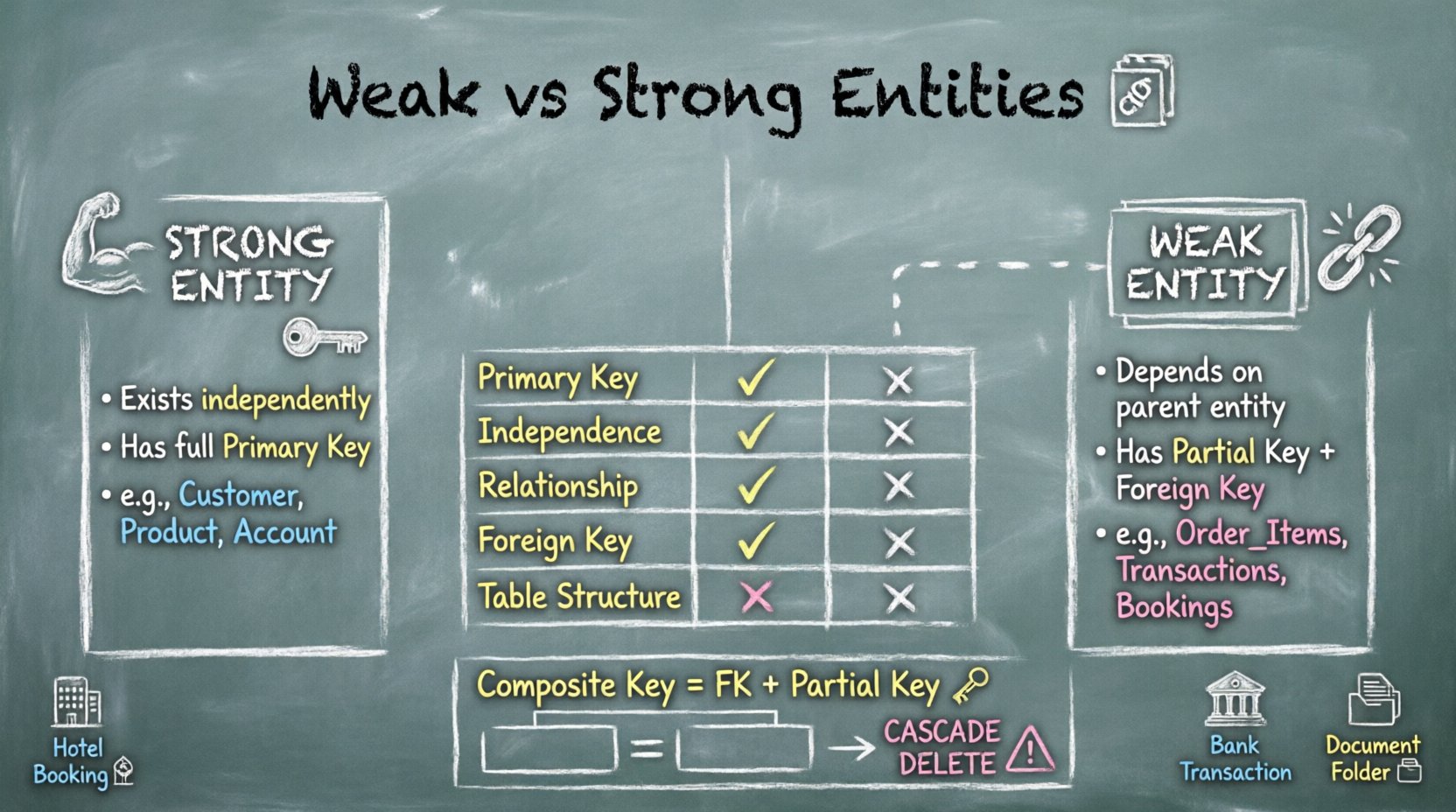
Defining the Strong Entity 💪
A strong entity, often referred to as a regular entity, represents a distinct object or concept that exists independently within the database. It possesses its own unique identity, which does not rely on the existence of any other entity. In modeling terms, a strong entity is capable of being uniquely identified by a primary key that is intrinsic to the entity itself.
Characteristics of Strong Entities
- Independent Existence: A record for a strong entity can exist without a parent record. For example, a Customer can exist in a database even if they have never placed an order.
- Unique Identifier: Every instance of the entity must have a primary key that guarantees uniqueness across the entire table. This is often an auto-incrementing integer or a UUID.
- Structural Stability: The schema for a strong entity typically remains stable over time, as it represents core business objects rather than transient data.
Consider a scenario involving an inventory system. The Product entity is strong. A product definition exists in the catalog regardless of whether a specific instance is currently in stock or associated with a specific warehouse location. The product has its own ID, say product_id, which serves as the primary key.
Defining the Weak Entity ⛓️
A weak entity is an entity that cannot be uniquely identified by its own attributes alone. It relies on a parent entity for its identity. Without the parent entity, a weak entity record has no meaning or context. In database modeling, this dependency is critical for maintaining referential integrity.
Characteristics of Weak Entities
- Existence Dependency: The existence of a weak entity record is contingent upon the existence of a specific strong entity record. If the parent is deleted, the child weak entity must also be removed.
- Partial Key: Weak entities do not have a full primary key. Instead, they possess a partial key (also known as a discriminator) that is unique only within the context of the parent entity.
- Identifying Relationship: The connection between a weak entity and its strong parent is an identifying relationship. This relationship is mandatory and usually represented by a double line in ERD notation.
Take the example of Order_Items. An order line item cannot exist without an Order. Furthermore, an order item is not just defined by its own internal ID, but by which order it belongs to. A specific line item might be the first item in one order and the second item in another. The uniqueness of the line item is derived from the combination of the Order_ID and a sequence number like line_number.
Comparing Strong and Weak Structures 📊
Visualizing the differences helps in applying the correct modeling techniques. The following table outlines the technical distinctions between the two entity types.
| Feature | Strong Entity | Weak Entity |
|---|---|---|
| Primary Key | Full Primary Key (Unique ID) | Partial Key (Discriminator) |
| Independence | Exists independently | Depends on Strong Entity |
| Relationship Type | Non-identifying (Optional) | Identifying (Mandatory) |
| Foreign Key | Not required for identity | Required for identity |
| Table Structure | Standard Table | Often merged or linked via FK |
Identifying Attributes and Partial Keys 🔑
The concept of the partial key is central to understanding weak entities. In a strong entity, the primary key is unique across all instances of that entity. In a weak entity, the partial key is only unique within the scope of the specific parent instance.
Constructing the Composite Key
To implement a weak entity in a physical database, the database management system typically creates a composite primary key. This key consists of two parts:
- The Foreign Key: This references the primary key of the strong parent entity.
- The Partial Key: This is the local attribute that differentiates the weak entity instances from one another within the parent.
For instance, in a schema for a Project and Project_Tasks relationship:
project_id(Foreign Key from Project)task_sequence(Partial Key)
The unique identifier for a task is the combination of project_id and task_sequence. A task with sequence number 1 in Project A is distinct from a task with sequence number 1 in Project B. This composite structure ensures that data remains consistent and prevents ambiguity.
Relationships and Cardinality ⚖️
The relationship between strong and weak entities is not just a logical concept; it dictates the cardinality and optionality constraints in the ERD.
Mandatory Participation
Because a weak entity cannot exist without its parent, the participation of the weak entity in the relationship is mandatory. In diagramming terms, this is often shown with a double line connecting the relationship to the weak entity. This signifies that you cannot create a record in the child table without a corresponding valid record in the parent table.
Referential Integrity
Implementing this relationship in a database requires strict referential integrity constraints. When the strong entity is deleted, the database engine must handle the weak entities. This is commonly achieved through CASCADE DELETE actions. If the parent is removed, all dependent weak entities are automatically removed to prevent orphaned records.
This logic prevents data corruption. Imagine a scenario where an Invoice is deleted, but the Invoice_Lines remain. The orphaned lines would reference a non-existent invoice, creating data anomalies that are difficult to debug and query.
Design Best Practices 🛠️
Applying these concepts correctly requires adherence to specific modeling guidelines. Deviating from these practices can lead to performance issues and data inconsistency.
1. Avoid Unnecessary Weak Entities
Not every relationship that seems dependent should be modeled as a weak entity. If an entity has meaning on its own, it should be a strong entity. For example, a Employee and a Dependent might seem dependent, but a dependent could exist independently of a specific employment record in some contexts. Careful analysis of business rules is required.
2. Ensure Clear Naming Conventions
Since weak entities rely on foreign keys for identity, naming conventions should reflect this dependency. Using prefixes or suffixes like _line, _item, or _detail can help developers and analysts quickly identify the nature of the relationship.
3. Indexing Strategies
Composite primary keys in weak entities require specific indexing strategies. The foreign key component should be indexed to speed up joins. In many systems, the entire composite key is the index, which aids in retrieval but can impact write performance if the partial key is not sequential.
4. Normalization Considerations
Weak entities often appear in the context of Third Normal Form (3NF). By isolating the dependent attributes into a separate table linked by an identifying relationship, you eliminate transitive dependencies. This ensures that changes to the parent entity do not require updates to multiple rows in the child table.
Common Modeling Pitfalls ⚠️
Even experienced designers can make mistakes when handling entity types. Awareness of these pitfalls can save significant refactoring time later.
Pitfall: Treating a Weak Entity as Strong
If you assign a standalone primary key to a weak entity (like an auto-increment ID), you break the dependency logic. This allows the weak entity to exist without a parent, violating the business rule. It also complicates the logic required to retrieve related data.
Pitfall: Ignoring Cascade Deletes
Defining the relationship without handling deletion logic can lead to database errors. If the parent is deleted and the foreign key constraint prevents it, the application will crash. If the parent is deleted but the child remains, the data becomes orphaned. The schema must explicitly define the behavior for parent deletion.
Pitfall: Ambiguous Partial Keys
A partial key must be truly unique within the parent. If a partial key is reused across different parents without the foreign key context, the composite key loses its uniqueness. This often happens when using simple counters (1, 2, 3) without verifying that the scope is limited to the parent record.
Real-World Application Scenarios 🌍
Understanding these concepts becomes clearer when applied to specific domains. Below are common scenarios where weak entities are the appropriate choice.
1. Hotel Booking Systems
In a hotel database, a Room might be considered a strong entity (Room 101 always exists). However, a Room_Booking is a weak entity. A booking record is meaningless without a specific room and a specific date. The booking is uniquely identified by the Room_ID and the Date.
2. Financial Transactions
Consider a bank account system. An Account is a strong entity. A Transaction within that account is a weak entity. While a transaction might have a transaction ID, its context is entirely defined by the account it belongs to. A transaction ID 500 in Account A is different from Transaction ID 500 in Account B.
3. Document Management
In a document repository, a Folder is a strong entity. A Document inside the folder is often modeled as a weak entity relative to the folder hierarchy. The document’s path and visibility are dependent on the folder structure.
Implementation and Evolution 🔄
Database schemas are rarely static. As business requirements change, the distinction between weak and strong entities may shift.
Refactoring Dependencies
Over time, a weak entity might gain enough independence to become a strong entity. For example, a Support_Ticket might initially be weak to a User. However, if the system evolves to allow anonymous tickets or tickets linked to multiple users, the entity may need to be refactored to a strong entity with a new primary key.
Performance Implications
Deep nesting of weak entities (weak entity of a weak entity) can impact query performance. Each level adds a join requirement. It is advisable to keep the hierarchy flat where possible. If a relationship is deeply nested, consider denormalizing the data for read-heavy operations, provided data integrity can be maintained.
Conclusion on Data Integrity 🛡️
The decision to model an entity as weak or strong is a fundamental architectural choice. It affects how data is queried, how relationships are enforced, and how the system handles deletions. By strictly adhering to the rules of identifying relationships and composite keys, you ensure that your database remains a reliable source of truth. This discipline prevents the accumulation of orphaned data and simplifies the maintenance of the system as it scales.
When reviewing your ERDs, ask if the entity can exist without its parent. If the answer is no, model it as a weak entity. If the answer is yes, treat it as strong. This binary logic, applied consistently, forms the bedrock of a well-structured database schema.