


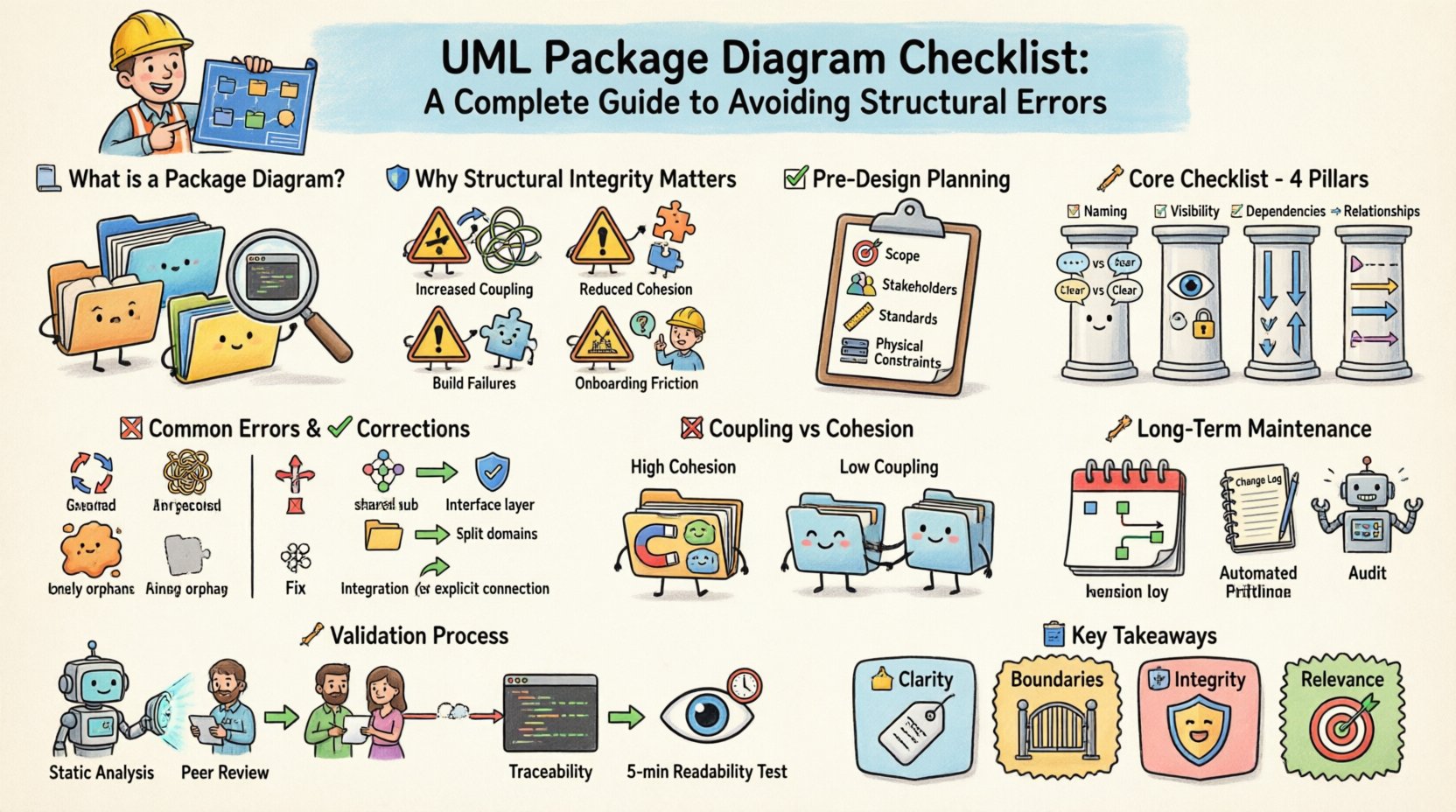
🏗️ Introduction to Package Diagrams
A UML Package Diagram serves as a structural blueprint for software systems. Unlike class diagrams that focus on individual entities, package diagrams organize elements into namespaces. This high-level view is critical for understanding the modular architecture of complex applications. When designing these diagrams, precision is paramount. A single misconfigured dependency can lead to significant technical debt later in the development lifecycle.
This guide provides a rigorous checklist to ensure your package diagrams are robust. We focus on structural integrity, logical grouping, and dependency management. By following these standards, architects and developers can prevent common pitfalls that compromise system stability.
🛡️ Why Structural Integrity Matters
Software architecture is not merely about drawing boxes and arrows. It is about defining boundaries and interactions that enforce separation of concerns. When package structures are flawed, several issues arise:
- Increased Coupling: Modules become too interdependent, making changes risky.
- Reduced Cohesion: Related functionality is scattered across unrelated namespaces.
- Build Failures: Circular dependencies prevent compilation in many language environments.
- Onboarding Friction: New team members struggle to navigate a chaotic namespace hierarchy.
A well-structured package diagram acts as a contract. It tells developers where to place new code and which existing components they can safely reference. Ignoring this structure often results in a “spaghetti architecture” where logic is tangled and difficult to isolate.
📋 Pre-Design Planning
Before drawing a single rectangle, preparation is essential. Rushing into diagramming without a clear strategy leads to structural errors. Consider the following steps:
- Define the Scope: Are you modeling the entire system or a specific subsystem? Keep the scope manageable.
- Identify Stakeholders: Who will use this diagram? Developers, architects, or QA teams need different levels of detail.
- Establish Standards: Agree on naming conventions and visibility rules before starting.
- Map Physical Constraints: Consider if packages map to physical deployment units or just logical groupings.
Skipping these steps often results in diagrams that are difficult to maintain or interpret over time. A clear plan ensures the diagram remains a useful artifact rather than a static picture.
🔍 The Core Checklist
This section outlines the specific criteria to validate your package diagram. Each item addresses a common source of structural error.
1️⃣ Naming Conventions 🏷️
Naming is the first layer of communication. Ambiguous names lead to confusion about a package’s purpose. Use the following rules:
- Use Descriptive Names: Avoid generic terms like “Core” or “Utils” unless their scope is strictly defined.
- Follow Namespace Patterns: Adopt a consistent pattern, such as
organization.module.feature. - Check for Uniqueness: Ensure no two packages share the exact same name within the same context.
- Use Lowercase or CamelCase: Stick to one style throughout the diagram to maintain visual consistency.
2️⃣ Visibility and Scope 👁️
Not all packages should be accessible everywhere. Defining visibility controls access and reduces accidental dependencies.
- Public vs. Private: Mark internal packages as private to hide implementation details.
- Interface Exposure: Only expose public interfaces to external packages. Keep implementation logic internal.
- Package Protection: Ensure that a package cannot be modified by another package unless explicitly intended.
3️⃣ Dependency Management 🔗
Dependencies define how packages interact. Poorly managed dependencies create fragile systems.
- Minimize Cross-References: Keep dependencies within a single package where possible.
- Avoid Cycles: Ensure there are no circular dependencies between packages.
- Directional Flow: Dependencies should flow in one direction, typically from high-level modules to low-level utilities.
- Stable Dependencies: Depend upon abstractions. Concrete packages should depend on interfaces, not other concrete packages.
4️⃣ Relationship Types ➡️
UML defines specific relationships. Using the wrong type creates ambiguity about the nature of the connection.
- Dependency: Use for temporary usage or one-time interaction.
- Association: Use for structural links that exist for the lifetime of the objects.
- Realization: Use when a package implements an interface defined in another package.
- Import/Include: Use when one package explicitly requires another to function.
🚫 Common Structural Errors & Corrections
Even experienced architects make mistakes. The table below highlights frequent errors and the corrective actions required to fix them.
| ❌ Error | 🔍 Description | ✅ Correction |
|---|---|---|
| Circular Dependency | Package A depends on B, and B depends on A. | Extract shared logic into a third package that both depend on. |
| Spaghetti Coupling | Too many cross-package arrows creating a web. | Introduce an interface layer to decouple direct connections. |
| Over-Granularity | Too many packages with minimal content. | Consolidate related packages into larger cohesive units. |
| Under-Granularity | One massive package containing everything. | Split the package by functional domain or layer. |
| Orphaned Packages | Packages with no connections or purpose. | Remove unused packages or integrate them into a logical hierarchy. |
| Hidden Dependencies | Implicit connections not shown in the diagram. | Make all cross-package dependencies explicit in the diagram. |
🧩 Managing Coupling and Cohesion
Two fundamental principles guide package design: coupling and cohesion. Understanding these concepts helps you apply the checklist effectively.
High Cohesion
Cohesion refers to how closely related the elements within a package are. A high-cohesion package contains classes and interfaces that perform a single, well-defined task. When building your diagram:
- Group related functionality together.
- Ensure all elements in a package contribute to its primary purpose.
- Avoid mixing data models with business logic in the same package unless necessary.
Low Coupling
Coupling refers to the degree of interdependence between packages. Low coupling means changes in one package have minimal impact on others. To achieve this:
- Use interfaces to define contracts between packages.
- Limit the number of packages a single package depends on.
- Avoid passing complex data structures across package boundaries.
🔎 Validation and Review Process
Creating the diagram is only half the work. You must validate it against your standards. A systematic review process catches errors before they propagate.
- Static Analysis: If your environment supports it, run static analysis tools to detect violations of dependency rules.
- Peer Review: Have another architect review the diagram. Fresh eyes often spot circular dependencies.
- Traceability Check: Verify that every package in the diagram corresponds to actual code artifacts.
- Readability Test: Can someone understand the architecture by looking at the diagram for five minutes?
Documentation is also part of validation. Ensure that each package has a brief description explaining its responsibility. This prevents future confusion about why a specific dependency exists.
🔄 Long-Term Maintenance
Software evolves. The package diagram must evolve with it. Static diagrams become obsolete quickly if not maintained. Adopt these practices for long-term success:
- Version Control: Store diagrams in the same repository as the source code.
- Change Logs: Document significant structural changes in the diagram history.
- Automated Checks: Integrate dependency checks into the build pipeline.
- Regular Audits: Schedule quarterly reviews of the package structure to ensure it still matches the system reality.
When a refactor occurs, update the diagram immediately. An outdated diagram is worse than no diagram at all, as it misleads developers into making incorrect architectural decisions.
📝 Summary of Key Takeaways
Building a reliable UML Package Diagram requires discipline. It is not enough to simply group classes together. You must enforce rules regarding naming, visibility, and dependencies. By adhering to the checklist provided in this guide, you create a structure that supports scalability and maintainability.
Remember the core principles:
- Clarity: Names must be descriptive and consistent.
- Boundaries: Dependencies should be explicit and minimized.
- Integrity: Avoid cycles and circular references at all costs.
- Relevance: Ensure every package serves a distinct purpose.
Following these guidelines helps you avoid structural errors that plague many software projects. A solid package structure forms the foundation of a resilient system, allowing teams to iterate with confidence and speed.