
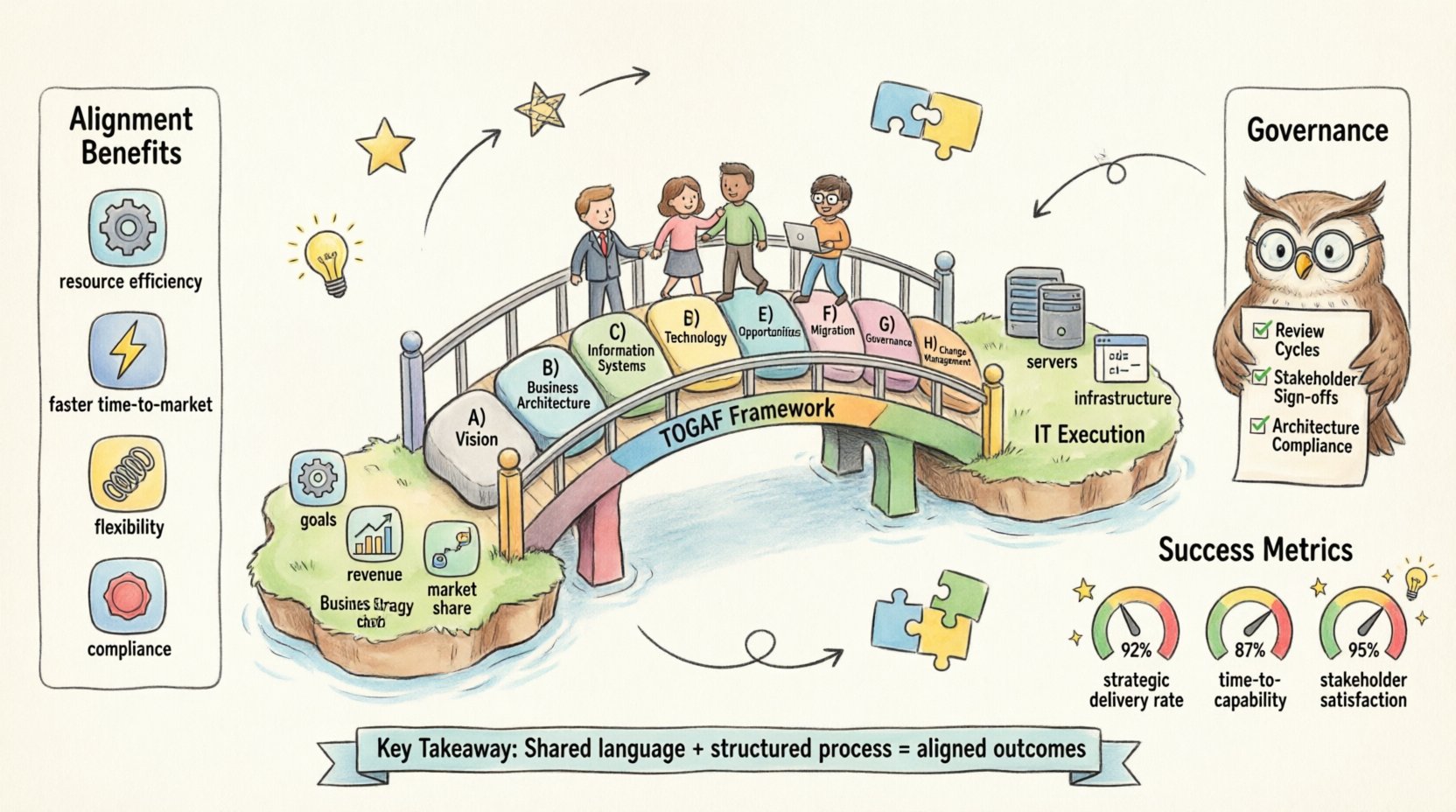
In modern enterprises, the divide between strategic intent and operational reality often widens. Business leaders set ambitious goals, while technical teams build systems that may not fully support those ambitions. This misalignment leads to wasted resources, delayed initiatives, and frustrated stakeholders. To resolve this, organizations require a structured approach to Enterprise Architecture. The TOGAF framework provides the necessary structure to connect high-level strategy with low-level execution.
When business objectives and IT capabilities move in sync, value creation accelerates. When they drift apart, efficiency collapses. This guide explores how leveraging the TOGAF framework can align these critical functions without relying on proprietary tools or hype. We will examine the Architecture Development Method, the role of business architecture, and the governance structures required to sustain alignment.
🚫 Understanding the Strategic Disconnect
The disconnect between strategy and execution is not merely a communication issue; it is a structural one. Often, business strategies are defined in isolation from technical constraints. Conversely, IT roadmaps are built based on technology trends rather than business needs. This siloed approach creates several risks:
- Resource Misallocation: Funding is directed toward projects that do not yield strategic ROI.
- Slow Time-to-Market: Redundant systems and lack of integration delay product launches.
- Inflexibility: The infrastructure cannot adapt to shifting market demands.
- Compliance Gaps: Regulatory requirements are overlooked in favor of speed.
Without a unified framework, decisions are made locally rather than holistically. Leaders need a common language to discuss capabilities, processes, and data. This is where a standardized architecture framework becomes essential.
🏛️ What is TOGAF?
The Open Group Architecture Framework (TOGAF) is a globally recognized standard for Enterprise Architecture. It offers a modular approach to designing, planning, and governing an enterprise’s information systems and processes. Unlike specific software implementations, TOGAF is a methodology. It focuses on the principles and processes that drive architectural decisions.
Key components of TOGAF include:
- The Architecture Development Method (ADM): A cyclical process for developing architecture.
- The Architecture Content Framework: Defines what artifacts are produced.
- The Enterprise Continuum: A mechanism for classifying and organizing architectural assets.
- The Architecture Repository: A central store for all architectural information.
By adopting TOGAF, organizations establish a repeatable process for translating business strategy into actionable IT plans. It ensures that every system built serves a defined business purpose.
🔄 The Architecture Development Method (ADM) Explained
The core of TOGAF is the ADM. It is a cycle of phases that guides the development of an enterprise architecture. Each phase has specific deliverables and gates to ensure alignment with business goals. Using the ADM ensures that IT execution is never disconnected from strategic vision.
Phase A: Architecture Vision
This phase sets the scope and defines the stakeholders. The goal is to understand the business context and the strategic drivers. Key activities include:
- Identifying key stakeholders and their concerns.
- Defining the scope of the architecture project.
- Establishing the business case for the initiative.
- Creating the Architecture Vision document.
If this phase is skipped, the project lacks direction. It ensures that the IT effort is rooted in business reality from day one.
Phase B: Business Architecture
This is the critical bridge. Business Architecture defines the structure of the organization and its processes. It answers the question: “How does the business operate?” This phase translates strategy into a blueprint for operations. It covers:
- Business strategy and governance.
- Business goals and objectives.
- Business processes and workflows.
- Business information flows.
By modeling the business first, IT architects understand the capabilities required to support it. This prevents the common error of building technology that the business does not need.
Phase C: Information Systems Architectures
Once the business needs are clear, this phase addresses the data and applications required. It breaks down into Data Architecture and Application Architecture.
- Data Architecture: Defines the structure of logical and physical data assets.
- Application Architecture: Provides a blueprint for individual applications and their interactions.
This ensures that data flows correctly between systems and that applications support the business processes defined in Phase B.
Phase D: Technology Architecture
This phase defines the hardware and software infrastructure. It covers networks, platforms, and middleware. The focus is on the technical capabilities needed to host the applications and data. Key considerations include:
- Scalability and performance requirements.
- Security and compliance standards.
- Integration patterns.
- Infrastructure resilience.
This phase ensures that the technical foundation is robust enough to support the business functions without bottlenecks.
Phase E: Opportunities and Solutions
Here, the organization determines how to move from the current state to the target state. It involves evaluating implementation options and identifying gaps. Activities include:
- Identifying building blocks to be developed or purchased.
- Developing a migration plan.
- Assessing risks and dependencies.
- Prioritizing work packages.
This phase is crucial for execution planning. It turns the architectural vision into a concrete project portfolio.
Phase F: Migration Planning
Migration planning details the specific steps to implement the architecture. It creates a roadmap that aligns with budget cycles and business priorities. The output is a detailed implementation schedule.
Phase G: Implementation Governance
During the build phase, this ensures that the actual implementation matches the architecture. It involves monitoring and auditing to prevent drift. If a project deviates from the plan, it must be corrected or formally adjusted.
Phase H: Architecture Change Management
Finally, this phase ensures the architecture remains relevant. As business needs change, the architecture must evolve. This phase manages requests for change and updates the architecture repository accordingly.
📊 Comparing Business and IT Priorities
Understanding the differences in focus between business and IT teams is vital for alignment. The table below illustrates the typical divergence and how TOGAF reconciles them.
| Aspect | Business Focus | IT Focus | TOGAF Alignment |
|---|---|---|---|
| Primary Goal | Revenue, Market Share | Uptime, Performance | Link IT metrics to Business KPIs |
| Time Horizon | Quarterly/Annual | Project/Release Cycles | Long-term Roadmaps |
| Language | Market, Customer, Profit | Code, Infrastructure, Latency | Unified Terminology |
| Risk Appetite | High (Innovation) | Low (Stability) | Balanced Governance |
TOGAF bridges these gaps by creating a shared repository of information. It forces both sides to agree on the definitions of capabilities and requirements before work begins.
🛡️ Governance and Stakeholder Management
Architecture without governance is merely a suggestion. TOGAF emphasizes the importance of an Architecture Board and a governance framework. This structure ensures that decisions are made consistently and transparently.
The Architecture Board
This body is responsible for approving architectures and ensuring compliance. It typically includes senior representatives from both business and IT. Their role includes:
- Reviewing architecture compliance.
- Resolving conflicts between projects.
- Validating that investments align with strategy.
- Managing the architecture repository.
Stakeholder Management
Every architecture initiative affects different groups. Identifying these groups and understanding their concerns is a mandatory step. The ADM requires a Stakeholder Map that categorizes individuals by their influence and interest.
Effective engagement strategies include:
- Executive Sponsors: Provide funding and strategic direction.
- Business Users: Provide requirements and acceptance criteria.
- Technical Teams: Provide implementation feasibility.
- Compliance Officers: Ensure regulatory adherence.
Ignoring any of these groups can lead to project failure. TOGAF mandates that their concerns are documented and addressed in the architecture definitions.
📈 Measuring Success and Alignment
How do you know if the gap has been bridged? Metrics must be established that reflect both business value and IT health. Relying solely on technical metrics like uptime is insufficient. Relying solely on business metrics like revenue is also incomplete.
Recommended alignment metrics include:
- Strategic Initiative Delivery Rate: Percentage of IT projects that directly support a strategic goal.
- Time to Capability: How long it takes to deploy a new business capability.
- Technical Debt Ratio: The cost of maintaining legacy systems versus investing in new value.
- Stakeholder Satisfaction: Feedback from business leaders on IT responsiveness.
- Business Process Efficiency: Reduction in process time due to automation.
Tracking these metrics allows leadership to see the direct impact of IT investments on business outcomes. It shifts the conversation from “cost center” to “value driver”.
🧩 Overcoming Cultural Barriers
Even with a perfect framework, human factors can derail alignment. Silos, resistance to change, and lack of trust are common obstacles. TOGAF addresses this through the concept of the Enterprise Continuum, which promotes reuse and standardization.
To foster a culture of alignment:
- Shared Vocabulary: Ensure everyone uses the same terms for processes and data.
- Collaborative Workshops: Hold joint sessions where business and IT define requirements together.
- Transparent Roadmaps: Make the IT plan visible to business leaders to manage expectations.
- Continuous Education: Train business leaders on technology constraints and IT staff on business goals.
When culture shifts toward collaboration, the framework becomes easier to adopt. The goal is to make architecture a shared responsibility rather than a gatekeeping function.
🚀 Implementation Roadmap
Adopting TOGAF is not an overnight process. It requires a phased approach to integration. The following steps outline a practical path forward.
- Assessment: Evaluate current architecture maturity and identify gaps.
- Commitment: Secure executive sponsorship and define the scope.
- Training: Certify key personnel in TOGAF principles.
- Pilot: Run a small ADM cycle on a specific business initiative.
- Iteration: Refine the process based on pilot learnings.
- Scale: Expand the framework across the enterprise.
- Governance: Establish the Architecture Board and ongoing review cycles.
This roadmap minimizes risk and demonstrates value early. It allows the organization to adjust before full deployment.
🔗 The Role of the Enterprise Continuum
The Enterprise Continuum is a conceptual model that helps organize architectural assets. It ranges from generic industry standards to specific organization solutions. This tool helps architects avoid reinventing the wheel.
It encourages the use of existing assets and standards where possible. This reduces cost and complexity. By classifying assets within the continuum, organizations can ensure consistency across different departments.
🛠️ Artifacts and Deliverables
TOGAF defines specific artifacts to ensure clarity. These documents serve as the contract between business and IT. Key artifacts include:
- Architecture Principles: High-level guidelines that govern decisions.
- Business Capability Map: A visual representation of what the business can do.
- Process Models: Detailed flowcharts of business operations.
- System Interface Specifications: Definitions of how systems interact.
- Migration Plan: The step-by-step transition strategy.
These artifacts are stored in the Architecture Repository. They provide a historical record of decisions and the rationale behind them. This traceability is essential for audits and future planning.
💡 Key Takeaways for Leaders
Aligning business strategy with IT execution requires discipline, structure, and continuous engagement. TOGAF provides the framework to make this happen. It is not about bureaucracy; it is about clarity and focus.
Leaders should focus on:
- Defining clear business capabilities before discussing technology.
- Establishing a governance body that represents all interests.
- Measuring success through business value, not just technical output.
- Ensuring that the architecture evolves as the business changes.
By following these principles, organizations can build a resilient infrastructure that supports long-term growth. The gap between strategy and execution closes when both sides speak the same language and share the same goals.
The journey toward alignment is ongoing. It requires constant monitoring and adjustment. However, the payoff is an organization that is agile, efficient, and capable of delivering on its promises.