
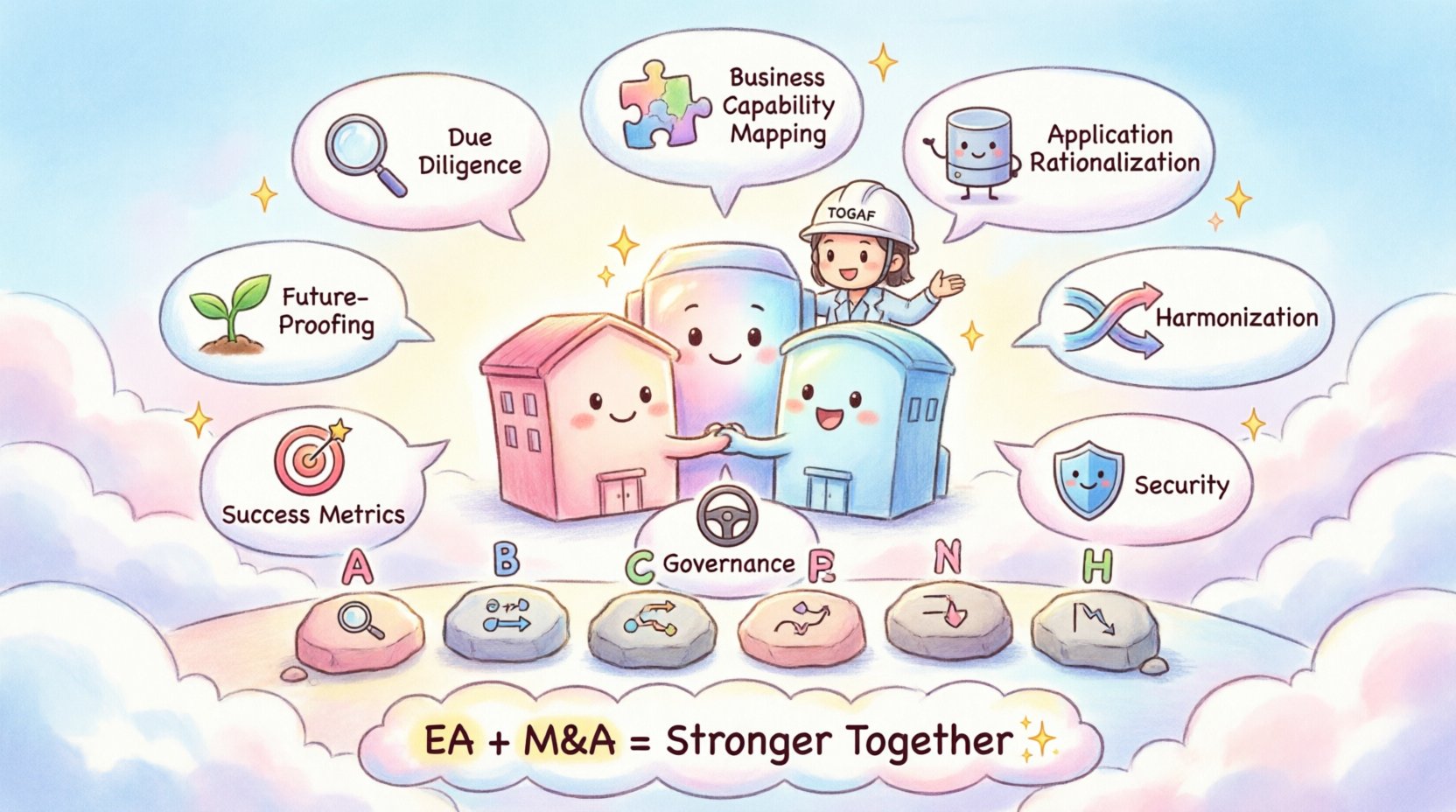
Mergers and acquisitions (M&A) represent some of the most complex undertakings in the business world. While financial metrics often drive the initial decision, the long-term success of such transactions depends heavily on organizational integration. When two distinct entities combine, their operational structures, technology stacks, and cultural frameworks must align to create value. This is where Enterprise Architecture (EA) becomes a critical asset. By applying structured frameworks like TOGAF, organizations can navigate the turbulence of integration with precision and clarity. 🚀
Without a coherent architectural strategy, M&A projects frequently suffer from duplicated efforts, incompatible systems, and delayed synergies. The goal is not merely to combine assets, but to create a unified operating model that supports future growth. This guide explores how to leverage Enterprise Architecture to guide M&A activities effectively. We will examine the practical application of architectural principles, the assessment of technology landscapes, and the governance required to sustain the new entity. 📊
🔍 The Strategic Imperative of Architecture in M&A
Enterprise Architecture serves as the blueprint for organizational change. In the context of M&A, it provides a neutral ground where stakeholders from both acquiring and target companies can visualize the future state. It moves the conversation away from isolated technical issues and toward business capability and strategic alignment. 🧩
Key benefits of using EA in this context include:
- Visibility: Creating a clear map of current capabilities and assets across both organizations.
- Risk Reduction: Identifying technical debt, security vulnerabilities, and compliance gaps before they become liabilities.
- Decision Support: Providing data-driven insights for consolidation, divestiture, or expansion.
- Communication: Offering a common language for business and IT leaders to discuss integration plans.
When EA is integrated early, it prevents the common pitfall of “business as usual” continuing for too long, which often leads to a chaotic integration later. Instead, the architecture team defines the target state and works backward to establish the transition roadmap. 🛤️
🔄 Applying the TOGAF Architecture Development Method
The TOGAF framework offers a structured approach to designing, planning, implementing, and governing an enterprise information architecture. While M&A projects often have compressed timelines, the core principles of the Architecture Development Method (ADM) remain applicable. We can map specific ADM phases to the lifecycle of a merger or acquisition. 📅
Phase A: Architecture Vision
During this initial stage, the scope of the integration is defined. The primary question is: What is the strategic purpose of this transaction? The architecture vision document outlines the high-level goals, such as cost reduction, market expansion, or technology modernization. It sets the boundaries for the integration effort. 🎯
Phase B: Business Architecture
This phase involves mapping the business capabilities of both entities. It identifies overlaps and gaps. For example, if both companies have a “Supply Chain Management” capability, the architecture team must decide whether to maintain both, select one, or develop a new shared service. This mapping is crucial for understanding the human and process implications of the merger. 🏢
Phase C: Information Systems Architectures
Here, the focus shifts to data and applications. The team assesses the application portfolios to determine which systems will be retained, migrated, or retired. This is often the most resource-intensive part of the integration. It requires detailed inventory of software licenses, database structures, and integration points. 💾
Phase D: Technology Architecture
The underlying infrastructure is evaluated. This includes network topology, cloud strategies, hardware standards, and security protocols. Harmonizing the technology foundation ensures that the new entity can operate securely and efficiently. 🔐
Phase E: Opportunities and Solutions
This phase determines the specific projects required to achieve the target architecture. It involves selecting build, buy, or reuse strategies for new capabilities. It also establishes the governance model for the transition. 🛠️
Phase F: Migration Planning
A detailed roadmap is created. This includes timelines, resource allocation, and dependency management. Critical path analysis ensures that high-risk activities are addressed early. 🗺️
Phase G: Implementation Governance
As integration projects begin, the architecture team monitors compliance with the defined standards. Deviations are flagged and managed to prevent architectural drift. 📋
Phase H: Architecture Change Management
Once the new entity is stabilized, the architecture is treated as a living asset. Changes to the environment are managed through a formal process to ensure consistency over time. 🔄
📋 Due Diligence: The Architectural Audit
Technical due diligence is a subset of the broader M&A due diligence process. However, it requires a specialized lens that only an Enterprise Architecture perspective can provide. It goes beyond checking code quality to evaluating the strategic fit of the technology portfolio. 🕵️♂️
The architectural audit should cover the following areas:
- Application Portfolio: What software is in use? What are the licensing costs? Are there legacy systems that are difficult to maintain?
- Infrastructure: Is the hardware modern? Are there single points of failure? How does the network scale?
- Data Assets: Where does the data live? Is it structured or unstructured? Are there data quality issues?
- Security Posture: How are identities managed? Are there compliance gaps regarding data privacy regulations?
- Integration Complexity: How many interfaces exist between systems? Are APIs documented?
This information forms the baseline for the integration strategy. It allows leadership to quantify the cost of integration. For example, if the target company relies on a proprietary database that the acquirer does not support, a migration plan must be budgeted immediately. 💰
🗺️ Business Capability Mapping
One of the most powerful tools in EA is the Business Capability Map. This visual representation shows what the organization does, independent of how it does it. In M&A, comparing the capability maps of both entities reveals the true scope of the merger. 🌐
| Capability Area | Acquirer Status | Target Status | Integration Decision |
|---|---|---|---|
| Customer Relationship Management | Established | Emerging | Migrate Target to Acquirer Platform |
| Human Resources | Cloud-Based | On-Premise | Migration Required |
| Product Development | Agile | Waterfall | Process Harmonization |
| Financial Reporting | Standardized | Customized | Consolidation to Standard |
This table illustrates a simplified view of how capabilities are compared. The goal is to eliminate redundancy. If both companies have a functional equivalent for a capability, the decision must be made on which one to retain. This decision is not just technical; it involves organizational culture and talent retention. 🤝
🗄️ Application Portfolio Rationalization
Following a merger, the combined entity often inherits a bloated application landscape. Rationalization is the process of reducing this complexity. It involves categorizing applications into specific actions: Retain, Replace, Retire, or Repurpose. 🗑️
Retention Criteria
Applications are retained if they provide unique competitive advantage or if the cost of replacement outweighs the benefits. They must align with the target architecture standards. ⭐
Replacement Strategy
Applications that are critical but outdated are replaced with modern solutions. This might involve adopting a suite-based approach to reduce integration overhead. 🔄
Retirement Plan
Redundant applications are decommissioned. This reduces licensing costs and maintenance burdens. Data from these systems must be archived or migrated to the new standard. 📉
Repurposing
Sometimes an application from one company fits a specific need in the other. Integration teams should look for these opportunities to maximize asset value. 🛠️
This process requires a rigorous assessment of technical debt. Legacy systems often hide complexity that only becomes apparent during integration. Early identification prevents surprises during the go-live phase. ⚠️
📊 Data and Information Architecture Harmonization
Data is the lifeblood of modern enterprises. When two companies merge, their data standards often conflict. One may use a specific format for dates, while the other uses a different one. One may classify customers differently than the other. Harmonization is essential for accurate reporting and analytics. 📈
Master Data Management (MDM)
Establishing a single source of truth for key entities like customers, products, and suppliers is a priority. An MDM strategy ensures that business rules are consistent across the new organization. 🏆
Standards and Taxonomies
Common definitions must be agreed upon. For example, what defines a “active user”? What is the classification for “high risk”? These definitions impact everything from sales reporting to risk management. 📝
Data Governance
With increased data volume comes increased responsibility. A unified governance model must be established to manage data quality, access, and security. This includes compliance with regulations like GDPR or CCPA. 🛡️
🛡️ Risk Management and Security
Integration introduces new security risks. Merging networks can create vulnerabilities. New users require access, and legacy permissions might be carried over inadvertently. Security architecture must be proactive, not reactive. 🔒
Key risk areas include:
- Identity and Access Management: Ensuring that users have the correct privileges in the new environment.
- Data Sovereignty: Ensuring that data remains within compliant jurisdictions.
- Vendor Risk: Assessing the security posture of third-party providers used by the target company.
- Business Continuity: Ensuring that critical services remain available during the transition.
A security architecture framework should be updated to reflect the new combined entity. This includes defining new perimeter boundaries and encryption standards. 🚧
🏗️ Integration Governance and Steering
Without governance, integration projects can drift off course. An Architecture Board or Steering Committee provides oversight. This group ensures that all integration work aligns with the defined target architecture. 🎼
The governance model should include:
- Decision Rights: Who has the authority to approve architectural changes?
- Review Gates: Checkpoints where progress is evaluated against the roadmap.
- Compliance Checks: Verification that standards are being met.
- Communication Channels: Clear lines of communication for escalation.
This structure ensures accountability. It prevents individual teams from making decisions that benefit their local area but harm the global architecture. 🌍
📉 Measuring Success and Value Realization
How do we know the integration was successful? Metrics must be established before the project begins. These KPIs should align with the original strategic goals of the merger. 🎯
Potential metrics include:
- Cost Synergies: Reduction in licensing and maintenance costs.
- Time-to-Market: Speed of launching new products or services.
- System Availability: Uptime and reliability of integrated systems.
- User Satisfaction: Feedback from employees using the new tools.
- Architecture Compliance: Percentage of systems adhering to standards.
Tracking these metrics provides objective evidence of value. It also helps identify areas where the integration is struggling, allowing for timely corrective action. 📊
🌱 Future Proofing the Combined Entity
Integration is not a one-time event. The combined organization must remain agile to adapt to market changes. The architecture built during the M&A process should be scalable and flexible. 🔨
Considerations for the future include:
- Cloud Readiness: Ensuring the infrastructure can support cloud migration if needed.
- API Strategy: Building interfaces that allow for easy integration with future partners.
- Modularity: Designing systems that can be updated without disrupting the whole.
- Innovation: Leaving room in the budget for experimentation and new technology adoption.
By focusing on flexibility, the organization ensures that the M&A investment continues to pay dividends long after the initial integration is complete. 🌟
🤝 Collaborative Integration Teams
Successful integration requires collaboration between business leaders and technical architects. The architecture team should not work in isolation. They must engage with department heads to understand operational needs. 🗣️
Key practices for collaboration include:
- Joint Workshops: Bringing teams together to define requirements.
- Transparent Roadmaps: Sharing integration plans openly with stakeholders.
- Feedback Loops: Regularly checking in with end-users to gather insights.
- Cultural Sensitivity: Acknowledging that technology changes often impact culture.
When teams work together, resistance to change is minimized. People feel heard and involved in the process. This leads to smoother adoption of new systems and processes. 👥
🧭 Navigating Technical Debt
Every organization carries technical debt. In an M&A context, this debt is multiplied. The combined entity inherits the legacy issues of both companies. Ignoring this debt can lead to system failures and security breaches. 🏚️
Addressing technical debt requires a dedicated strategy:
- Inventory: Catalog all legacy systems and their risks.
- Prioritization: Focus on high-risk or high-cost systems first.
- Refactoring: Improve code quality where feasible.
- Replacement: Phase out systems that are no longer viable.
This is a marathon, not a sprint. It requires sustained investment and management attention over time. ⏳
🔗 Connecting Strategy to Execution
The final piece of the puzzle is ensuring that the architectural vision translates into execution. Strategy documents are often ignored if they are not actionable. The architecture must be broken down into specific work packages. 📦
Work packages should include:
- Scope: What is included in this package?
- Dependencies: What must happen before this can start?
- Resources: Who is responsible for delivery?
- Timeline: When is the work due?
By linking high-level strategy to specific tasks, the organization ensures that the M&A goals are met. The architecture provides the structure, while the execution delivers the results. ⚙️
🎓 Building Internal Competency
Organizations often rely on external consultants for M&A integration. While experts bring valuable experience, building internal competency is crucial for long-term success. Training internal staff on EA principles ensures sustainability. 🎓
Competency areas to develop include:
- Architecture Modeling: Skills in creating and maintaining architecture diagrams.
- Tooling: Proficiency in architecture repositories and modeling tools.
- Stakeholder Management: Ability to navigate complex organizational politics.
- Financial Analysis: Understanding the cost implications of architectural decisions.
Investing in people creates a resilient organization. It reduces dependency on external vendors and empowers teams to solve problems independently. 💪
🏁 Final Thoughts on Architectural Leadership
Mergers and acquisitions are transformative events. They offer the potential for significant growth but carry substantial risk. Enterprise Architecture provides the discipline needed to manage this risk. By applying frameworks like TOGAF, organizations can navigate complexity with confidence. 🧭
The value of EA in M&A is not just about systems. It is about aligning technology with business strategy. It is about ensuring that the combined entity is stronger than the sum of its parts. When executed well, the architectural approach leads to a unified, efficient, and scalable organization. 🚀
As the business landscape continues to evolve, the ability to integrate acquisitions effectively will become a core competency. Organizations that invest in architectural governance today will be better positioned for future growth. The journey is complex, but the destination is worth the effort. 🏆