
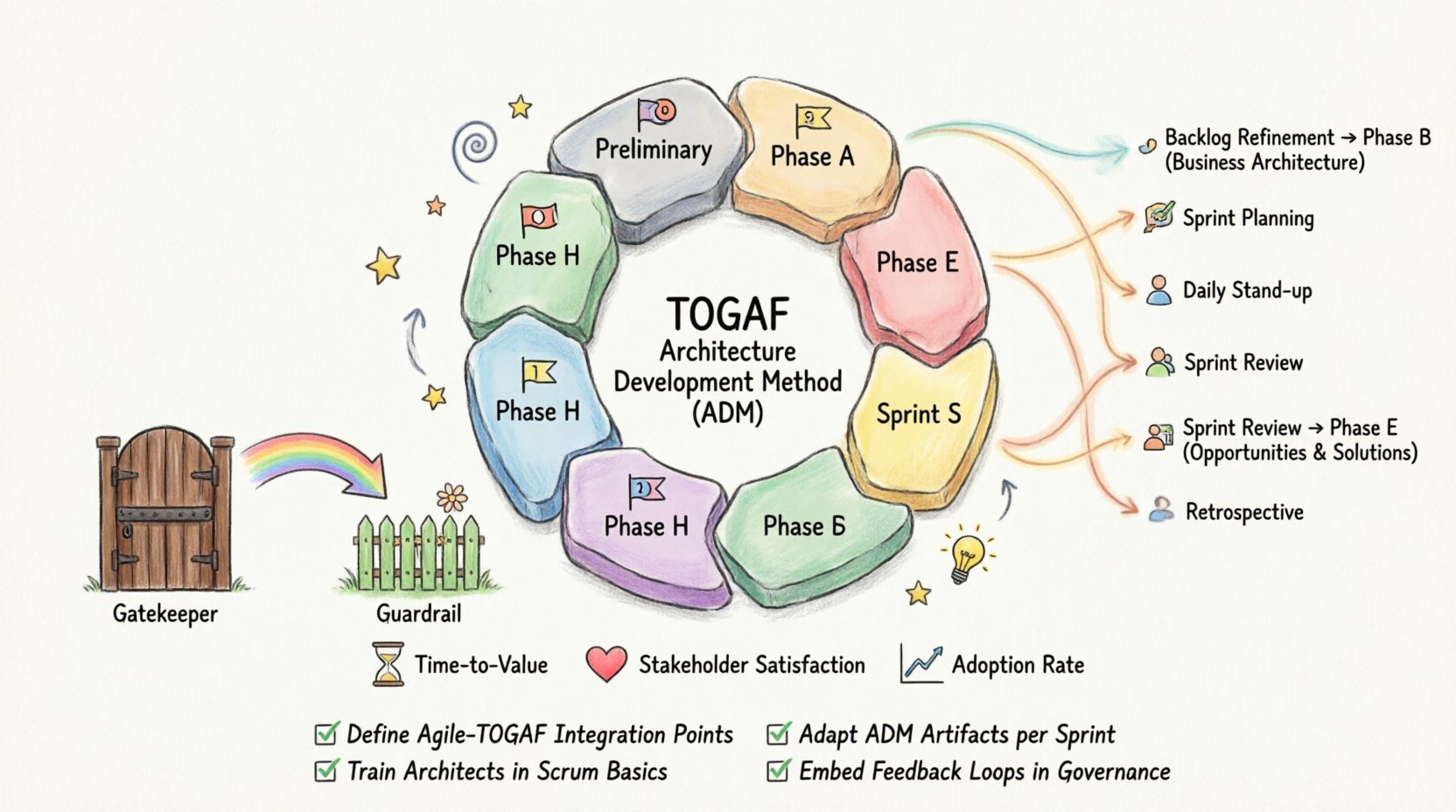
Enterprise architecture has traditionally operated within a structured, plan-driven framework. The The Open Group Architecture Framework (TOGAF) has been the standard for decades, emphasizing comprehensive documentation and phased delivery. However, modern business environments demand speed, adaptability, and continuous value delivery. This shift has necessitated a convergence of architectural rigor with Agile methodologies. Understanding how to integrate Agile practices within TOGAF architecture cycles is no longer optional; it is a requirement for resilient organizations.
This guide explores the practical mechanics of blending these two disciplines. It moves beyond theoretical alignment to provide actionable strategies for adapting the Architecture Development Method (ADM) to iterative workflows. We will examine artifact management, governance adjustments, and stakeholder engagement models that support both stability and flexibility.
🤝 Understanding the Convergence: TOGAF and Agile
At first glance, TOGAF and Agile appear to be at odds. TOGAF is often perceived as heavy, documentation-centric, and linear. Agile is viewed as lightweight, code-centric, and iterative. However, both share a common goal: delivering value to the enterprise through structured improvement. The friction often arises from implementation details rather than core philosophy.
- TOGAF Focus: Holistic view, long-term strategy, risk management, and standardization.
- Agile Focus: Customer value, rapid feedback, adaptability, and incremental delivery.
When integrating these approaches, the objective is not to dilute the architecture but to make it more responsive. Architecture should serve as a guardrail, not a gatekeeper. The following points highlight key areas where integration creates synergy:
- Iterative Cycles: ADM phases can be executed in iterations rather than a single linear sequence.
- Just-in-Time Documentation: Produce artifacts only when needed for decision-making, reducing waste.
- Stakeholder Feedback: Incorporate Agile feedback loops into the requirements gathering phase.
- Continuous Validation: Validate architectural decisions continuously against business outcomes.
🛠️ Adapting the TOGAF Architecture Development Method (ADM)
The core of TOGAF is the Architecture Development Method. To integrate Agile, we must treat ADM not as a waterfall process but as a cycle of iterations. Each iteration delivers a usable slice of the architecture that aligns with business capabilities.
1. Preliminary Phase: Setting the Stage
This phase defines the architecture capability within the organization. In an Agile context, this involves establishing the Architectural Runway. Teams need a foundation of standards, patterns, and tools before building begins.
- Define the Architecture Principles clearly and concisely.
- Establish the governance model that supports rapid decision-making.
- Identify key stakeholders and their roles in iterative reviews.
2. Phase A: Architecture Vision
Traditionally, this phase produces a high-level scope. In an Agile cycle, this becomes the Product Vision or Epics definition. The goal is to understand the business drivers without over-specifying the solution.
- Engage stakeholders in workshops to define value streams.
- Create a vision statement that guides the backlog.
- Identify risks early and document them in a risk register.
3. Phases B, C, and D: Business, Information Systems, and Technology Architecture
These phases are often the heaviest in terms of documentation. To integrate Agile, decompose these architectures into domain-specific increments.
- Business Architecture: Map capabilities to specific business outcomes. Use capability maps to prioritize initiatives.
- Information Systems: Define data models and application interfaces required for the current sprint or iteration.
- Technology Architecture: Select infrastructure patterns that support scalability and deployment automation.
4. Phase E: Opportunities and Solutions
This phase evaluates migration options. In an Agile environment, this is treated as a Backlog Refinement session. Solutions are not just selected; they are prototyped and validated.
- Build prototypes to validate technical feasibility.
- Assess impact on existing systems incrementally.
- Adjust the roadmap based on prototype findings.
5. Phase F: Migration Planning
Migration planning becomes Release Planning. Instead of a multi-year roadmap, focus on the next 3-6 months. This allows for adjustments as market conditions change.
- Define clear exit criteria for each release.
- Sequence projects based on dependency and value.
- Ensure resource allocation aligns with sprint capacities.
6. Phase G: Implementation Governance
Governance must shift from gate-based reviews to continuous monitoring. Architecture compliance checks should happen during code reviews and deployment pipelines.
- Automate compliance checks where possible.
- Hold regular architecture syncs with development teams.
- Allow exceptions when justified by business value, with a plan to remediate.
7. Phase H: Architecture Change Management
Architecture is never static. Change management in an Agile context is about Continuous Improvement. As the business evolves, the architecture must evolve with it.
- Monitor metrics to identify technical debt.
- Regularly review architecture principles against reality.
- Update the architecture repository to reflect current state.
📊 Mapping Agile Ceremonies to TOGAF Artifacts
To make integration tangible, we can map specific Agile ceremonies to the creation and review of TOGAF artifacts. This ensures that documentation is a byproduct of work, not a prerequisite.
| Agile Ceremony | TOGAF Activity | Output / Artifact |
|---|---|---|
| Backlog Refinement | Requirements Analysis | Business Scenarios, Gap Analysis |
| Sprint Planning | Architecture Definition | System Interface Specifications, Data Models |
| Daily Stand-up | Implementation Governance | Issue Logs, Status Updates |
| Sprint Review | Architecture Validation | Architecture Compliance Reports, Solution Evaluations |
| Retrospective | Change Management | Lessons Learned, Process Improvements |
🛡️ Governance in an Agile Enterprise Architecture
One of the primary concerns when introducing Agile to TOGAF is the loss of control. Without strict gates, how do we ensure standards are met? The answer lies in shifting governance from a policing model to an enablement model.
- Architectural Runway: Ensure the foundation is built before scaling. This includes shared services, APIs, and data standards.
- Community of Practice: Establish a group of architects who support teams rather than approve them. They provide guidance on patterns and anti-patterns.
- Definition of Done (DoD): Include architectural criteria in the DoD. For example, code must be documented, and interfaces must be versioned.
- Lightweight Documentation: Prefer living documents over static PDFs. Use wikis or repositories that can be updated easily.
🚀 Managing Risk and Compliance
Agile does not mean ignoring risk. In fact, Agile helps identify risks earlier through frequent delivery. However, specific enterprise risks, such as regulatory compliance or security, require structured attention.
1. Security and Privacy
Security cannot be an afterthought. Integrate security checks into the CI/CD pipeline. Architects must define security patterns that developers can apply directly.
- Define security standards as part of the architecture.
- Conduct regular threat modeling sessions.
- Ensure data privacy requirements are met in the design phase.
2. Regulatory Compliance
Compliance requirements often dictate rigid structures. Agile teams must understand these constraints early.
- Identify compliance requirements during Phase A.
- Map compliance rules to specific user stories.
- Automate compliance testing where feasible.
📈 Metrics and Measurement
To prove the value of this integrated approach, we need to measure success. Traditional metrics like “number of documents produced” are no longer relevant. Instead, focus on outcomes.
- Time to Value: How quickly can the architecture support a new business capability?
- Architecture Adoption Rate: How many teams are using the defined patterns and standards?
- Technical Debt: Monitor the accumulation of debt and the rate at which it is paid down.
- Stakeholder Satisfaction: Survey business leaders on their confidence in the IT roadmap.
🧱 Cultural Shifts Required
Technical integration is only half the battle. Organizational culture must shift to support this model. Architects must move from being “scribes” to being “enablers”.
- Collaboration: Architects must work side-by-side with developers.
- Transparency: Share architectural decisions openly and invite feedback.
- Empowerment: Allow teams to make local architectural decisions within guardrails.
- Learning: Encourage a culture of experimentation and failure.
⚠️ Common Challenges and Solutions
Implementing this model is not without hurdles. Here are common obstacles and how to address them.
Challenge 1: Resistance to Change
Teams accustomed to traditional waterfall may resist Agile architecture practices.
- Solution: Start with a pilot project. Demonstrate success before scaling.
- Solution: Provide training on both TOGAF and Agile frameworks.
Challenge 2: Documentation Overhead
Teams may feel burdened by the requirement to maintain TOGAF artifacts.
- Solution: Automate documentation generation from code and diagrams.
- Solution: Focus on value-added artifacts only. Discard what adds no value.
Challenge 3: Lack of Visibility
Without a central repository, the architecture may become fragmented.
- Solution: Implement a centralized architecture repository.
- Solution: Schedule regular architecture syncs to review progress.
🔮 Future Trends in Agile Architecture
The landscape of enterprise architecture is evolving. Cloud computing, microservices, and AI are changing how we build systems. TOGAF must continue to adapt to these technologies.
- Cloud-Native Architecture: Focus on elasticity and serverless patterns.
- Event-Driven Design: Align architecture with asynchronous communication.
- AI-Assisted Design: Use tools to suggest patterns and detect conflicts.
📝 Summary of Key Actions
To successfully integrate Agile practices within TOGAF architecture cycles, organizations should take the following steps:
- Reframe the ADM as an iterative cycle rather than a linear process.
- Map Agile ceremonies to TOGAF artifact creation and review.
- Shift governance from gatekeeping to enablement.
- Measure success through value delivery and adoption, not documentation volume.
- Foster a culture of collaboration and continuous learning.
By embracing this integration, organizations can achieve the stability required for enterprise scale while maintaining the agility needed to compete in a dynamic market. The path forward requires discipline, but the reward is a resilient, responsive enterprise architecture.