


Introduction to Instant Diagram Generation
In the fast-paced world of system analysis and project management, the ability to visualize complex data structures and process flows rapidly is a competitive advantage. Visual Paradigm Desktop has released a significant update to its AI Diagram Generator, introducing support for 11 new diagram types. This expansion addresses the critical need for diverse modeling tools, allowing professionals to generate Data Flow Diagrams (DFD), Entity-Relationship Diagrams (ERD), Mind Maps, and SysML diagrams instantly from textual descriptions. This guide explores how these new features streamline the transition from concept to visualization.
Key Concepts: Understanding the New Diagram Models
To effectively utilize the updated AI tools, it is essential to understand the specific diagram types now supported and their primary applications in software engineering and business analysis.

- Data Flow Diagram (DFD): A visualization of how data flows through a system. It tracks inputs, outputs, storage points, and process routes. The new update supports multiple standard notations including Gane-Sarson, Yourdon & Coad, and Yourdon DeMarco.
- Entity-Relationship Diagram (ERD – Chen Notation): A conceptual modeling tool used primarily for database design. It illustrates the logical structure of databases by defining entities, their attributes, and the relationships between them.
- SysML Internal Block Diagram (IBD): A modeling standard for systems engineering that describes the internal structure of a block in terms of its properties and connectors.
- Mind Maps: High-level conceptual diagrams used for brainstorming, organizing thoughts, and structuring project plans visually.
- CRC Card Diagram: Used in object-oriented design, Class-Responsibility-Collaboration cards help in identifying classes and their interactions during the early design phase.
Guidelines: How to Generate Diagrams with AI
The integration of AI into Visual Paradigm enables users to bypass the tedious process of dragging and dropping shapes manually. Follow these guidelines to generate standardized diagrams in seconds.
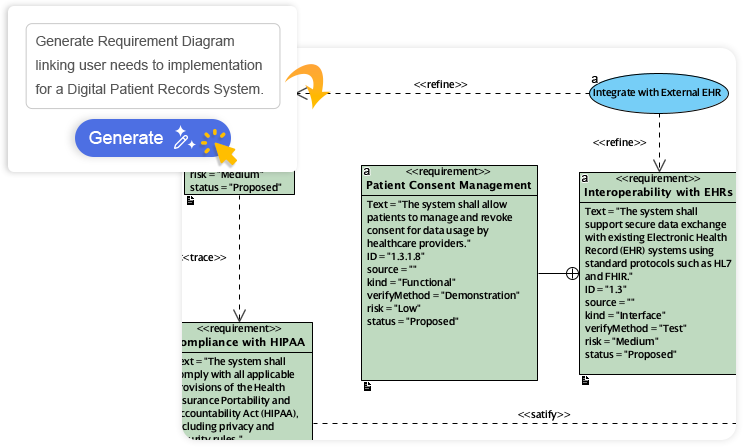
Step-by-Step Generation Process
- Access the Feature: Open Visual Paradigm Desktop and navigate to the Tool tab on the main ribbon.
- Initiate AI Tool: Click on the AI Diagram button to open the generation interface.
- Select Diagram Type: From the dropdown menu, choose the specific diagram required (e.g., “Data Flow Diagram” or “ERD (Chen Notation)”).
- Define the Scope: Enter a specific topic or a detailed text description of the system you wish to model. For example, entering “Online Food Ordering System” for a DFD or “Music Streaming Subscription Services” for an ERD.
- Generate: Click OK. The AI will analyze the prompt and construct a fully editable diagram complete with appropriate shapes and connectors.
Best Practices for AI-Assisted Modeling
While the AI Diagram Generator handles the heavy lifting of drawing, adhering to best practices ensures the output is accurate, professional, and ready for stakeholder presentation.
Ensure Notation Consistency
When generating DFDs, carefully select the notation standard that matches your organization’s guidelines. The AI now supports Gane-Sarson, Yourdon & Coad, and Yourdon DeMarco. Consistency in notation prevents confusion among technical teams and stakeholders.
Provide Contextual Prompts
The quality of the AI output correlates with the specificity of the input. When defining your topic, include the scope of the system. For an implementation plan or migration roadmap, specify the timeframe or key phases to receive a more structured output.
Review and Refine
AI generation should be viewed as a high-speed first draft. Always review the generated relationships—such as the cardinality in ERDs or the data stores in DFDs—to ensure they align with specific business logic. Visual Paradigm allows full editing of the generated result, so use this to fine-tune the details.
Tips and Tricks for Workflow Optimization
Leverage these lesser-known strategies to maximize productivity with the new AI features.
- Rapid Prototyping: Use the Mind Mapping feature to brainstorm initial requirements with a client, then immediately convert those concepts into a SysML or Implementation Plan Diagram to show technical feasibility during the same meeting.
- Tailor to Audience: Utilize the AI customization options to adjust the tone and content type. You can generate a simplified DFD for executive stakeholders and a detailed, technical version for engineering teams using the same core topic.
- Kickstart Complex Logic: Use the Decision Table generation to visualize complex logic sets before coding. This helps in identifying missing conditions or logic gaps early in the development cycle.
- Legacy System Documentation: If you are documenting an existing system (e.g., a legacy database), describe it textually to the AI to generate a Chen Notation ERD. This provides an instant visual reference for migration or refactoring projects without drawing from scratch.
Conclusion
The addition of 11 new diagram types to Visual Paradigm’s AI Diagram Generator marks a shift from manual drafting to intelligent design. By automating the creation of complex models like SysML IBDs, DFDs, and ERDs, professionals can focus their energy on analysis and decision-making rather than formatting shapes. Update your desktop client today to harness these capabilities and accelerate your modeling workflow.
Related posts:
 Instant UML Package Diagrams: A Guide to Visual Paradigm’s AI Generator
 Deploying with Intelligence: A Modern Guide to AI-Powered Deployment Diagrams
 Visual Paradigm: Complete Guide to the Tree Diagram Editor in OpenDocs
 From Overwhelmed to Empowered: A Practitioner’s Journey Through the 14 UML Diagram Types with AI-Powered Tools