Digital transformation is often described as a journey rather than a destination. For a Chief Information Officer, the challenge lies not merely in adopting new technologies, but in restructuring the underlying architecture to support agility, scalability, and resilience. The Open Group Architecture Framework (TOGAF) provides a proven methodology for this complex undertaking. By integrating TOGAF standards, CIOs can move beyond ad-hoc solutions and establish a coherent enterprise architecture that aligns IT capabilities with business strategy.
This guide outlines the strategic application of TOGAF to drive digital transformation. It focuses on the practical implementation of the Architecture Development Method (ADM), the governance of architecture assets, and the cultural shifts required to sustain long-term success. There is no quick fix here. Sustainable transformation requires discipline, clarity, and a structured approach to decision-making.
📋 Understanding the Role of Enterprise Architecture
Enterprise architecture (EA) is often misunderstood as a documentation exercise. In reality, it is a strategic discipline that defines the blueprint for an organization. For a CIO, EA acts as the connective tissue between business goals and technical execution. Without this alignment, digital initiatives often result in siloed systems, redundant investments, and fragmented data.
TOGAF offers a comprehensive framework that standardizes this discipline. It is not prescriptive software but a set of standards, methods, and tools. This flexibility allows organizations to adapt the framework to their specific context without being locked into a specific vendor’s ecosystem. The goal is to create a shared understanding of the current state and the desired future state.
🔄 The Architecture Development Method (ADM)
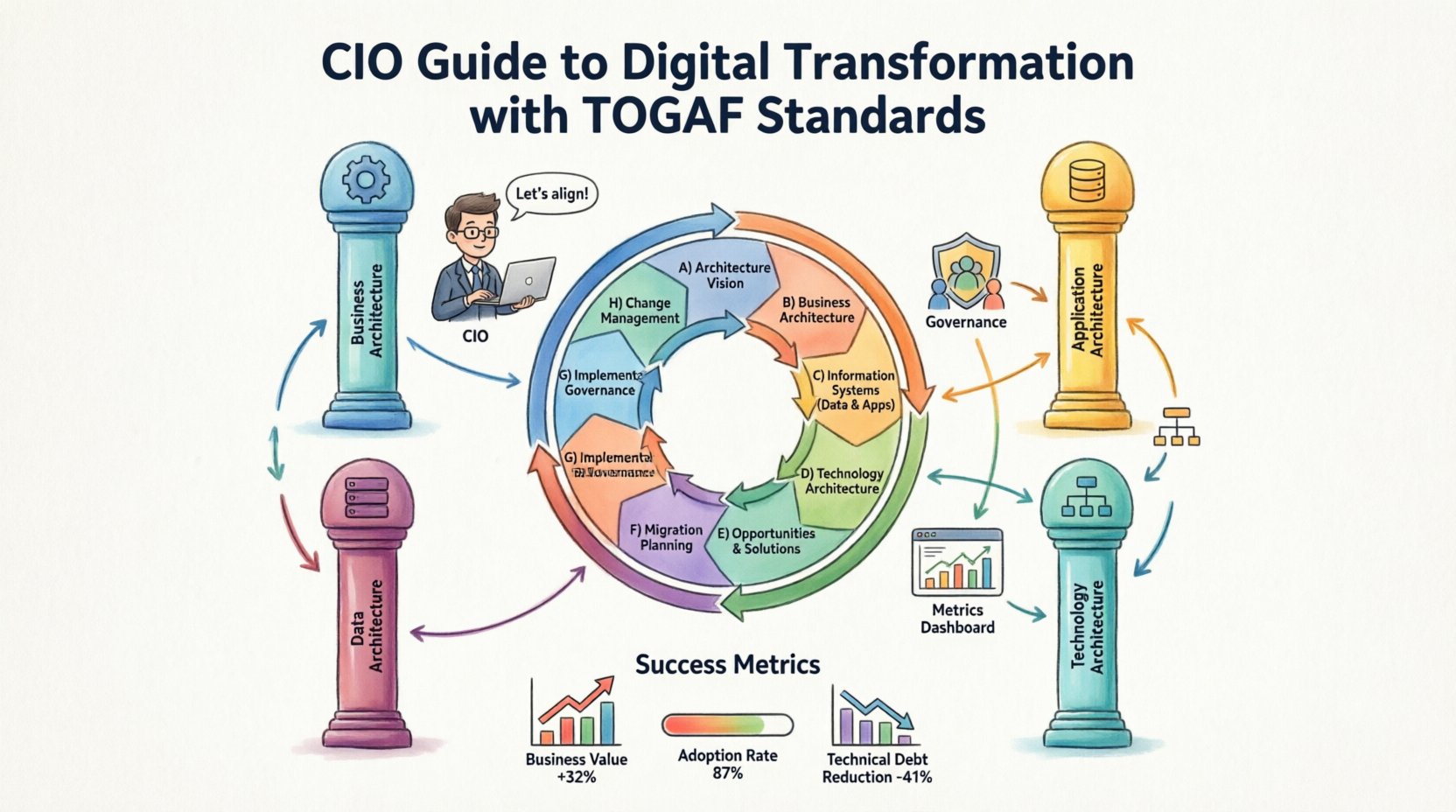
The core of TOGAF is the Architecture Development Method. It is a step-by-step approach to designing, planning, implementing, and governing information architecture. The ADM is iterative, allowing for continuous refinement as business needs evolve. It consists of several distinct phases, each serving a specific purpose in the transformation lifecycle.
Phase A: Architecture Vision
The process begins by defining the scope and constraints of the transformation. This phase establishes the architectural vision and secures the necessary stakeholder buy-in. It answers critical questions: What business problems are we solving? What are the boundaries of the project? Who are the key decision-makers?
During this stage, the CIO must articulate the value proposition clearly. The vision document serves as a contract between the IT function and the business units. It ensures that the transformation effort is not just a technical upgrade but a business enabler.
Phase B: Business Architecture
Before touching technology, the business architecture must be understood. This phase maps out the business processes, organizational structure, and information flows. It ensures that the technology strategy supports the actual way the business operates, or identifies where processes need to change to support the new strategy.
Key activities include:
- Mapping current business processes.
- Identifying gaps between current and target operations.
- Defining the business capabilities required for the future.
Phase C: Information Systems Architectures
This phase is divided into two sub-domains: Data Architecture and Application Architecture.
Data Architecture: Digital transformation relies heavily on data quality and accessibility. This section defines how data is stored, managed, and protected. It establishes data standards, security protocols, and governance policies to ensure data integrity across the enterprise.
Application Architecture: This defines the structure of the application portfolio. It identifies which applications support business functions, how they interact, and where legacy systems need to be replaced or integrated. The goal is to reduce complexity and increase interoperability.
Phase D: Technology Architecture
With the data and application layers defined, the Technology Architecture focuses on the infrastructure. This includes hardware, software, networks, and cloud environments. The objective is to select technology standards that support the application and data requirements while ensuring scalability and security.
For a CIO, this phase is critical for making decisions about cloud migration, infrastructure consolidation, and integration patterns. It ensures that the underlying platform is robust enough to handle the demands of modern digital services.
Phase E: Opportunities and Solutions
This phase moves from planning to execution. It identifies the specific projects and initiatives required to bridge the gap between the current and target architectures. It involves creating a transition architecture and a migration plan.
Key considerations include:
- Identifying quick wins to build momentum.
- Sequencing projects to minimize disruption.
- Assessing risks and resource requirements.
Phase F: Migration Planning
Once the transition architecture is defined, a detailed implementation plan is developed. This phase ensures that the transformation is managed in a controlled manner. It involves scheduling, budgeting, and resource allocation. The plan must be realistic and flexible enough to accommodate unforeseen challenges.
Phase G: Implementation Governance
During the actual deployment of solutions, the Architecture Governance function ensures that the implementation aligns with the defined architecture. This phase involves reviewing project deliverables, managing compliance, and handling deviations. If a project diverges from the architectural standards, it must be corrected or formally exempted through a structured process.
Phase H: Architecture Change Management
Transformation is not a one-time event. This phase establishes a mechanism for managing changes to the architecture over time. It ensures that the architecture evolves in step with business changes. It involves monitoring the architecture, updating standards, and managing the lifecycle of architectural artifacts.
| Phase | Focus Area | Key Output |
|---|---|---|
| A | Architecture Vision | Architecture Vision Document |
| B | Business Architecture | Business Capability Map |
| C | Information Systems | Data & Application Standards |
| D | Technology Architecture | Infrastructure Standards |
| E | Opportunities & Solutions | Implementation Plan |
| F | Migration Planning | Migration Roadmap |
| G | Implementation Governance | Compliance Reports |
| H | Change Management | Architecture Updates |
🏗️ Enterprise Architecture Domains
TOGAF structures the architecture into four primary domains. Understanding the interplay between these domains is essential for a CIO overseeing a complex transformation.
Business Architecture
This defines the business strategy, governance, organization, and key business processes. It ensures that the technology investment directly supports business outcomes. Without a clear business architecture, IT initiatives often lack direction.
Application Architecture
This provides a blueprint for the individual application systems, their interactions, and their relationships to the core business processes. It helps in managing the application portfolio and retiring redundant systems.
Data Architecture
This describes the structure of the logical and physical data assets and data management resources. In a digital economy, data is a critical asset. This domain ensures data is accessible, secure, and trustworthy.
Technology Architecture
This describes the logical software and hardware capabilities required to support the deployment of business, data, and application services. It includes cloud platforms, network infrastructure, and security protocols.
🛡️ Governance and Compliance
One of the most significant challenges in digital transformation is maintaining governance without stifling innovation. TOGAF provides a framework for Architecture Governance that balances control with flexibility.
Effective governance requires a clear definition of roles and responsibilities. The CIO must establish an Architecture Board that reviews proposed changes and ensures alignment with strategic goals. This board should include representatives from business units, IT, security, and compliance.
Key governance activities include:
- Compliance Reviews: Checking projects against architectural standards.
- Trade-off Analysis: Evaluating the impact of decisions on cost, risk, and performance.
- Exception Handling: Managing deviations from the standard in a controlled manner.
When governance is too rigid, innovation stalls. When it is too loose, technical debt accumulates. The goal is to create a culture where architects are advisors and enablers, not gatekeepers.
🤝 People and Culture
Technology is only half the equation. The success of any TOGAF implementation depends on the people and the culture surrounding it. Many transformation initiatives fail because they focus on the architecture diagrams and neglect the human element.
Stakeholder Management: Every transformation affects different groups within the organization. Identifying these stakeholders and understanding their concerns is vital. A matrix of stakeholder influence and interest helps prioritize engagement efforts.
| Role | Primary Concern | Engagement Strategy |
|---|---|---|
| CEO / Board | ROI & Strategic Alignment | High-level dashboards & Executive Summaries |
| CFO | Cost & Budget Control | Financial modeling & Cost-benefit analysis |
| Business Unit Heads | Operational Efficiency | Process workshops & Impact assessments |
| IT Team | Feasibility & Maintainability | Technical deep-dives & Standards documentation |
| End Users | Usability & Training | User testing & Change management training |
Change Management: Transformation often requires new ways of working. This can be met with resistance. A structured change management plan helps smooth the transition. It involves communication, training, and support systems to help employees adapt to new tools and processes.
Talent Development: The CIO must ensure the IT team has the skills required to operate in a transformed environment. This may involve upskilling existing staff or recruiting new talent with expertise in cloud, data, and modern architecture patterns.
📊 Measuring Success
How does a CIO know if the digital transformation is working? Quantitative and qualitative metrics are needed to track progress. Relying solely on IT metrics like uptime or speed is insufficient. The metrics must reflect business value.
Architectural Metrics:
- Reduction in application redundancy.
- Improvement in data quality scores.
- Reduction in technical debt.
Business Metrics:
- Time to market for new features.
- Cost savings from infrastructure consolidation.
- Customer satisfaction scores.
Adoption Metrics:
- User adoption rates of new systems.
- Training completion rates.
- Reduction in support tickets related to legacy systems.
Regular reviews of these metrics allow the CIO to adjust the strategy as needed. It creates a feedback loop that ensures the transformation remains on track.
⚠️ Common Pitfalls to Avoid
Even with a robust framework like TOGAF, pitfalls can derail a transformation. Being aware of these common issues allows for proactive mitigation.
1. Over-Engineering
Creating detailed architecture for every minor change can slow down delivery. The CIO must distinguish between the core architecture that requires strict governance and the peripheral areas where agility is more important. Use the concept of “sufficient rigor” to determine the level of documentation needed.
2. Ignoring the Current State
Focusing too much on the future state while neglecting the current reality leads to unrealistic plans. A thorough assessment of the existing landscape is necessary to identify legacy constraints and technical debt that must be managed.
3. Lack of Executive Sponsorship
Digital transformation is a business initiative, not just an IT project. Without active support from the C-suite, architectural decisions often lack the authority needed to enforce standards. The CIO must maintain a strong relationship with business leaders to secure this sponsorship.
4. Static Documentation
Architecture documents that are created once and never updated become obsolete quickly. The architecture must be a living artifact. Tools and processes should be in place to keep the architecture repository current and accessible.
🚀 Moving Forward
Implementing TOGAF standards for digital transformation is a significant commitment. It requires a shift in mindset from project-based delivery to capability-based management. The CIO plays a pivotal role in driving this shift.
By following the Architecture Development Method, defining clear domains, and establishing strong governance, organizations can build a foundation that supports innovation. The framework provides the structure, but the CIO provides the vision. Success comes from balancing the discipline of architecture with the agility required in the modern market.
Digital transformation is not about replacing everything. It is about optimizing the enterprise to deliver value more effectively. With TOGAF, CIOs have the tools to make informed decisions, manage complexity, and guide their organizations through the evolving digital landscape.