Enterprise Architecture (EA) serves as the blueprint for organizational change. However, the path from current state to future state is rarely smooth. One of the most persistent challenges architects face is technical debt—the implied cost of additional rework caused by choosing an easy, limited solution now instead of using a better approach that would take longer. In the context of TOGAF (The Open Group Architecture Framework), managing this debt is not just an IT concern; it is a strategic imperative that influences business agility and risk posture.
When organizations undergo major transitions, legacy systems, outdated data models, and fragmented integration points often accumulate. Ignoring these liabilities can stall digital transformation initiatives. This guide provides a structured approach to identifying, prioritizing, and mitigating technical debt throughout the Enterprise Architecture lifecycle, aligned with TOGAF principles.
Understanding Technical Debt in the TOGAF Context 💡
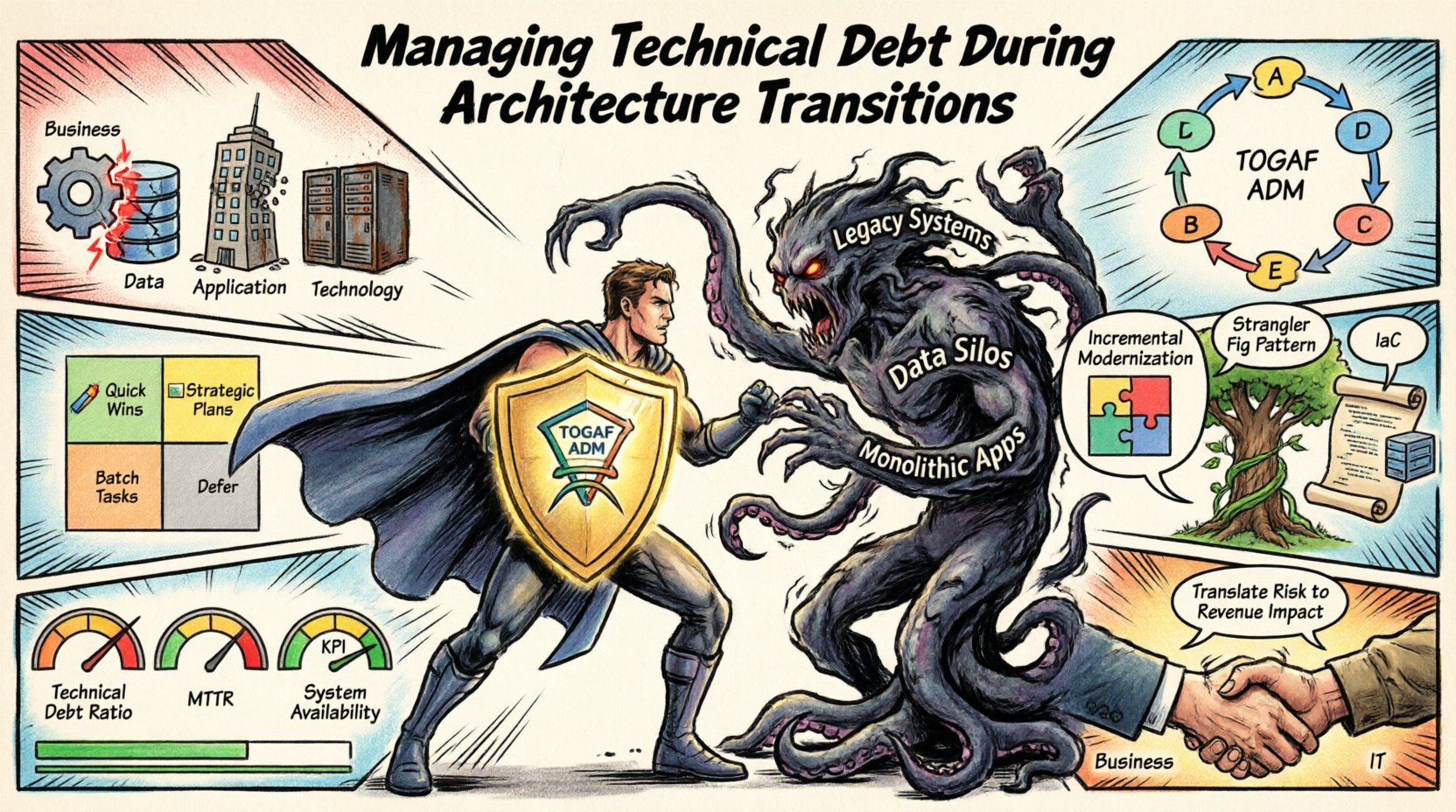
Technical debt is often viewed as code-level issues, but in Enterprise Architecture, it manifests at multiple levels. It includes:
- Business Architecture Debt: Misaligned processes or outdated governance models.
- Data Architecture Debt: Inconsistent definitions, siloed repositories, or poor data quality.
- Application Architecture Debt: Monolithic structures lacking modularity or reliance on end-of-life technologies.
- Technology Architecture Debt: Hardware dependencies, unsupported infrastructure, or security gaps.
Within the TOGAF framework, the Architecture Development Method (ADM) provides the cycle through which these issues are addressed. The ADM is iterative, meaning debt management is not a one-time event but a continuous activity woven into the architecture lifecycle.
Why Technical Debt Hinders Transitions 📉
Accumulated debt creates friction during transitions. When attempting to move from a Baseline Architecture to a Target Architecture, hidden dependencies often surface. Common consequences include:
- Increased Migration Costs: Refactoring legacy components during migration is more expensive than building new solutions.
- Extended Timelines: Unforeseen complexities delay project delivery.
- Operational Instability: New systems built on unstable foundations suffer frequent outages.
- Compliance Risks: Older systems may not meet current regulatory standards.
Identifying Technical Debt Across ADM Phases 🔍
Effective management requires identification. You cannot fix what you cannot see. The TOGAF ADM cycles offer specific opportunities to surface debt. Below is a breakdown of how debt identification fits into the core phases.
Phase A: Architecture Vision
During the initiation of an architecture project, the scope must include a high-level assessment of existing liabilities. The Architecture Vision document should explicitly state the Technical Debt Assessment as a key deliverable.
- Stakeholder Analysis: Identify business units that are most affected by legacy constraints.
- Scope Definition: Define whether the transition includes full replacement or incremental modernization.
- Risk Register: Document potential risks associated with current technical limitations.
Phase B, C, D: Business, Information Systems, and Technology
These phases involve detailed modeling. Debt identification here is granular.
- Application Portfolio Analysis: Review the inventory of applications to determine support status and usage frequency.
- Interface Audits: Map data flows to find brittle integration points.
- Infrastructure Health Checks: Assess the age and maintenance contract status of underlying hardware and platforms.
Phase E: Opportunities and Solutions
This phase determines how to address the gaps. Technical debt is treated as a gap that requires remediation. Options include:
- Replatforming: Moving to a new infrastructure while keeping the code.
- Refactoring: Restructuring code without changing external behavior.
- Replacement: Building new functionality to retire old components.
Integrating Debt Management into the Architecture Board 🛡️
The Architecture Board is a governance body within TOGAF responsible for ensuring compliance with standards. To manage debt effectively, the Board must shift from purely approving designs to actively monitoring debt accumulation.
Key Governance Activities
- Architecture Compliance Review (ACR): Conduct regular reviews to ensure new implementations do not introduce new debt. This includes checking adherence to the Architecture Principles.
- Debt Tracking Log: Maintain a central register of known debt items, their severity, and their status.
- Change Control: Evaluate change requests to determine if they exacerbate existing debt or provide a chance to reduce it.
Prioritization Frameworks for Remediation 🎯
Not all debt can be fixed at once. Resources are finite. A prioritization framework helps decide which liabilities to address first. The goal is to balance immediate business value against long-term maintainability.
The Impact vs. Effort Matrix
Use a matrix to categorize technical debt items. This visual tool helps stakeholders understand trade-offs.
| Category | Description | Typical Action |
|---|---|---|
| High Impact, Low Effort | Quick wins that significantly reduce risk or cost. | Address Immediately 🚀 |
| High Impact, High Effort | Major structural issues requiring significant investment. | Plan Strategically 🗓️ |
| Low Impact, Low Effort | Nuisance issues that accumulate over time. | Batch Process 📦 |
| Low Impact, High Effort | Complex fixes with minimal business return. | Defer or Accept ⏳ |
Criteria for Prioritization
When populating the matrix, consider these factors:
- Security Risk: Does the debt expose the organization to vulnerabilities?
- Business Criticality: Does the component support a core revenue stream?
- Maintenance Cost: Is the cost of keeping it running higher than replacing it?
- Vendor Support: Is the technology still supported by the vendor?
Strategies for Migration and Remediation 🔄
Once debt is prioritized, the organization needs a strategy to address it during the transition. TOGAF recommends a phased approach to minimize disruption.
1. Incremental Modernization
Instead of a “big bang” replacement, break the transition into manageable increments. This allows for:
- Continuous validation of the new architecture.
- Phased retirement of legacy components.
- Feedback loops from users during the transition.
2. The Strangler Fig Pattern
This strategy involves gradually replacing specific functions of a legacy system with new services until the old system is no longer needed. It reduces the risk of a total system failure.
- Identify Boundaries: Define clear interfaces between old and new.
- Route Traffic: Direct new requests to the modern components.
- Decommission: Turn off legacy components once functionality is fully migrated.
3. Infrastructure as Code (IaC) Practices
While avoiding specific tools, the principle of defining infrastructure through code ensures consistency. This reduces configuration drift, which is a common source of technical debt.
- Document all environment configurations.
- Automate provisioning processes.
- Version control infrastructure changes.
Metrics for Measuring Debt Reduction 📊
To prove the value of debt management, you need metrics. These indicators should be tracked over time to show progress.
Key Performance Indicators (KPIs)
- Technical Debt Ratio: The estimated cost to fix debt compared to the total cost of development.
- Change Failure Rate: The percentage of changes that cause failures in production.
- System Availability: Uptime percentages for critical systems.
- Mean Time to Recovery (MTTR): How quickly the team can fix issues after a failure.
- Legacy Component Count: A simple count of systems still running on unsupported technology.
Challenges in Managing Technical Debt 🚧
Even with a solid plan, obstacles arise. Understanding these challenges helps in mitigating them before they become blockers.
1. Lack of Visibility
Teams often do not know the full extent of the debt. Documentation may be outdated or non-existent. Solution: Invest in automated discovery tools and comprehensive asset inventories.
2. Short-Term Pressure
Business units often demand immediate features, pushing debt reduction to the back of the queue. Solution: Allocate a fixed percentage of capacity (e.g., 20%) specifically for debt reduction in every sprint or cycle.
3. Cultural Resistance
Developers may resist refactoring if it slows down delivery. Solution: Educate teams on the long-term benefits of clean architecture and include debt reduction in performance metrics.
4. Knowledge Silos
Legacy systems often rely on tribal knowledge. When key personnel leave, the organization loses the ability to maintain the system. Solution: Enforce knowledge sharing sessions and documentation standards as part of the architecture principles.
Aligning Business and IT Goals 🤝
Technical debt is often an IT problem, but its impact is business-focused. Bridging this gap is essential for successful transitions.
Translating Debt to Business Value
When discussing debt with stakeholders, avoid technical jargon. Translate risks into business terms:
- Risk: “The database is outdated.”
- Business Impact: “We cannot process transactions quickly enough during peak sales, leading to lost revenue.”
Joint Ownership
Establish a shared responsibility model. Business leaders own the outcomes, while IT leaders own the implementation. Both must agree on the acceptable level of risk.
Building a Sustainable Architecture Culture 🌱
Managing technical debt is not just about processes; it is about culture. A sustainable culture embeds quality into the DNA of the organization.
Principles for a Healthy Culture
- Definition of Done: Include debt reduction tasks in the definition of done for features.
- Code Reviews: Implement peer reviews to catch architectural anti-patterns early.
- Training: Provide ongoing training on modern architectural patterns and design principles.
- Recognition: Reward teams that proactively identify and resolve debt.
Case Study Considerations 📝
While specific vendor examples are not discussed, the following scenarios illustrate common TOGAF-aligned approaches.
Scenario 1: Data Silos
A financial organization had customer data scattered across five different databases. This created a high debt burden for reporting. The architecture team defined a unified data model in the Business and Information Systems Architecture phases. Over three years, they migrated data to a centralized warehouse. The result was improved reporting accuracy and reduced compliance risk.
Scenario 2: Monolithic Application
A retail company relied on a single monolithic application for its e-commerce platform. Scaling during holidays was impossible. The team adopted a microservices approach. They broke the application into smaller services (Inventory, Order, Payment) and deployed them incrementally. This reduced deployment time and isolated failures.
Future-Proofing Your Architecture 🚀
To prevent new debt from accumulating, the architecture must be adaptable. This involves:
- Modularity: Design systems so components can be replaced without affecting the whole.
- Interoperability: Use standard interfaces to ensure different systems can communicate.
- Automation: Automate testing and deployment to reduce human error.
- Feedback Loops: Ensure operations teams provide feedback to architects continuously.
Final Considerations on Governance and Evolution 🛠️
The landscape of technology changes rapidly. What is innovative today may be obsolete tomorrow. The architecture framework must be flexible enough to accommodate this change without accumulating excessive debt.
Continuous monitoring is the key. Just as physical infrastructure requires maintenance, digital infrastructure requires regular health checks. The TOGAF Architecture Repository should be updated regularly to reflect the current state of the enterprise.
Success in managing technical debt requires patience and discipline. It is a marathon, not a sprint. By integrating debt management into the ADM cycle, organizations can ensure that their architectural transitions are sustainable, secure, and aligned with long-term business goals.
Start by assessing your current state. Identify the largest liabilities. Create a roadmap that balances immediate business needs with long-term stability. With the right governance and a committed team, technical debt can be transformed from a burden into a manageable aspect of architectural evolution.