


Designing robust database schemas requires more than just listing tables and columns. It demands a deep understanding of how entities relate to one another. Among the most powerful yet complex concepts in Entity-Relationship Diagrams (ERD) is inheritance. This mechanism allows us to model real-world hierarchies where objects share common characteristics but also possess unique attributes. In the context of database design, this translates to supertypes and subtypes. 🧩
When we model inheritance, we are essentially capturing the “is-a” relationship. For example, a Vehicle is a type of Product, and a Car is a type of Vehicle. This hierarchy allows us to reuse attributes at higher levels while defining specific behaviors or data at lower levels. Understanding how to implement this in a relational database is crucial for data integrity and query performance. 🗄️
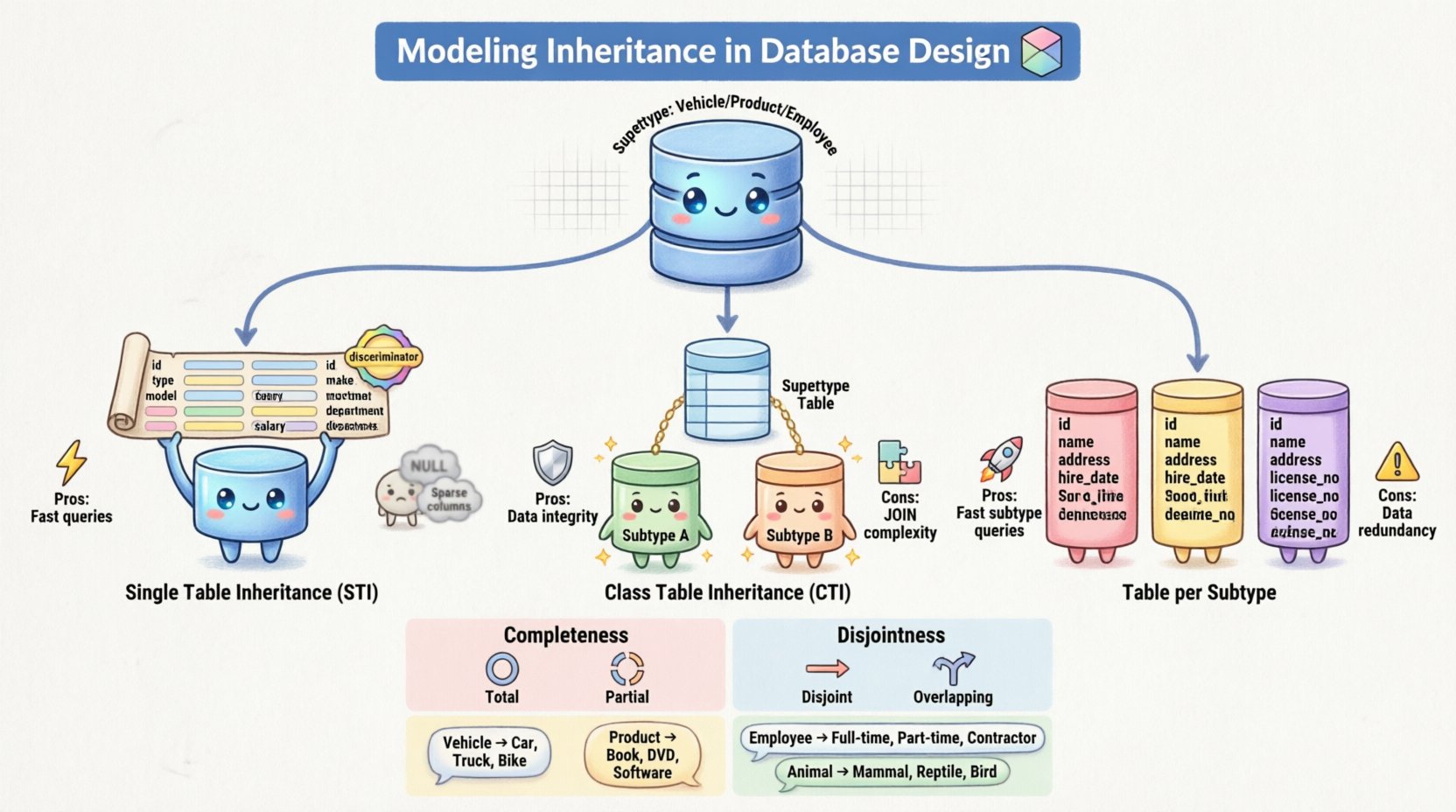
🔑 Core Concepts: Supertypes and Subtypes
Before diving into implementation, we must define the terminology clearly. Inheritance in database modeling is not merely about code; it is about structural representation of data.
- Supertype: This is the parent entity. It contains attributes common to all related entities. It represents the general category. For instance, Employee could be a supertype.
- Subtype: These are the child entities. They inherit attributes from the supertype but may also have their own unique attributes. Examples include Manager or Developer.
- Entity Category: The supertype is sometimes referred to as the entity category, grouping the subtypes together.
- Discriminator: A specific attribute within the supertype that identifies which subtype an instance belongs to. This is often used in physical implementations.
The relationship between a supertype and a subtype is strict. Every instance of a subtype must also be an instance of the supertype. However, not every instance of the supertype needs to be an instance of a specific subtype. This distinction is vital for data modeling accuracy. ✅
📊 Implementation Strategies
Translating the logical ERD model into a physical database schema involves specific mapping strategies. There are three primary approaches used to represent inheritance in relational systems. Each has trade-offs regarding storage, retrieval speed, and data integrity. 🛠️
1. Single Table Inheritance (STI)
In this approach, all attributes of the supertype and all subtypes are combined into a single table. The table contains columns for every attribute defined in the entire hierarchy. To distinguish between rows belonging to different subtypes, a discriminator column is added.
- Pros: Extremely efficient for reading data. A simple
SELECTretrieves all information without complex joins. - Cons: The table can become very wide with many
NULLvalues for attributes that do not apply to specific subtypes. It can also make updates difficult if subtype-specific constraints change.
2. Class Table Inheritance (CTI)
Here, the supertype and each subtype are mapped to their own separate tables. The supertype table contains the common attributes and a primary key. Each subtype table contains the unique attributes and a foreign key linking back to the supertype’s primary key.
- Pros: Highly normalized. No
NULLvalues for non-applicable attributes. Enforces referential integrity strictly. - Cons: Retrieving data requires multiple
JOINoperations, which can impact performance on large datasets. It also complicatesINSERToperations since data must be written to multiple tables.
3. Table per Subtype (Concrete Table Inheritance)
This strategy creates a table for every subtype, including the supertype. However, each subtype table contains a copy of the supertype’s attributes. There is no direct link back to a central supertype table.
- Pros: Querying a specific subtype is very fast as all data is in one place. It avoids the
NULLproblem of STI. - Cons: Data redundancy. If a common attribute changes in the supertype, it must be updated in every subtype table. This increases the risk of data inconsistency.
⚖️ Constraints on Inheritance
Not all inheritance relationships are the same. We must define constraints that govern how instances relate to their types. These constraints ensure the data remains logical and consistent. 📝
Completeness Constraint
This constraint dictates whether every supertype instance must belong to a subtype.
- Complete: Every instance of the supertype must be a member of at least one subtype. There are no “generic” instances. For example, every Animal must be either a Mammal or a Bird.
- Partial: An instance of the supertype does not necessarily belong to any subtype. It can exist as a general entity. This is common when the hierarchy is used for categorization rather than strict classification.
Disjointness Constraint
This constraint determines if an instance can belong to multiple subtypes simultaneously.
- Disjoint: An instance can belong to only one subtype. It cannot be both a Manager and a Developer at the same time within this model.
- Overlap: An instance can belong to more than one subtype. This allows for complex roles where an Employee can hold multiple positions or classifications.
Combining these constraints results in four distinct modeling scenarios. Understanding which scenario fits your business logic is critical before creating the schema. 🧠
| Constraint Type | Definition | Example Scenario |
|---|---|---|
| Disjoint + Complete | One subtype only, no generic instances | Order Status: Pending, Shipped, Delivered |
| Disjoint + Partial | One subtype only, optional subtype | Customer: VIP or Regular (some are neither) |
| Overlap + Complete | Multiple subtypes allowed, must belong to one | User Role: Admin and Editor (must have at least one) |
| Overlap + Partial | Multiple subtypes allowed, optional | Product: Saleable, Promotional (can be both or neither) |
🔍 Querying and Data Retrieval
The choice of mapping strategy significantly impacts how you write queries. In a normalized environment, you often need to traverse the hierarchy to get a complete picture of an entity. 🔎
- Retrieving Subtype Data: If you need to access attributes specific to a subtype, you must join the subtype table. This is standard in Class Table Inheritance.
- Retrieving Supertype Data: If you need common attributes, you can query the supertype table directly.
- Polymorphic Queries: When querying for all instances regardless of subtype, a single table approach is fastest. However, if using multiple tables, you must use
UNIONoperations or complex joins.
Consider the performance implications. A query that joins five tables to retrieve a single record can be slower than a query on a denormalized single table. However, the denormalized table may violate normalization rules, leading to update anomalies. Balancing these factors is a key part of schema design. ⚖️
🛠️ Maintenance and Evolution
Schemas are not static. Business requirements change, and so must the database structure. Inheritance modeling offers flexibility, but it also introduces complexity during maintenance. 🔄
Adding New Subtypes
Adding a new subtype is generally straightforward. You create a new table (in CTI) or a new value in the discriminator column (in STI). However, you must ensure that existing queries and application logic accommodate the new type. Failure to update code can lead to runtime errors.
Modifying Supertype Attributes
If you add an attribute to the supertype, it must be reflected in every subtype table if using CTI or Table per Subtype. In STI, you add it once to the single table. This makes STI easier to maintain for common changes, but harder to maintain for specific changes.
Data Migration
Refactoring an inheritance model is a significant undertaking. Moving from a single table to a normalized structure requires migrating data across multiple tables. This process must be carefully managed to avoid data loss or corruption. 🚧
📈 Normalization and Inheritance
Inheritance modeling interacts closely with database normalization. The goal of normalization is to reduce redundancy and improve data integrity. Inheritance can sometimes conflict with these goals if not handled correctly.
- First Normal Form (1NF): Inheritance models generally satisfy 1NF, as attributes are atomic.
- Second Normal Form (2NF): In STI, a table might contain attributes that are not fully dependent on the primary key if the discriminator is not part of the key. This requires careful key design.
- Third Normal Form (3NF): In CTI, the separation of attributes into subtype tables often helps achieve 3NF by removing transitive dependencies.
When designing supertypes, ensure that the common attributes are truly common. If an attribute is only used by one subtype, it should likely not be in the supertype. This prevents the supertype from becoming a “god table” that is difficult to query. 👁️
🎯 Best Practices for Schema Design
To ensure your inheritance model remains maintainable and performant, follow these guidelines.
- Limit Depth: Avoid deep hierarchies. Three levels of inheritance is usually the maximum recommended. Beyond this, the complexity of queries and maintenance outweighs the benefits.
- Use Clear Naming: Names should reflect the hierarchy. Vehicle, Car, Truck is clear. Entity1, Entity2 is not.
- Plan for Growth: Anticipate future subtypes. If you expect many new subtypes, a single table might become unwieldy. If you expect few, CTI might be better.
- Document Constraints: Clearly document the disjointness and completeness constraints. Future developers need to know if an instance can belong to multiple subtypes.
- Indexing Strategy: If using CTI, index the foreign key columns in subtype tables to speed up joins. If using STI, index the discriminator column for filtering.
🧪 Real-World Scenarios
Let us look at how this applies to actual data modeling challenges.
Scenario 1: Human Resources
In an HR system, you have Person as a supertype. Subtypes include Employee, Contractor, and Intern. Each subtype has unique data: Employee has a payroll ID, Contractor has a billing rate. A Person table holds name and address. This fits the Class Table Inheritance model well.
Scenario 2: Inventory Management
Consider a product catalog. Product is the supertype. Subtypes are Electronics, Furniture, and Clothing. Electronics has Warranty Period. Clothing has Size and Color. If you query for all products with a warranty, you must join the Electronics table. This highlights the query performance trade-off. 🔍
Scenario 3: Financial Transactions
In a banking system, Account is the supertype. Subtypes are Savings, Checking, and Loan. A Savings account has an interest rate. A Loan account has a due date. This scenario often benefits from a Single Table approach to simplify balance calculations across all account types.
🚀 Performance Considerations
Performance is often the deciding factor when choosing a mapping strategy. Large datasets amplify the differences between approaches.
- Write Performance: STI is fastest for inserts because it is a single
INSERTstatement. CTI requires multipleINSERTstatements, which increases transaction overhead. - Read Performance: If you frequently query for specific subtypes, CTI is faster than STI because you only read relevant columns. If you query for all instances, STI is faster.
- Storage: STI uses more storage due to
NULLpadding. CTI uses more storage due to duplicate primary keys and foreign keys, but less due to lack ofNULLpadding.
It is essential to profile your application. Theoretical performance does not always match real-world usage patterns. Testing with realistic data volumes is the only way to confirm your choice. 📊
🛡️ Data Integrity and Validation
Maintaining data integrity in an inheritance model requires strict validation rules. You must ensure that data entered into a subtype table matches the constraints of the supertype.
- Foreign Key Constraints: Ensure that subtype rows always link to valid supertype rows. This prevents orphaned data.
- Check Constraints: Use check constraints to enforce business rules. For example, ensure that the Interest Rate in a Savings subtype is never negative.
- Triggers: In some complex scenarios, database triggers may be necessary to maintain consistency across tables during updates.
Automated testing should cover inheritance scenarios. Verify that creating a new subtype instance correctly updates the supertype. Verify that deleting a supertype instance cascades correctly to subtypes if that is the intended behavior. 🧪
📝 Final Considerations
Modeling inheritance is a balancing act between flexibility and complexity. There is no single “correct” way to do it. The best choice depends on your specific data access patterns, business rules, and performance requirements.
- Start with a clear understanding of the domain. Map the entities before worrying about the tables.
- Choose a mapping strategy that aligns with your most frequent queries.
- Document your decisions. Future maintenance will rely on this documentation.
- Review the schema periodically. As the business evolves, the model may need to change.
By carefully designing supertypes and subtypes, you create a database that is robust, scalable, and easy to understand. This foundation supports the applications that rely on it, ensuring long-term stability and efficiency. 🏗️
Related posts:
 Entity-Relationship Diagram Fundamentals: Visual Guide for Beginners
 ERD Guide: Entities, Attributes, Relationships: Core Concepts Every Developer Should Know
 ERD Guide: Cardinality and Participation Constraints: Real-World Examples Explained
 ERD Guide: Weak vs Strong Entities: Practical Guidelines for Database Modeling