


Designing a database architecture for a multi-tenant environment requires careful consideration of data isolation, scalability, and maintenance overhead. The Entity Relationship Diagram (ERD) serves as the blueprint for these decisions, dictating how data is structured across tenants. Choosing the right approach impacts performance, security, and the ability to evolve the system over time. This guide explores the primary architectural patterns, their ERD implications, and the trade-offs involved in each strategy.
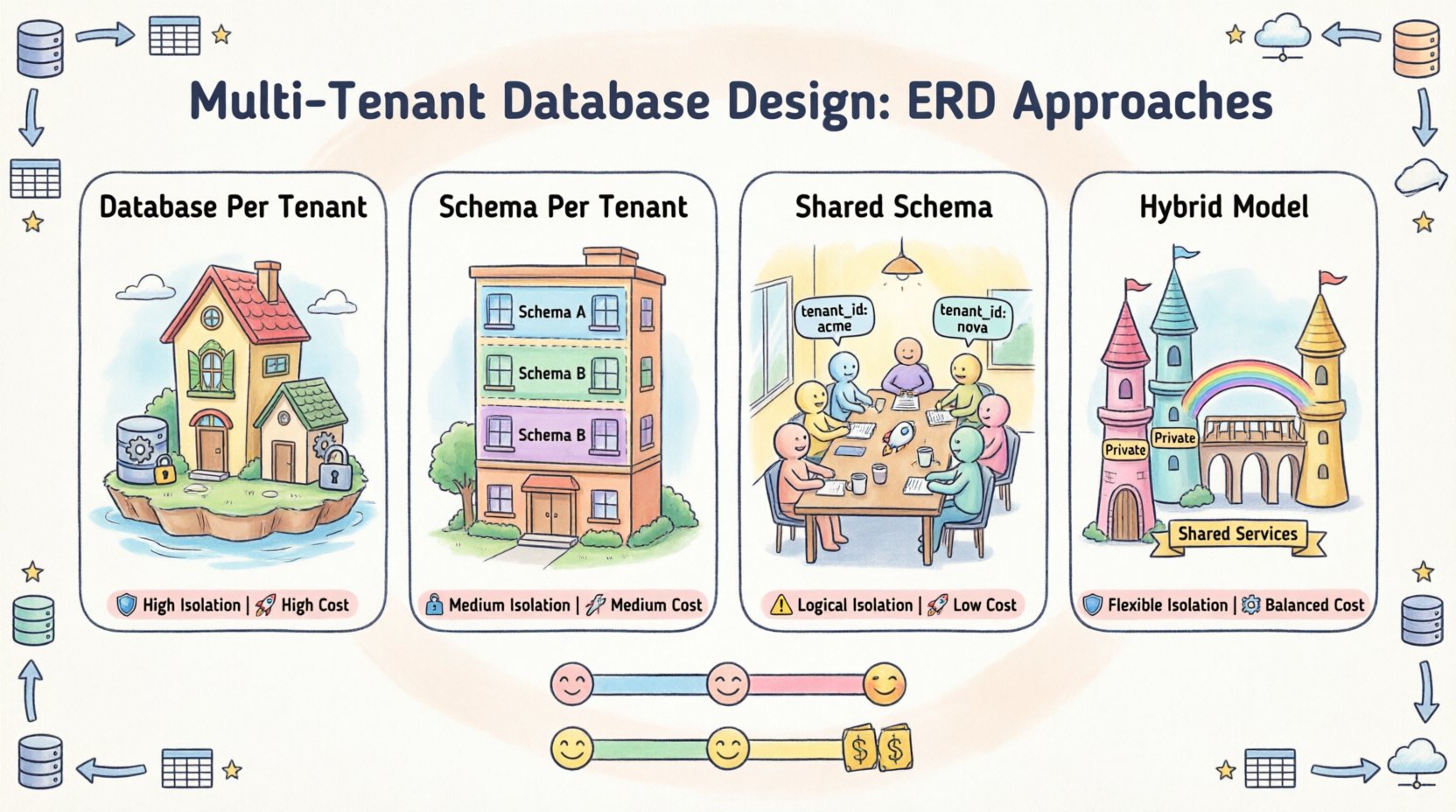
🔍 Understanding Multi-Tenancy in Data Modeling
Multi-tenancy allows a single instance of software to serve multiple customers, often referred to as tenants. In the context of database design, the core challenge is deciding how to separate tenant data while maintaining efficiency. The ERD must reflect these separation boundaries clearly.
- Tenant: An individual customer or organization using the system.
- Shared System: The application logic and potentially the underlying infrastructure.
- Data Isolation: Ensuring one tenant cannot access another’s data.
The design choices primarily revolve around where the isolation boundary sits. Does it exist at the database level, the schema level, or the row level? Each choice demands a specific ERD structure.
🏗️ Strategy 1: Database Per Tenant
In this model, every tenant receives a dedicated database instance. This provides the highest level of isolation and security. From an ERD perspective, the schema remains identical across all databases, but the physical separation is absolute.
📊 ERD Structure
The ERD diagram for a single tenant database looks identical to a standard single-tenant design. There is no need for a tenant_id column because the database boundary itself acts as the filter.
- Table Structure: Tables contain only data relevant to the specific tenant.
- Foreign Keys: Standard referential integrity applies without tenant awareness.
- Indexes: Optimized for the specific data volume of that tenant.
✅ Advantages
- Complete Isolation: A breach in one database does not affect others.
- Customization: Schema modifications can be applied to specific tenants without affecting others.
- Performance: No contention from other tenants on the same connection pool or disk I/O.
❌ Disadvantages
- Cost: High infrastructure cost due to multiple instances.
- Maintenance: Schema updates require deployment to every database instance.
- Complexity: Managing connections and orchestration becomes difficult at scale.
🏗️ Strategy 2: Schema Per Tenant
This approach sits between the previous two. Each tenant gets a dedicated schema within the same database server. This reduces the overhead of managing multiple database connections while maintaining logical separation.
📊 ERD Structure
The ERD remains consistent with a single-tenant model, but the namespace changes. Tables exist within a specific schema namespace rather than the public namespace.
- Table Names: Standard naming conventions (e.g.,
users,orders). - Schema Names: Unique identifiers (e.g.,
schema_tenant_a,schema_tenant_b). - Connectivity: The application connects to the specific schema for the active tenant.
✅ Advantages
- Isolation: Stronger isolation than shared schema models.
- Management: Easier to manage than separate database instances.
- Backup: Can restore or backup individual schemas independently.
❌ Disadvantages
- Resource Usage: Still consumes more resources than a fully shared model.
- Query Complexity: Aggregating data across tenants requires dynamic schema switching.
- Schema Drift: Keeping schemas synchronized across many tenants is labor-intensive.
🏗️ Strategy 3: Shared Database, Shared Schema
This is the most common approach for SaaS applications. All tenants share the same database and the same tables. Data separation is achieved logically through a unique identifier column.
📊 ERD Structure
The ERD must explicitly include a tenant_id column in every table that stores tenant-specific data. This column acts as the partition key.
- Core Tables:
users,orders,productsall contain atenant_id. - Shared Tables: Tables like
rolesorpermissionsmight be shared across all tenants. - Constraints: Foreign keys may need to be scoped to ensure referential integrity is maintained within the tenant context.
✅ Advantages
- Cost Efficiency: Lowest infrastructure cost.
- Maintenance: Schema changes apply to all tenants instantly.
- Analytics: Easier to aggregate data for system-wide reporting.
❌ Disadvantages
- Complex Queries: Every query requires filtering by
tenant_id. - Performance: High contention risks if one tenant consumes excessive resources.
- Security: Higher risk of logic errors leading to data leakage.
🏗️ Strategy 4: Hybrid Model
A hybrid approach combines elements of the strategies above. For example, a shared schema for standard data, but a dedicated schema for premium tiers or specific high-value tenants.
📊 ERD Structure
The ERD becomes more complex, distinguishing between shared tables and tenant-specific tables.
- Global Tables: Store configuration or shared metadata.
- Tenant Tables: Store user data with a
tenant_idor in separate schemas. - Linking: Join operations must account for the scope of the data.
🛡️ Data Isolation and Security Considerations
Regardless of the chosen strategy, data isolation is paramount. The ERD must support mechanisms that prevent accidental data access.
🔒 Row-Level Security
In a shared schema model, row-level security (RLS) policies can be defined. The database engine restricts access to rows where the tenant_id matches the authenticated context.
- Implementation: Policies enforce checks on every
SELECT,UPDATE, andDELETEoperation. - Benefit: Prevents application-level bugs from causing data leaks.
- ERD Impact: Requires explicit
tenant_idcolumns on all relevant tables.
🔒 Foreign Key Constraints
Ensuring referential integrity across tenants can be tricky in shared models. A foreign key should ideally not point to a table that spans multiple tenants unless the relationship is explicitly global.
- Self-Referencing: If a table references itself (e.g.,
parent_id), thetenant_idmust match on both sides. - Global References: Tables like
categoriesmight be global, allowing them to be referenced by any tenant.
⚡ Performance and Scaling Strategies
As the number of tenants grows, performance becomes a critical concern. The ERD design directly influences how well the system scales.
📈 Indexing Strategies
Indexes are crucial for query performance. In a shared schema, the tenant_id column should be part of the primary composite key or heavily indexed.
- Composite Indexes:
(tenant_id, created_at)allows efficient filtering by tenant and time. - Partial Indexes: Indexes can be created only for specific conditions, reducing index size.
- Avoid: Indexing columns that do not aid in tenant filtering.
📦 Partitioning
Table partitioning can help manage large datasets. Data can be partitioned by tenant_id or by time ranges within a tenant.
- Range Partitioning: Splits data based on date ranges.
- List Partitioning: Splits data based on specific tenant IDs.
- Management: Partitions can be detached or archived to improve performance.
🔧 Maintenance and Schema Evolution
Software evolves. Tables need to be added, columns modified, or types changed. The chosen architecture dictates the effort required for these changes.
🔄 Schema Updates
- Shared Schema: A single migration script updates the schema for all tenants. This is the simplest path.
- Database Per Tenant: The migration script must be executed against every database instance. Automation is required.
- Schemas Per Tenant: Similar to database per tenant, but managed within the same instance.
📝 Backward Compatibility
When modifying the ERD, ensure backward compatibility to avoid downtime.
- Add Columns: Use nullable columns first, then populate data, then make non-null.
- Drop Columns: Rename columns before removing them to prevent breaking changes.
- Versioning: Consider versioning the schema itself if tenants can opt out of updates.
📋 Comparison of Architectural Approaches
| Feature | Database Per Tenant | Schema Per Tenant | Shared Schema |
|---|---|---|---|
| Isolation | High | Medium | Low |
| Cost | High | Medium | Low |
| Maintenance | Complex | Medium | Simple |
| Query Performance | High (No filtering) | Medium | Variable (Filtering needed) |
| ERD Complexity | Simple (Per DB) | Simple (Per Schema) | Complex (tenant_id required) |
| Scalability | Horizontal | Vertical | Vertical/Horizontal |
✅ Best Practices Checklist
Before finalizing the ERD for a multi-tenant system, ensure the following criteria are met.
- Define Tenant Scope: Clearly identify which data belongs to a tenant and which is global.
- Standardize Naming: Use consistent naming conventions for
tenant_idcolumns across all tables. - Enforce Constraints: Use database constraints to prevent cross-tenant data access where possible.
- Plan for Churn: Design for tenant onboarding and offboarding (data deletion or archival).
- Test Isolation: Regularly test to ensure one tenant cannot query another tenant’s data.
- Document Relationships: Clearly document foreign key relationships in the ERD documentation.
- Monitor Performance: Set up alerts for slow queries that may indicate tenant-specific bottlenecks.
🧩 Handling Edge Cases
Real-world scenarios often introduce complexities that standard ERDs do not cover immediately.
🔄 Tenant Merging
Sometimes, two tenants merge into one. In a shared schema, this requires moving rows from one tenant_id to another. In a database-per-tenant model, this involves merging two entire databases.
- Data Consistency: Ensure no data is lost during the merge.
- Deduplication: Handle duplicate records that may arise from the merge.
📉 Tenant Churn
Tenants leave. The decision to delete data or archive it affects the ERD.
- Soft Deletes: Add an
is_deletedflag to preserve data for compliance. - Hard Deletes: Remove rows entirely. Ensure cascading deletes are configured correctly to avoid orphaned records.
- Archiving: Move old tenant data to cold storage tables while keeping the schema intact.
🔗 Integrating with Application Logic
The ERD is not an island. It must integrate seamlessly with the application layer.
- Middlewares: Use application-level middlewares to inject
tenant_idinto every query automatically. - ORM Configuration: Configure Object-Relational Mapping tools to handle tenant scoping.
- API Design: Ensure API endpoints validate tenant context before returning data.
🎯 Final Thoughts on Design
Selecting the appropriate database design for a multi-tenant environment is a balance between isolation and efficiency. The ERD acts as the contract that defines these boundaries. There is no single perfect solution; the choice depends on the specific requirements for security, cost, and scale. By understanding the implications of each strategy, architects can build systems that are robust, scalable, and secure.
Focusing on clear data modeling practices ensures that the system remains maintainable as the number of tenants grows. Regular reviews of the ERD against real-world usage patterns help identify bottlenecks or security gaps before they become critical issues.
Ultimately, the goal is a design that supports the business without compromising the integrity of the data. Careful planning at the ERD stage prevents costly refactoring later.
Related posts:
 Entity-Relationship Diagram Fundamentals: Visual Guide for Beginners
 ERD Guide: Entities, Attributes, Relationships: Core Concepts Every Developer Should Know
 ERD Guide: Cardinality and Participation Constraints: Real-World Examples Explained
 ERD Guide: Weak vs Strong Entities: Practical Guidelines for Database Modeling