


In the world of software development and data management, the ability to design robust database structures is a foundational skill. An Entity Relationship Diagram (ERD) serves as the blueprint for how data is organized, stored, and retrieved. For hiring managers and technical recruiters, seeing a well-thought-out ERD in your portfolio provides immediate evidence of your understanding of data integrity, relationships, and system architecture. 🗂️
This guide outlines specific project ideas ranging from beginner to advanced levels. It explains the design logic behind each schema, helping you build a portfolio that demonstrates deep technical competence without relying on buzzwords or salesy language. By the end of this article, you will have a clear roadmap for creating ERDs that stand out in job applications.
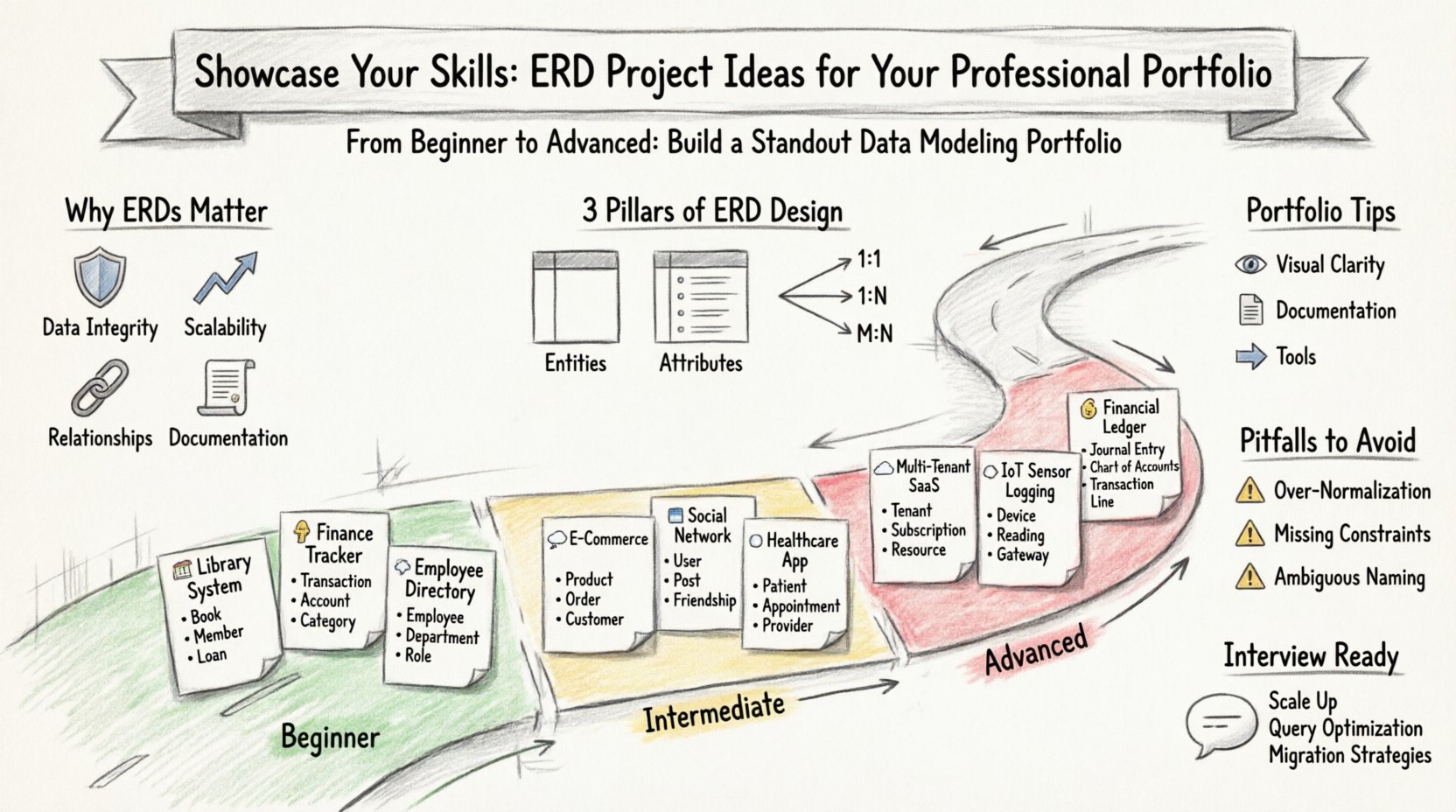
Why ERDs Matter in Your Portfolio 📊
Code snippets show that you can write syntax, but an ERD shows that you can think. When you submit a project to a potential employer, they want to know how you handle data complexity. A strong ERD demonstrates:
- Data Integrity: You understand how to prevent anomalies through normalization.
- Scalability: You can design schemas that grow with user demand.
- Relationships: You grasp the nuances of foreign keys and join operations.
- Documentation: You can communicate complex structures to stakeholders.
Recruiters often look for the “why” behind the design. Did you choose a many-to-many relationship here? Why? Does this table violate the third normal form? Being prepared to answer these questions is just as important as the diagram itself.
Foundations of a Strong ERD Design 🧩
Before diving into specific project ideas, it is essential to review the core components that make an ERD effective. Every diagram relies on three pillars: entities, attributes, and relationships.
1. Entities and Tables
An entity represents a real-world object or concept about which you need to store data. In a database, this translates to a table. Good entity naming is singular and descriptive. For example, use Customer instead of Customers, and Invoice instead of InvoiceRecords.
2. Attributes and Columns
Attributes define the properties of an entity. Each attribute should have a clear data type. Avoid storing complex objects in a single field. For instance, instead of a single field for Address, consider breaking it down into Street, City, State, and ZipCode to facilitate searching and sorting.
3. Relationships and Cardinality
Relationships define how entities interact. Understanding cardinality is critical:
- One-to-One (1:1): One record in Table A relates to only one record in Table B. Example: A Person and their Passport.
- One-to-Many (1:N): One record in Table A relates to multiple records in Table B. Example: One Author writes many Books.
- Many-to-Many (M:N): Multiple records in Table A relate to multiple records in Table B. Example: Students and Courses. This usually requires a junction table.
Beginner Level Projects 🟢
If you are just starting, focus on clarity and basic normalization. These projects should demonstrate that you can model simple business rules without over-engineering.
1. Library Management System 📚
This is a classic project that covers inventory, lending, and user management. It is excellent for demonstrating one-to-many and many-to-many relationships.
- Key Entities:
- Book: ISBN, Title, PublicationYear, Genre, StockCount
- Author: AuthorID, Name, Biography
- Member: MemberID, Name, Email, JoinDate, Status
- Loan: LoanID, BookID, MemberID, CheckoutDate, DueDate, ReturnDate
- Design Logic:
- A Book can have multiple Authors (M:N), requiring a junction table.
- A Member can borrow multiple Books (1:N via the Loan table).
- Use ReturnDate as nullable to indicate active loans.
2. Personal Finance Tracker 💰
Financial data requires precision. This project highlights the importance of data types (decimals vs. integers) and historical tracking.
- Key Entities:
- Account: AccountID, AccountName, Balance, Type (Checking/Savings)
- Transaction: TransactionID, AccountID, Amount, Date, Category, Type (Credit/Debit)
- Category: CategoryID, Name, ParentCategoryID
- Design Logic:
- Use Decimal types for currency to avoid floating-point errors.
- Implement a Self-Referencing Relationship in the Category table for hierarchical budgeting (e.g., Food > Groceries).
- Ensure every transaction links back to exactly one account.
3. Employee Directory 👥
Simple but effective for demonstrating hierarchical data structures and self-referencing relationships.
- Key Entities:
- Employee: EmployeeID, Name, Role, HireDate, ManagerID
- Department: DeptID, DeptName, Budget
- Design Logic:
- The ManagerID in the Employee table is a foreign key pointing to the Employee table itself. This creates a recursive relationship.
- Each employee belongs to one Department.
- Consider adding a LeaveRequest table to show transactional history.
Intermediate Level Projects 🟡
At this stage, you must handle complex business rules, concurrency, and more intricate normalization requirements. These projects show you can handle real-world complexity.
4. E-Commerce Platform 🛒
Selling products online involves inventory, orders, payments, and reviews. This is a high-value project for backend roles.
- Key Entities:
- Product: ProductID, Name, Description, BasePrice, SKU
- Order: OrderID, CustomerID, OrderDate, Status, ShippingAddress
- OrderItem: OrderItemID, OrderID, ProductID, Quantity, PriceAtPurchase
- Customer: CustomerID, Email, PasswordHash, BillingAddress
- Review: ReviewID, ProductID, CustomerID, Rating, Comment
- Design Logic:
- Crucial decision: Store the PriceAtPurchase in OrderItem. If the product price changes later, the historical order record must remain accurate.
- Use a Many-to-Many relationship between Customer and Product via the Order/OrderItem structure.
- Implement a Soft Delete flag for products that are discontinued rather than removed from the database.
5. Social Networking Application 📱
Social graphs are notoriously complex. This project demonstrates your ability to model connections and content feeds.
- Key Entities:
- User: UserID, Username, ProfilePic, Bio
- Post: PostID, UserID, Content, Timestamp
- Follows: FollowerID, FolloweeID, FollowDate
- Comment: CommentID, PostID, UserID, Content
- Design Logic:
- The Follows table is a junction table for a many-to-many relationship.
- Consider adding a Block table to manage user restrictions.
- Use indexes on Timestamp to optimize feed retrieval queries.
- Ensure referential integrity prevents deletion of a user who has existing posts or comments.
6. Healthcare Appointment System 🏥
Healthcare data requires strict privacy and scheduling logic. This highlights constraint handling.
- Key Entities:
- Patient: PatientID, Name, DOB, InsuranceID
- Doctor: DoctorID, Name, Specialization
- Appointment: AppointmentID, PatientID, DoctorID, StartTime, EndTime, Reason
- MedicalRecord: RecordID, PatientID, DoctorID, Diagnosis, Notes
- Design Logic:
- Time Slots: Prevent double-booking by ensuring StartTime and EndTime do not overlap for the same Doctor.
- History: A patient can have multiple records from the same doctor over time.
- Privacy: Sensitive fields should be logically separated or encrypted in the application layer.
Advanced Level Projects 🔴
For senior-level positions, you must demonstrate an understanding of scalability, multi-tenancy, and audit trails. These schemas are designed for high-volume environments.
7. Multi-Tenant SaaS Architecture ☁️
Software as a Service (SaaS) platforms serve many organizations from a single instance. Designing the schema for this requires careful isolation strategies.
- Key Entities:
- Tenant: TenantID, Name, SubscriptionPlan
- User: UserID, TenantID, Email, Role
- DataRecord: RecordID, TenantID, UserID, Payload, CreatedAt
- Design Logic:
- Tenant Isolation: Every table must have a TenantID foreign key to ensure data segregation.
- Global vs. Local: Decide whether to share a schema (cheaper, harder to isolate) or use separate schemas per tenant (expensive, secure).
- Performance: Ensure queries always include TenantID in the WHERE clause to avoid cross-tenant data leaks.
8. IoT Sensor Data Logging 📡
Internet of Things generates massive amounts of time-series data. This project focuses on storage efficiency and time-based queries.
- Key Entities:
- Device: DeviceID, DeviceType, Location, InstallDate
- Reading: ReadingID, DeviceID, SensorType, Value, Timestamp
- Alert: AlertID, DeviceID, ThresholdValue, TriggeredAt, ResolvedAt
- Design Logic:
- Partitioning: The Reading table should be partitioned by time (e.g., monthly) to manage growth.
- Compression: Store values efficiently, potentially using specific data types optimized for sensor data.
- Retention: Define policies for archiving old readings to keep the active database performant.
9. Financial Transaction Ledger 💸
Financial systems require absolute accuracy. Double-entry bookkeeping principles must be reflected in the schema.
- Key Entities:
- Account: AccountID, AccountType, Balance
- Transaction: TransactionID, Date, Description
- Entry: EntryID, TransactionID, AccountID, DebitAmount, CreditAmount
- Design Logic:
- Atomicity: Every transaction must have at least one debit and one credit entry summing to zero.
- Immutability: Never update a ledger entry. If an error occurs, create a reversing entry.
- Concurrency: Use locking mechanisms to prevent race conditions when updating balances.
Presenting Your Portfolio Effectively 📝
Creating the diagram is only half the battle. How you present it determines whether the reviewer understands your intent. Follow these guidelines to maximize impact.
1. Documentation Standards 📄
A diagram without context is confusing. Include a README file or a description section for each project that covers:
- Business Context: What problem does this database solve?
- Assumptions: What rules did you assume were true? (e.g., “A user can only have one active subscription.”)
- Normalization: Briefly explain why you stopped at 3rd Normal Form (3NF) or why you deviated for performance.
2. Visual Clarity 👁️
Ensure your ERD is readable. Avoid crossing lines unnecessarily. Use consistent naming conventions (e.g., camelCase for columns, PascalCase for tables). If possible, provide both a high-level view and a detailed view.
3. Tools and Formats
Export your diagrams in standard formats like PNG or SVG. Do not rely on proprietary file formats that cannot be opened by the reviewer. Ensure the resolution is high enough for text to remain legible when zoomed in.
Common Pitfalls to Avoid ⚠️
Even experienced designers make mistakes. Review your work against this checklist to catch errors before submission.
| Pitfall | Impact | Solution |
|---|---|---|
| Over-Normalization | Too many joins slow down queries. | Denormalize specific fields for read-heavy operations. |
| Missing Constraints | Data integrity risks (e.g., negative age). | Add CHECK constraints and NOT NULL flags. |
| Ambiguous Naming | Confusion during development. | Use descriptive names (e.g., created_at vs date1). |
| Hardcoded Values | Schema becomes rigid and hard to change. | Use lookup tables for status codes or categories. |
| Ignoring Timezones | Incorrect timestamps across regions. | Store UTC and convert in the application layer. |
Preparing for the Interview 🗣️
Once you have these projects in your portfolio, be ready to defend your choices. Interviewers often ask “What if” scenarios to test your adaptability.
- Scale Up: “What happens if this table grows to 100 million rows?” Be ready to discuss indexing strategies, partitioning, or sharding.
- Query Optimization: “How would you find the top 10 users by spending?” Explain your approach to filtering and sorting.
- Changes: “How would you add a new feature that requires changing this structure?” Discuss migration strategies and backward compatibility.
By focusing on the logic behind your design rather than just the syntax, you demonstrate senior-level thinking. Employers value the ability to make trade-offs and justify technical decisions. Use these project ideas as a foundation, but feel free to adapt them to your specific interests. Whether you are interested in fintech, healthcare, or social media, the underlying principles of data modeling remain consistent. Build your portfolio with care, document your reasoning, and let your diagrams speak for your expertise.
Related posts:
 Entity-Relationship Diagram Fundamentals: Visual Guide for Beginners
 ERD Guide: Entities, Attributes, Relationships: Core Concepts Every Developer Should Know
 ERD Guide: Cardinality and Participation Constraints: Real-World Examples Explained
 ERD Guide: Weak vs Strong Entities: Practical Guidelines for Database Modeling