


Strategic planning requires more than internal data. It demands a clear view of the forces acting outside your organization. A PEST analysis provides this view. It structures how you examine the external landscape. This guide offers a comprehensive PEST checklist to help you navigate macro-environmental scans with precision.
Organizations that ignore external factors often face unexpected disruptions. This document serves as a reference for leaders, analysts, and strategists. It breaks down the four core pillars: Political, Economic, Social, and Technological. Each section includes specific questions and data sources to guide your research.
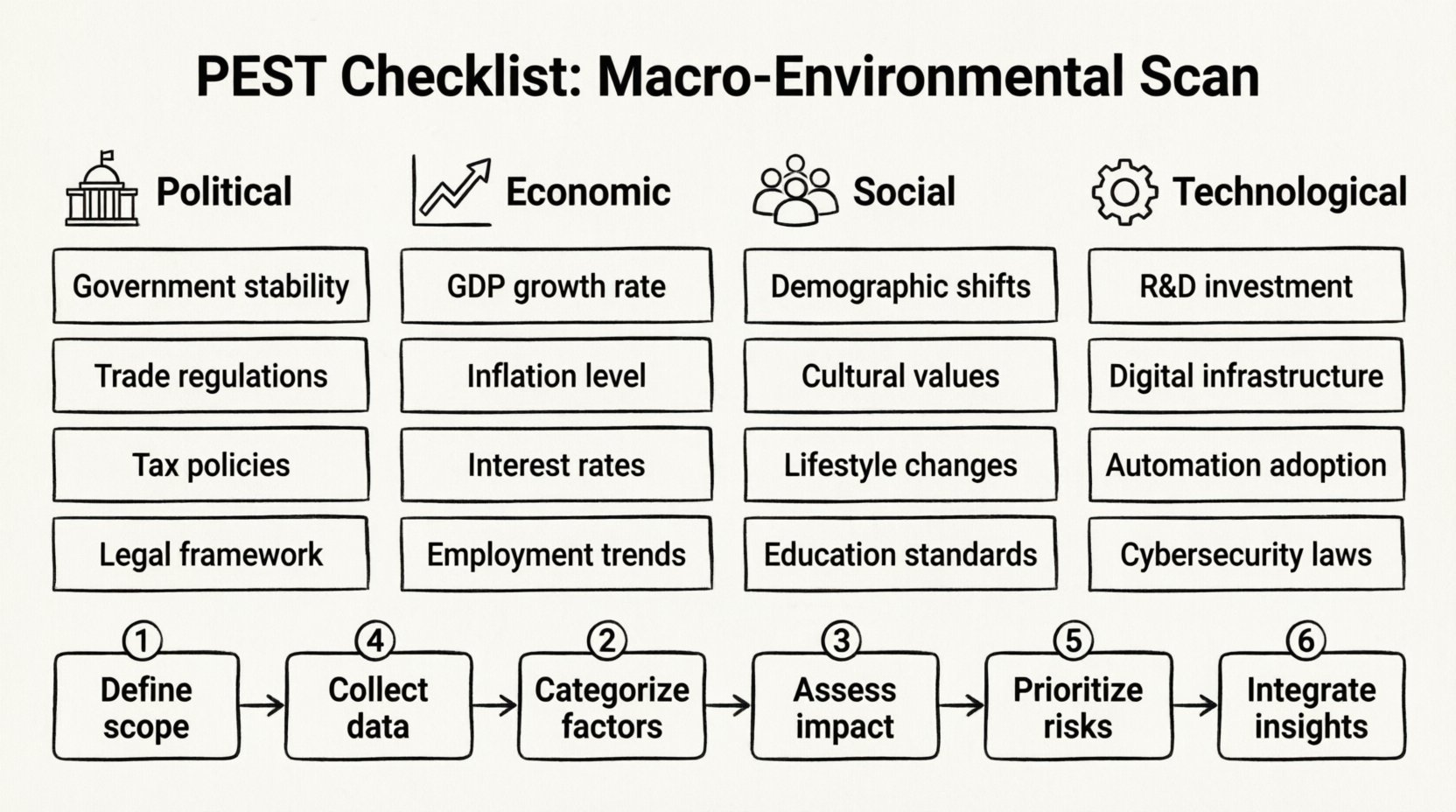
🔍 Understanding the PEST Framework
The PEST framework is a strategic tool used to analyze the external factors that impact an organization. It stands for Political, Economic, Social, and Technological. While often used interchangeably with PESTLE, the core PEST model focuses on these four primary dimensions.
- Purpose: To identify opportunities and threats in the broader environment.
- Application: Used during market entry, product launches, and long-term planning.
- Benefit: Provides a structured approach to avoid overlooking critical external shifts.
Unlike SWOT analysis, which includes internal strengths and weaknesses, PEST focuses strictly on the external macro-environment. This distinction is vital. Internal factors are within your control. External factors are not. Your strategy must adapt to the latter.
🏛️ The Political Factor: Stability and Regulation
Political factors refer to the extent to which a government intervenes in the economy. They are often the most volatile component of the macro-environment. Changes in policy can alter the cost of doing business overnight.
Key Areas to Investigate
- Government Stability: Is the current administration stable? Frequent elections or regime changes create uncertainty.
- Trade Restrictions: Are there tariffs, quotas, or embargoes affecting your supply chain?
- Tax Policy: How does corporate tax law impact your bottom line? Are there incentives for specific industries?
- Labour Laws: What are the regulations regarding minimum wage, working hours, and unions?
- Environmental Regulations: What compliance costs are associated with waste, emissions, or sustainability?
Political Checklist
| Factor | Key Question | Potential Impact |
|---|---|---|
| Trade Policy | Are import duties rising? | Higher costs for raw materials |
| Taxation | Is corporate tax increasing? | Reduced net profit margins |
| Licensing | Do we need new permits? | Delayed project timelines |
| Political Stability | Is the region stable? | Risk of operational disruption |
When analyzing political factors, look beyond national borders. Regional and local laws can also dictate operational feasibility. For example, a city might ban certain types of delivery vehicles, affecting logistics.
💰 The Economic Factor: Growth and Resources
Economic factors determine the purchasing power of potential customers and the cost of capital. These indicators are often published by government statistical agencies and central banks.
Key Areas to Investigate
- Economic Growth: Is the economy in a recession or an expansion? GDP growth rates indicate market potential.
- Interest Rates: High rates increase borrowing costs for expansion. Low rates encourage investment.
- Inflation: Rising prices increase input costs and may reduce consumer spending power.
- Exchange Rates: Currency fluctuations affect import/export costs and profitability in foreign markets.
- Disposable Income: How much money do consumers have left after essential expenses?
Economic Checklist
| Indicator | Data Source | Strategic Implication |
|---|---|---|
| GDP Growth | National Statistics Bureau | Market demand expansion or contraction |
| Inflation Rate | Central Bank Reports | Pricing strategy adjustments |
| Interest Rates | Financial News | Capital investment feasibility |
| Unemployment | Labour Department | Talent availability and wage pressure |
Economic conditions vary by region. A national average might hide a boom in one sector and a bust in another. Segment your analysis by specific geographic markets where you operate.
👥 The Social Factor: Demographics and Culture
Social factors encompass the cultural and demographic aspects of the external environment. They influence demand for your products and the availability of talent.
Key Areas to Investigate
- Population Growth: Is the population aging or growing rapidly? This affects long-term demand.
- Age Distribution: A younger population may require different products than an older one.
- Health Consciousness: Are consumers prioritizing wellness? This impacts food, fitness, and insurance sectors.
- Lifestyle Trends: Are people working remotely? Are they valuing experiences over goods?
- Education Levels: Higher education levels can lead to higher skill availability and higher expectations.
Social Checklist
| Trend | Observation | Action Required |
|---|---|---|
| Aging Population | Median age increasing | Develop age-friendly products |
| Urbanization | More people moving to cities | Focus on urban distribution |
| Remote Work | Shift in work culture | Invest in digital collaboration tools |
| Diversity | Workforce demographics changing | Review HR policies for inclusion |
Social trends often evolve slowly but have profound long-term effects. A shift in family structure, for instance, changes the demand for housing and childcare services. Understanding these nuances is critical for product development.
🚀 The Technological Factor: Innovation and Infrastructure
Technological factors relate to the invention of new technologies and the rate of obsolescence. In the modern economy, this is often the most dynamic category.
Key Areas to Investigate
- R&D Activity: How much investment is going into innovation in your sector?
- Automation: Can machines replace labor in your supply chain?
- Infrastructure: Is the internet reliable? Is the logistics network robust?
- Disruptive Tech: Are there new technologies that could make your product irrelevant?
- Intellectual Property: How strong are patent laws protecting your innovations?
Technological Checklist
| Factor | Question | Impact Level |
|---|---|---|
| Automation | Is AI replacing manual tasks? | High |
| Internet Access | Is connectivity universal? | Medium |
| Patents | Are competitors patenting core tech? | High |
| Data Security | Are cyber threats increasing? | Medium |
Technological changes can create new markets overnight. A business that fails to adapt to a technological shift risks becoming obsolete. Continuous monitoring of the R&D landscape is necessary.
📝 Conducting the Macro-Environmental Scan
Having the checklist is the first step. Executing the scan requires a disciplined process. Follow these steps to ensure your analysis is robust and actionable.
- Define the Scope: Are you analyzing a specific region, a product line, or the entire organization?
- Identify Data Sources: Gather information from government reports, industry journals, and news outlets.
- Filter Information: Not all data is relevant. Focus on factors that directly impact your strategic goals.
- Score the Impact: Rate each factor based on its likelihood and potential impact on your business.
- Document Findings: Record your findings in a central repository for future reference.
- Review Regularly: The environment changes. Schedule periodic reviews of your PEST analysis.
Data collection should be systematic. Avoid relying on anecdotal evidence. Use verified statistics where possible. This ensures your strategic decisions are grounded in reality.
🔗 Integrating Findings into Strategy
The value of the PEST checklist lies in its application. Raw data does not create strategy. Synthesis does.
- Align with SWOT: External opportunities from PEST can become Strengths or Opportunities in a SWOT analysis.
- Risk Management: High-impact threats identified in PEST should be added to your risk register.
- Resource Allocation: Use the findings to decide where to invest capital. If technology is a threat, invest in R&D.
- Scenario Planning: Use the factors to build different future scenarios. Plan for the best, worst, and most likely outcomes.
Integration ensures that the analysis influences decision-making. If the scan is done but ignored, the effort is wasted. Share the results with key stakeholders to build consensus on the strategic direction.
⚠️ Common Pitfalls to Avoid
Even with a solid checklist, errors can occur. Be aware of these common mistakes to maintain the integrity of your analysis.
- Recency Bias: Focusing only on the most recent news. Historical trends provide context for current events.
- Generalization: Applying national trends to local markets. Local nuances often override general data.
- Static Analysis: Treating the scan as a one-time event. The environment is dynamic.
- Confirmation Bias: Looking for data that supports a pre-existing decision. Seek contradictory evidence.
- Ignoring Interconnections: Factors often overlap. Economic changes can drive political shifts. Consider these links.
❓ Frequently Asked Questions
How often should I update the PEST checklist?
There is no fixed rule. For fast-moving industries like technology, a quarterly review is advisable. For stable industries, an annual review may suffice. The key is consistency.
Is PESTLE better than PEST?
PESTLE adds Legal and Environmental factors. These are subsets of Political and Social factors in the standard model. If your industry is heavily regulated or sensitive to climate, use PESTLE. Otherwise, PEST is sufficient.
Can I use this for non-profit organizations?
Yes. Non-profits also operate in an external environment. Donors, government funding, and social trends all fall under these categories.
What tools do I need?
There is no specific software required. You can use a spreadsheet or a document management system. The method of recording is less important than the rigor of the research.
🛠️ Final Thoughts on Macro-Environmental Scans
A well-structured PEST checklist is a foundation for resilience. It does not predict the future, but it prepares you for it. By systematically examining political, economic, social, and technological factors, you reduce the element of surprise in your strategic planning.
Keep the analysis current. Keep the data verified. Keep the focus on actionable insights. This approach ensures your organization remains adaptable in a complex world.
Remember that strategy is not a destination. It is a continuous process of adjustment. Use this reference guide to maintain that momentum.
Related posts:
 How to Execute a PEST Analysis for Your International Business Strategy: A Step-by-Step Walkthrough
 PEST Analysis vs. SWOT: A Direct Comparison for MBA Students to Avoid Common Pitfalls
 The 3-Step Quick Start Guide to Conducting a PEST Framework in Under an Hour
 Real-World Case Studies: How Top Firms Used PEST Analysis to Navigate Global Markets