


Strategic planning forms the backbone of organizational decision-making. Among the various tools available, the PEST analysis stands out as a fundamental method for understanding the macro-environmental factors that influence a business. However, a recurring issue persists in academic and early professional settings. Many students approach the PEST framework incorrectly, often reversing the logic or confusing external drivers with internal capabilities.
This guide addresses the core misconceptions surrounding this tool. It moves beyond simple definitions to explore the mechanics of effective external environmental scanning. By understanding the nuances of Political, Economic, Social, and Technological factors, you can construct a robust strategic foundation. Let us examine why the standard approach often fails and how to correct it.
The Fundamental Misconception 🚫
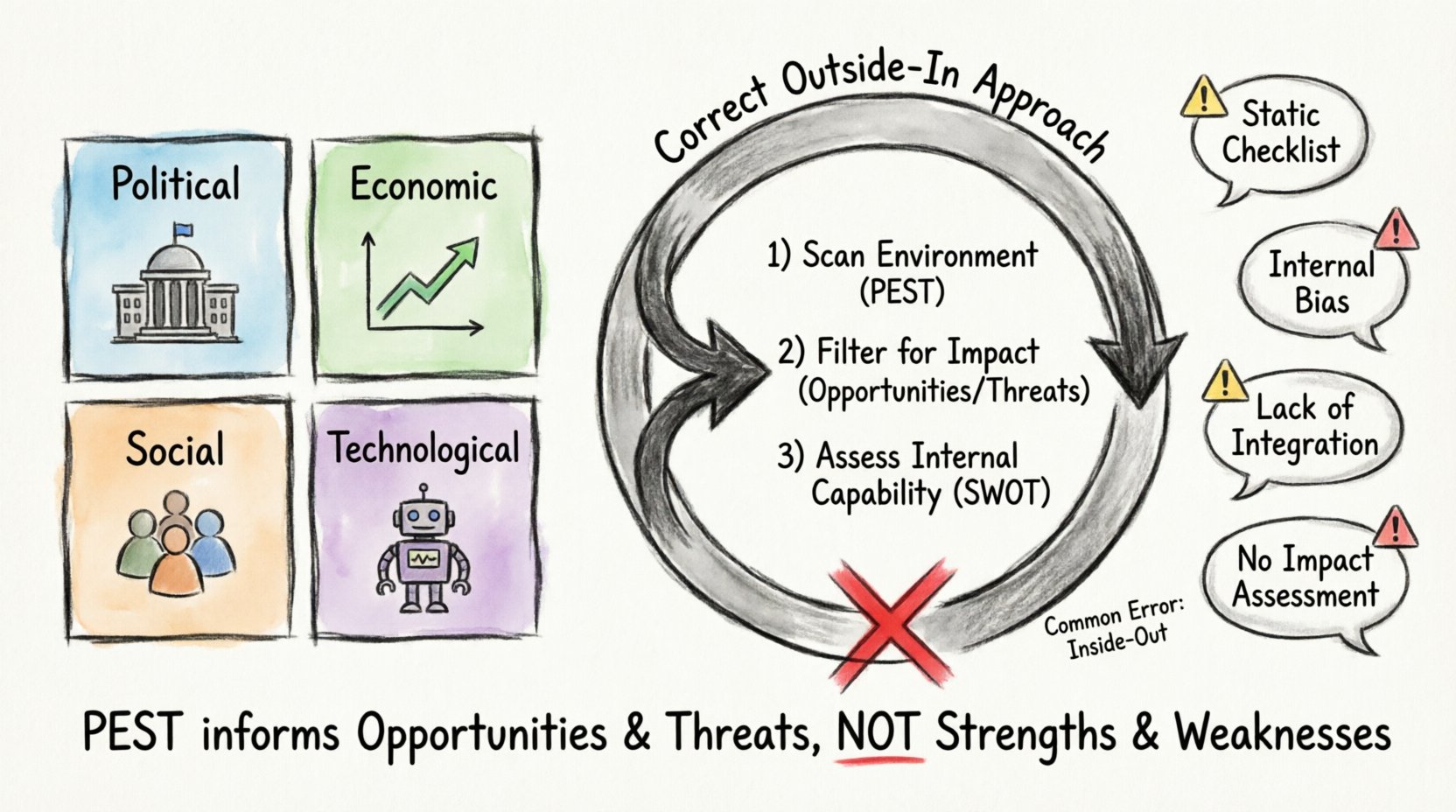
The primary error lies in the perception of PEST as a static checklist. Students often view the acronym as a set of boxes to tick rather than a dynamic lens through which to view the market. This leads to a superficial analysis where factors are listed without context or impact assessment.
Another significant misunderstanding involves the direction of the analysis. Strategic thinking requires moving from the outside in. The environment dictates the possibilities for the organization. Yet, many learners start with internal strengths and work outward, effectively reversing the causal flow of information. This results in strategies that are disconnected from market reality.
Key points regarding this misconception:
- Static vs. Dynamic: The environment changes constantly. A PEST analysis done once a year may be obsolete by the time it is presented.
- Checklist Mentality: Listing a law or a trend does not constitute an analysis. The impact must be defined.
- Internal Bias: Focusing on what the company wants to do rather than what the environment allows.
- Lack of Integration: Treating PEST as an isolated exercise rather than part of a larger strategic ecosystem.
Deconstructing the Acronym: P-E-S-T 🔍
To correct the framework application, one must understand the depth of each component. These letters represent external forces that are generally beyond the control of the individual organization. The goal is to identify opportunities and threats arising from these forces.
| Factor | Focus Area | Key Questions to Ask |
|---|---|---|
| Political | Government intervention, stability, and policy. | How do tax policies affect margins? Is there political instability in target regions? |
| Economic | Financial conditions and growth indicators. | What is the inflation rate? How does exchange rate fluctuation impact costs? |
| Social | Cultural trends, demographics, and lifestyle. | How is the population aging? What are the shifting consumer values? |
| Technological | Innovation, automation, and R&D activity. | Is there a new disruptor technology? What is the infrastructure readiness? |
1. Political Factors 🏛️
Political analysis goes beyond the headline news. It involves a granular look at how government actions shape the business landscape. This includes trade regulations, labor laws, and environmental restrictions.
Common pitfalls in this section include:
- Overestimating Stability: Assuming current regulations will remain in place indefinitely.
- Ignoring Lobbying: Failing to account for how industry groups influence policy.
- Geographic Blindness: Applying domestic political knowledge to international markets without research.
For example, a change in tariff policy can instantly alter supply chain viability. A business relying on imported raw materials must monitor trade agreements closely. Conversely, subsidies for green energy can open new revenue streams for manufacturers.
2. Economic Factors 📈
Economic conditions determine the purchasing power of customers and the cost of capital. This section requires an understanding of macroeconomic indicators and microeconomic behaviors.
Key elements to evaluate:
- GDP Growth Rates: Indicates the overall health of the economy.
- Interest Rates: Affects borrowing costs for expansion.
- Inflation: Erodes profit margins if costs rise faster than prices.
- Exchange Rates: Critical for businesses operating across borders.
- Unemployment Levels: Influences labor availability and wage expectations.
During periods of high inflation, consumers may prioritize essential goods over luxury items. A strategic analysis must predict how this shift affects demand curves. Similarly, rising interest rates can dampen investment in capital-intensive projects.
3. Social Factors 👥
Social factors are often the most volatile. They relate to the human element of the market. Demographics, cultural norms, and health consciousness drive consumer behavior.
Consider the following dimensions:
- Demographics: Age distribution, population density, and growth rates.
- Attitudes: Views on work-life balance, sustainability, and ethics.
- Lifestyle Changes: Remote work trends, urbanization, and health consciousness.
- Educational Levels: The skill level of the available workforce.
A classic example is the shift towards plant-based diets. Food companies that ignored this social trend faced declining relevance. Conversely, brands that adapted to remote work cultures saw increased demand for digital collaboration tools. Understanding these shifts is crucial for product development.
4. Technological Factors 🤖
Technology is the fastest-moving category in modern analysis. It encompasses the rate of innovation, automation, and the lifecycle of products.
Essential considerations include:
- Innovation Rate: How quickly does the industry evolve?
- Automation: Impact on labor costs and efficiency.
- Infrastructure: Availability of internet, energy, and logistics.
- R&D Activity: Investment in new product development.
- Patent Restrictions: Intellectual property barriers to entry.
Failing to account for technological disruption is a primary cause of business failure. The rise of streaming services disrupted traditional media. Companies that viewed technology merely as a support function rather than a strategic driver often lost market share.
The “Backwards” Error Explained 🔄
Why do students consistently get this framework backwards? The confusion usually stems from mixing PEST with SWOT analysis. While related, they serve different functions.
In a SWOT analysis, Strengths and Weaknesses are internal. Opportunities and Threats are external. Students often try to fit PEST factors directly into Strengths and Weaknesses. This is incorrect. PEST factors should feed into Opportunities and Threats.
The correct workflow is:
- Scan the Environment: Use PEST to identify external factors.
- Filter for Impact: Determine which factors create Opportunities or Threats.
- Assess Internal Capability: Use SWOT to see if you have the Strengths to seize opportunities or the resources to mitigate threats.
When this order is reversed, the strategy becomes wishful thinking. You might identify a technological opportunity but lack the internal engineering capability to execute it. This disconnect is the “backwards” approach.
Step-by-Step Execution Guide 📝
To ensure accurate application, follow a structured process. This removes ambiguity and forces critical thinking.
Step 1: Define the Scope
Clearly define the market and time horizon. Are you analyzing a local market or a global one? Is this for the next quarter or the next decade? A broader scope requires a more high-level view, while a narrower scope allows for granular detail.
Step 2: Gather Data Sources
Rely on credible information. Government statistics, industry reports, and academic journals provide the backbone for this research. Avoid anecdotal evidence unless it represents a verified trend.
Step 3: Brainstorm Factors
For each letter of PEST, list all potential factors. Do not filter immediately. Quantity leads to quality in the initial phase. Use a whiteboard or collaborative document.
Step 4: Analyze Impact
This is the critical step. For every factor identified, assign a value. Is it a High Impact or Low Impact? Is it Positive or Negative? A factor that is low impact can be ignored to save time.
Step 5: Prioritize and Act
Select the top three factors from each category. Develop specific responses for these. If a political factor is a high threat, what is the mitigation plan? If a social factor is a high opportunity, how will you capitalize?
Connecting PEST to Strategic Planning 🧩
A PEST analysis is not an end product; it is an input for strategy. It informs decision-making in marketing, operations, and finance.
Marketing Implications
Social and Economic factors dictate messaging. If inflation is high, marketing should focus on value and durability. If social trends favor sustainability, branding must reflect environmental responsibility.
Operations Implications
Technological and Political factors affect supply chains. Automation might be necessary due to labor laws. Political instability might require diversifying suppliers to different regions.
Finance Implications
Economic factors drive budgeting. Interest rates affect capital structure. Currency fluctuations affect cash flow projections. Financial models must incorporate PEST variables to remain accurate.
Advanced Variations: PESTLE and STEEPLE 📊
As the business environment becomes more complex, the basic PEST framework is sometimes expanded. These variations add layers of specificity.
PESTLE: Adds Legal and Environmental factors.
- Legal: Specific laws regarding employment, safety, and consumer protection.
- Environmental: Climate change, carbon footprint, and resource scarcity.
STEEPLE: Adds Ethical and Demographic factors.
- Ethical: Corporate responsibility and moral standards.
- Demographic: A more detailed breakdown of population stats.
Choosing the right variation depends on the industry. A pharmaceutical company requires a heavy focus on Legal and Ethical factors. A tech startup might prioritize Technological and Social factors.
Real-World Application Scenarios 🌍
To illustrate the correct application, consider a hypothetical scenario involving a renewable energy company.
Scenario A: Incorrect Approach
The team lists “Tax Credits” under Economic. They assume this guarantees success. They do not consider the political risk of the credits being revoked. They do not check if the technology is mature enough to handle the grid requirements. They build a strategy based on hope.
Scenario B: Correct Approach
The team identifies “Tax Credits” under Political. They assess the stability of the legislation. They analyze the “Technological” readiness of battery storage. They look at “Social” acceptance of wind farms in local communities. They check “Economic” feasibility against interest rates.
The second approach yields a viable strategy. It anticipates risks and aligns resources with reality.
Common Pitfalls to Avoid ⚠️
Even with the correct framework, errors occur. Awareness of these pitfalls helps maintain accuracy.
- Recency Bias: Focusing only on recent news. Historical data provides context for trends.
- Confirmation Bias: Only listing factors that support the pre-existing plan. Actively seek disconfirming evidence.
- Lack of Specificity: Using vague terms like “Economy is growing.” Specify “GDP growth of 2.5% driven by manufacturing.”
- Ignoring Interconnectivity: Political changes often trigger Economic shifts. Technological advances alter Social norms. Map these relationships.
- One-Off Exercise: Treating the analysis as a one-time event. Update it quarterly or whenever a major shift occurs.
Integrating Data for Credibility 🔗
Reliability is key in strategic planning. Unsupported claims weaken the analysis. Use data to back every assertion.
For Political factors, cite specific bills or election outcomes. For Economic factors, reference central bank reports. For Social factors, use census data or survey results. For Technological factors, cite adoption rates or patent filings.
When presenting this information, use visual aids. Charts showing inflation trends or graphs depicting demographic shifts make the data digestible. This ensures stakeholders understand the basis of the strategy.
The Role of Scenario Planning 🎲
A PEST analysis often reveals uncertainty. This is where scenario planning becomes valuable. Instead of predicting one future, create multiple plausible futures based on the PEST variables.
For example, consider the Technological factor of Artificial Intelligence. One scenario assumes rapid adoption. Another assumes regulatory slowdown. A third assumes stagnation. Develop strategies for each scenario. This builds resilience into the organization.
This approach moves the analysis from descriptive to predictive. It prepares the team for volatility rather than just documenting it.
Final Considerations for Practitioners 💡
Mastery of the PEST framework comes with practice. It requires a mindset shift from internal focus to external awareness. The goal is not to control the environment, but to adapt to it.
Remember that this tool is part of a larger toolkit. It works best when combined with competitor analysis, financial modeling, and customer feedback. No single framework provides the complete picture.
By avoiding the common traps of internal bias and static thinking, you can leverage PEST to build strategies that withstand market shifts. Focus on the impact of the factors, not just their existence. Prioritize the data that matters. And always keep the external environment in the driver’s seat of your strategic planning process.
Adopting this rigorous approach separates effective strategists from those who simply follow templates. The difference lies in the depth of analysis and the courage to confront uncomfortable external truths.
Related posts:
 How to Execute a PEST Analysis for Your International Business Strategy: A Step-by-Step Walkthrough
 PEST Analysis vs. SWOT: A Direct Comparison for MBA Students to Avoid Common Pitfalls
 The 3-Step Quick Start Guide to Conducting a PEST Framework in Under an Hour
 Real-World Case Studies: How Top Firms Used PEST Analysis to Navigate Global Markets