


In the complex landscape of modern business strategy, understanding the macro-environment is not optional—it is essential. A PEST analysis provides a framework for scanning the external factors that influence an organization. However, a full technical report is often too dense for busy decision-makers. This is where the PEST analysis executive summary becomes a critical asset. It distills complex data into actionable insights, ensuring that leadership teams can navigate uncertainty with confidence. This guide details how to construct a compelling summary that bridges the gap between data gathering and strategic action.
What is a PEST Analysis Executive Summary? 📝
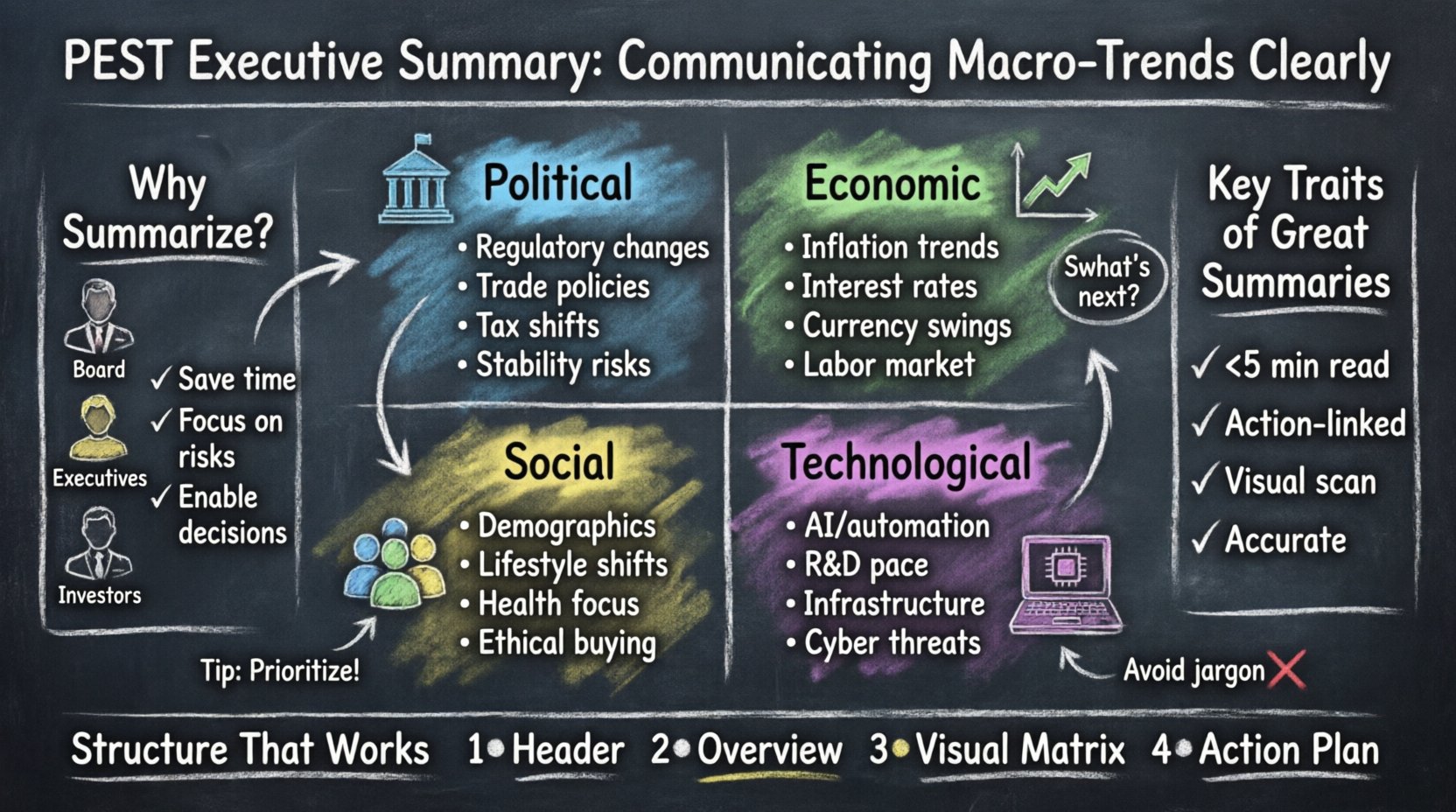
A PEST analysis examines four key external categories: Political, Economic, Social, and Technological. While a comprehensive report might span dozens of pages with raw data, charts, and citations, the executive summary serves as a high-level overview. Its primary purpose is to answer the question: “What does this mean for our future?” rather than just “What is happening?”.
This document acts as the bridge between the research team and the C-suite. It must be concise, precise, and visually structured. When stakeholders receive a lengthy document, they often skim the text and miss the critical implications. By providing a summary, you respect their time and highlight the specific areas requiring immediate attention or long-term planning.
Key characteristics of an effective summary include:
- Brevity: It should be readable in under five minutes.
- Action-Oriented: It connects trends to business decisions.
- Visual Clarity: It uses formatting to guide the eye.
- Accuracy: It reflects the depth of the underlying research without distortion.
Why Stakeholders Need a Distilled View 🤝
Stakeholders come from various backgrounds. An investor cares about risk and return. An operations manager cares about supply chain continuity. A marketing director cares about consumer sentiment. A single, detailed PEST report rarely satisfies all these needs simultaneously. The executive summary tailors the information to these priorities.
1. The Board of Directors
Board members oversee governance and long-term viability. They do not have the bandwidth to review every data point. They need to know the risks to the brand reputation, regulatory compliance issues, and market shifts that could alter the company’s trajectory. The summary highlights these high-level risks clearly.
2. Senior Management
Executives are responsible for execution. They need to know where to allocate resources. If the Economic section indicates inflation is rising, management needs to understand if pricing strategies must shift. The summary translates trends into operational adjustments.
3. Investors and Shareholders
Capital allocation requires confidence in the future. Investors look for evidence that the company understands its environment. A well-crafted summary demonstrates strategic foresight. It shows that the organization is not reactive but proactive in the face of macro-trends.
Deep Dive: The Four Pillars of the Summary 🌍
Each section of the PEST framework requires specific attention when condensed for an executive audience. Below is a breakdown of what to prioritize in each category.
Political Factors 🏛️
Political stability and government policies directly impact business operations. In the summary, focus on:
- Regulatory Changes: Are there new laws regarding data privacy, labor, or environmental standards?
- Trade Policies: Are tariffs or trade agreements affecting import/export costs?
- Taxation: Will corporate tax rates change in key markets?
- Political Stability: Is the operating environment stable, or is there risk of unrest?
Example Insight: “New data localization laws in the EU will require infrastructure investment in local servers by Q4, impacting capital expenditure by 15%.”
Economic Factors 📈
Economic conditions determine purchasing power and cost of capital. The summary should address:
- Inflation Rates: How does rising cost of goods affect margins?
- Interest Rates: How does borrowing cost impact expansion plans?
- Exchange Rates: Are currency fluctuations hurting international revenue?
- Unemployment: How does the labor market affect hiring and wage demands?
Example Insight: “Projected interest rate hikes suggest delaying the new facility expansion to Q3 next year to preserve liquidity.”
Social Factors 👥
Demographics and cultural trends drive demand. This section is crucial for marketing and product development.
- Demographics: Is the population aging or growing younger?
- Lifestyle Trends: Are consumers shifting toward remote work or sustainability?
- Health Awareness: Is there a demand for wellness-focused products?
- Ethical Consumption: Do customers prefer companies with strong social responsibility?
Example Insight: “Gen Z consumers now prioritize sustainability over price, necessitating a review of our supply chain transparency.”
Technological Factors 💻
Technological innovation creates opportunities and threats. This is often the most volatile category.
- Innovation Pace: Is AI or automation disrupting the industry?
- R&D Activity: What are competitors investing in?
- Infrastructure: Is internet or energy infrastructure reliable?
- Cybersecurity: Are data breaches becoming more frequent and costly?
Example Insight: “Adoption of generative AI tools could reduce content production costs by 30%, but requires new governance protocols.”
Structuring the Document for Impact 📑
Layout matters as much as content. A wall of text discourages reading. Use a structured approach to ensure readability.
1. The Header
Start with a clear title, date, and preparation status. This establishes context immediately.
2. The Executive Overview
Write a paragraph that synthesizes the entire analysis. This is the “elevator pitch” of the document. It should state the overall strategic posture (e.g., “Opportunity exists, but regulatory risk is high”).
3. The Visual Matrix
Use a table to summarize the findings. This allows stakeholders to scan quickly.
| Category | Key Trend | Impact Level | Strategic Implication |
|---|---|---|---|
| Political | Stricter Data Laws | High | Invest in compliance |
| Economic | Rising Inflation | Medium | Review pricing model |
| Social | Remote Work Shift | High | Update HR policies |
| Technological | AI Automation | Medium | Pilot new tools |
4. The Action Plan
End with a list of recommended next steps. Do not leave stakeholders guessing what to do. Assign ownership where possible.
Common Pitfalls to Avoid 🚫
Even with good data, the summary can fail if the communication is flawed. Avoid these common errors to maintain credibility.
- Too Much Detail: If you include raw data tables in the summary, you defeat the purpose. Keep the details for the appendix.
- Jargon Overload: Avoid technical terms that finance or operations leaders may not know. Use plain language.
- Lack of Prioritization: Not all trends are equal. If everything is “High Priority,” nothing is. Use a scoring system.
- Passive Voice: Avoid “It is believed that.” Use active voice: “We recommend.” This shows confidence.
- Ignoring Negative Trends: Do not sugarcoat bad news. Stakeholders trust honesty more than optimism. Highlight risks clearly.
Tailoring the Message to Audience 👥
One size does not fit all. You may need to create variations of the summary for different groups.
For the Board
Focus on governance, risk, and long-term strategy. Keep the financial implications front and center. Ensure the language aligns with fiduciary responsibilities.
For the Operations Team
Focus on supply chain, logistics, and resource allocation. How do these trends affect the daily workflow? Be specific about timelines.
For the Marketing Team
Focus on Social and Technological trends. How does consumer behavior change? What new channels are emerging? Keep it creative but grounded in data.
The Process of Synthesis 🔄
Creating this summary is a multi-step process. It requires discipline to edit down information without losing value.
- Gather Raw Data: Collect reports, news, and internal metrics related to PEST factors.
- Filter for Relevance: Discard information that does not impact the specific business context. Irrelevant global news should be excluded.
- Categorize Findings: Sort information into the four PEST buckets.
- Identify Implications: For each finding, ask “So what?” Write down the business consequence.
- Draft the Summary: Write the executive overview and the action plan first.
- Review for Clarity: Read the document aloud. If a sentence is confusing, rewrite it.
- Final Polish: Check formatting and ensure tables are aligned.
Measuring the Impact of the Summary 📉
How do you know the summary worked? Success is not just about sending the document. It is about the reaction it generates.
- Engagement: Did stakeholders request follow-up meetings based on the document?
- Decision Speed: Did the summary help the board approve a budget or strategy faster?
- Feedback: Did leadership note that the information was “clear” and “useful”?
- Alignment: Did different departments start discussing the same trends using the same terminology?
Final Thoughts on Strategic Communication 🌟
The goal of a PEST analysis is not just to catalog the environment, but to influence the future. The executive summary is the tool that makes this possible. It transforms noise into signal. It turns observation into strategy.
By focusing on clarity, prioritizing actionable insights, and respecting the time of stakeholders, you position yourself as a strategic partner rather than just a data collector. This approach builds trust and ensures that macro-trends drive tangible business outcomes.
Remember, the quality of the strategy depends on the quality of the information flow. A well-structured summary ensures that the right information reaches the right people at the right time. In a volatile market, this clarity is a competitive advantage.
Checklist for Submission ✅
- Is the title clear and specific?
- Are the four PEST categories represented?
- Is the impact level clearly defined for each point?
- Are there specific recommendations attached to each trend?
- Is the document free of jargon?
- Is the formatting consistent and clean?
- Have all sensitive data been anonymized if necessary?
Utilizing this framework ensures that your macro-environmental analysis remains relevant and impactful. It empowers your organization to navigate the complexities of the modern business world with precision and foresight.
Related posts:
 How to Execute a PEST Analysis for Your International Business Strategy: A Step-by-Step Walkthrough
 PEST Analysis vs. SWOT: A Direct Comparison for MBA Students to Avoid Common Pitfalls
 The 3-Step Quick Start Guide to Conducting a PEST Framework in Under an Hour
 Real-World Case Studies: How Top Firms Used PEST Analysis to Navigate Global Markets