


Model-Based Systems Engineering (MBSE) has transformed how complex systems are designed, analyzed, and validated. At the heart of this methodology lies the Systems Modeling Language (SysML), a standardized graphical language designed to support the specification, analysis, design, and verification of systems. Despite its widespread adoption in aerospace, automotive, and defense sectors, significant resistance remains within engineering organizations. This resistance often stems from deeply ingrained misconceptions that obscure the true value of the technology.
Many engineering leaders hesitate to commit to a full MBSE transformation because they believe the learning curve is insurmountable, the cost outweighs the benefits, or the technology is too rigid for agile workflows. These beliefs are not merely harmless doubts; they are active barriers that prevent teams from achieving higher levels of system integrity and traceability. To move forward, it is necessary to dismantle these narratives with factual evidence and practical insight.
In this guide, we will examine five specific misconceptions that frequently stall SysML adoption. We will analyze the technical reality behind each myth, offering a clear path toward effective implementation without relying on hype or oversimplified promises.
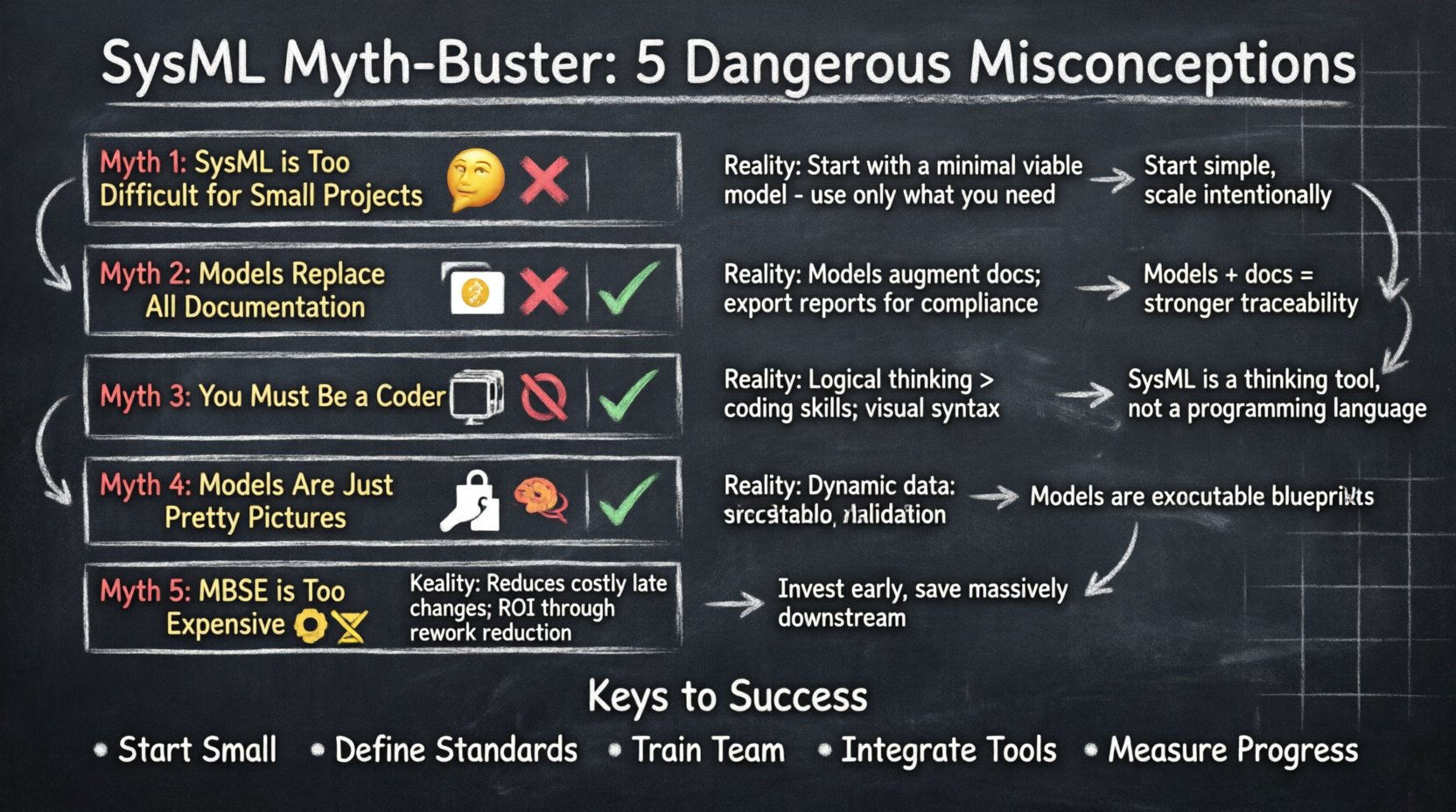
1. The Complexity Barrier: “SysML is Too Difficult for Small Projects” 🤔
The most common objection to adopting SysML is the perceived complexity of the language. Critics argue that the overhead of learning a formal modeling language is unjustified for projects with limited scope or budget. This perspective assumes that a modeling language must be monolithic and all-encompassing to be useful.
While SysML is indeed a comprehensive standard with 9 distinct diagrams, it is not designed to be used in its entirety for every project. The language allows for profile creation and tailored subsets. A team does not need to master every diagram type to gain value. Often, a single project team only utilizes a fraction of the available capabilities, such as the Requirements diagram or the Block Definition Diagram.
- Reality Check: Complexity is often a function of scope, not just the tool.
- The Approach: Start with a minimal viable model. Define the core requirements and the top-level system structure.
- The Benefit: Even a basic model provides immediate benefits in terms of requirement traceability and stakeholder communication.
When teams attempt to model everything at once, they create a barrier to entry that feels insurmountable. However, adopting a phased approach allows engineers to build competence incrementally. This strategy aligns with the natural learning curve of the discipline.
Furthermore, the complexity of modern systems often exceeds the capacity of traditional document-based methods. When a system involves hundreds of interacting components, a spreadsheet or Word document becomes a source of error rather than clarity. In this context, the “complexity” of SysML is actually a necessary tool to manage the complexity of the system itself.
2. The Documentation Replacement Fallacy: “Models Will Replace All Documentation” 📄❌
There is a pervasive belief that once a model is created, all traditional documentation becomes obsolete. Proponents of this view often suggest that the model itself is the single source of truth and that no additional artifacts are required. This interpretation can lead to significant compliance issues and communication gaps.
While SysML models are powerful, they are not a complete replacement for all forms of documentation. Regulatory bodies, certification authorities, and specific client contracts often require formal, human-readable documents. A model is a structured representation of data, but it is not always a substitute for a narrative explanation or a formal certification record.
- The Truth: Models augment documentation; they do not always eliminate it.
- The Risk: Relying solely on models can lead to gaps in legal or regulatory compliance.
- The Solution: Use the model to generate reports, but maintain the ability to export formal documents when required.
Effective MBSE involves a dual approach. The model serves as the central repository for system logic and relationships, ensuring consistency. Meanwhile, documentation serves as the formal interface for stakeholders who may not have access to modeling tools or the training to read the model directly. The goal is to reduce redundancy, not to remove the human-readable context entirely.
By understanding the distinct roles of the model and the document, teams can avoid the trap of creating “model-only” deliverables that fail to meet external expectations. The model ensures that the documentation generated from it is accurate, but the documentation remains necessary for specific contractual and regulatory needs.
3. The Programming Prerequisite: “You Must Be a Coder to Use SysML” 💻🚫
Another significant hurdle is the assumption that Systems Modeling Language requires programming expertise. Because the syntax involves logic and constraints, some engineers fear that they need to be software developers to participate. This fear often prevents systems engineers, who are the primary users of the language, from engaging with the methodology.
SysML is distinct from programming languages like C++ or Python. It is a modeling language designed to describe the structure, behavior, and requirements of a system. While it uses formal semantics to ensure precision, it does not require the ability to write executable code. The primary skill set required is logical thinking and systems understanding, not software development.
- Syntax vs. Logic: SysML syntax is visual and structured, not text-based code.
- Domain Knowledge: Understanding the physical or logical system is more important than understanding compiler flags.
- Collaboration: Engineers can focus on system architecture while software teams handle the implementation details.
Many organizations struggle because they treat SysML as a coding exercise. This misalignment creates friction between systems engineering and software engineering teams. When the language is correctly positioned as a system definition tool, it bridges the gap between high-level requirements and low-level implementation without requiring every systems engineer to become a developer.
Training programs should focus on the principles of systems engineering and the semantics of the language, rather than syntax memorization. This distinction empowers systems engineers to take ownership of the model without needing to cross into the domain of software development.
4. The Static Model Misunderstanding: “Models Are Just Pretty Pictures” 🖼️🚫
One of the most damaging misconceptions is that SysML models are static visualizations, essentially fancy diagrams that do not drive analysis. This view reduces the model to a documentation artifact rather than an analytical engine. If a model is only drawn and never queried, it is merely an image.
SysML models are dynamic repositories of data. They contain relationships, constraints, and parameters that can be used for analysis. When a model is properly constructed, it supports simulation, verification, and validation activities. The language allows for the definition of value types and constraints that can be evaluated.
- Traceability: Links between requirements and design elements allow for impact analysis.
- Simulation: Behavioral diagrams can define logic that simulates system performance.
- Validation: Automated checks can ensure consistency across the entire system definition.
When teams treat models as static, they miss the opportunity to catch errors early in the design process. A static model might look correct visually, but it may contain logical contradictions that only become apparent during execution or testing. By leveraging the analytical capabilities of the language, organizations can identify design flaws before they reach the physical prototype stage.
This shift from “drawing” to “engineering” requires a change in mindset. The model is not a picture of the system; it is the digital twin of the system logic. It is a living artifact that evolves as the system design evolves.
5. The Cost Reality: “MBSE is Too Expensive for ROI” 💰📉
The final major barrier is financial. Many organizations view MBSE as a luxury investment with a long return on investment (ROI) horizon. They argue that the time spent learning the tool and building the model is time taken away from actual design work, resulting in a net loss.
This calculation often fails to account for the cost of errors. In systems engineering, a change in the design phase is exponentially cheaper than a change in the manufacturing or deployment phase. MBSE reduces the cost of change by providing a clear, consistent view of the system.
| Factor | Traditional Document-Based | Model-Based Systems Engineering |
|---|---|---|
| Change Impact | High (Manual updates required) | Low (Automated traceability) |
| Consistency | Prone to human error | Enforced by tool logic |
| Reusability | Low (Copy-paste often fails) | High (Components are reusable) |
| Verification | Post-design testing | Continuous validation |
The true cost of MBSE lies in the initial setup and training. However, the operational savings accrue over the lifecycle of the project. By reducing rework, minimizing integration issues, and improving communication, the methodology pays for itself. The ROI is realized through the reduction of late-stage changes and the acceleration of time-to-market.
Organizations that wait for the ROI to be proven before investing often find themselves perpetually behind. The investment in MBSE is an investment in the organization’s ability to manage complexity. It is a foundational capability, not a project-specific expense.
Strategies for Successful Implementation 🚀
Overcoming these misconceptions requires a structured approach to adoption. It is not enough to simply purchase a tool and expect results. The following strategies can help teams navigate the transition:
- Start Small: Begin with a pilot project. Select a scope that is manageable but representative of the larger system.
- Define Standards: Establish modeling standards early. This ensures consistency across the team and prevents the model from becoming a chaotic collection of diagrams.
- Invest in Training: Ensure that the team understands the theory behind the language, not just the software interface.
- Integrate Early: Connect the modeling environment with requirements management and project management tools.
- Measure Progress: Track metrics such as requirement coverage, change frequency, and defect detection rates.
The Path Forward Without Hype 🛤️
Adopting SysML and MBSE is not about finding a silver bullet. It is about recognizing that the complexity of modern systems requires a more rigorous approach to definition and analysis. The myths surrounding the language often serve as defense mechanisms against the effort required to change established workflows.
By addressing the technical realities, teams can move past the fear of complexity and the hesitation regarding cost. The goal is not to replace engineers but to equip them with better tools for thinking and communicating about systems. When the focus shifts from the tool to the methodology, the benefits become clear.
Success in MBSE comes from consistency, discipline, and a willingness to challenge established norms. It requires a commitment to the data that drives the design. As organizations continue to face increasing system complexity, the ability to model that complexity accurately will become a competitive advantage.
The journey toward effective Model-Based Systems Engineering is ongoing. It involves continuous improvement of processes and models. By dispelling the myths that hold teams back, organizations can unlock their true potential for innovation and quality. The technology is ready; the mindset is the only variable remaining.
Ultimately, the decision to adopt SysML is a decision to prioritize precision and clarity. It is a commitment to building systems that are understood, verifiable, and maintainable. This commitment pays dividends in the reliability and safety of the final product.
Related posts:
 MBSE for Beginners: A Clear SysML Primer That Explains the Core Concepts Without the Jargon
 The SysML Cheat Sheet: Your 10-Minute Quick Start Guide to Modeling Requirements and Block Definitions
 Stop Guessing with SysML: A Practical Checklist for MBSE Leads to Avoid Early Roadblocks
 SysML Case Study: How a Simple Elevator Model Reveals Complex Behavior Issues in MBSE