
Private AI for Enterprises: Integrating Custom LLMs with Visual Paradigm
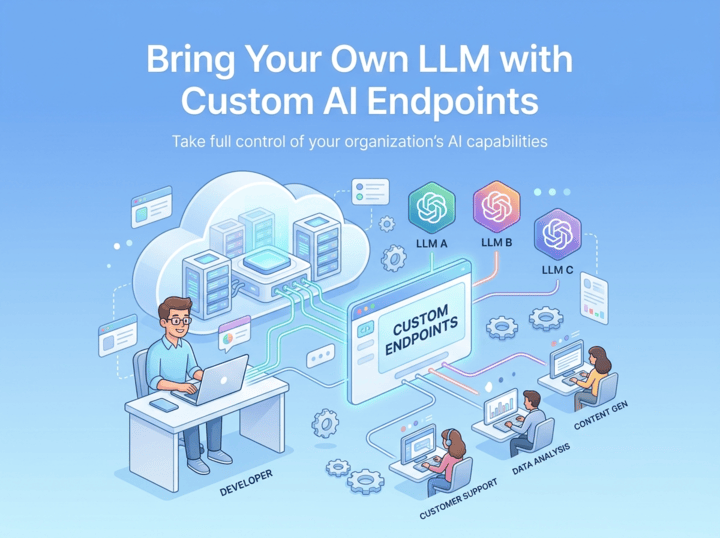
In the modern enterprise landscape, the integration of Artificial Intelligence is no longer optional; it is a strategic imperative. However, many organizations hesitate to adopt AI tools due to strict data privacy regulations and security compliance requirements. Visual Paradigm addresses this critical challenge with its Private LLM Binding feature, allowing users to bypass public AI endpoints and connect directly to their own self-hosted Large Language Models (LLMs).
This tutorial explores the architectural significance of this capability and how it enables organizations to build secure, high-level knowledge management solutions without compromising data sovereignty.
The Architecture of Private AI
The concept of “Bring Your Own LLM” (BYOL) shifts the paradigm from relying on shared, public cloud services to establishing a localized AI infrastructure. In the context of Visual Paradigm, this is not just a configuration setting; it is a fundamental architectural component that ensures data never leaves the organization’s perimeter.
When a team connects Visual Paradigm to a private AI endpoint, they are establishing a direct communication channel between their modeling environment and their internal AI cluster. This setup typically involves:
- Self-Hosted Infrastructure: The AI models (LLM A, LLM B, LLM C) run on the organization’s own servers or private cloud environment.
- Custom Endpoints: These are specific API URLs that route requests from the Visual Paradigm application directly to the local model instance.
- Controlled Environment: Corporate data used for prompt generation or analysis remains within the controlled network, subject to the organization’s specific security policies.
Step-by-Step: Configuring Custom AI Endpoints
Implementing this architecture requires a systematic approach to ensure the application suite can successfully communicate with the AI environment. The following steps outline the logical flow of this integration.
1. Establishing the AI Endpoint
Before any modeling can take place, the IT or Data Science team must ensure that a compliant AI model is running and accessible via an API. This could be an open-source model like Llama 3 or Mistral, hosted on an internal server.
2. Defining the Connection
Within the Visual Paradigm application suite, administrators configure the AI Endpoint settings. This involves inputting the specific URL, authentication tokens, and configuration parameters required to reach the private server.
3. Binding the Application Suite
Once the endpoint is defined, the application suite binds to it. This binding is persistent, meaning all subsequent AI interactions—such as generating code, analyzing requirements, or creating diagrams—are routed through this private channel.
Use Case: The Secure Modeling Workflow
Consider a scenario where a development team is working on a proprietary financial system. They need to generate a complex process flow diagram based on sensitive requirements documents. In a public AI environment, these documents might be uploaded to an external server. With Private LLM Binding, the workflow changes:
- Input: The developer provides the sensitive requirements text to the Visual Paradigm tool.
- Routing: The request is sent to the Custom Endpoint hosted internally.
- Processing: The private LLM (e.g., LLM A) processes the data locally.
- Output: The generated diagram or code snippet is returned to the user, with zero exposure to public networks.
This workflow supports various roles, from Data Analysis teams needing quick insights to Content Generation specialists creating technical documentation, all while maintaining a unified security posture.
Conclusion: The Future of Secure Modeling
The ability to bind Visual Paradigm to a private AI endpoint represents a significant evolution in enterprise software. It empowers organizations to adopt AI-powered knowledge management and productivity tools without sacrificing the security and operational requirements that define their business.
By combining the powerful modeling capabilities of Visual Paradigm with the flexibility of custom AI endpoints, businesses can create an integrated ecosystem where innovation thrives securely. Whether you are a Small-to-Medium Enterprise (SME) or a large global corporation, this architecture ensures that your intellectual property remains yours, protected by your own infrastructure.