
Supercharging Enterprise Modeling: AI-Driven Mermaid Diagrams with VPasCode
In the modern landscape of software architecture and system design, the gap between abstract conceptualization and technical implementation is bridged by powerful tools. Visual Paradigm VPasCode represents a significant leap forward, specifically through its integration of Artificial Intelligence. This tutorial explores how to leverage the AI Mermaid Diagram Generator to transform simple natural language prompts into complex, syntactically correct architecture maps, and how to refine these models using advanced AI assistance.
1. The AI Diagram Generation Workflow
The core of this workflow is the ability to “think” in natural language and have the system translate that thought into code. This removes the barrier of memorizing complex syntax rules for diagramming languages like Mermaid.
The Input Process
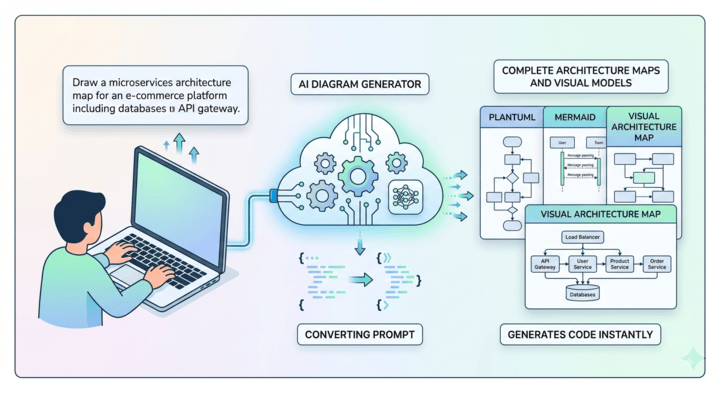
The journey begins with a clear, high-level idea. Whether you are describing a microservices architecture, a database schema, or a sequence flow, you can type this directly into the VPasCode interface. The system acts as an intelligent bridge, taking your text description and parsing it into a structured representation.
- User Input: “Draw a microservices architecture map for an e-commerce platform including databases and an API gateway.”
- Prompt Conversion: The AI engine interprets the entities (Microservices, Database, API Gateway) and their relationships.
- Code Generation: The system instantly produces the Mermaid code required to render this visualization.
The Output: Complete Architecture Maps
The result is not just a static image, but a fully functional diagram. VPasCode supports multiple visualization formats, ensuring that your architecture maps are versatile. The AI can generate:
- PlantUML: Ideal for detailed, text-based software architecture modeling.
- Mermaid: Perfect for lightweight, web-compatible flowcharts and sequence diagrams.
- Visual Architecture Map: A high-level visual representation that organizes components logically.
2. Refining and Modifying Your Model
Once the initial diagram is generated, the workflow shifts from “creation” to “refinement.” In system design, requirements often change, or new components are added. VPasCode’s AI Script Modification capabilities allow you to evolve your diagram without starting from scratch.
Iterative Design
Instead of manually hunting through strings of code to change a relationship or add a new step, you can simply ask the AI assistant to modify the existing code. This is particularly powerful for complex architectures.
- Inject Blocks: Add new logic flows or components.
- Trim Loops: Simplify complex decision paths.
- Change Styles: Update the visual hierarchy without breaking the syntax.
3. Managing Syntax and Global Collaboration
Even with AI assistance, syntax errors can occur, or collaboration across borders may require translation. VPasCode addresses these common friction points with specific AI tools.
One-Click Syntax Fixing
Syntax errors can halt progress. If your diagram fails to render due to a misplaced bracket or a typo in a label, the AI identifies the mistake and offers a one-click fix. Crucially, it explains the correction, allowing you to learn the rules of Mermaid syntax over time and master the tool.
AI Translation for Global Teams
For international projects, language barriers can slow down development. VPasCode includes a built-in AI translation feature that instantly converts diagram text into different languages. This facilitates smoother global collaboration by ensuring that architectural documentation is accessible to all stakeholders, regardless of their native language.
4. Enterprise-Grade Data Privacy
For enterprise users, data privacy is paramount. VPasCode understands that not all organizations are comfortable sending proprietary architectural data to public AI models. To address this, the tool supports custom AI endpoint integration.
You can integrate your own API credentials from leading providers such as OpenAI, Anthropic, Google, DeepSeek, Mistral, Qwen, and Groq. This ensures that you retain complete management over data handling and operational costs, allowing you to keep sensitive architectural logic within your own secure infrastructure.