
AI-Driven Mermaid Refinement with VPasCode
In the realm of modern software engineering, the transition from abstract concept to concrete documentation is often bottlenecked by the “syntax gap.” Developers may understand the logic of a sequence or the flow of data, but the effort required to translate that into strict markup languages like Mermaid or PlantUML can be significant. VPasCode bridges this gap by introducing an intelligent layer of modification and refinement. This tutorial explores the architecture of AI-driven diagram editing, specifically focusing on how the system transforms complex code into refined visuals through natural language instructions.
The Architecture of AI Diagram Modification
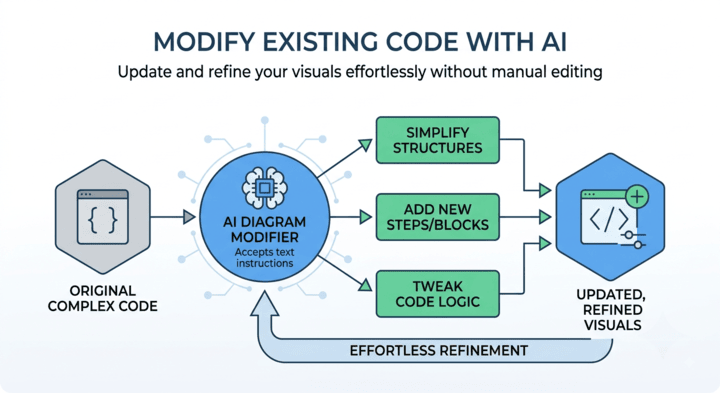
The core philosophy of VPasCode’s AI engine is to treat diagram code not as a static file, but as a dynamic, malleable object. The workflow depicted in the system architecture follows a distinct loop of input, transformation, and iterative refinement. Unlike traditional editors where a user must manually locate a specific line of code to make a change, the AI-driven approach operates on the semantic meaning of the diagram.
1. The Input: Original Complex Code
The process begins with an Original Complex Code base. This is often a diagram that has evolved over time or was generated from a large dataset, resulting in a structure that is difficult to manage manually. This code serves as the “source of truth” for the diagram. In a high-level context, this might be a dense sequence diagram describing a microservices architecture or a complex state machine.
- Context: The code is syntactically valid but perhaps visually cluttered or logically rigid.
- Role: It acts as the canvas upon which the AI will paint its refinements.
2. The Core Engine: The AI Diagram Modifier
At the center of the system lies the AI Diagram Modifier. This is the computational engine responsible for interpreting user intent. Its primary capability is accepting text instructions (natural language prompts) and mapping them to specific syntax modifications.
The engine operates on three primary dimensions of modification:
- Simplify Structures: Identifying redundant nodes or overly complex nesting that hinders readability.
- Add New Steps/Blocks: Injecting new logical steps, such as a new authentication method or a data validation loop, into the existing flow.
- Tweak Code Logic: Refining the relationships between actors and objects, or adjusting the styling and formatting to adhere to design standards.
3. The Output: Updated, Refined Visuals
The final stage is the generation of Updated, Refined Visuals. The AI outputs the modified code block, which is then rendered into a visual diagram. This ensures that the visual representation accurately reflects the updated logic without requiring the user to manually rewrite the underlying syntax.
Step-by-Step: The Workflow of Refinement
To effectively utilize this system, one must understand the flow of data and instructions. The process is designed to be iterative, allowing for “Effortless Refinement” where the user can tweak the diagram multiple times until it meets their exact specifications.
Step 1: Analyzing the Existing State
Before making changes, the system analyzes the Original Complex Code. This step is crucial for the AI to understand the context. For example, if you are working on a login flow, the AI needs to recognize the existing actors (User, Server, Database) and their current interactions.
Step 2: Defining the Intent
The user provides a text instruction. This is the critical interaction point. Instead of writing code, the user describes the desired change. For instance, a user might say, “Simplify the error handling block and add a retry mechanism for failed requests.”
Step 3: Execution of Modification Logic
The AI Diagram Modifier processes this instruction. It performs the following logical operations:
- Mapping: It maps the text instruction to specific syntax rules (e.g., Mermaid syntax).
- Injection/Deletion: It injects new blocks or deletes redundant ones.
- Refinement: It adjusts the structure to ensure the diagram remains balanced and readable.
Step 4: Verification and Rendering
The system verifies the new code for syntax errors. If the code is valid, it renders the Updated, Refined Visuals. The user can then review the diagram. If the result is not perfect, the “Effortless Refinement” loop allows the user to provide further feedback, creating a continuous cycle of improvement.
Strategic Benefits of AI-Driven Diagramming
Implementing an AI-driven modification workflow offers several strategic advantages for technical teams:
- Reduced Cognitive Load: Developers can focus on the “what” (the logic) rather than the “how” (the syntax).
- Consistency: The AI ensures that all modifications adhere to a consistent style and structure.
- Speed: Complex changes that would take minutes to manually code can be achieved with a single sentence.
Conclusion
The integration of AI into diagramming tools like VPasCode represents a paradigm shift in technical documentation. By automating the tedious aspects of syntax management and focusing on the logical refinement of diagrams, teams can produce high-quality, accurate visualizations at unprecedented speeds. The architecture described—moving from complex code to refined visuals through natural language—sets a new standard for how we visualize and interact with system architecture.